
Commercial Solar Payback Period: Busting the 10-Year Break-Even Myth in 2026

If your CFO is still citing a decade-long timeline for energy ROI, they’re working from a playbook that’s effectively obsolete. Most California executives look at the cratering export rates under NEM 3.0 and assume the math for a commercial solar payback period no longer works. It's an understandable skepticism. After all, watching your PG&E or SCE demand charges climb while the utility pays you pennies for your excess power feels like a losing game.
But the 10-year myth is being dismantled by a specific, aggressive strategy that most vendors aren't talking about. We're seeing savvy firms hit a break-even point in as little as three to five years by shifting focus from simple generation to strategic BESS integration and 100% bonus depreciation. This isn't about hoping for better policy; it's about using the 2026 tax window and storage to claw back control from the grid. We’re going to walk through the data-backed timeline for 2026 and show you exactly how to accelerate your return before the July 4th ITC deadline passes.
Key Takeaways
- Forget the decade-long estimates; skyrocketing utility rates in California are actually forcing a much shorter commercial solar payback period for those who move before the 2026 tax shifts.
- Understand why pairing BESS with your rooftop array is no longer optional if you want to eliminate the heavy demand charges that bloat your monthly bill.
- Use the 2026 tax window, specifically the 30% ITC and 100% bonus depreciation, to significantly lower your initial capital outlay and front-load your returns.
- Learn why the "cheapest bid" often backfires, as poorly engineered systems fail to account for the self-consumption needs that drive real ROI under NEM 3.0.
- Look beyond the utility bill to see how solar carports and rooftop systems drive up your property's Net Operating Income and long-term asset value.
Table of Contents
- The 10-Year Payback Myth: Why California Businesses Break Even Faster in 2026
- Performance Over Price: How Right-Sizing and BESS Slash Your Payback Period
- Beyond the Break-Even Point: Navigating Incentives and Long-Term Fiscal Impact
The 10-Year Payback Myth: Why California Businesses Break Even Faster in 2026
The idea that you have to wait a decade to see a return on photovoltaic systems is a relic of the mid-2010s. Back then, residential systems dominated the narrative and utility rates were relatively stable. Today, the math has flipped. California businesses are facing aggressive rate hikes from PG&E and SCE that make the status quo more expensive than the investment. It's a simple reality: as utility costs rise, the time it takes to recover your capital shrinks.
Energy costs in the state have surged, with some commercial rates hitting averages near 28 cents per kWh as of early 2026. When your "do nothing" cost is rising at double-digit percentages, your commercial solar payback period naturally accelerates. Small-scale commercial properties, which often lack the massive negotiating power of industrial giants, are seeing some of the fastest recovery times because their baseline utility spend is so high. They don't just save money; they stop a massive operational leak.
To effectively plug this leak, business owners often explore Solar Panel Install options that prioritize immediate energy efficiency and long-term cost stability.
The NEM 3.0 Reality Check
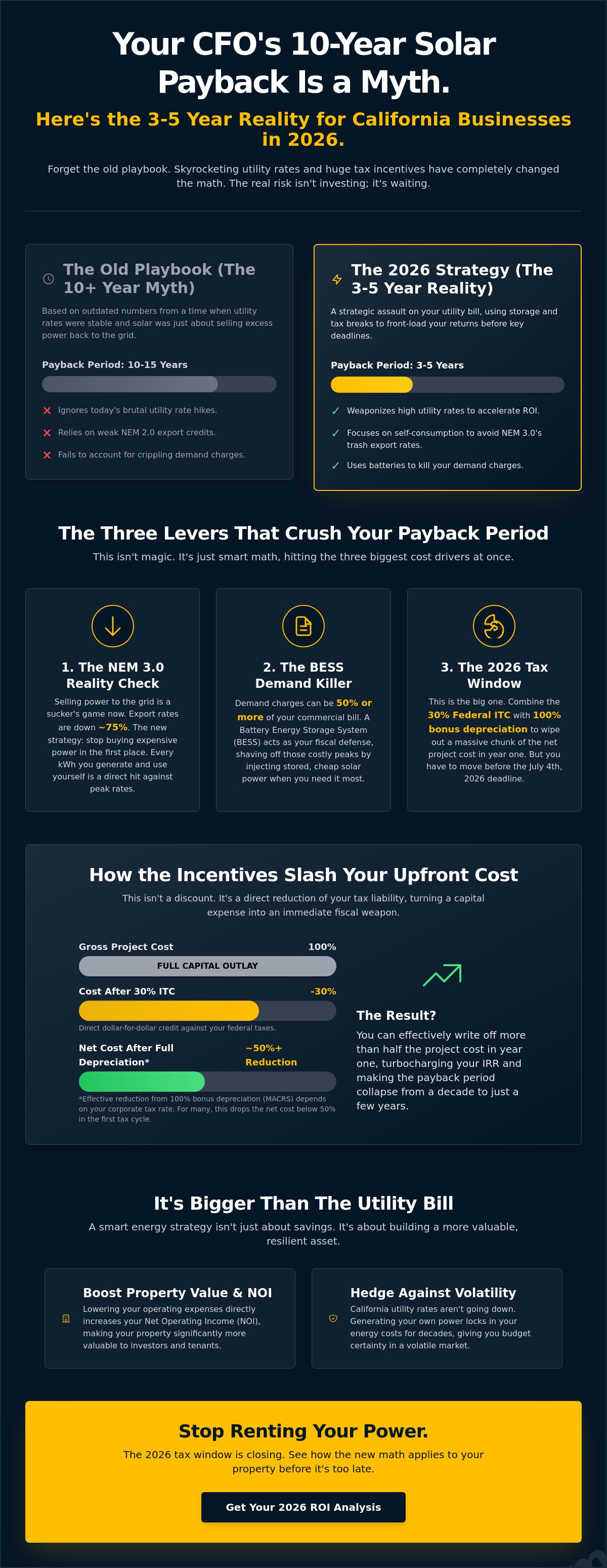
The rules changed in April 2023, and the industry is finally catching up to the implications in 2026. Exporting power to the grid is a losing game now. Export rates are roughly 75% lower than they were under NEM 2.0. The strategy has shifted from being a mini-power plant to being an energy fortress. You aren't trying to sell power back to the utility for pennies. You're trying to avoid buying it from them for 60 cents during peak demand. This shift toward "avoided cost" is what makes the ROI predictable. For a deeper dive into how this fits into your balance sheet, check out our Commercial Solar Financing in California guide.
Immediate Fiscal Wins: ITC and MACRS Depreciation
Liquidity is usually the biggest hurdle for any CAPEX project. The Federal Investment Tax Credit (ITC) provides a 30% credit right out of the gate, provided you begin construction before the July 4, 2026 deadline. It's an immediate injection of capital. When you layer that with 100% bonus depreciation under MACRS, you're looking at a massive year-one tax offset. Combined, these incentives can effectively wipe out more than 50% of the net project cost in the first tax cycle, turning a long-term asset into an immediate fiscal win.
Performance Over Price: How Right-Sizing and BESS Slash Your Payback Period
The "cheapest bid" is a common trap that ends up costing California businesses hundreds of thousands in lost efficiency. If a vendor offers a low-cost rooftop system without analyzing your specific interval data, they're likely undersizing the hardware or ignoring your demand charges. In the NEM 3.0 era, an improperly engineered system actually extends your commercial solar payback period because it fails to capture the high-value electrons you need during peak pricing windows. For high-load facilities like cold storage or manufacturing, solar panels alone are rarely enough to move the needle on a massive utility bill.
The real ROI is found in precision engineering. When you consult the Database of State Incentives for Renewables & Efficiency, you'll see a complex landscape of local and federal programs, but the real needle-mover is how you stack these with storage. Pairing generation with Commercial Battery Storage Incentives can effectively double the speed of your ROI by addressing the charges solar alone can't touch.
BESS: The ROI Multiplier
Battery Energy Storage Systems (BESS) perform a task called peak shaving. It’s a straightforward concept: the battery detects when your facility is about to hit a massive demand spike and injects stored power to "shave" that peak off your bill. Since demand charges can make up 50% or more of a commercial bill in California, this turns a solar project from a simple green initiative into a ruthless fiscal defense strategy. We focus on SolarPorts Development's turnkey BESS solutions to ensure the hardware is right-sized for your specific load profile, preventing the waste of over-investing in capacity you don't need.
Why Simple Payback is a Flawed Metric for CFOs
Simple payback tells you when you get your cash back, but it doesn't account for the Internal Rate of Return (IRR) or the cost of inaction. Every month you delay is a month of paying unrecoverable "rent" to the utility at 2026 rates. Viewed over the long term, achieving a 5-year payback on an asset designed to last 25 years represents a 400% return on your capital. If you want to see how these numbers look for your specific facility, you can request a preliminary energy cost saving analysis to verify the math before committing capital.
Beyond the Break-Even Point: Navigating Incentives and Long-Term Fiscal Impact
Once you've cleared the initial hurdle of the capital recovery phase, the focus shifts toward asset appreciation. A well executed solar installation does more than lower a line item on your P&L; it fundamentally alters the Net Operating Income (NOI) of the property. In the California commercial market, where cap rates are tight, every dollar removed from operating expenses can significantly boost the overall property valuation. You're effectively converting a variable, escalating liability into a fixed, depreciable asset that pays dividends for twenty years or more.
Turning Parking Lots into Profit Centers
Parking lots are often the most underutilized square footage on a commercial site. By installing commercial solar carports, you transform that dead space into a revenue generating power plant. Beyond the energy production, these structures offer tangible value to tenants through shaded parking and integrated EV charging infrastructure. We've seen this play out across various SolarPorts' recent projects, where carports become a key differentiator for attracting high-value corporate tenants who prioritize sustainability and employee amenities.
The 2026 California Incentive Landscape
The state's Self-Generation Incentive Program (SGIP) remains a critical, if complex, piece of the puzzle for those integrating storage. In 2026, navigating these rebates requires a precise understanding of current "step" levels and utility-specific availability in regions like Northern California. Stacking federal credits with state-level storage incentives is the only way to squeeze the commercial solar payback period down to its absolute minimum. Because the red tape can be dense, having a seasoned commercial solar project management partner is mandatory to ensure you don't leave six figures of incentive capital on the table. It all starts with a granular commercial property energy cost saving analysis to identify the sweet spot where your specific load profile meets the maximum available subsidy.
Locking in Your 2026 Energy Strategy
The window for capturing these specific fiscal benefits is closing. Waiting for utility rates to stabilize is a losing strategy that essentially burns your operational budget every single month. You've seen how integrating BESS and carports doesn't just shave a bill; it creates a high-value asset that pushes your property's valuation higher. Hit the 30% ITC and 100% bonus depreciation while they're still here, and you'll find that a 3 to 5 year commercial solar payback period isn't just a sales pitch. It's the standard for businesses that know how to stack incentives correctly.
We focus exclusively on the California commercial market, offering the turnkey BESS and carport solutions that generalists usually fumble. Our methodology is built on data-driven sizing so you aren't paying for capacity you won't use. You can request your custom 2026 Energy Cost Saving Analysis from SolarPorts to see the actual math for your building. It’s time to stop renting your power and start owning the infrastructure that generates it.
Frequently Asked Questions
What is the average commercial solar payback period in California for 2026?
Most California businesses are seeing a commercial solar payback period between 5 and 8 years when they integrate battery storage. Without a battery, that timeline stretches significantly because you're at the mercy of low utility export rates. If you utilize the full 30% ITC and 100% bonus depreciation before the July 2026 deadline, you're looking at the lower end of that range. High utility rates in territories like PG&E and SCE are ironically making the math work faster than ever.
Does NEM 3.0 make the payback period longer for businesses?
It makes the payback longer for "solar-only" systems that rely on selling power back to the grid. Export credits are roughly 75% lower under NEM 3.0 compared to previous rules. However, for businesses that shift to a self-consumption model using batteries, the impact is mitigated. You're no longer trying to sell power for pennies; you're trying to avoid buying expensive utility power for 40 to 60 cents per kWh during peak windows.
How much does a commercial battery storage system (BESS) reduce the payback time?
BESS can shave years off your timeline by attacking demand charges, which often account for half of a commercial bill. By peak shaving or using stored energy during the most expensive hours, you avoid the highest utility rates. It's the difference between a project that sits as a slow-moving asset and one that pays for itself rapidly through aggressive operational savings. In California's current rate environment, storage is the primary driver of ROI.
Can I get a commercial solar project to pay for itself in under 4 years?
It's possible, but it requires a specific combination of high electricity usage, aggressive tax optimization, and immediate incentive capture. You'd need to maximize the 30% ITC and 100% bonus depreciation in year one while eliminating massive demand charges with a right-sized BESS. While not the statistical average, these accelerated timelines are achievable for properties with high peak demand and enough tax liability to absorb the credits immediately.
What is the difference between ROI and payback period for solar?
Payback period is simply the time it takes to recover your initial capital outlay from energy savings. ROI, or more accurately Internal Rate of Return (IRR), looks at the total financial gain over the system's 25-year lifespan. A project might have a 6-year payback, but the long-term ROI is massive because you have nearly two decades of energy independence and a significantly higher property valuation after the initial cost is recovered.
Do federal tax credits apply to solar carports as well as rooftop systems?
Yes, solar carports qualify for the same 30% Federal Investment Tax Credit as rooftop installations. Since they're categorized as energy property, they also qualify for accelerated depreciation under MACRS. This makes carports a dual-value asset for property owners. You get to generate power and provide shaded parking for tenants or employees while receiving the same heavy federal subsidies that apply to traditional rooftop arrays.
Frequently asked questions
The NEM 3.0 Reality Check
The rules changed in April 2023, and the industry is finally catching up to the implications in 2026. Exporting power to the grid is a losing game now. Export rates are roughly 75% lower than they were under NEM 2.0. The strategy has shifted from being a mini-power plant to being an energy fortress. You aren't trying to sell power back to the utility for pennies. You're trying to avoid buying it from them for 60 cents during peak demand. This shift toward "avoided cost" is what makes the ROI predictable. For a deeper dive into how this fits into your balance sheet, check out our Commercial Solar Financing in California guide.
Immediate Fiscal Wins: ITC and MACRS Depreciation
Liquidity is usually the biggest hurdle for any CAPEX project. The Federal Investment Tax Credit (ITC) provides a 30% credit right out of the gate, provided you begin construction before the July 4, 2026 deadline. It's an immediate injection of capital. When you layer that with 100% bonus depreciation under MACRS, you're looking at a massive year-one tax offset. Combined, these incentives can effectively wipe out more than 50% of the net project cost in the first tax cycle, turning a long-term asset into an immediate fiscal win. The "cheapest bid" is a common trap that ends up costing California businesses hundreds of thousands in lost efficiency. If a vendor offers a low-cost rooftop system without analyzing your specific interval data, they're likely undersizing the hardware or ignoring your demand charges. In the NEM 3.0 era, an improperly engineered system actually extends your commercial solar payback period because it fails to capture the high-value electrons you need during peak pricing windows. For high-load facilities like cold storage or manufacturing, solar panels alone are rarely enough to move the needle on a massive utility bill. The real ROI is found in precision engineering. When you consult the Database of State Incentives for Renewables & Efficiency, you'll see a complex landscape of local and federal programs, but the real needle-mover is how you stack these with storage. Pairing generation with Commercial Battery Storage Incentives can effectively double the speed of your ROI by addressing the charges solar alone can't touch.
BESS: The ROI Multiplier
Battery Energy Storage Systems (BESS) perform a task called peak shaving. It’s a straightforward concept: the battery detects when your facility is about to hit a massive demand spike and injects stored power to "shave" that peak off your bill. Since demand charges can make up 50% or more of a commercial bill in California, this turns a solar project from a simple green initiative into a ruthless fiscal defense strategy. We focus on SolarPorts Development's turnkey BESS solutions to ensure the hardware is right-sized for your specific load profile, preventing the waste of over-investing in capacity you don't need.
Why Simple Payback is a Flawed Metric for CFOs
Simple payback tells you when you get your cash back, but it doesn't account for the Internal Rate of Return (IRR) or the cost of inaction. Every month you delay is a month of paying unrecoverable "rent" to the utility at 2026 rates. Viewed over the long term, achieving a 5-year payback on an asset designed to last 25 years represents a 400% return on your capital. If you want to see how these numbers look for your specific facility, you can request a preliminary energy cost saving analysis to verify the math before committing capital. Once you've cleared the initial hurdle of the capital recovery phase, the focus shifts toward asset appreciation. A well executed solar installation does more than lower a line item on your P&L; it fundamentally alters the Net Operating Income (NOI) of the property. In the California commercial market, where cap rates are tight, every dollar removed from operating expenses can significantly boost the overall property valuation. You're effectively converting a variable, escalating liability into a fixed, depreciable asset that pays dividends for twenty years or more.
Turning Parking Lots into Profit Centers
Parking lots are often the most underutilized square footage on a commercial site. By installing commercial solar carports, you transform that dead space into a revenue generating power plant. Beyond the energy production, these structures offer tangible value to tenants through shaded parking and integrated EV charging infrastructure. We've seen this play out across various SolarPorts' recent projects, where carports become a key differentiator for attracting high-value corporate tenants who prioritize sustainability and employee amenities.
The 2026 California Incentive Landscape
The state's Self-Generation Incentive Program (SGIP) remains a critical, if complex, piece of the puzzle for those integrating storage. In 2026, navigating these rebates requires a precise understanding of current "step" levels and utility-specific availability in regions like Northern California. Stacking federal credits with state-level storage incentives is the only way to squeeze the commercial solar payback period down to its absolute minimum. Because the red tape can be dense, having a seasoned commercial solar project management partner is mandatory to ensure you don't leave six figures of incentive capital on the table. It all starts with a granular commercial property energy cost saving analysis to identify the sweet spot where your specific load profile meets the maximum available subsidy. The window for capturing these specific fiscal benefits is closing. Waiting for utility rates to stabilize is a losing strategy that essentially burns your operational budget every single month. You've seen how integrating BESS and carports doesn't just shave a bill; it creates a high-value asset that pushes your property's valuation higher. Hit the 30% ITC and 100% bonus depreciation while they're still here, and you'll find that a 3 to 5 year commercial solar payback period isn't just a sales pitch. It's the standard for businesses that know how to stack incentives correctly. We focus exclusively on the California commercial market, offering the turnkey BESS and carport solutions that generalists usually fumble. Our methodology is built on data-driven sizing so you aren't paying for capacity you won't use. You can request your custom 2026 Energy Cost Saving Analysis from SolarPorts to see the actual math for your building. It’s time to stop renting your power and start owning the infrastructure that generates it.
What is the average commercial solar payback period in California for 2026?
Most California businesses are seeing a commercial solar payback period between 5 and 8 years when they integrate battery storage. Without a battery, that timeline stretches significantly because you're at the mercy of low utility export rates. If you utilize the full 30% ITC and 100% bonus depreciation before the July 2026 deadline, you're looking at the lower end of that range. High utility rates in territories like PG&E and SCE are ironically making the math work faster than ever.
Does NEM 3.0 make the payback period longer for businesses?
It makes the payback longer for "solar-only" systems that rely on selling power back to the grid. Export credits are roughly 75% lower under NEM 3.0 compared to previous rules. However, for businesses that shift to a self-consumption model using batteries, the impact is mitigated. You're no longer trying to sell power for pennies; you're trying to avoid buying expensive utility power for 40 to 60 cents per kWh during peak windows.
How much does a commercial battery storage system (BESS) reduce the payback time?
BESS can shave years off your timeline by attacking demand charges, which often account for half of a commercial bill. By peak shaving or using stored energy during the most expensive hours, you avoid the highest utility rates. It's the difference between a project that sits as a slow-moving asset and one that pays for itself rapidly through aggressive operational savings. In California's current rate environment, storage is the primary driver of ROI.
Can I get a commercial solar project to pay for itself in under 4 years?
It's possible, but it requires a specific combination of high electricity usage, aggressive tax optimization, and immediate incentive capture. You'd need to maximize the 30% ITC and 100% bonus depreciation in year one while eliminating massive demand charges with a right-sized BESS. While not the statistical average, these accelerated timelines are achievable for properties with high peak demand and enough tax liability to absorb the credits immediately.
What is the difference between ROI and payback period for solar?
Payback period is simply the time it takes to recover your initial capital outlay from energy savings. ROI, or more accurately Internal Rate of Return (IRR), looks at the total financial gain over the system's 25-year lifespan. A project might have a 6-year payback, but the long-term ROI is massive because you have nearly two decades of energy independence and a significantly higher property valuation after the initial cost is recovered.
Do federal tax credits apply to solar carports as well as rooftop systems?
Yes, solar carports qualify for the same 30% Federal Investment Tax Credit as rooftop installations. Since they're categorized as energy property, they also qualify for accelerated depreciation under MACRS. This makes carports a dual-value asset for property owners. You get to generate power and provide shaded parking for tenants or employees while receiving the same heavy federal subsidies that apply to traditional rooftop arrays.