
Commercial Solar Feasibility Study in California: The Strategic 2026 Guide

Your next utility bill isn't just an expense. It's a warning that the old way of powering California commerce is dead. With utility demand charges hitting record highs and the Solar Billing Plan (NEM 3.0) punishing simple rooftop setups, you can't afford to guess on your energy strategy. A comprehensive commercial solar feasibility study California is no longer a sales tool. It's the only way to determine if your roof can actually handle the load or if your interconnection will be stalled for months by grid constraints.
We know the uncertainty around Title 24 mandates and structural integrity keeps you from pulling the trigger. You want a definitive "go/no-go" decision backed by hard data, not a solar rep’s commission-driven estimate. This guide breaks down how a data-driven study protects your capital, identifies the exact ROI for Battery Energy Storage Systems (BESS), and ensures you hit the July 4, 2026, Safe Harbor deadline for the 30% tax credit. We're stripping away the marketing noise to provide a clear roadmap for carports, storage, and long-term fiscal optimization.
Key Takeaways
- Stop treating solar like a simple purchase. A real audit is a financial stress test for your property's operational future, not just a sales estimate.
- Quantify how NEM 3.0 and rising demand charges change your math so you know if battery storage is actually required for ROI.
- A thorough commercial solar feasibility study California gives you a hard "go/no-go" signal by vetting structural integrity and grid capacity before you sign a contract.
- Use your data to build a roadmap that secures the 30% ITC before the July 4, 2026, Safe Harbor deadline passes.
- Learn why small-scale commercial projects need a specialized strategy that the massive utility-scale developers usually ignore.
Table of Contents
- Beyond the Quote: What a California Commercial Solar Feasibility Study Actually Is
- The Three Pillars of a Professional Feasibility Assessment
- Turning Data into Infrastructure: Implementing Your Strategy
Beyond the Quote: What a California Commercial Solar Feasibility Study Actually Is
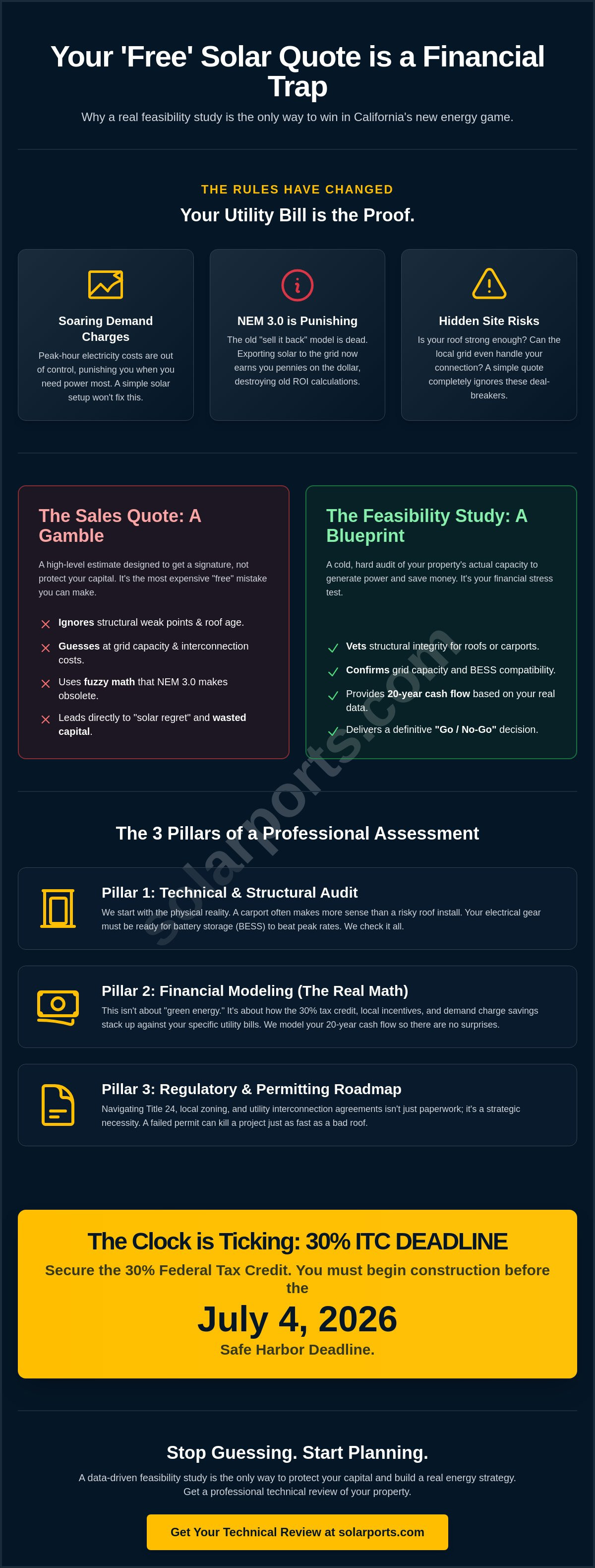
A preliminary quote is a guess. It's usually an optimistic one designed to get a signature. A commercial solar feasibility study California is the opposite; it’s a cold, hard audit of your property’s actual capacity to generate and save money. We view it as a pre-construction diagnostic tool that eliminates the risk of "solar regret" by identifying technical deal-breakers before you commit capital.
The core objective isn't to see if the sun shines on your roof. It's to identify the gap between your current utility spend and your potential optimized energy floor. In the 2026 landscape, that gap is moving. Between shifting time-of-use rates and new mandates, your energy strategy needs to be as dynamic as the grid itself. You aren't just buying hardware. You're securing a financial hedge against a utility provider that's constantly moving the goalposts.
Why a "Free Quote" is the Most Expensive Mistake You Can Make
Relying on a high-level estimate is a gamble. Most generic quotes ignore the granular data found in a detailed business energy efficiency analysis. Without site-specific detail, you'll likely end up with a system that's over-built for your daytime needs or under-built for your peak demand. This isn't just a technical error. It's a "right-sizing" failure that destroys your 20-year cash flow projections before the first panel is even installed. Precision matters when every kilowatt-hour has a different price tag depending on the time of day.
California-Specific Variables: NEM 3.0 and Beyond
The rules of the game have changed. Under current California net billing tariffs, the old logic of maximizing energy production is dead. The value of solar power now hinges on "avoided cost." You need to know exactly how much utility power you aren't buying during the most expensive hours of the day. A professional commercial solar feasibility study California models these specific variables, ensuring your investment is protected against the volatility of the state's evolving utility rate structures. It's the difference between a system that looks good on paper and one that actually moves the needle on your bottom line.
The Three Pillars of a Professional Feasibility Assessment
A commercial solar feasibility study California isn't a marketing brochure. It's a technical and financial gauntlet. To pass a CFO’s desk in 2026, the data must be intellectually rigorous and stripped of any "best-case scenario" fluff. We focus on three specific pillars that determine whether a project is a strategic asset or a long-term liability. If one fails, the whole project is likely dead. You have to look at technical viability, evaluating structural integrity and grid capacity, but that's only half the story. The financial modeling has to hold up under scrutiny, projecting 20-year cash flow while accounting for the 30% ITC and demand charge mitigation. Then there's the regulatory and zoning hurdle. Navigating Title 24 requirements isn't just paperwork; it's a strategic necessity.
Technical Infrastructure: Roofs, Parking Lots, and Panels
Roofs are the obvious starting point, but they’re often a mistake. If your building is older or the roof is nearing its end, a solar carport is usually the smarter asset. It skips the structural headaches and offers a clean footprint for BESS (Battery Energy Storage Systems) integration. We also vet your existing electrical service for battery compatibility. If your switchgear can't handle a BESS unit, your ability to dodge peak utility rates under NEM 3.0 disappears. It's about finding the path of least resistance for your specific property layout.
Economic Feasibility: ROI, ITC, and Demand Charges
The math has to be grounded in reality. We use a commercial energy audit checklist California to feed raw consumption data into our financial models. This isn't just about "green energy." It's about the unfiltered reality of how the ITC and local incentives stack up against your specific load profile. If you're ready to see how these numbers actually land for your property, you can book a technical review with SolarPorts Development to vet your site's potential.
Turning Data into Infrastructure: Implementing Your Strategy
Once the data is verified, the report stops being a document and becomes a tactical blueprint. It dictates every phase of the commercial solar installation timeline, from procurement to the final Permission to Operate (PTO). While massive developers chase 50-acre utility farms, SolarPorts Development focuses on the properties they skip, turning a "thinking fix" into a physical asset through turnkey project management. Battery energy storage for commercial buildings serves as the final piece of this financial puzzle, allowing you to bypass the worst of California's peak pricing spikes.
Executing the "Right-Sized" Solution
You need a partner that handles the heavy lifting from the initial cost saving analysis to the final interconnection. If the handoff between the analyst and the installer is messy, the project's ROI suffers immediately. We look at our past projects to see how feasibility data actually translates to real-world performance. It's about execution, not just theory. A system that's built for the wrong load profile is just expensive roof weight that won't pay for itself.
Navigating the California Interconnection Queue
Let's be real about PG&E, SCE, and SDG&E. They aren't in a hurry to help you stop buying their power. The final implementation phase is a battle of paperwork and grid capacity. A commercial solar feasibility study California pre-empts these "utility-side" delays by identifying capacity issues before you're six months into the project. With lead times for high-voltage transformers often exceeding 20 weeks, knowing your site's constraints early is the only way to hit the July 4, 2026, Safe Harbor deadline. Don't wait for the utility to tell you "no" after you've already broken ground.
Securing Your Property’s Energy Independence Before 2026
The window for guessing is closed. California’s utility rates aren't going down, and the Solar Billing Plan has made simple rooftop arrays a thing of the past. A professional commercial solar feasibility study California is the only way to ensure your capital isn't wasted on a system that can't handle your specific load or falls short of structural requirements. You need an audit that prioritizes ROI over hardware sales, focusing on how storage and carports can actually slash those skyrocketing demand charges.
SolarPorts Development provides turnkey solutions that the big utility-scale developers often ignore. We offer the data-driven recommendations you need to make a definitive "go/no-go" decision. Our expertise lies in navigating the California-specific hurdles that stall most projects, ensuring your investment is protected from interconnection delays and regulatory shifts. It's time to stop reacting to utility bills and start controlling your operational costs with a strategy built for the 2026 landscape.
Schedule your strategic energy cost saving analysis with SolarPorts Development to lock in your 2026 strategy. You've got the data; now it's time to build a more resilient bottom line.
Frequently Asked Questions
How much does a commercial solar feasibility study cost in California?
Honestly, we don't have a flat rate because every commercial meter setup is its own unique headache. You're paying for a specialized engineering and financial audit of your specific property, and that price scales with the complexity of your electrical room and how much data we have to hunt down. It’s a drop in the bucket compared to the six-figure mistake of discovering your transformer can't handle a backfeed once the panels are already on the truck.
How long does a typical solar feasibility study take for a commercial property?
You should plan for three to six weeks. Most of that time is spent waiting on the utility to release your interval data or digging through old structural blueprints to see if your roof can actually hold the weight. If we hit a snag with grid capacity maps, it might lean toward the longer end, but we don't rush it because the math has to be perfect before you pull the trigger.
Do I need a feasibility study if I am only interested in solar carports?
Yes, and in some ways, it's even more critical than a roof check. A commercial solar feasibility study California for carports has to account for things you can't see, like soil stability and underground trenching paths. You also have to navigate ADA parking compliance and local setback rules that can kill a project if they aren't caught early. We treat the parking lot like a power plant, and that requires a real plan.
What happens if the feasibility study shows solar is not viable for my roof?
We consider that a win. It’s better to spend a small amount finding out your roof is too weak than to find out after you've signed a massive contract. If the roof is a no-go, we usually pivot the analysis to solar carports or a standalone Battery Energy Storage System (BESS) to attack those demand charges directly. The goal is to find the most efficient way to lower your bill, even if it isn't what you originally envisioned.
Frequently asked questions
Why a "Free Quote" is the Most Expensive Mistake You Can Make
Relying on a high-level estimate is a gamble. Most generic quotes ignore the granular data found in a detailed business energy efficiency analysis. Without site-specific detail, you'll likely end up with a system that's over-built for your daytime needs or under-built for your peak demand. This isn't just a technical error. It's a "right-sizing" failure that destroys your 20-year cash flow projections before the first panel is even installed. Precision matters when every kilowatt-hour has a different price tag depending on the time of day.
California-Specific Variables: NEM 3.0 and Beyond
The rules of the game have changed. Under current California net billing tariffs, the old logic of maximizing energy production is dead. The value of solar power now hinges on "avoided cost." You need to know exactly how much utility power you aren't buying during the most expensive hours of the day. A professional commercial solar feasibility study California models these specific variables, ensuring your investment is protected against the volatility of the state's evolving utility rate structures. It's the difference between a system that looks good on paper and one that actually moves the needle on your bottom line. A commercial solar feasibility study California isn't a marketing brochure. It's a technical and financial gauntlet. To pass a CFO’s desk in 2026, the data must be intellectually rigorous and stripped of any "best-case scenario" fluff. We focus on three specific pillars that determine whether a project is a strategic asset or a long-term liability. If one fails, the whole project is likely dead. You have to look at technical viability, evaluating structural integrity and grid capacity, but that's only half the story. The financial modeling has to hold up under scrutiny, projecting 20-year cash flow while accounting for the 30% ITC and demand charge mitigation. Then there's the regulatory and zoning hurdle. Navigating Title 24 requirements isn't just paperwork; it's a strategic necessity.
Technical Infrastructure: Roofs, Parking Lots, and Panels
Roofs are the obvious starting point, but they’re often a mistake. If your building is older or the roof is nearing its end, a solar carport is usually the smarter asset. It skips the structural headaches and offers a clean footprint for BESS (Battery Energy Storage Systems) integration. We also vet your existing electrical service for battery compatibility. If your switchgear can't handle a BESS unit, your ability to dodge peak utility rates under NEM 3.0 disappears. It's about finding the path of least resistance for your specific property layout.
Economic Feasibility: ROI, ITC, and Demand Charges
The math has to be grounded in reality. We use a commercial energy audit checklist California to feed raw consumption data into our financial models. This isn't just about "green energy." It's about the unfiltered reality of how the ITC and local incentives stack up against your specific load profile. If you're ready to see how these numbers actually land for your property, you can book a technical review with SolarPorts Development to vet your site's potential. Once the data is verified, the report stops being a document and becomes a tactical blueprint. It dictates every phase of the commercial solar installation timeline, from procurement to the final Permission to Operate (PTO). While massive developers chase 50-acre utility farms, SolarPorts Development focuses on the properties they skip, turning a "thinking fix" into a physical asset through turnkey project management. Battery energy storage for commercial buildings serves as the final piece of this financial puzzle, allowing you to bypass the worst of California's peak pricing spikes.
Executing the "Right-Sized" Solution
You need a partner that handles the heavy lifting from the initial cost saving analysis to the final interconnection. If the handoff between the analyst and the installer is messy, the project's ROI suffers immediately. We look at our past projects to see how feasibility data actually translates to real-world performance. It's about execution, not just theory. A system that's built for the wrong load profile is just expensive roof weight that won't pay for itself.
Navigating the California Interconnection Queue
Let's be real about PG&E, SCE, and SDG&E. They aren't in a hurry to help you stop buying their power. The final implementation phase is a battle of paperwork and grid capacity. A commercial solar feasibility study California pre-empts these "utility-side" delays by identifying capacity issues before you're six months into the project. With lead times for high-voltage transformers often exceeding 20 weeks, knowing your site's constraints early is the only way to hit the July 4, 2026, Safe Harbor deadline. Don't wait for the utility to tell you "no" after you've already broken ground. The window for guessing is closed. California’s utility rates aren't going down, and the Solar Billing Plan has made simple rooftop arrays a thing of the past. A professional commercial solar feasibility study California is the only way to ensure your capital isn't wasted on a system that can't handle your specific load or falls short of structural requirements. You need an audit that prioritizes ROI over hardware sales, focusing on how storage and carports can actually slash those skyrocketing demand charges. SolarPorts Development provides turnkey solutions that the big utility-scale developers often ignore. We offer the data-driven recommendations you need to make a definitive "go/no-go" decision. Our expertise lies in navigating the California-specific hurdles that stall most projects, ensuring your investment is protected from interconnection delays and regulatory shifts. It's time to stop reacting to utility bills and start controlling your operational costs with a strategy built for the 2026 landscape. Schedule your strategic energy cost saving analysis with SolarPorts Development to lock in your 2026 strategy. You've got the data; now it's time to build a more resilient bottom line.
How much does a commercial solar feasibility study cost in California?
Honestly, we don't have a flat rate because every commercial meter setup is its own unique headache. You're paying for a specialized engineering and financial audit of your specific property, and that price scales with the complexity of your electrical room and how much data we have to hunt down. It’s a drop in the bucket compared to the six-figure mistake of discovering your transformer can't handle a backfeed once the panels are already on the truck.
How long does a typical solar feasibility study take for a commercial property?
You should plan for three to six weeks. Most of that time is spent waiting on the utility to release your interval data or digging through old structural blueprints to see if your roof can actually hold the weight. If we hit a snag with grid capacity maps, it might lean toward the longer end, but we don't rush it because the math has to be perfect before you pull the trigger.
Do I need a feasibility study if I am only interested in solar carports?
Yes, and in some ways, it's even more critical than a roof check. A commercial solar feasibility study California for carports has to account for things you can't see, like soil stability and underground trenching paths. You also have to navigate ADA parking compliance and local setback rules that can kill a project if they aren't caught early. We treat the parking lot like a power plant, and that requires a real plan.
What happens if the feasibility study shows solar is not viable for my roof?
We consider that a win. It’s better to spend a small amount finding out your roof is too weak than to find out after you've signed a massive contract. If the roof is a no-go, we usually pivot the analysis to solar carports or a standalone Battery Energy Storage System (BESS) to attack those demand charges directly. The goal is to find the most efficient way to lower your bill, even if it isn't what you originally envisioned.