
Commercial Solar Financing in California: A Strategic 2026 Financial Analysis

Waiting for the "perfect" economic climate to fix your energy costs is a strategic error. In 2026, California's utility volatility is doing more damage to your bottom line than a high interest rate ever could. You are likely searching for commercial solar financing options California provides because your OpEx has become an unpredictable liability. It's frustrating to watch demand charges eat your margins while you try to decode the difference between ITC bonuses and MACRS schedules.
The old model of just sticking panels on a roof is dead. Today, solar is a financial hedge, not an environmental hobby. We are going to break down how to use integrated solar and battery storage to aggressively cut those demand charges. This isn't about taking on bad debt. It is about finding a financing structure that preserves your cash flow and hits a full payback in under five years. We will look at the July 4, 2026, ITC deadline and why the NEM 3.0 math makes battery storage a non-negotiable part of the deal.
Key Takeaways
- California utility rates are decoupling from standard inflation, making it essential to convert your energy bill from a volatile liability into a fixed, predictable asset.
- Navigating the commercial solar financing options California provides requires a choice between the immediate cash-flow relief of a PPA and the long-term equity of direct ownership.
- Battery Energy Storage Systems (BESS) are no longer optional. They are the primary engine for crushing demand charges and making the math work under NEM 3.0.
- The 30% Investment Tax Credit is just the baseline; domestic content adders and accelerated depreciation are the levers that can bring project payback under the five-year mark.
Table of Contents
- The Financial Reality of California Commercial Solar in 2026
- Financing Structures: Comparing PPAs, Leases, and Direct Ownership
- Maximizing ROI with BESS and Federal Incentives
The Financial Reality of California Commercial Solar in 2026
California utility rates aren't just rising; they've decoupled from predictable inflation. If you're running a business in this state, you already know the monthly bill feels less like a standard operational expense and more like a volatile liability. By 2026, the grid has become a structural risk. Relying on it without a hedge is basically writing a blank check to the utility every month. You need to evaluate commercial solar financing options California offers as a fixed-cost contract for your building’s future. The July 4, 2026, federal deadline to "commence construction" for the full 30% Investment Tax Credit (ITC) makes this a critical pivot point for your 2027 fiscal planning.
Why Northern California Businesses Face Unique Pressure
In the North, the pressure is physical as much as it is financial. Public Safety Power Shutoffs (PSPS) are no longer a rare event; they are a recurring operational hazard for industrial zones. Localized energy generation acts as an insurance policy against these grid failures. Under NEM 3.0, exporting power back to the grid is a losing game because export rates have plummeted to an average of $0.05 to $0.08 per kWh. Success now depends on self-consumption. This reality is driving interest in Power Purchase Agreements (PPAs) and other models that prioritize onsite usage over grid sales.
Defining the 2026 Commercial Solar Investment
A 2026 solar investment is a multi-asset financial strategy that integrates photovoltaic generation, battery energy storage systems (BESS), and tax equity to de-risk operational cash flow. The market has moved past simple rooftop arrays. Most strategic projects now focus on integrated solar carports and storage systems that maximize the utility of existing real estate while crushing demand charges.
Financing Structures: Comparing PPAs, Leases, and Direct Ownership
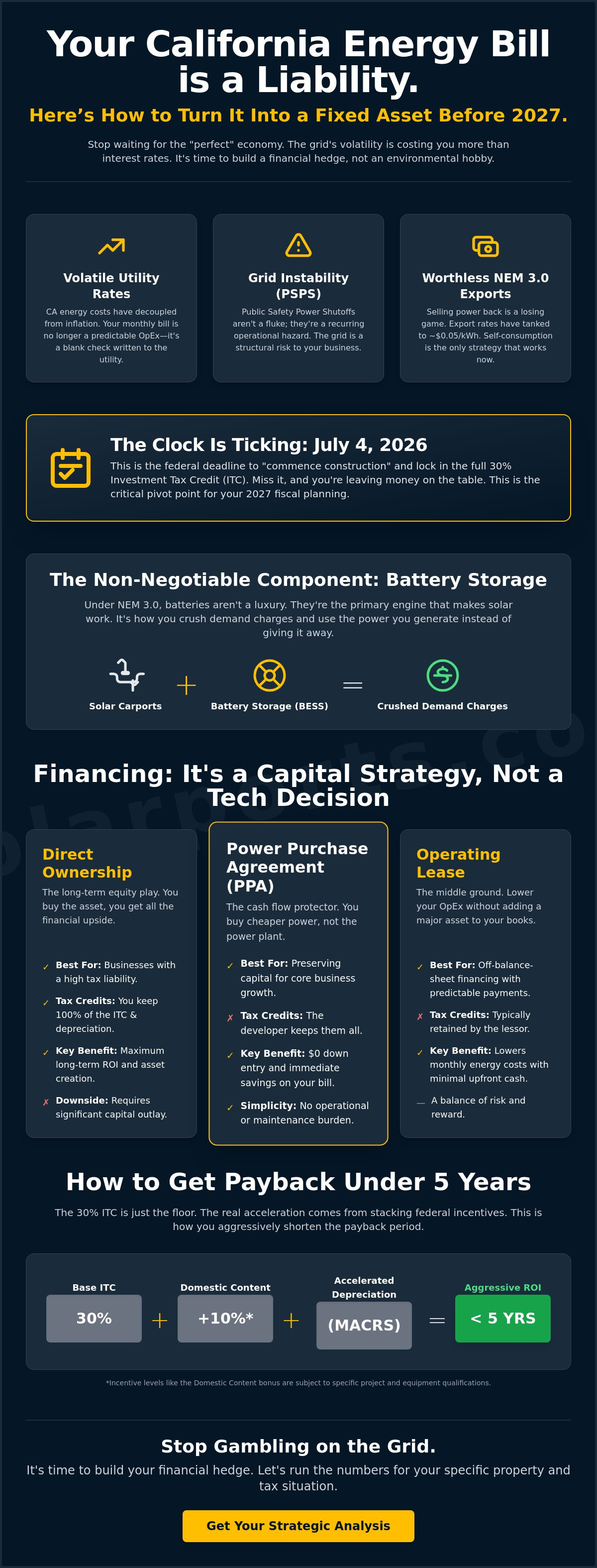
Selecting from the commercial solar financing options California offers isn't a technical decision. It's a capital allocation strategy. You're either buying an asset to crush your tax liability or you're outsourcing your energy generation to protect cash flow. Direct ownership requires a significant capital outlay, but it allows you to capture 100% of the 30% federal ITC and the 100% federal bonus depreciation available for 2026. If you're looking for the long-term equity play, you should review our commercial solar ROI analysis to see how the ownership model stacks up against current utility volatility.
On the other end of the spectrum, Power Purchase Agreements (PPAs) offer a zero-down entry point. You get immediate savings on your per-kWh rate, but the developer keeps the tax credits. It’s a trade-off: you lose the tax hedge but gain operational simplicity. Operating leases sit in the middle, often keeping the equipment off the balance sheet while still lowering your monthly OpEx. It's about deciding whether you want to own the power plant or just the power it produces.
The CFO’s Decision Matrix
The choice usually comes down to tax appetite. If your business has a high tax liability, ownership is the clear winner because of the ITC and MACRS benefits. If you'd rather keep your capital for core business growth, a PPA provides the predictability you need without the debt. Some businesses are also looking into California community solar programs as a way to participate in regional greening without the onsite construction footprint.
The Impact of Interest Rates on 2026 Solar Loans
With interest rates for commercial solar loans sitting between 6% and 12% in mid-2026, the cost of capital has changed the payback period math. You aren't seeing the three-year paybacks of the low-interest era anymore. However, C-PACE financing remains a powerful alternative because it attaches the loan to the property tax bill rather than your business credit. To understand how these deals actually get across the finish line, look at the commercial solar project management in CA reality. It’s often worth scheduling a strategic review to see which debt structure fits your specific property profile.
Maximizing ROI with BESS and Federal Incentives
The 30% Investment Tax Credit is the floor, not the ceiling. In 2026, savvy property owners are looking at Domestic Content adders that can push that credit significantly higher. If you're weighing commercial solar financing options California has available, you have to account for MACRS and 100% bonus depreciation in your first-year analysis. This is the hidden engine of solar ROI. It’s often the difference between a project that feels like a capital burden and one that pays for itself before the system has even been through its first summer. But the real money isn't just found in the tax code; it's in the batteries.
Killing Demand Charges with Battery Storage
A building’s peak usage for just 15 minutes can dictate 40% of the entire monthly bill. That’s the brutal reality of demand charges in California. Battery Energy Storage Systems (BESS) are no longer a "nice to have" add-on. They are the primary tool for shaving those peaks. By capturing midday solar and discharging it during expensive evening peak-demand windows, you flatten your utility profile. You can find a deeper breakdown of the specific math in our guide to commercial battery storage incentives California.
The 2026 ITC Timeline and Safe Harbor Rules
Timing is everything right now. To lock in the 30% ITC with a four-year completion window, you must commence construction by July 4, 2026. Missing this date complicates the project economics significantly. A professional commercial energy cost saving analysis is the only way to prove this ROI to a board of directors who might still be skeptical of the underlying technology. Don't guess on the numbers. You should get a custom energy analysis for your property to see exactly how these incentives stack for your specific site.
Secure Your Operational Margin for 2027
The financial math for 2026 is unambiguous. You can't afford to let the utility dictate your OpEx while the critical July 4, 2026, ITC deadline approaches. Navigating the commercial solar financing options California provides isn't just a matter of finding the lowest rate. It's a strategic choice between immediate cash flow protection and long-term tax equity. If you're operating in Northern California, grid instability means onsite storage is a physical necessity for your business continuity.
We've specialized in California commercial real estate since 2021, focusing on BESS and demand charge mitigation that actually moves the needle. Our team provides turnkey Northern California delivery that strips away the complexity of these projects. It's time to stop writing blank checks to the utility and start treating your property like the financial hedge it was meant to be.
Request a Turnkey Energy Cost Saving Analysis
Your property has the potential to pay for itself. Let's look at your specific load profile and find the path that secures your bottom line.
Strategic Financial FAQ
Is the 30% federal solar tax credit still available for California businesses in 2026?
Yes, the 30% Investment Tax Credit (ITC) remains the baseline for projects that commence construction by July 4, 2026. This credit applies to the total system cost, including the panels, labor, and battery storage. It's the primary anchor for the commercial solar financing options California firms use to offset their federal tax liability while building equity in their energy infrastructure.
What is the average payback period for a commercial solar investment in California today?
The typical payback period currently ranges between 5 and 8 years. While California's average electricity rate hit $0.31/kWh in late 2024, which should accelerate ROI, higher interest rates and NEM 3.0 policies have balanced the timeline. Your specific payback depends heavily on how aggressively you utilize the 100% bonus depreciation and the Domestic Content bonus adders available this year.
Can I install solar on a Triple Net (NNN) lease property?
You can, but it requires a "green lease" or a PPA to align the incentives between the landlord and the tenant. Since the tenant pays the utility bill, the owner needs a mechanism to recover the capital cost or share in the savings. When structured correctly, this turns the roof into a revenue-generating asset for the owner while lowering the tenant's total occupancy cost.
How does NEM 3.0 affect the ROI of new commercial solar projects in California?
NEM 3.0 shifted the ROI focus from selling power back to the grid to avoiding expensive utility purchases. Export rates have dropped by roughly 75%, meaning you only get about $0.05 to $0.08 per kWh for the energy you send back. The math only works now if you consume the power onsite in real-time or store it for use during peak hours.
Do I need a battery storage system (BESS) for my solar project to make financial sense?
It's hard to find a scenario where a commercial project makes sense without a battery in 2026. Because midday solar is worth so little under NEM 3.0, you need a BESS to store that power for the evening peak. This "load shifting" is the only effective way to crush demand charges, which often account for half of a commercial utility bill.
Frequently asked questions
Why Northern California Businesses Face Unique Pressure
In the North, the pressure is physical as much as it is financial. Public Safety Power Shutoffs (PSPS) are no longer a rare event; they are a recurring operational hazard for industrial zones. Localized energy generation acts as an insurance policy against these grid failures. Under NEM 3.0, exporting power back to the grid is a losing game because export rates have plummeted to an average of $0.05 to $0.08 per kWh. Success now depends on self-consumption. This reality is driving interest in Power Purchase Agreements (PPAs) and other models that prioritize onsite usage over grid sales.
Defining the 2026 Commercial Solar Investment
A 2026 solar investment is a multi-asset financial strategy that integrates photovoltaic generation, battery energy storage systems (BESS), and tax equity to de-risk operational cash flow. The market has moved past simple rooftop arrays. Most strategic projects now focus on integrated solar carports and storage systems that maximize the utility of existing real estate while crushing demand charges. Selecting from the commercial solar financing options California offers isn't a technical decision. It's a capital allocation strategy. You're either buying an asset to crush your tax liability or you're outsourcing your energy generation to protect cash flow. Direct ownership requires a significant capital outlay, but it allows you to capture 100% of the 30% federal ITC and the 100% federal bonus depreciation available for 2026. If you're looking for the long-term equity play, you should review our commercial solar ROI analysis to see how the ownership model stacks up against current utility volatility. On the other end of the spectrum, Power Purchase Agreements (PPAs) offer a zero-down entry point. You get immediate savings on your per-kWh rate, but the developer keeps the tax credits. It’s a trade-off: you lose the tax hedge but gain operational simplicity. Operating leases sit in the middle, often keeping the equipment off the balance sheet while still lowering your monthly OpEx. It's about deciding whether you want to own the power plant or just the power it produces.
The CFO’s Decision Matrix
The choice usually comes down to tax appetite. If your business has a high tax liability, ownership is the clear winner because of the ITC and MACRS benefits. If you'd rather keep your capital for core business growth, a PPA provides the predictability you need without the debt. Some businesses are also looking into California community solar programs as a way to participate in regional greening without the onsite construction footprint.
The Impact of Interest Rates on 2026 Solar Loans
With interest rates for commercial solar loans sitting between 6% and 12% in mid-2026, the cost of capital has changed the payback period math. You aren't seeing the three-year paybacks of the low-interest era anymore. However, C-PACE financing remains a powerful alternative because it attaches the loan to the property tax bill rather than your business credit. To understand how these deals actually get across the finish line, look at the commercial solar project management in CA reality. It’s often worth scheduling a strategic review to see which debt structure fits your specific property profile. The 30% Investment Tax Credit is the floor, not the ceiling. In 2026, savvy property owners are looking at Domestic Content adders that can push that credit significantly higher. If you're weighing commercial solar financing options California has available, you have to account for MACRS and 100% bonus depreciation in your first-year analysis. This is the hidden engine of solar ROI. It’s often the difference between a project that feels like a capital burden and one that pays for itself before the system has even been through its first summer. But the real money isn't just found in the tax code; it's in the batteries.
Killing Demand Charges with Battery Storage
A building’s peak usage for just 15 minutes can dictate 40% of the entire monthly bill. That’s the brutal reality of demand charges in California. Battery Energy Storage Systems (BESS) are no longer a "nice to have" add-on. They are the primary tool for shaving those peaks. By capturing midday solar and discharging it during expensive evening peak-demand windows, you flatten your utility profile. You can find a deeper breakdown of the specific math in our guide to commercial battery storage incentives California.
The 2026 ITC Timeline and Safe Harbor Rules
Timing is everything right now. To lock in the 30% ITC with a four-year completion window, you must commence construction by July 4, 2026. Missing this date complicates the project economics significantly. A professional commercial energy cost saving analysis is the only way to prove this ROI to a board of directors who might still be skeptical of the underlying technology. Don't guess on the numbers. You should get a custom energy analysis for your property to see exactly how these incentives stack for your specific site. The financial math for 2026 is unambiguous. You can't afford to let the utility dictate your OpEx while the critical July 4, 2026, ITC deadline approaches. Navigating the commercial solar financing options California provides isn't just a matter of finding the lowest rate. It's a strategic choice between immediate cash flow protection and long-term tax equity. If you're operating in Northern California, grid instability means onsite storage is a physical necessity for your business continuity. We've specialized in California commercial real estate since 2021, focusing on BESS and demand charge mitigation that actually moves the needle. Our team provides turnkey Northern California delivery that strips away the complexity of these projects. It's time to stop writing blank checks to the utility and start treating your property like the financial hedge it was meant to be. Request a Turnkey Energy Cost Saving Analysis Your property has the potential to pay for itself. Let's look at your specific load profile and find the path that secures your bottom line.
Is the 30% federal solar tax credit still available for California businesses in 2026?
Yes, the 30% Investment Tax Credit (ITC) remains the baseline for projects that commence construction by July 4, 2026. This credit applies to the total system cost, including the panels, labor, and battery storage. It's the primary anchor for the commercial solar financing options California firms use to offset their federal tax liability while building equity in their energy infrastructure.
What is the average payback period for a commercial solar investment in California today?
The typical payback period currently ranges between 5 and 8 years. While California's average electricity rate hit $0.31/kWh in late 2024, which should accelerate ROI, higher interest rates and NEM 3.0 policies have balanced the timeline. Your specific payback depends heavily on how aggressively you utilize the 100% bonus depreciation and the Domestic Content bonus adders available this year.
Can I install solar on a Triple Net (NNN) lease property?
You can, but it requires a "green lease" or a PPA to align the incentives between the landlord and the tenant. Since the tenant pays the utility bill, the owner needs a mechanism to recover the capital cost or share in the savings. When structured correctly, this turns the roof into a revenue-generating asset for the owner while lowering the tenant's total occupancy cost.
How does NEM 3.0 affect the ROI of new commercial solar projects in California?
NEM 3.0 shifted the ROI focus from selling power back to the grid to avoiding expensive utility purchases. Export rates have dropped by roughly 75%, meaning you only get about $0.05 to $0.08 per kWh for the energy you send back. The math only works now if you consume the power onsite in real-time or store it for use during peak hours.
Do I need a battery storage system (BESS) for my solar project to make financial sense?
It's hard to find a scenario where a commercial project makes sense without a battery in 2026. Because midday solar is worth so little under NEM 3.0, you need a BESS to store that power for the evening peak. This "load shifting" is the only effective way to crush demand charges, which often account for half of a commercial utility bill.