
Reducing Carbon Footprint for Business: Moving Past the Myths to Real ROI in 2026

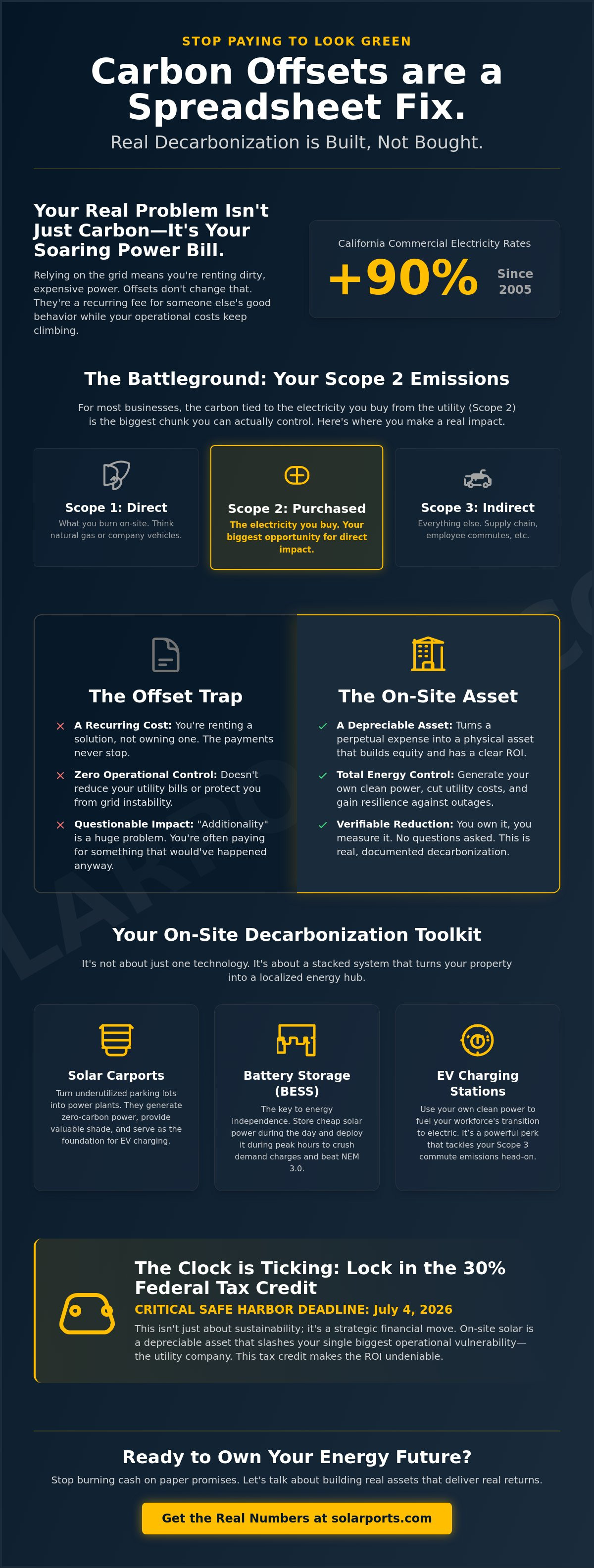
Buying carbon offsets is usually just an expensive way to pay for someone else's good behavior while your own utility bills keep climbing. It's a spreadsheet fix for a physical problem that doesn't actually help your bottom line. You've probably noticed that California's commercial electricity rates have jumped nearly 90% since 2005. It is a massive, recurring operational burden. You are likely feeling the heat from stakeholders to show "green" progress, but the path through the technology noise isn't always clear.
We are stripping away the marketing fluff to focus on what works right now. Real carbon reduction comes from turning your facility into a localized energy hub. By implementing commercial renewable energy solutions California leaders can actually verify, you stop renting power and start owning your infrastructure. We'll show you how to navigate the July 4, 2026, Safe Harbor deadline for the 30% federal tax credit. We will also explore how stacking battery storage with solar offsets the impact of NEM 3.0 to drive down costs. This is about moving past myths and securing a documented, financial return on your decarbonization efforts.
Key Takeaways
- Stop relying on paper thin offsets that don't touch your operational reality. You'll learn why addressing Scope 2 emissions through on-site infrastructure is the only way to actually control your energy destiny.
- Turn your underutilized parking lots into high yield energy assets. We break down how solar carports generate zero carbon power while protecting vehicles and lowering your building's footprint.
- Discover how integrating commercial renewable energy solutions California businesses need, like BESS, allows you to flatten demand charges and store power for when the grid is at its dirtiest.
- Real sustainability isn't just about the environment; it's about operational resilience. Find out how physical site upgrades keep your business running during grid instability while providing verifiable carbon data.
- Move past the fluff and see the math. We look at how physical infrastructure drives a tangible ROI through utility savings and tax incentives that carbon offsets simply cannot match.
Table of Contents
- The Carbon Footprint Trap: Why Offsets Aren’t a Business Strategy
- The High-Impact Reality: Decarbonizing Your Physical Asset
- Beyond the Spreadsheet: Building a Resilient, Low-Carbon Operation
The Carbon Footprint Trap: Why Offsets Aren’t a Business Strategy
Your business carbon footprint isn't just a buzzword. It's the total volume of greenhouse gases your operations generate, usually split into three buckets. Scope 1 covers what you burn directly, like gas in company vehicles. Scope 3 is the messy stuff in your supply chain. But for most California executives, Scope 2 is the real battleground. This is the carbon tied to the electricity you buy from the utility. Many companies try to solve this by buying cheap carbon offsets. It feels like an easy win. You pay a third party to plant trees or protect a swamp, then check the "net zero" box. It's a spreadsheet fix that fails the reality test.
The problem is additionality. Savvy investors and California regulators are tired of green claims that don't actually change the energy mix. If your offset doesn't fund a project that wouldn't have happened otherwise, it's just fluff. Relying on these indirect reductions is a risky bet. As we move through 2026, sticking with the grid is both a carbon risk and a fiscal liability. You're essentially renting a dirty, increasingly expensive product when you could be owning a clean one. Real commercial renewable energy solutions California businesses can rely on require physical infrastructure on your own property.
Understanding Scope 2: Your Biggest Opportunity
Purchased electricity is usually the largest addressable chunk of your footprint. It's also the most volatile. California's grid is cleaner than most, but it isn't perfect. During peak hours, the carbon intensity of the grid spikes as older, dirtier plants kick in to meet demand. If your operations rely on the grid during these windows, your carbon numbers suffer regardless of how many trees you "planted" in another state. True Corporate sustainability means taking control of where that power comes from at the source. Implementing commercial renewable energy solutions California properties can host on-site is the only way to decouple your growth from the grid's carbon intensity.
The ROI of Direct Decarbonization
Onsite generation turns a recurring utility expense into a depreciable asset. It's a fundamental shift in how you view your facility. When you compare the never-ending cost of offsets to a one-time investment in turnkey commercial solar in CA, the math isn't even close. One is a permanent tax on your operations; the other is a structural improvement that builds equity and slashes long-term overhead.
The High-Impact Reality: Decarbonizing Your Physical Asset
Most commercial properties in California are sitting on a goldmine of dead space that they never think to use. I'm talking about the parking lot. While rooftop solar remains the reliable workhorse for office and industrial sites, it often isn't enough to hit aggressive carbon targets on its own. This is where physical site infrastructure needs to get creative. You don't need to cover every square inch of your property to see a massive drop in your footprint. It's about the right-sizing principle. We focus on finding the sweet spot where generation meets your peak load without overbuilding, ensuring the commercial renewable energy solutions California businesses invest in actually pay for themselves.
Solar Carports as a Dual-Benefit Solution
Solar carports are the ultimate dual-benefit move. They turn a hot, asphalt liability into a power plant. By installing commercial solar carports in California, you provide shade for employees and tenants while pumping zero-carbon power directly into your building. A standard commercial lot can produce hundreds of MWh annually, depending on the layout. It's a visible, tangible sign of progress that people actually appreciate when they aren't returning to a 120-degree car in the middle of a July heatwave.
Integrating EV Infrastructure
Once you're generating your own power, adding EV charging is the only logical next step. It's how you tackle those stubborn Scope 3 employee commuting emissions. Providing onsite solar charging isn't just a workplace perk; it's a strategic way to decarbonize your entire operational ecosystem. You're effectively using your real estate to fuel your workforce. If you're wondering how these systems fit into your specific site plan, you might want to book a quick site assessment to see what your parking lot is actually capable of producing.
Beyond the Spreadsheet: Building a Resilient, Low-Carbon Operation
Data collection is a fine start, but spreadsheets don't generate power. You can track every gram of carbon your facility emits, but without the physical hardware to act on those insights, you're just documenting your own inefficiency. This is where commercial renewable energy solutions California businesses are adopting in 2026 move from theory to reality. In Northern California, the conversation is increasingly dominated by demand charges. These fees can account for up to half of a commercial bill, and they usually hit when the grid is at its dirtiest and most expensive. If you're pulling heavy power during these windows, you're paying a premium for high-carbon electricity.
The BESS Advantage in California
Batteries are the bridge between generating green power and actually using it when it matters most. Using commercial BESS solutions allows your business to store solar energy produced at noon and deploy it during the evening peak. Peak shaving reduces both your carbon intensity and your utility bills by discharging stored energy when grid rates are at their highest. Beyond the fiscal savings, a low-carbon operation is simply more resilient. For companies in Northern California, a facility with on-site storage keeps critical systems running during grid instability or Public Safety Power Shutoffs (PSPS) while competitors are left in the dark.
From Analysis to Action
Waiting to pull the trigger is getting more expensive every month. With Northern California utility rates continuing their upward trend through 2026, the cost of inaction is quantifiable and rising. Regional incentives, such as the 3CE Battery Rebate, provide significant capital relief, but these programs have hard deadlines like the September 30, 2026 cutoff. A professional commercial energy cost saving analysis identifies exactly where your waste lives before you spend a dime on hardware. You can't guess your way into a 70% reduction in utility expenses. We recommend reviewing our past commercial solar projects to see how physical site upgrades translate into verifiable carbon and cost outcomes. The window for the best incentives is closing.
Securing Your 2026 Operational Advantage
The era of checking boxes with paper-thin carbon offsets is over. California's regulatory environment and rising utility rates have made it clear that only physical, on-site changes deliver a real return. You've seen how solar carports and rooftop systems turn underused real estate into active power plants. By pairing these assets with BESS, you aren't just cutting carbon; you're insulating your business from the grid's most expensive and volatile hours. It's a shift from being a passive ratepayer to an active energy owner.
Implementing commercial renewable energy solutions California companies can actually verify is about more than just sustainability. It's about data-driven ROI and long-term operational resilience. We specialize in California commercial real estate, delivering turnkey BESS and solar carport solutions that strip away the complexity of decarbonization. Our approach focuses on clear carbon impact reporting and structural efficiency that stays on your balance sheet for decades.
You shouldn't have to guess about your energy future while utility costs continue to climb. The math is straightforward, and the technology is ready to work. Book your free solar consultation and energy analysis today to get a clear, no-nonsense picture of your property's potential. Let's build a strategy that actually moves the needle on your bottom line.
Frequently Asked Questions
Is carbon offsetting actually effective for businesses in 2026?
Offsets are largely an accounting maneuver rather than an operational strategy. They don't reduce your utility bills or your Scope 2 emissions because they don't change how your building pulls power from the grid. In 2026, savvy investors look for "additionality," which means your investment actually creates new green energy. Physical site upgrades are the only way to prove you aren't just paying for someone else's sustainability while your own footprint remains unchanged.
How much can a solar carport actually reduce my company carbon footprint?
A solar carport can reduce your Scope 2 emissions by 30% to 70% depending on your energy load and the size of your parking lot. It captures zero-carbon energy from underutilized asphalt and feeds it directly into your building's electrical system. By integrating EV charging, you also address Scope 3 emissions from employee commuting. It's one of the most visible commercial renewable energy solutions California companies use to prove their commitment to decarbonization.
What is the difference between Scope 1, 2, and 3 emissions for a small business?
Scope 1 includes emissions you produce directly, like the gas burned in a company boiler or fleet vehicle. Scope 2 covers the indirect emissions from the electricity you buy from the utility to keep your facility running. Scope 3 is the broadest category, covering everything in your value chain from waste disposal to employee travel. For most California businesses, Scope 2 is the most immediate target for elimination through on-site infrastructure like solar and storage.
How do batteries (BESS) help reduce a business carbon footprint if they don't generate power?
Batteries reduce your footprint by allowing you to use your own solar power when the sun isn't shining. Without storage, you're forced to pull from the grid during peak evening hours when California's energy mix is at its highest carbon intensity. BESS lets you "time shift" your clean generation. It ensures you aren't relying on high-carbon peaker plants to meet your operational needs, allowing you to deploy commercial renewable energy solutions California properties need for 24-hour decarbonization.
Frequently asked questions
Understanding Scope 2: Your Biggest Opportunity
Purchased electricity is usually the largest addressable chunk of your footprint. It's also the most volatile. California's grid is cleaner than most, but it isn't perfect. During peak hours, the carbon intensity of the grid spikes as older, dirtier plants kick in to meet demand. If your operations rely on the grid during these windows, your carbon numbers suffer regardless of how many trees you "planted" in another state. True Corporate sustainability means taking control of where that power comes from at the source. Implementing commercial renewable energy solutions California properties can host on-site is the only way to decouple your growth from the grid's carbon intensity.
The ROI of Direct Decarbonization
Onsite generation turns a recurring utility expense into a depreciable asset. It's a fundamental shift in how you view your facility. When you compare the never-ending cost of offsets to a one-time investment in turnkey commercial solar in CA, the math isn't even close. One is a permanent tax on your operations; the other is a structural improvement that builds equity and slashes long-term overhead. Most commercial properties in California are sitting on a goldmine of dead space that they never think to use. I'm talking about the parking lot. While rooftop solar remains the reliable workhorse for office and industrial sites, it often isn't enough to hit aggressive carbon targets on its own. This is where physical site infrastructure needs to get creative. You don't need to cover every square inch of your property to see a massive drop in your footprint. It's about the right-sizing principle. We focus on finding the sweet spot where generation meets your peak load without overbuilding, ensuring the commercial renewable energy solutions California businesses invest in actually pay for themselves.
Solar Carports as a Dual-Benefit Solution
Solar carports are the ultimate dual-benefit move. They turn a hot, asphalt liability into a power plant. By installing commercial solar carports in California, you provide shade for employees and tenants while pumping zero-carbon power directly into your building. A standard commercial lot can produce hundreds of MWh annually, depending on the layout. It's a visible, tangible sign of progress that people actually appreciate when they aren't returning to a 120-degree car in the middle of a July heatwave.
Integrating EV Infrastructure
Once you're generating your own power, adding EV charging is the only logical next step. It's how you tackle those stubborn Scope 3 employee commuting emissions. Providing onsite solar charging isn't just a workplace perk; it's a strategic way to decarbonize your entire operational ecosystem. You're effectively using your real estate to fuel your workforce. If you're wondering how these systems fit into your specific site plan, you might want to book a quick site assessment to see what your parking lot is actually capable of producing. Data collection is a fine start, but spreadsheets don't generate power. You can track every gram of carbon your facility emits, but without the physical hardware to act on those insights, you're just documenting your own inefficiency. This is where commercial renewable energy solutions California businesses are adopting in 2026 move from theory to reality. In Northern California, the conversation is increasingly dominated by demand charges. These fees can account for up to half of a commercial bill, and they usually hit when the grid is at its dirtiest and most expensive. If you're pulling heavy power during these windows, you're paying a premium for high-carbon electricity.
The BESS Advantage in California
Batteries are the bridge between generating green power and actually using it when it matters most. Using commercial BESS solutions allows your business to store solar energy produced at noon and deploy it during the evening peak. Peak shaving reduces both your carbon intensity and your utility bills by discharging stored energy when grid rates are at their highest. Beyond the fiscal savings, a low-carbon operation is simply more resilient. For companies in Northern California, a facility with on-site storage keeps critical systems running during grid instability or Public Safety Power Shutoffs (PSPS) while competitors are left in the dark.
From Analysis to Action
Waiting to pull the trigger is getting more expensive every month. With Northern California utility rates continuing their upward trend through 2026, the cost of inaction is quantifiable and rising. Regional incentives, such as the 3CE Battery Rebate, provide significant capital relief, but these programs have hard deadlines like the September 30, 2026 cutoff. A professional commercial energy cost saving analysis identifies exactly where your waste lives before you spend a dime on hardware. You can't guess your way into a 70% reduction in utility expenses. We recommend reviewing our past commercial solar projects to see how physical site upgrades translate into verifiable carbon and cost outcomes. The window for the best incentives is closing. The era of checking boxes with paper-thin carbon offsets is over. California's regulatory environment and rising utility rates have made it clear that only physical, on-site changes deliver a real return. You've seen how solar carports and rooftop systems turn underused real estate into active power plants. By pairing these assets with BESS, you aren't just cutting carbon; you're insulating your business from the grid's most expensive and volatile hours. It's a shift from being a passive ratepayer to an active energy owner. Implementing commercial renewable energy solutions California companies can actually verify is about more than just sustainability. It's about data-driven ROI and long-term operational resilience. We specialize in California commercial real estate, delivering turnkey BESS and solar carport solutions that strip away the complexity of decarbonization. Our approach focuses on clear carbon impact reporting and structural efficiency that stays on your balance sheet for decades. You shouldn't have to guess about your energy future while utility costs continue to climb. The math is straightforward, and the technology is ready to work. Book your free solar consultation and energy analysis today to get a clear, no-nonsense picture of your property's potential. Let's build a strategy that actually moves the needle on your bottom line.
Is carbon offsetting actually effective for businesses in 2026?
Offsets are largely an accounting maneuver rather than an operational strategy. They don't reduce your utility bills or your Scope 2 emissions because they don't change how your building pulls power from the grid. In 2026, savvy investors look for "additionality," which means your investment actually creates new green energy. Physical site upgrades are the only way to prove you aren't just paying for someone else's sustainability while your own footprint remains unchanged.
How much can a solar carport actually reduce my company carbon footprint?
A solar carport can reduce your Scope 2 emissions by 30% to 70% depending on your energy load and the size of your parking lot. It captures zero-carbon energy from underutilized asphalt and feeds it directly into your building's electrical system. By integrating EV charging, you also address Scope 3 emissions from employee commuting. It's one of the most visible commercial renewable energy solutions California companies use to prove their commitment to decarbonization.
What is the difference between Scope 1, 2, and 3 emissions for a small business?
Scope 1 includes emissions you produce directly, like the gas burned in a company boiler or fleet vehicle. Scope 2 covers the indirect emissions from the electricity you buy from the utility to keep your facility running. Scope 3 is the broadest category, covering everything in your value chain from waste disposal to employee travel. For most California businesses, Scope 2 is the most immediate target for elimination through on-site infrastructure like solar and storage.
How do batteries (BESS) help reduce a business carbon footprint if they don't generate power?
Batteries reduce your footprint by allowing you to use your own solar power when the sun isn't shining. Without storage, you're forced to pull from the grid during peak evening hours when California's energy mix is at its highest carbon intensity. BESS lets you "time shift" your clean generation. It ensures you aren't relying on high-carbon peaker plants to meet your operational needs, allowing you to deploy commercial renewable energy solutions California properties need for 24-hour decarbonization.