
Commercial Battery Storage Incentives California: The 2026 Strategic Resource Guide

The July 4, 2026, Safe Harbor deadline is a hard fiscal cliff. If you haven't broken ground or committed 5% of project costs by mid-summer, you're effectively walking away from a 30% federal credit. It's a high-stakes scenario made worse by the fact that commercial battery storage incentives California are notoriously difficult to track. Most executives see the potential for savings but get stuck in the weeds of opaque utility rates and the sheer complexity of stacking multiple financial layers.
You already know that paying up to $0.50 per kWh is an unsustainable way to run a business in this state. This guide moves past the theory and gives you a pragmatic roadmap to stack the ITC, SGIP rebates, and MACRS depreciation before the window closes. We're going to look at specific SGIP eligibility for PG&E sites and set a timeline that ensures you don't miss the 2026 deadline. It's about turning a volatile operational cost into a predictable, high-yield asset.
Key Takeaways
- Missing the July 4, 2026, deadline means losing the 30% ITC floor. We break down the 5% cost test you need to pass to lock in that rate today.
- Stacking commercial battery storage incentives California with MACRS depreciation allows you to recover roughly 60% of your total system costs in the first five years.
- The SGIP program remains open for non-residential projects in PG&E territory, but the biggest payouts are reserved for specific fire-threat zones.
- Bonus depreciation is dropping to 20% for 2026. You'll need a clear timeline to maximize your year-one tax benefits before the phase-out continues.
Table of Contents
- The 30% Federal Investment Tax Credit: Why the July 2026 Window Matters
- Maximizing ROI with MACRS and Bonus Depreciation
- The California SGIP: Navigating Northern California Rebates
The 30% Federal Investment Tax Credit: Why the July 2026 Window Matters
The 30% tax credit isn't a suggestion. It's the baseline for making these projects pencil out. Since the Inflation Reduction Act passed, standalone Battery Energy Storage Systems (BESS) finally get the same treatment as solar. But there's a catch. You have to move fast because the July 4, 2026, deadline is approaching. This is where most commercial battery storage incentives California strategies live or die. If you don't "commence construction" by that date, you're gambling with your ROI. For many, the Federal Business Energy Investment Tax Credit is the difference between a project that's viable and one that's just a drain on capital. 2026 also brings new flexibility. REITs and non-profits can now use direct pay or transferability to monetize these credits. You don't need a complex tax equity partner to see the benefit anymore.
The 2026 Safe Harbor Reality Check
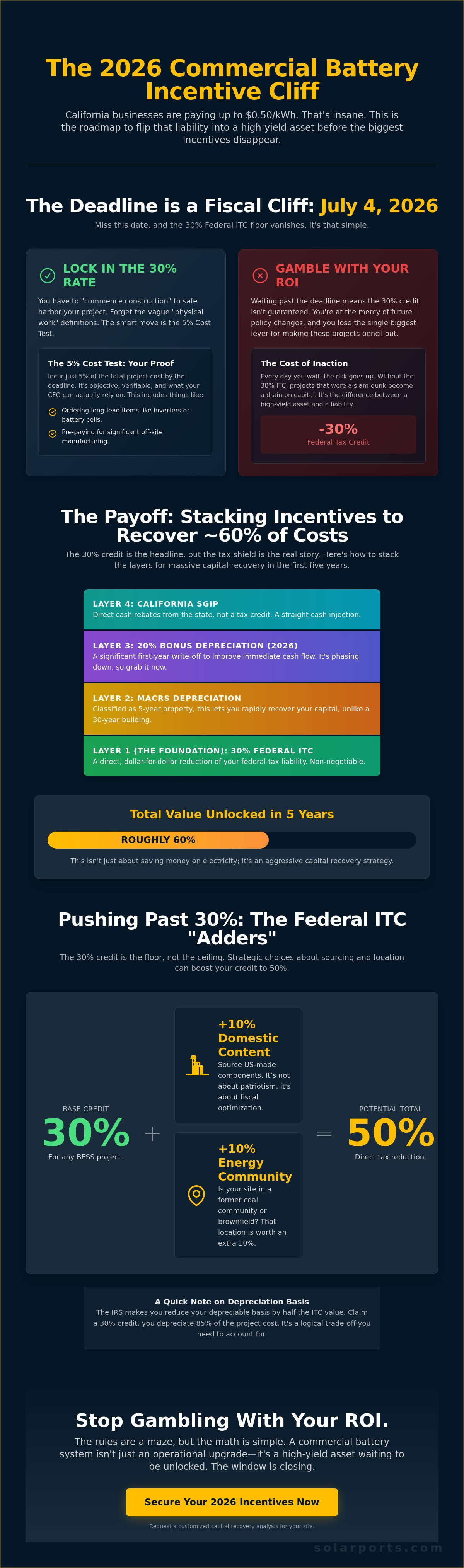
Physical work is a gray area. The IRS defines it as "work of a significant nature," which involves actual on-site labor or significant off-site manufacturing. I tell CFOs to stick to the 5% cost test. It's objective and verifiable. If you've incurred 5% of the total project cost by the deadline, you've met the requirement. Ordering long-lead items like inverters or large-scale battery cells counts toward this total. The ITC is a direct dollar-for-dollar reduction in federal tax liability for the year the BESS is placed in service.
Incentive Stacking with Commercial Solar
Batteries shouldn't always stand alone. Pairing them with solar carports turns a parking lot into a revenue-generating asset and a massive tax shield. You're essentially stacking the BESS credit on top of the 2026 commercial solar tax credit in California. This isn't about being green for the sake of it. It's about aggressive capital recovery and protecting your bottom line from utility hikes.
Maximizing ROI with MACRS and Bonus Depreciation
The 30% ITC is the headline, but the tax shield is the real story. Most executives fixate on the credit and ignore the depreciation schedule, which is a massive oversight for your 2026 tax planning. Under the Modified Accelerated Cost Recovery System (MACRS), battery storage is classified as 5-year property. This means you aren't waiting decades to recover your capital. In 2026, bonus depreciation has phased down to 20%. While it's not the 100% write-off we saw in previous years, it still provides a significant front-loaded benefit that improves immediate cash flow. When you stack these commercial battery storage incentives California correctly, you can effectively recover over half of your system cost through tax savings alone within the first five years.
You do have to account for the basis reduction. The IRS requires you to reduce your depreciable basis by half of the ITC value. If you claim the 30% credit, you depreciate 85% of the project cost. It's a logical trade-off. To push the ROI further, look at the Domestic Content Adder. Sourcing US-made battery components can tack an extra 10% onto your ITC, bringing your total credit to 40%. This isn't just about being patriotic; it's about aggressive fiscal optimization. If you're curious about how these specific percentages would impact your next quarter, you can request a customized capital recovery analysis for your site.
Turning Energy Storage into a Depreciable Asset
The math of a tax shield is simple. Depreciation offsets taxable income. For a firm investing in rooftop solar for office buildings CA, the BESS component acts as a high-velocity asset. Because it's 5-year property, the annual deductions are substantial. It turns a necessary operational upgrade into a tool for reducing your overall tax liability.
Energy Community and Low-Income Adders
Location matters for your bottom line. If your Northern California property sits in an "Energy Community," you qualify for an additional 10% ITC bonus. This includes brownfield sites or regions with a specific history of fossil fuel employment. These adders are often the deciding factor in whether a project meets internal hurdle rates. They function independently of the California Self-Generation Incentive Program (SGIP), allowing for a truly "stacked" financial stack.
The California SGIP: Navigating Northern California Rebates
SGIP is where the state of California actually puts cash on the table. Unlike the federal credits we discussed, these are direct rebates based on capacity. The California Self-Generation Incentive Program (SGIP) is currently tiered. In 2026, the General Market tier for non-residential customers in PG&E territory offers rebates between $150 and $200 per kWh. But the real money is in the Equity Resiliency tiers. Those can hit $850 to $1,000 per kWh for businesses in High Fire-Threat Districts (HFTD). This isn't just a safety net. It's a tool to combat the "Duck Curve." You charge when rates are low and discharge that power when PG&E hits you with peak evening rates that can reach $0.50 per kWh. Using commercial battery storage incentives California correctly means you're effectively getting the state to subsidize your defense against utility rate hikes.
Northern California Utility Dynamics
PG&E territory has its own set of rules. If you're running what the state calls a "Critical Facility," you move to the front of the line for higher payouts. This includes everything from grocery stores to health clinics. You can't just guess your way into these incentive tiers. A commercial energy cost saving analysis is the only way to see which tier you actually land in. It’s about matching your load profile to the right rebate category before the 2026 funding pots dry up.
From Analysis to Implementation
Modeling is everything. If you oversize, you waste capital. If you undersize, you miss out on the incentive cap. We use data-driven modeling to ensure your BESS is right-sized for the maximum possible capture. Once the math is done, the paperwork begins. You can check out our commercial solar project management CA guide to see how we handle the slog of incentive applications and utility interconnects. It's a grind, but it's how you protect the ROI we’ve spent this whole guide building.
Securing Your 2026 Energy Infrastructure
The July 4, 2026, Safe Harbor deadline is the most critical date on your current fiscal calendar. Missing that window for the 30% ITC or failing to secure your spot in the SGIP general market tier will fundamentally change the ROI of your project. We've detailed how stacking commercial battery storage incentives California with MACRS depreciation creates a powerful capital recovery tool. It's the difference between reacting to utility rate hikes and proactively stripping those costs from your bottom line.
As specialists in turnkey BESS and solar carport systems for CA commercial real estate, we handle the technical modeling and the incentive paperwork that usually stalls these projects. Our team provides the data-driven energy cost saving analysis you need to justify the investment to your board. Schedule Your Free Commercial Solar & BESS Consultation today to ensure your project meets the 2026 requirements. You have a narrow window to lock in these rates, and we're ready to help you hit those targets.
Frequently Asked Questions
Is the 30% federal tax credit still available for commercial batteries in 2026?
Yes, the 30% Investment Tax Credit (ITC) remains fully available for standalone battery storage systems throughout 2026. To lock in this specific rate, you must meet the "begin construction" requirements by the July 4 deadline. Projects that miss this window but are placed in service before the end of 2027 may still qualify, but the Safe Harbor provides the most certainty for your current fiscal planning.
How do I qualify for the SGIP Equity Resiliency rebate in Northern California?
Qualification for the highest rebate tiers requires your property to meet specific geographic and operational criteria. Your site must be located in a Tier 2 or Tier 3 High Fire-Threat District or have been impacted by multiple Public Safety Power Shutoff (PSPS) events. Your business also needs to be classified as a "critical facility," such as a grocery store, or serve a low-income community to access these top-tier payouts.
What is the July 4, 2026 Safe Harbor deadline for commercial solar and storage?
This date is the hard cutoff for the "commence construction" requirement under the Inflation Reduction Act. To satisfy the IRS, you must either begin physical work of a significant nature or meet the 5% cost test by this date. It's a vital milestone for anyone stacking commercial battery storage incentives California provides, as it guarantees the 30% credit rate before any potential future step-downs.
Can I stack the ITC with MACRS depreciation for my battery system?
You can definitely use both, and most CFOs do to maximize the tax shield. The IRS allows you to claim the 30% ITC while depreciating the system over a 5-year MACRS schedule. You just have to reduce your depreciable basis by 50% of the credit's value. This means you'll depreciate 85% of the total project cost, which significantly front-loads your capital recovery.
Does my business need to be in a high fire-threat zone to get battery incentives?
No, you don't have to be in a high-risk area to see a return. While the Equity Resiliency rebates are restricted to fire-prone zones, the 30% federal ITC and the SGIP General Market rebates are available to all qualifying commercial customers. Even without the resiliency bonus, the General Market tier offers a substantial rebate that helps offset the upfront cost of your storage installation.
What is the difference between the ITC and PTC for commercial energy storage?
The ITC is an investment-based credit that gives you a one-time tax reduction based on the total project cost. The PTC is a production-based credit that pays out over ten years based on the actual energy the system discharges. For most BESS projects, the ITC is the logical choice. It provides immediate capital relief rather than forcing you to wait a decade to realize the full financial benefit.
Frequently asked questions
The 2026 Safe Harbor Reality Check
Physical work is a gray area. The IRS defines it as "work of a significant nature," which involves actual on-site labor or significant off-site manufacturing. I tell CFOs to stick to the 5% cost test. It's objective and verifiable. If you've incurred 5% of the total project cost by the deadline, you've met the requirement. Ordering long-lead items like inverters or large-scale battery cells counts toward this total. The ITC is a direct dollar-for-dollar reduction in federal tax liability for the year the BESS is placed in service.
Incentive Stacking with Commercial Solar
Batteries shouldn't always stand alone. Pairing them with solar carports turns a parking lot into a revenue-generating asset and a massive tax shield. You're essentially stacking the BESS credit on top of the 2026 commercial solar tax credit in California. This isn't about being green for the sake of it. It's about aggressive capital recovery and protecting your bottom line from utility hikes. The 30% ITC is the headline, but the tax shield is the real story. Most executives fixate on the credit and ignore the depreciation schedule, which is a massive oversight for your 2026 tax planning. Under the Modified Accelerated Cost Recovery System (MACRS), battery storage is classified as 5-year property. This means you aren't waiting decades to recover your capital. In 2026, bonus depreciation has phased down to 20%. While it's not the 100% write-off we saw in previous years, it still provides a significant front-loaded benefit that improves immediate cash flow. When you stack these commercial battery storage incentives California correctly, you can effectively recover over half of your system cost through tax savings alone within the first five years. You do have to account for the basis reduction. The IRS requires you to reduce your depreciable basis by half of the ITC value. If you claim the 30% credit, you depreciate 85% of the project cost. It's a logical trade-off. To push the ROI further, look at the Domestic Content Adder. Sourcing US-made battery components can tack an extra 10% onto your ITC, bringing your total credit to 40%. This isn't just about being patriotic; it's about aggressive fiscal optimization. If you're curious about how these specific percentages would impact your next quarter, you can request a customized capital recovery analysis for your site.
Turning Energy Storage into a Depreciable Asset
The math of a tax shield is simple. Depreciation offsets taxable income. For a firm investing in rooftop solar for office buildings CA, the BESS component acts as a high-velocity asset. Because it's 5-year property, the annual deductions are substantial. It turns a necessary operational upgrade into a tool for reducing your overall tax liability.
Energy Community and Low-Income Adders
Location matters for your bottom line. If your Northern California property sits in an "Energy Community," you qualify for an additional 10% ITC bonus. This includes brownfield sites or regions with a specific history of fossil fuel employment. These adders are often the deciding factor in whether a project meets internal hurdle rates. They function independently of the California Self-Generation Incentive Program (SGIP), allowing for a truly "stacked" financial stack. SGIP is where the state of California actually puts cash on the table. Unlike the federal credits we discussed, these are direct rebates based on capacity. The California Self-Generation Incentive Program (SGIP) is currently tiered. In 2026, the General Market tier for non-residential customers in PG&E territory offers rebates between $150 and $200 per kWh. But the real money is in the Equity Resiliency tiers. Those can hit $850 to $1,000 per kWh for businesses in High Fire-Threat Districts (HFTD). This isn't just a safety net. It's a tool to combat the "Duck Curve." You charge when rates are low and discharge that power when PG&E hits you with peak evening rates that can reach $0.50 per kWh. Using commercial battery storage incentives California correctly means you're effectively getting the state to subsidize your defense against utility rate hikes.
Northern California Utility Dynamics
PG&E territory has its own set of rules. If you're running what the state calls a "Critical Facility," you move to the front of the line for higher payouts. This includes everything from grocery stores to health clinics. You can't just guess your way into these incentive tiers. A commercial energy cost saving analysis is the only way to see which tier you actually land in. It’s about matching your load profile to the right rebate category before the 2026 funding pots dry up.
From Analysis to Implementation
Modeling is everything. If you oversize, you waste capital. If you undersize, you miss out on the incentive cap. We use data-driven modeling to ensure your BESS is right-sized for the maximum possible capture. Once the math is done, the paperwork begins. You can check out our commercial solar project management CA guide to see how we handle the slog of incentive applications and utility interconnects. It's a grind, but it's how you protect the ROI we’ve spent this whole guide building. The July 4, 2026, Safe Harbor deadline is the most critical date on your current fiscal calendar. Missing that window for the 30% ITC or failing to secure your spot in the SGIP general market tier will fundamentally change the ROI of your project. We've detailed how stacking commercial battery storage incentives California with MACRS depreciation creates a powerful capital recovery tool. It's the difference between reacting to utility rate hikes and proactively stripping those costs from your bottom line. As specialists in turnkey BESS and solar carport systems for CA commercial real estate, we handle the technical modeling and the incentive paperwork that usually stalls these projects. Our team provides the data-driven energy cost saving analysis you need to justify the investment to your board. Schedule Your Free Commercial Solar & BESS Consultation today to ensure your project meets the 2026 requirements. You have a narrow window to lock in these rates, and we're ready to help you hit those targets.
Is the 30% federal tax credit still available for commercial batteries in 2026?
Yes, the 30% Investment Tax Credit (ITC) remains fully available for standalone battery storage systems throughout 2026. To lock in this specific rate, you must meet the "begin construction" requirements by the July 4 deadline. Projects that miss this window but are placed in service before the end of 2027 may still qualify, but the Safe Harbor provides the most certainty for your current fiscal planning.
How do I qualify for the SGIP Equity Resiliency rebate in Northern California?
Qualification for the highest rebate tiers requires your property to meet specific geographic and operational criteria. Your site must be located in a Tier 2 or Tier 3 High Fire-Threat District or have been impacted by multiple Public Safety Power Shutoff (PSPS) events. Your business also needs to be classified as a "critical facility," such as a grocery store, or serve a low-income community to access these top-tier payouts.
What is the July 4, 2026 Safe Harbor deadline for commercial solar and storage?
This date is the hard cutoff for the "commence construction" requirement under the Inflation Reduction Act. To satisfy the IRS, you must either begin physical work of a significant nature or meet the 5% cost test by this date. It's a vital milestone for anyone stacking commercial battery storage incentives California provides, as it guarantees the 30% credit rate before any potential future step-downs.
Can I stack the ITC with MACRS depreciation for my battery system?
You can definitely use both, and most CFOs do to maximize the tax shield. The IRS allows you to claim the 30% ITC while depreciating the system over a 5-year MACRS schedule. You just have to reduce your depreciable basis by 50% of the credit's value. This means you'll depreciate 85% of the total project cost, which significantly front-loads your capital recovery.
Does my business need to be in a high fire-threat zone to get battery incentives?
No, you don't have to be in a high-risk area to see a return. While the Equity Resiliency rebates are restricted to fire-prone zones, the 30% federal ITC and the SGIP General Market rebates are available to all qualifying commercial customers. Even without the resiliency bonus, the General Market tier offers a substantial rebate that helps offset the upfront cost of your storage installation.
What is the difference between the ITC and PTC for commercial energy storage?
The ITC is an investment-based credit that gives you a one-time tax reduction based on the total project cost. The PTC is a production-based credit that pays out over ten years based on the actual energy the system discharges. For most BESS projects, the ITC is the logical choice. It provides immediate capital relief rather than forcing you to wait a decade to realize the full financial benefit.