
The Financial Logic of Solar Carports: Why California Businesses Are Converting Asphalt into Assets

Your parking lot is likely the most undervalued square footage on your balance sheet. It just sits there. It absorbs heat. It costs money to maintain. Meanwhile, your utility rates climb at a pace that makes long-term budgeting feel like guesswork. If you've been told your roof is too old for a system or you're tired of peak demand charges eating your margins, you're right to be frustrated. Many California executives are finally realizing that the benefits of solar carports for businesses go far beyond simple PR.
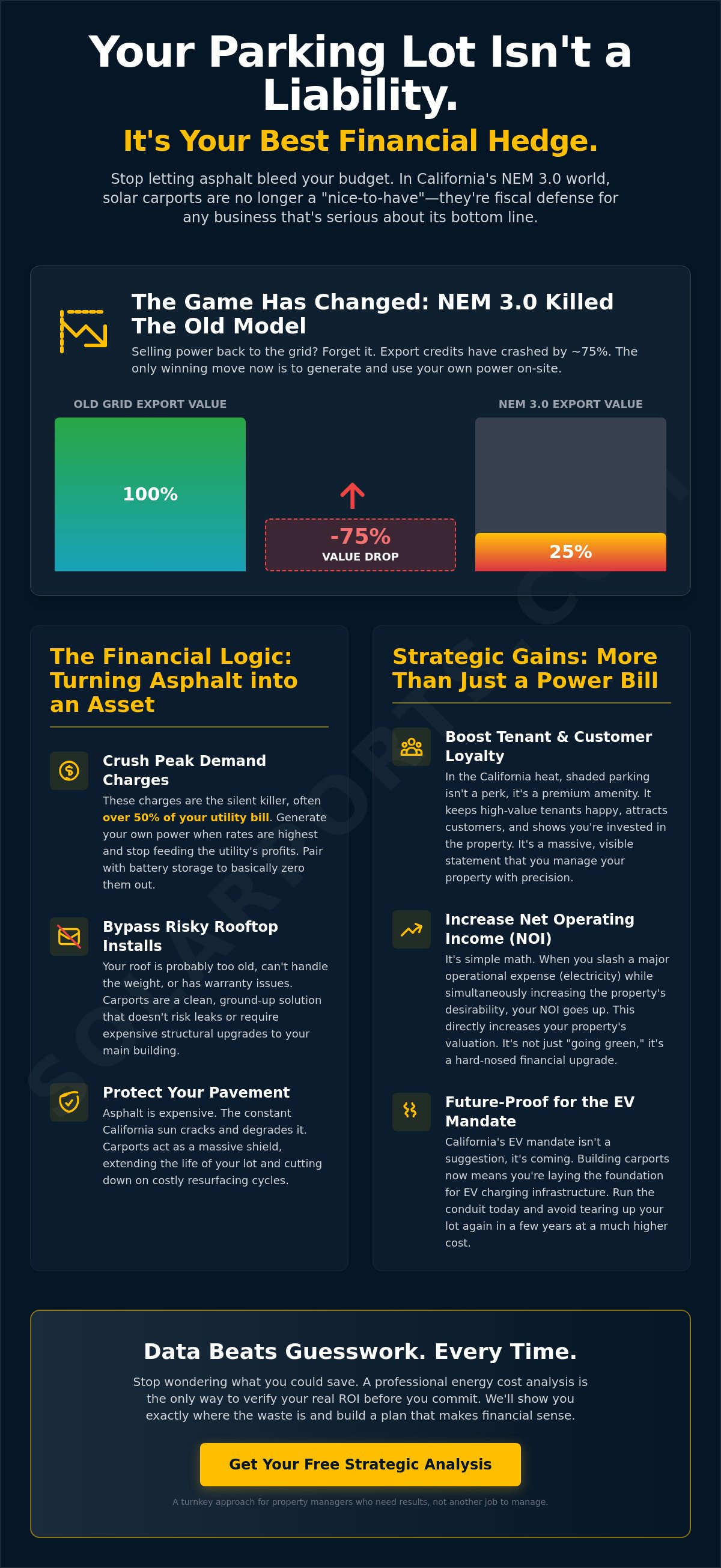
It's a matter of fiscal defense in this current NEM 3.0 reality. Export credits have plummeted by roughly 75%, so the old model of selling power back to the grid is effectively dead. We'll show you how to turn that asphalt into a strategic financial hedge that actually protects your cash flow. This guide breaks down the shift toward self-consumption, why battery storage is now a non-negotiable for peak shaving, and how to leverage 2026 tax incentives to transform a passive expense into a high-performing asset.
Key Takeaways
- Stop viewing your parking lot as a liability. You'll learn how to turn idle asphalt into a revenue engine that actively hedges against California's volatile utility rates.
- Shaded parking is a premium asset. We'll explain how these structures extend the life of your pavement and help you hold onto high-value tenants who want relief from the sun.
- NEM 3.0 changed the math for everyone. Discover the strategic benefits of solar carports for businesses and why on-site consumption is now the most effective way to protect your margins.
- Data beats intuition when it's time to invest. See why a professional energy cost saving analysis is the only way to verify your actual ROI before you commit capital to a project.
- Managing a build shouldn't be your second job. Find out why a turnkey approach is the only logical path for property managers who need results without the usual operational friction.
Table of Contents
- The Financial Logic: Turning Dead Parking Space into a Revenue Engine
- Operational and Strategic Advantages Beyond the Utility Bill
- Implementation Reality: Navigating the California Landscape
The Financial Logic: Turning Dead Parking Space into a Revenue Engine
California electricity is expensive. It's actually among the costliest in the nation. For a business owner, an empty parking lot is basically a missed opportunity. It's dead space that absorbs heat and requires maintenance without giving anything back. By installing solar canopies, you're effectively weaponizing that asphalt. You're turning a liability into a revenue engine. The primary benefits of solar carports for businesses stem from this ability to generate power on-site, right where it's needed, without touching the building's main structure.
Bypassing Rooftop Constraints
Most commercial roofs weren't built with solar in mind. They often fail structural audits because they can't handle the weight, or the warranty is so old that drilling holes for panels is a legal nightmare. Carports solve this. They don't risk leaks. They don't mess with your building's integrity. Carports are the strategic alternative that often delivers a cleaner ROI because you aren't paying to fix a roof before you even start the solar install. Industry leaders such as Eastern Electric demonstrate how specializing in the design and installation of high-performance solar PV and battery storage can significantly improve long-term energy independence.
Mitigating California’s Peak-Demand Charges
Demand charges are the silent killer on a Northern California utility bill. They often make up over 50% of the total cost. Generating your own power during those brutal afternoon peak hours is the most direct way to cut these expenses. To get the math right, you need a commercial energy cost saving analysis to see exactly where the waste is. When you pair a carport with battery energy storage for commercial buildings, you can flatten your load profile and stop paying the utility's highest rates. It's about taking control of your operational overhead before the next rate hike hits.
Operational and Strategic Advantages Beyond the Utility Bill
The conversation usually starts with kilowatt-hours, but the benefits of solar carports for businesses extend into areas that a utility meter simply doesn't track. Think about the Billboard Effect. Rooftop solar is effective, but it's invisible to everyone except a passing pilot. A carport is a massive, structural statement of intent. It tells every tenant, client, and employee that you're managing your overhead with precision.
This visibility directly impacts tenant retention. In the California sun, shaded parking is a premium amenity. If you're a property manager, providing a cool car for an executive or a retail shopper isn't just a courtesy; it's a strategic move to keep lease rates high and vacancy low. When you lower operational expenses and simultaneously increase the desirability of the space, your Net Operating Income (NOI) improves. This isn't just green marketing. It is a fundamental increase in property valuation.
Future-Proofing for the EV Mandate
California is aggressive about electric vehicles. The mandate for zero-emission vehicles isn't a suggestion, it's a regulatory reality that's coming fast. Installing Solar Shaded Canopies and Carports today means you're building the foundation for EV charging infrastructure before the demand peaks. By running the conduit and setting the structural footings now, you avoid the massive cost of tearing up your lot again in three years.
Asset Protection and Maintenance Savings
Asphalt is expensive. UV radiation and heat cycles crack it. By shielding the lot, you're slowing down that degradation and extending the life of your pavement. It's basic math: less sun exposure equals fewer resurfacing cycles. There's also the security aspect. Integrated LED lighting under the structure makes the lot safer at night, reducing liability risks. Understanding these secondary benefits of solar carports for businesses is what separates a simple vendor from a strategic partner. If you're curious about how these factors apply to your specific site, you can book a strategic consultation to see the numbers.
Implementation Reality: Navigating the California Landscape
The logistics of a California build are usually where good intentions go to die. It's one thing to want a lower utility bill; it's another to handle the seismic engineering, the local fire marshal's requirements, and the utility interconnection line. Before you even think about structural steel, you need a commercial energy cost saving analysis. This isn't just a formality. In the NEM 3.0 era, your ROI depends entirely on how well the system matches your actual load profile. If the system is oversized and you're exporting power for pennies, the math fails.
Managing the actual build is the next hurdle. An active parking lot is the lifeblood of a commercial property, and shutting it down for weeks isn't an option. Professional commercial solar project management is what keeps the disruption to a minimum. It's about phased construction and clear communication so your tenants don't lose their minds while you're improving the asset. The benefits of solar carports for businesses are only realized if the implementation doesn't bankrupt your operational efficiency during the process.
The Turnkey Advantage in Northern California
Northern California permitting is notoriously fragmented. One city wants specific lighting under the canopy; another has strict height restrictions. Dealing with this yourself is a recipe for a six-month delay. A turnkey partner handles the design, the electrical engineering, and the utility paperwork under one roof. For property managers who don't have time to be a full-time solar consultant, SolarPorts services provides that single point of accountability that keeps the project moving through the bureaucracy.
Financing and ROI Realities
There's a common myth that carports are too expensive compared to rooftop systems. While the upfront steel costs are higher, the 2026 tax landscape makes the gap much smaller than people think. You're looking at a 30% Federal Investment Tax Credit (ITC) and the ability to utilize 80% bonus depreciation through MACRS in the first year. For most California commercial properties, we're seeing payback periods that make sense when you factor in the avoided cost of high-tier utility rates. Real ROI is a calculated combination of direct energy savings, aggressive tax credits, and the tangible increase in property value.
Stop Paying for Asphalt and Start Owning Your Energy
A parking lot shouldn't just be a maintenance expense. In California's current energy market, leaving that space uncovered is a missed opportunity to hedge against the next inevitable rate hike. We've covered the structural logic and the operational wins, but the real value is in the long-term stability of your overhead. When you account for the 2026 tax landscape and the protection of your pavement, the benefits of solar carports for businesses become impossible to ignore. It's a strategic move that turns underutilized real estate into a high-performing financial asset.
Getting these projects done in California requires more than just panels. You need a partner that understands the granular details of BESS integration and the nightmare of local utility interconnection. We provide turnkey solutions that focus on mitigating those brutal peak-demand charges while you focus on running your business. It's about precision, not persuasion. If you're ready to see exactly how the math works for your specific lot, it's time to get a professional evaluation.
Request a Strategic Energy Cost Saving Analysis for Your Property. Let's look at your actual load profile and build a plan that finally puts your asphalt to work.
Frequently Asked Questions
How much do solar carports actually cost for a commercial property in California?
Total project costs are highly variable and depend on site specific engineering requirements like seismic structural needs and whether you choose a cantilever or T-frame design. Beyond the steel and panels, "soft costs" for permitting, utility interconnection studies, and professional engineering stamps make up a significant portion of the budget. It is more accurate to evaluate the net investment after applying the 30% federal ITC and MACRS depreciation rather than looking at a raw sticker price.
Can a solar carport power my entire commercial building?
It depends entirely on your energy density and the square footage of your parking lot. A typical office building might offset a large percentage of its load, but a heavy industrial facility with high manufacturing demands might only cover a portion. The strategic goal in the current NEM 3.0 environment is to maximize the benefits of solar carports for businesses by matching production with your highest on-site consumption periods to avoid buying expensive peak power.
What happens to the solar carport during a California power outage?
Standard systems are designed to shut down during a grid failure to prevent "islanding" and protect utility workers. However, if your carport is integrated with a Battery Energy Storage System (BESS), it can be configured to provide backup power to critical loads. This allows your facility to remain operational during local outages or Public Safety Power Shutoff (PSPS) events which are common across Northern California.
Do solar carports require a lot of maintenance compared to rooftop solar?
Maintenance is generally more straightforward because the components are accessible from the ground without the risks of roof work or potential leaks. You'll need periodic panel cleaning to maintain efficiency and standard inverter inspections to ensure performance. One often overlooked benefit is that the structure itself reduces long term asphalt maintenance costs by shielding your parking lot from the UV degradation that causes cracking and fading.
How long does the installation of a commercial solar carport typically take?
The physical construction on-site often moves quickly, but the pre-construction phase is the real bottleneck in the California landscape. You should expect several months for the engineering, seismic reviews, and utility interconnection approval process before any steel is actually erected. Using a turnkey partner helps keep these administrative phases moving so that the actual parking lot disruption is limited to a few weeks of active construction.
Frequently asked questions
Bypassing Rooftop Constraints
Most commercial roofs weren't built with solar in mind. They often fail structural audits because they can't handle the weight, or the warranty is so old that drilling holes for panels is a legal nightmare. Carports solve this. They don't risk leaks. They don't mess with your building's integrity. Carports are the strategic alternative that often delivers a cleaner ROI because you aren't paying to fix a roof before you even start the solar install.
Mitigating California’s Peak-Demand Charges
Demand charges are the silent killer on a Northern California utility bill. They often make up over 50% of the total cost. Generating your own power during those brutal afternoon peak hours is the most direct way to cut these expenses. To get the math right, you need a commercial energy cost saving analysis to see exactly where the waste is. When you pair a carport with battery energy storage for commercial buildings, you can flatten your load profile and stop paying the utility's highest rates. It's about taking control of your operational overhead before the next rate hike hits. The conversation usually starts with kilowatt-hours, but the benefits of solar carports for businesses extend into areas that a utility meter simply doesn't track. Think about the Billboard Effect. Rooftop solar is effective, but it's invisible to everyone except a passing pilot. A carport is a massive, structural statement of intent. It tells every tenant, client, and employee that you're managing your overhead with precision. This visibility directly impacts tenant retention. In the California sun, shaded parking is a premium amenity. If you're a property manager, providing a cool car for an executive or a retail shopper isn't just a courtesy; it's a strategic move to keep lease rates high and vacancy low. When you lower operational expenses and simultaneously increase the desirability of the space, your Net Operating Income (NOI) improves. This isn't just green marketing. It is a fundamental increase in property valuation.
Future-Proofing for the EV Mandate
California is aggressive about electric vehicles. The mandate for zero-emission vehicles isn't a suggestion, it's a regulatory reality that's coming fast. Installing Solar Shaded Canopies and Carports today means you're building the foundation for EV charging infrastructure before the demand peaks. By running the conduit and setting the structural footings now, you avoid the massive cost of tearing up your lot again in three years.
Asset Protection and Maintenance Savings
Asphalt is expensive. UV radiation and heat cycles crack it. By shielding the lot, you're slowing down that degradation and extending the life of your pavement. It's basic math: less sun exposure equals fewer resurfacing cycles. There's also the security aspect. Integrated LED lighting under the structure makes the lot safer at night, reducing liability risks. Understanding these secondary benefits of solar carports for businesses is what separates a simple vendor from a strategic partner. If you're curious about how these factors apply to your specific site, you can book a strategic consultation to see the numbers. The logistics of a California build are usually where good intentions go to die. It's one thing to want a lower utility bill; it's another to handle the seismic engineering, the local fire marshal's requirements, and the utility interconnection line. Before you even think about structural steel, you need a commercial energy cost saving analysis. This isn't just a formality. In the NEM 3.0 era, your ROI depends entirely on how well the system matches your actual load profile. If the system is oversized and you're exporting power for pennies, the math fails. Managing the actual build is the next hurdle. An active parking lot is the lifeblood of a commercial property, and shutting it down for weeks isn't an option. Professional commercial solar project management is what keeps the disruption to a minimum. It's about phased construction and clear communication so your tenants don't lose their minds while you're improving the asset. The benefits of solar carports for businesses are only realized if the implementation doesn't bankrupt your operational efficiency during the process.
The Turnkey Advantage in Northern California
Northern California permitting is notoriously fragmented. One city wants specific lighting under the canopy; another has strict height restrictions. Dealing with this yourself is a recipe for a six-month delay. A turnkey partner handles the design, the electrical engineering, and the utility paperwork under one roof. For property managers who don't have time to be a full-time solar consultant, SolarPorts services provides that single point of accountability that keeps the project moving through the bureaucracy.
Financing and ROI Realities
There's a common myth that carports are too expensive compared to rooftop systems. While the upfront steel costs are higher, the 2026 tax landscape makes the gap much smaller than people think. You're looking at a 30% Federal Investment Tax Credit (ITC) and the ability to utilize 80% bonus depreciation through MACRS in the first year. For most California commercial properties, we're seeing payback periods that make sense when you factor in the avoided cost of high-tier utility rates. Real ROI is a calculated combination of direct energy savings, aggressive tax credits, and the tangible increase in property value. A parking lot shouldn't just be a maintenance expense. In California's current energy market, leaving that space uncovered is a missed opportunity to hedge against the next inevitable rate hike. We've covered the structural logic and the operational wins, but the real value is in the long-term stability of your overhead. When you account for the 2026 tax landscape and the protection of your pavement, the benefits of solar carports for businesses become impossible to ignore. It's a strategic move that turns underutilized real estate into a high-performing financial asset. Getting these projects done in California requires more than just panels. You need a partner that understands the granular details of BESS integration and the nightmare of local utility interconnection. We provide turnkey solutions that focus on mitigating those brutal peak-demand charges while you focus on running your business. It's about precision, not persuasion. If you're ready to see exactly how the math works for your specific lot, it's time to get a professional evaluation. Request a Strategic Energy Cost Saving Analysis for Your Property. Let's look at your actual load profile and build a plan that finally puts your asphalt to work.
How much do solar carports actually cost for a commercial property in California?
Total project costs are highly variable and depend on site specific engineering requirements like seismic structural needs and whether you choose a cantilever or T-frame design. Beyond the steel and panels, "soft costs" for permitting, utility interconnection studies, and professional engineering stamps make up a significant portion of the budget. It is more accurate to evaluate the net investment after applying the 30% federal ITC and MACRS depreciation rather than looking at a raw sticker price.
Can a solar carport power my entire commercial building?
It depends entirely on your energy density and the square footage of your parking lot. A typical office building might offset a large percentage of its load, but a heavy industrial facility with high manufacturing demands might only cover a portion. The strategic goal in the current NEM 3.0 environment is to maximize the benefits of solar carports for businesses by matching production with your highest on-site consumption periods to avoid buying expensive peak power.
What happens to the solar carport during a California power outage?
Standard systems are designed to shut down during a grid failure to prevent "islanding" and protect utility workers. However, if your carport is integrated with a Battery Energy Storage System (BESS), it can be configured to provide backup power to critical loads. This allows your facility to remain operational during local outages or Public Safety Power Shutoff (PSPS) events which are common across Northern California.
Do solar carports require a lot of maintenance compared to rooftop solar?
Maintenance is generally more straightforward because the components are accessible from the ground without the risks of roof work or potential leaks. You'll need periodic panel cleaning to maintain efficiency and standard inverter inspections to ensure performance. One often overlooked benefit is that the structure itself reduces long term asphalt maintenance costs by shielding your parking lot from the UV degradation that causes cracking and fading.
How long does the installation of a commercial solar carport typically take?
The physical construction on-site often moves quickly, but the pre-construction phase is the real bottleneck in the California landscape. You should expect several months for the engineering, seismic reviews, and utility interconnection approval process before any steel is actually erected. Using a turnkey partner helps keep these administrative phases moving so that the actual parking lot disruption is limited to a few weeks of active construction.