
Battery Energy Storage for Commercial Buildings: A Strategic Financial Asset

Your commercial property is currently a passive energy consumer, and that's exactly how the utility companies want it. Every afternoon, your building is likely leaking capital through demand charges that feel more like a penalty than a service. In Northern California, the grid isn't just unstable; it's expensive by design. You've looked at your bill and felt that hit of frustration when a single fifteen-minute spike in usage dictates your entire month's overhead. We agree that the current model is broken. Integrating battery energy storage for commercial buildings isn't about being "green" for a PR slide; it's about seizing control of those peak-demand windows before they eat your margin.
This article shows how BESS turns your property into a strategic financial asset. You'll see exactly how to mitigate those exorbitant California demand charges while building real energy independence. We're stripping away the technical jargon to give you a clear financial justification for this investment. We'll cover the impact of Title 24 requirements, the 30% Federal ITC for 2026, and how the shift to NEM 3.0 makes onsite storage a necessity for any building owner who actually cares about their bottom line.
Key Takeaways
- Stop thinking of batteries as emergency generators; they're actually tools for financial arbitrage that exploit the utility's own rate games.
- We'll show you how battery energy storage for commercial buildings uses peak shaving to flatten those expensive demand spikes automatically.
- It's about more than just hardware, since the real value comes from syncing storage with solar carports and shifting your heaviest loads to cheaper hours.
- Don't buy a single battery until you've done a proper energy analysis, or you'll likely end up with an expensive, oversized asset that never pays for itself.
Table of Contents
- Beyond Backup: Why California Commercial Buildings Need Battery Storage Now
- Practical BESS Applications: From Peak Shaving to Solar Carport Integration
- Strategic Implementation: Moving from Energy Analysis to a Turnkey BESS Solution
Beyond Backup: Why California Commercial Buildings Need Battery Storage Now
Most people think a battery is just a giant backup generator for when the lights go out. That's a mistake. In the current California market, a battery energy storage system is actually a financial arbitrage tool. It sits between your building and the grid, acting as a buffer against the most aggressive utility rates in the country. Northern California businesses aren't just paying for energy. They're paying for the privilege of accessing the grid during the exact same window as everyone else.
The reality of 2026 is that the grid is more volatile than ever. New Title 24 standards already require solar and storage for most nonresidential buildings because the state knows the grid can't handle the load. With the transition to NEM 3.0, exporting solar energy is a losing game. You're basically giving it away. By using battery energy storage for commercial buildings, you store that power and use it when the utility wants to charge you four times the base rate. It's a calculated move to protect your margin.
The Invisible Cost: Crushing Demand Charges in Northern California
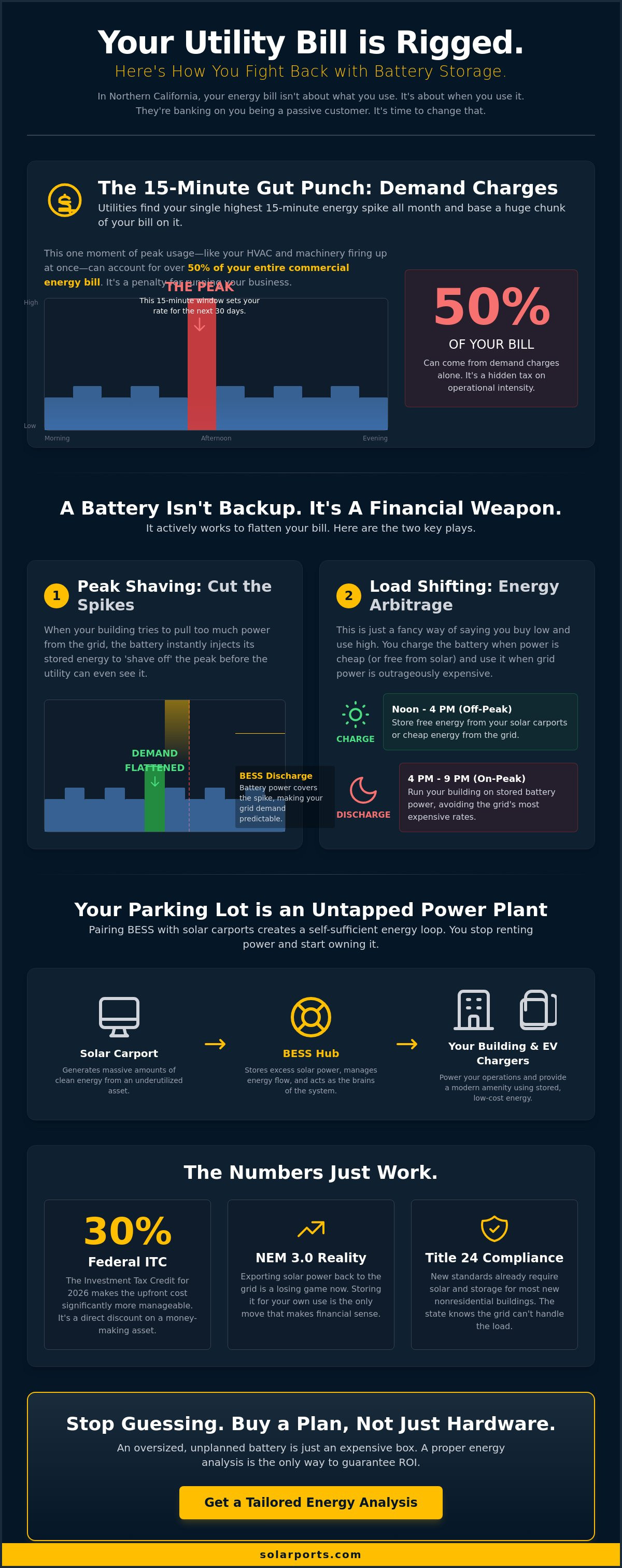
Your utility company looks for the single highest 15 minute window of usage in your entire billing cycle. They then charge you based on that peak, even if you only hit it once. Demand charges are a hidden tax on commercial operational intensity. In many cases, these charges account for 50% of a commercial bill. Local grid constraints in Northern California make these penalties even more aggressive for buildings that haven't optimized their load. If your HVAC kicks on at the same time your machinery starts up, you're paying for that coincidence for the next thirty days. A battery stops this by injecting power the moment it senses a spike, keeping your "official" demand flat and your bill predictable.
Practical BESS Applications: From Peak Shaving to Solar Carport Integration
It's one thing to understand the theory of demand charges, but it's another to watch your meter spin during a heatwave. Peak shaving is the most immediate fix. Your battery waits for the moment your building tries to pull too much from the grid and steps in to carry the load. It's an automated defense mechanism. While some regions look to NYSERDA incentives for energy storage as a model, California businesses are already using this to survive the 4 p.m. to 9 p.m. rate spikes. Integrating battery energy storage for commercial buildings into your existing infrastructure isn't as disruptive as it sounds. It just makes the building smarter.
Load shifting is where the real arbitrage happens. You fill the battery when the sun is blasting at noon or when off-peak rates are at their lowest. You then dump that power into your operations when the utility gets greedy. If the grid goes down, you don't have to deal with the noise, smell, or fuel logistics of a diesel backup. Battery energy storage for commercial buildings provides a silent, instant bridge that keeps critical systems live without a hiccup. It's clean, it's quiet, and it actually pays for itself over time, unlike a traditional generator that just sits there and depreciates.
Synergistic Energy: Pairing BESS with Solar Carports for Maximum ROI
The parking lot is often the most underutilized asset on a commercial property. When you install commercial solar carports with EV charging California, you're creating a massive amount of energy right where people park. But solar is temperamental. Cloud cover or a late-day surge in EV charging can mess with your ROI if you're pulling from the grid to cover the gap. Adding BESS creates a closed-loop system. The carport generates the juice, and the battery stores it until it's worth the most. These units aren't the room-sized monsters they used to be. Modern BESS hardware is compact enough to tuck behind a transformer or into a corner of the lot. You've probably walked past these systems without realizing it. They aren't flashy; they just sit there doing the math that saves you money. If you're wondering how this fits your specific layout, getting a tailored energy analysis is the next logical step.
Strategic Implementation: Moving from Energy Analysis to a Turnkey BESS Solution
Buying hardware without a plan is a fast way to waste money. You shouldn't just guess at the capacity you need based on a salesperson's pitch. Right-sizing is the difference between a high-ROI project and a stranded asset that never pays for itself. Before you even look at a spec sheet, a commercial energy cost saving analysis has to happen. This isn't just about looking at a single bill; it's about mapping your specific load profile across an entire year to see exactly where those 15-minute peaks are killing your budget.
Once the data is clear, the implementation needs to be turnkey. You have a business to run. You don't have time to haggle with utility interconnection or figure out local fire safety codes like SB 283. A real partner handles the permitting and the software optimization that actually tells the battery when to discharge. If the software isn't tuned to your specific usage patterns, you're just sitting on a very expensive paperweight. Data-driven recommendations ensure that your battery energy storage for commercial buildings is lean, efficient, and actually does the job it was bought for.
Navigating Financing: Direct Ownership vs. Power Purchase Agreements in 2026
Financing comes down to your tax appetite and how long you plan to hold the property. Direct ownership usually offers the best long-term savings because you get to keep the 2026 commercial solar tax credit California, which is currently sitting at 30% for qualifying systems. It's a heavy lift upfront, but the asset is yours. If you'd rather keep your capital for operations, a Power Purchase Agreement (PPA) is the zero-down alternative. You just pay for the energy the battery provides. Either way, you're looking at a 15 to 20 year horizon. These aren't short-term fixes; they're structural improvements to your property's financial health.
Securing Your Property's Financial Resilience
The utility company isn't going to lower your rates out of the goodness of their heart. You've seen how demand charges and grid volatility in Northern California are designed to keep your overhead high. Investing in battery energy storage for commercial buildings is about drawing a line in the sand. It's the shift from being a victim of the grid to becoming a strategic operator of your own power. We've discussed how peak shaving stops the bleeding and how solar carports turn your parking lot into a revenue-protecting asset. But it all starts with the numbers.
Our team provides turnkey California-based engineering that doesn't rely on guesswork. We are specialists in Northern California utility rate structures and deliver data-backed ROI projections that show exactly how the hardware pays for itself. You don't need a generic estimate. You need a plan built for your specific load profile. Request Your Strategic Energy Cost Saving Analysis and stop treating energy as a fixed cost. You can actually win this game if you have the right data.
Answers to Common Implementation Questions
How much space does a commercial battery storage system require?
A standard commercial system usually requires between 30 and 60 square feet of dedicated space, depending on the energy capacity you're targeting. Most modern units are modular and designed for outdoor installation on a concrete pad, which preserves your valuable indoor square footage. We often tuck these systems near existing electrical transformers or in the corner of a parking lot. It's much less intrusive than the massive, room-sized equipment people often expect.
Can BESS help my building qualify for LEED or other sustainability certifications?
Battery energy storage for commercial buildings directly supports LEED certification by earning points in the Energy and Atmosphere category. It specifically helps with Grid Harmony and Demand Response credits because you're actively reducing the strain on the California grid during peak hours. Beyond just points, it proves your building is an active participant in the state's decarbonization goals. This makes your property more attractive to high-value tenants who have their own corporate sustainability mandates to hit.
What is the typical lifespan of a commercial BESS unit in 2026?
You should expect a 10 to 15 year operational lifespan for most Lithium Iron Phosphate systems installed today. Performance usually stays above 70% of the original capacity throughout that first decade. By 2026, the technology has stabilized enough that most tier-one manufacturers provide a 10-year performance guarantee as a baseline. It's a long-term asset that requires minimal maintenance beyond annual inspections of the cooling systems and routine software updates.
How does battery storage interact with the existing electrical switchgear in my building?
The battery system connects to your building's electrical heart through a dedicated circuit breaker in your existing main switchgear. An integrated inverter handles the heavy lifting of converting stored DC power into the AC power your building actually uses. It's a "behind-the-meter" setup, meaning the system talks to your building first and the grid second. This integration is handled during the engineering phase to ensure your current gear can handle the bidirectional flow without needing a total replacement.
Frequently asked questions
How much space does a commercial battery storage system require?
A standard commercial system usually requires between 30 and 60 square feet of dedicated space, depending on the energy capacity you're targeting. Most modern units are modular and designed for outdoor installation on a concrete pad, which preserves your valuable indoor square footage. We often tuck these systems near existing electrical transformers or in the corner of a parking lot. It's much less intrusive than the massive, room-sized equipment people often expect.
Can BESS help my building qualify for LEED or other sustainability certifications?
Battery energy storage for commercial buildings directly supports LEED certification by earning points in the Energy and Atmosphere category. It specifically helps with Grid Harmony and Demand Response credits because you're actively reducing the strain on the California grid during peak hours. Beyond just points, it proves your building is an active participant in the state's decarbonization goals. This makes your property more attractive to high-value tenants who have their own corporate sustainability mandates to hit.
What is the typical lifespan of a commercial BESS unit in 2026?
You should expect a 10 to 15 year operational lifespan for most Lithium Iron Phosphate systems installed today. Performance usually stays above 70% of the original capacity throughout that first decade. By 2026, the technology has stabilized enough that most tier-one manufacturers provide a 10-year performance guarantee as a baseline. It's a long-term asset that requires minimal maintenance beyond annual inspections of the cooling systems and routine software updates.
How does battery storage interact with the existing electrical switchgear in my building?
The battery system connects to your building's electrical heart through a dedicated circuit breaker in your existing main switchgear. An integrated inverter handles the heavy lifting of converting stored DC power into the AC power your building actually uses. It's a "behind-the-meter" setup, meaning the system talks to your building first and the grid second. This integration is handled during the engineering phase to ensure your current gear can handle the bidirectional flow without needing a total replacement.