
Turnkey Commercial Solar in CA: A No-Nonsense Guide to 2026 Energy Independence

In California, the utility grid is no longer a neutral service provider. It's a structural liability for your bottom line. With average commercial rates hitting 19.42¢/kWh and some areas seeing spikes near 28¢, the cost of doing nothing is quantifiable and climbing. You've likely seen the chaos of NEM 3.0 and the way it slashed export credits by 75%. It left many executives wondering if the numbers still work. They do. But they only work if you stop treating energy as a series of disconnected equipment purchases. That's where turnkey commercial solar CA enters the conversation as a strategic financial move rather than a construction headache.
It's frustrating to watch a project stall because of a permitting cycle that feels designed to fail. You shouldn't have to manage three different contractors just to get a predictable power bill. This guide strips away the jargon to show you how a single-source partner handles the technical and regulatory heavy lifting. We'll look at the critical July 4, 2026, federal tax credit deadline, the necessity of battery storage for real ROI, and the exact steps to secure energy independence before the state's property tax exclusions expire at the end of the year.
Key Takeaways
- Stop juggling multiple vendors and learn why turnkey commercial solar CA is the only way to ensure your system engineering actually accounts for local peak-demand charges.
- Navigate the hardware debate by understanding how to choose between rooftop solar and solar carport systems based on your property’s specific footprint and energy density.
- Beat the NEM 3.0 "trap" by discovering how integrating a Battery Energy Storage System (BESS) protects your ROI from the state's aggressive export credit cuts.
- Offload the regulatory burden and see how a single-source partner swallows the complexity of California’s permitting and interconnect agreements so your project doesn't stall.
Table of Contents
- Why Turnkey is the Only Logical Play for CA Commercial Solar
- Mapping Your Solution: Carports, Rooftops, and BESS
- The Unfiltered Path from Analysis to Commissioning
Why Turnkey is the Only Logical Play for CA Commercial Solar
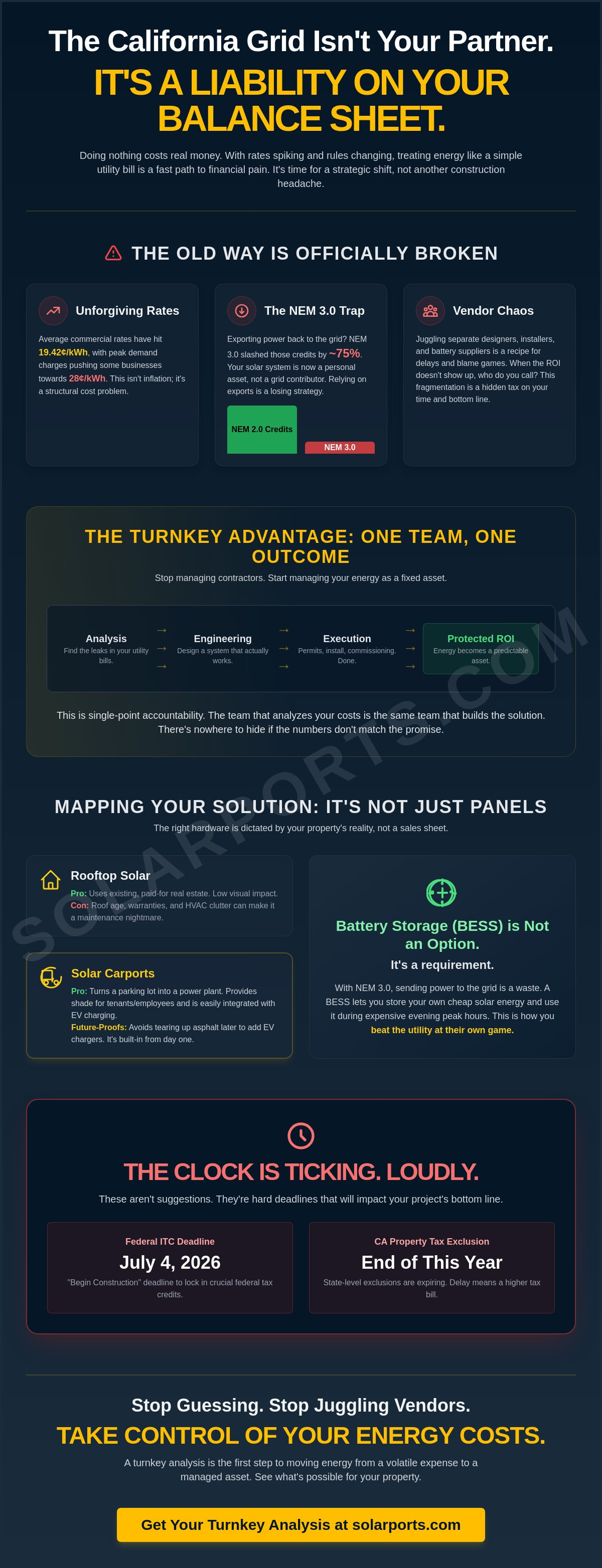
California’s energy market in 2026 is a hostile environment for the unprepared. If you're still looking at solar as a simple equipment purchase, you're missing the point. The shift to the Solar Billing Plan (NEM 3.0) means export credits are roughly 75% lower than they were under previous rules. This isn't just about panels anymore; it's about sophisticated load management. Choosing turnkey commercial solar CA means you aren't just buying hardware. You're hiring a team to integrate analysis, engineering, and execution under one roof. It's the difference between a project that looks good on paper and one that actually protects your cash flow from utility hikes.
The 2026 reality is unforgiving. If you try to coordinate a multi-vendor solution now, you're inheriting a massive liability. Between the July 4th ITC "begin construction" deadline and the expiration of property tax exclusions at the end of the year, there is no room for the delays that inevitably happen with fragmented teams. Investing in turnkey commercial solar CA isn't about following a trend; it's about structural fiscal optimization. It moves energy from a volatile expense to a managed asset.
The Problem with Fragmented Energy Projects
When you hire three different vendors for your rooftop, carports, and batteries, things break. Designers often don't talk to installers. This leads to overbuilt systems that cost too much or underperforming assets that fail to mitigate your peak-demand charges. While utility-scale solar power focuses on massive grid contributions, your business needs a surgical focus on internal efficiency. Managing multiple contracts creates a hidden management tax on your time that most firms conveniently forget to mention.
The "Single Point of Accountability" Advantage
One firm, one phone call. That's the logic. When a single partner performs the commercial energy cost saving analysis and then builds the system, they can't hide behind excuses if the ROI doesn't materialize. They own the data and the outcome. This singular point of view ensures that the technical specs match the financial goals set in the boardroom. It's about moving away from a construction mindset to a strategy where energy is a controlled variable, not a wild card.
Mapping Your Solution: Carports, Rooftops, and BESS
Most commercial solar conversations get bogged down in technical specs before anyone even looks at the property. That’s a mistake. A proper turnkey commercial solar CA strategy begins with the physical constraints of your real estate. You aren't just buying panels; you're optimizing space. If your roof is nearing the end of its life or is cluttered with HVAC units, forcing a rooftop system is a recipe for maintenance nightmares. Right-sizing is the goal. Overbuilding just to hit a number kills your ROI in those critical first five years.
Step-by-Step: Evaluating Your Property Potential
- Analyze the data: Look at the last 12 months of utility bills. We’re looking for "leaks", specifically those times of day when demand charges spike your costs.
- Site Comparison: Weigh the benefits of rooftop solar against solar carport systems for commercial properties. Carports often win on ease of installation and visibility, while rooftops use existing footprints.
- Model the BESS: Use your load profile to simulate how a Battery Energy Storage System can shave off evening peak rates.
The BESS factor is no longer a luxury add-on. Since the California Solar Initiative paved the way for massive adoption, the grid has changed. Now, with NEM 3.0, exporting power back to the utility is a losing game. You need to keep that energy behind the meter. This is where a turnkey commercial solar CA partner proves their worth by ensuring the storage capacity matches your actual discharge needs during peak TOU windows.
The Dual-Purpose Benefit of Solar Carports
Carports are the workhorses of the commercial sector. They provide vehicle shade for tenants or employees while turning an underutilized parking lot into a power plant. This is also where you future-proof. By integrating EV charging into the initial turnkey plan, you avoid the cost of ripping up asphalt later. You can dig deeper into the specifics by reading our comparison of commercial solar carports with EV charging in California. If you aren't sure which hardware fits your site, it’s worth scheduling a brief technical review to map out the potential.
The Unfiltered Path from Analysis to Commissioning
The transition from a financial model to a physical asset is where most projects lose their momentum. In California, the "build" is often the easiest part. The real friction exists in the invisible layers: local permitting, structural clearances, and the utility’s own internal bureaucracy. A turnkey commercial solar CA partner doesn't just hire contractors; they eat this complexity on your behalf. They navigate the specific building codes of Northern California municipalities and handle the technical back-and-forth required for interconnect agreements without dragging you into the weeds.
Permitting and Utility Coordination in California
Interconnection is where projects go to die if you don't have a proactive strategy. Utilities like PG&E or SCE have zero incentive to fast-track your independence. You need a partner who anticipates utility delays before they stall the commercial solar installation timeline. While programs like the California Solar Initiative historically shaped the market, today's landscape requires a "thinking fix" for modern grid constraints. You can find more on the unfiltered reality of commercial solar project management in CA to see how these hurdles are cleared in the real world.
Realizing the ROI and Long-Term Savings
The final hand-off isn't just about flipping a switch. It’s about verification. You should be able to look at your first post-solar utility bill and see exactly where the demand charges were blunted and how the BESS system discharged during peak TOU windows. This isn't a "set it and forget it" situation. Ongoing commercial solar ROI analysis is necessary to ensure the system performs as modeled during the analysis phase. When the data matches the boardroom promises, your energy spend officially moves from a volatile cost center to a predictable, sustainable asset. By the time the 2027 property tax exclusions hit, your system should be fully commissioned, operational, and already paying for itself.
Securing Your Fiscal Perimeter Before the 2026 Deadlines
The utility market in California isn't going to get easier. You've seen how NEM 3.0 changed the math, and the upcoming 2026 deadlines for the ITC and property tax exclusions mean the window for maximum fiscal impact is closing fast. Waiting for rates to stabilize is a losing strategy. Real energy independence requires a shift from being a passive ratepayer to an active asset manager. This is exactly why turnkey commercial solar CA makes sense. It stops the bleeding of demand charges by pairing specialized Northern California project management with integrated BESS and carport expertise.
You shouldn't have to guess if the numbers hold up. We focus on the small-scale commercial niche because that's where the most operational waste happens. It's time to move past the marketing fluff and look at your actual load profile. To get started, you can Get a Professional Energy Cost Saving Analysis to see exactly how these systems function on your specific property. Protecting your bottom line starts with a clear, data-driven plan. Let's get to work.
Frequently Asked Questions
What does turnkey commercial solar actually include in California?
A turnkey solution covers the entire project lifecycle from the initial commercial energy cost saving analysis to the final utility commission. In the context of turnkey commercial solar CA, this means a single firm manages the engineering, city permitting, hardware procurement, and construction. You avoid the headache of coordinating separate electrical and roofing contractors because one team owns the accountability for the system's performance.
How long does a typical turnkey solar installation take for a CA business?
Most projects require six to nine months from contract signature to operation, though physical construction usually only takes a few weeks. The timeline is primarily dictated by municipal permitting and utility interconnect agreements, which are notoriously slow in California. You need to account for these administrative lead times if you want to hit the July 4, 2026, federal "begin construction" deadline for the 30% tax credit.
Is battery storage (BESS) always necessary for commercial solar in 2026?
It isn't legally required for existing buildings, but it's financially essential under the current Solar Billing Plan (NEM 3.0). Since export credits are now 75% lower than they were under previous rules, selling power back to the utility is no longer profitable. A Battery Energy Storage System allows you to store your own generation for use during expensive evening peak hours, which is the only way to secure a meaningful ROI.
Can I install solar carports if my roof isn’t suitable for panels?
Yes, solar carport systems are the go-to alternative for properties with structural roof issues or significant HVAC obstructions. They allow you to generate power using existing parking lot space without touching the building's envelope. This approach is often preferred for turnkey commercial solar CA projects because it provides visible shade for tenants and simplifies future EV charging infrastructure without the risks associated with aging roof membranes.
What are the main tax incentives for commercial solar in California right now?
The 30% Federal Investment Tax Credit (ITC) remains the most powerful incentive for both solar and BESS installations. To qualify for the full 30%, your project must begin construction by July 4, 2026. Additionally, California provides a property tax exclusion for the value added by a solar system, but this expires for new installations unless you receive Permission to Operate (PTO) before January 1, 2027.
How much disruption should I expect at my property during installation?
Operational disruption is usually minimal because the work happens almost entirely on the exterior of your facility. Rooftop projects involve staging areas that won't block your main entrances. For carport installations, the parking lot is typically cordoned off in phases to preserve access. A professional team will coordinate the heavy trenching and electrical tie-ins during off-peak hours to ensure your daily business flow remains intact.
Frequently asked questions
The Problem with Fragmented Energy Projects
When you hire three different vendors for your rooftop, carports, and batteries, things break. Designers often don't talk to installers. This leads to overbuilt systems that cost too much or underperforming assets that fail to mitigate your peak-demand charges. While utility-scale solar power focuses on massive grid contributions, your business needs a surgical focus on internal efficiency. Managing multiple contracts creates a hidden management tax on your time that most firms conveniently forget to mention.
The "Single Point of Accountability" Advantage
One firm, one phone call. That's the logic. When a single partner performs the commercial energy cost saving analysis and then builds the system, they can't hide behind excuses if the ROI doesn't materialize. They own the data and the outcome. This singular point of view ensures that the technical specs match the financial goals set in the boardroom. It's about moving away from a construction mindset to a strategy where energy is a controlled variable, not a wild card. Most commercial solar conversations get bogged down in technical specs before anyone even looks at the property. That’s a mistake. A proper turnkey commercial solar CA strategy begins with the physical constraints of your real estate. You aren't just buying panels; you're optimizing space. If your roof is nearing the end of its life or is cluttered with HVAC units, forcing a rooftop system is a recipe for maintenance nightmares. Right-sizing is the goal. Overbuilding just to hit a number kills your ROI in those critical first five years.
Step-by-Step: Evaluating Your Property Potential
The BESS factor is no longer a luxury add-on. Since the California Solar Initiative paved the way for massive adoption, the grid has changed. Now, with NEM 3.0, exporting power back to the utility is a losing game. You need to keep that energy behind the meter. This is where a turnkey commercial solar CA partner proves their worth by ensuring the storage capacity matches your actual discharge needs during peak TOU windows.
The Dual-Purpose Benefit of Solar Carports
Carports are the workhorses of the commercial sector. They provide vehicle shade for tenants or employees while turning an underutilized parking lot into a power plant. This is also where you future-proof. By integrating EV charging into the initial turnkey plan, you avoid the cost of ripping up asphalt later. You can dig deeper into the specifics by reading our comparison of commercial solar carports with EV charging in California. If you aren't sure which hardware fits your site, it’s worth scheduling a brief technical review to map out the potential. The transition from a financial model to a physical asset is where most projects lose their momentum. In California, the "build" is often the easiest part. The real friction exists in the invisible layers: local permitting, structural clearances, and the utility’s own internal bureaucracy. A turnkey commercial solar CA partner doesn't just hire contractors; they eat this complexity on your behalf. They navigate the specific building codes of Northern California municipalities and handle the technical back-and-forth required for interconnect agreements without dragging you into the weeds.
Permitting and Utility Coordination in California
Interconnection is where projects go to die if you don't have a proactive strategy. Utilities like PG&E or SCE have zero incentive to fast-track your independence. You need a partner who anticipates utility delays before they stall the commercial solar installation timeline. While programs like the California Solar Initiative historically shaped the market, today's landscape requires a "thinking fix" for modern grid constraints. You can find more on the unfiltered reality of commercial solar project management in CA to see how these hurdles are cleared in the real world.
Realizing the ROI and Long-Term Savings
The final hand-off isn't just about flipping a switch. It’s about verification. You should be able to look at your first post-solar utility bill and see exactly where the demand charges were blunted and how the BESS system discharged during peak TOU windows. This isn't a "set it and forget it" situation. Ongoing commercial solar ROI analysis is necessary to ensure the system performs as modeled during the analysis phase. When the data matches the boardroom promises, your energy spend officially moves from a volatile cost center to a predictable, sustainable asset. By the time the 2027 property tax exclusions hit, your system should be fully commissioned, operational, and already paying for itself. The utility market in California isn't going to get easier. You've seen how NEM 3.0 changed the math, and the upcoming 2026 deadlines for the ITC and property tax exclusions mean the window for maximum fiscal impact is closing fast. Waiting for rates to stabilize is a losing strategy. Real energy independence requires a shift from being a passive ratepayer to an active asset manager. This is exactly why turnkey commercial solar CA makes sense. It stops the bleeding of demand charges by pairing specialized Northern California project management with integrated BESS and carport expertise. You shouldn't have to guess if the numbers hold up. We focus on the small-scale commercial niche because that's where the most operational waste happens. It's time to move past the marketing fluff and look at your actual load profile. To get started, you can Get a Professional Energy Cost Saving Analysis to see exactly how these systems function on your specific property. Protecting your bottom line starts with a clear, data-driven plan. Let's get to work.
What does turnkey commercial solar actually include in California?
A turnkey solution covers the entire project lifecycle from the initial commercial energy cost saving analysis to the final utility commission. In the context of turnkey commercial solar CA, this means a single firm manages the engineering, city permitting, hardware procurement, and construction. You avoid the headache of coordinating separate electrical and roofing contractors because one team owns the accountability for the system's performance.
How long does a typical turnkey solar installation take for a CA business?
Most projects require six to nine months from contract signature to operation, though physical construction usually only takes a few weeks. The timeline is primarily dictated by municipal permitting and utility interconnect agreements, which are notoriously slow in California. You need to account for these administrative lead times if you want to hit the July 4, 2026, federal "begin construction" deadline for the 30% tax credit.
Is battery storage (BESS) always necessary for commercial solar in 2026?
It isn't legally required for existing buildings, but it's financially essential under the current Solar Billing Plan (NEM 3.0). Since export credits are now 75% lower than they were under previous rules, selling power back to the utility is no longer profitable. A Battery Energy Storage System allows you to store your own generation for use during expensive evening peak hours, which is the only way to secure a meaningful ROI.
Can I install solar carports if my roof isn’t suitable for panels?
Yes, solar carport systems are the go-to alternative for properties with structural roof issues or significant HVAC obstructions. They allow you to generate power using existing parking lot space without touching the building's envelope. This approach is often preferred for turnkey commercial solar CA projects because it provides visible shade for tenants and simplifies future EV charging infrastructure without the risks associated with aging roof membranes.
What are the main tax incentives for commercial solar in California right now?
The 30% Federal Investment Tax Credit (ITC) remains the most powerful incentive for both solar and BESS installations. To qualify for the full 30%, your project must begin construction by July 4, 2026. Additionally, California provides a property tax exclusion for the value added by a solar system, but this expires for new installations unless you receive Permission to Operate (PTO) before January 1, 2027.
How much disruption should I expect at my property during installation?
Operational disruption is usually minimal because the work happens almost entirely on the exterior of your facility. Rooftop projects involve staging areas that won't block your main entrances. For carport installations, the parking lot is typically cordoned off in phases to preserve access. A professional team will coordinate the heavy trenching and electrical tie-ins during off-peak hours to ensure your daily business flow remains intact.