
Strategies to Lower Commercial Electricity Bills in California: The Unfiltered 2026 Reality

Your biggest electricity expense isn't how much power you use; it's when you use it and how fast you pull it from the grid. In California, the average commercial rate has climbed to 19.42¢/kWh, but focusing on that number alone is a trap. Most property owners are exhausted by the same tired advice to swap LED bulbs or nudge thermostats while unpredictable demand charges eat 40% of their operating budget. It is frustrating to watch rates jump 8.9% year over year while the complexity of NEM 3.0 makes traditional solar feel like a moving target.
You deserve a strategy that addresses the structural reality of 2026 rather than just hoping for better behavior from tenants. We are going to look at the specific strategies to lower commercial electricity bills California owners are using to move beyond generic tips and tackle the actual drivers of utility cost. This guide breaks down how to leverage Battery Energy Storage Systems and solar carports to bypass peak TOU windows and turn the 2025 Energy Code updates into a competitive advantage for your asset's valuation.
Key Takeaways
- Stop obsessing over the thermostat. It's the 15-minute demand spikes, not total usage, that actually dictate your monthly overhead in California.
- Discover why solar carports and BESS are the only reliable strategies to lower commercial electricity bills California property owners can use to bypass peak TOU windows.
- Get 12 months of Green Button interval data before talking to a vendor. Without it, you're just guessing at what your building actually needs.
- Avoid the "bigger is better" sales pitch. Right-sizing your system based on your specific base load is the difference between a real ROI and a wasted asset.
Table of Contents
- Stop Chasing Pennies: Why Behavior Changes Fail California Commercial Owners
- The Infrastructure Playbook: Strategic Assets for Business Electricity Cost Reduction CA
- Executing the Strategy: From Energy Audit to Operational Savings
Stop Chasing Pennies: Why Behavior Changes Fail California Commercial Owners
It’s a lie. Or at least, it’s a massive distraction. Most "business energy saving tips" focus on tiny behavior changes that barely register on a Northern California utility bill. If you are operating in PG&E territory, telling your tenants to turn the AC up two degrees isn't going to save your bottom line. Since rates are climbing nearly 9% annually, the problem is structural. You aren't fighting a usage problem; you are fighting a timing problem.
The real issue is how the grid is built in 2026. While basic energy efficiency principles like better insulation or LED retrofits help around the edges, they don't stop the financial bleeding caused by demand charges. These fees often account for 50% of your total bill. If you want effective strategies to lower commercial electricity bills California owners can actually bank on, you have to stop looking at total kilowatt-hours. You need to focus on load management and peak shaving. Saving energy is fine, but managing when you pull that energy is where the actual profit lives.
The Hidden Killer: How Demand Charges Erode Your Net Operating Income
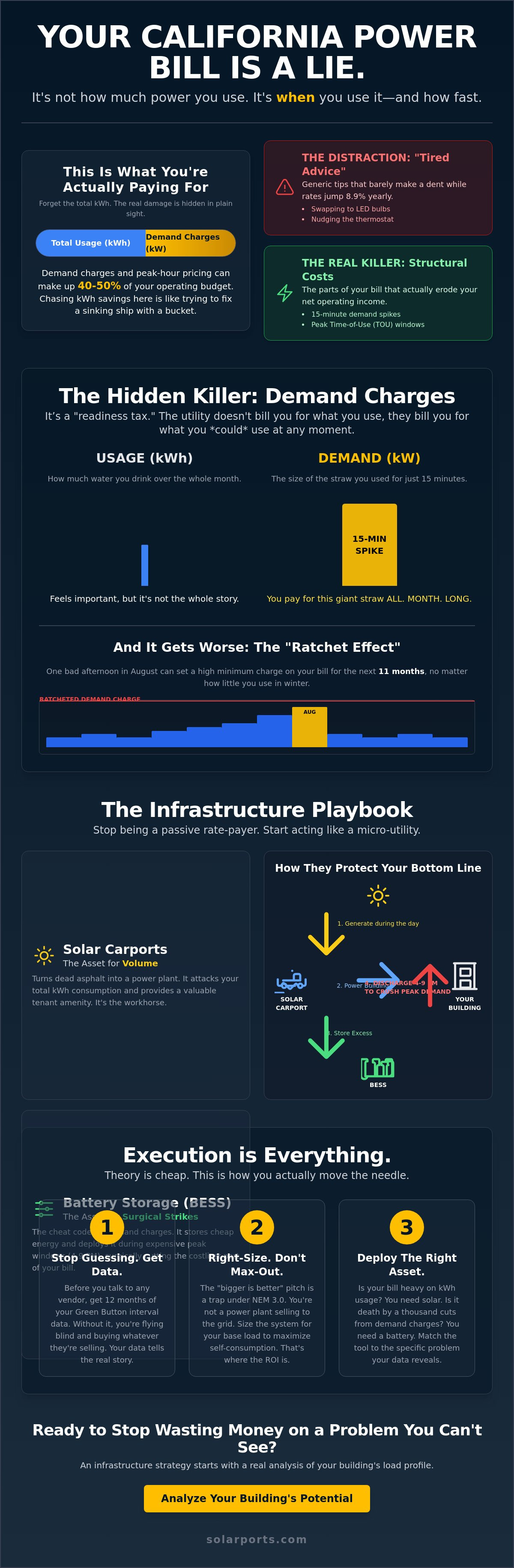
Look at it this way: a demand charge is basically a "readiness tax." The utility doesn't care about your average usage; they care about the absolute maximum amount of power you might pull at once. They have to keep that capacity ready for you, and they charge you a premium for the privilege. Usage is how much you drink, but demand is how big the straw is. If you use a massive straw for just 15 minutes, you're paying for that giant straw all month long.
Many owners in Northern California don't realize that some rate plans include a "ratchet effect." This means a single bad afternoon in August, maybe when the heat peaked and every compressor in the building kicked on at once, can haunt your bill for the next eleven months. You could spend all winter being incredibly careful with your consumption, yet you're still paying a premium based on that one summer spike. This is where the real money is lost. No amount of light-flipping will fix a structural demand spike that the utility has already locked into your billing cycle.
The Infrastructure Playbook: Strategic Assets for Business Electricity Cost Reduction CA
If you're still waiting for the CPUC to cut you a break on rates, you're going to be waiting a long time. Real strategies to lower commercial electricity bills California owners actually see results from aren't about habits. They're about infrastructure. You have to stop being a passive consumer and start acting like a micro-utility. This means moving past the "save energy" mindset and into "asset deployment."
Rooftop solar is the standard, but 2026 is the year of right-sizing. Under the current Net Billing Tariff, maxing out your roof just to sell power back to the grid at a pittance is a bad investment. You want a system sized for your base load. If you have a massive parking lot, you're sitting on a dead asset. A solar carport turns that asphalt into a power plant. It provides shade for tenants and generates power right where you need it. It’s a dual-value move that pays off in both energy savings and tenant retention.
The real "cheat code" for California’s demand charge system is a Battery Energy Storage System (BESS). While solar handles the volume of your usage, BESS handles the timing. It lets you store energy when it's cheap and discharge it during those brutal 4 p.m. to 9 p.m. peak windows. When you combine these assets, you can maximize the 2026 commercial solar tax credit California offers, significantly offsetting the initial capital expenditure. It starts with analyzing your specific load profile to see which asset hits your bill the hardest.
BESS vs. Solar: Which Asset Solves Your Specific Bill Problem?
Think of it this way: Solar is for volume, BESS is for surgical strikes against demand charges. If your bill is heavy on kWh usage, you need more panels. If your bill is dominated by 15-minute spikes, you need a battery. A Commercial solar carport with EV charging California setup is often the sweet spot. It produces the power, stores the excess, and even provides a future-proof amenity for tenants who are increasingly demanding on-site charging. It’s about building a moat around your net operating income.
Executing the Strategy: From Energy Audit to Operational Savings
Theory is cheap. Actually moving the needle on a P&L requires a transition from broad concepts to technical execution. If you want real results from strategies to lower commercial electricity bills California utilities won't hand you, it starts with a cold, hard look at your 12 month interval data. This is often called Green Button data. Without it, you're just guessing. You need to see exactly when your building breathes, when it spikes, and when it wastes money while nobody is even there.
Don't fall for the "max-size" trap. A salesperson's incentive is often tied to the size of the system they sell you, but in 2026, overbuilding is a financial liability. You need to right-size your solar or BESS to your specific base load. If you build a system that generates more than you can use or store effectively, you're essentially gifting cheap power back to the utility. That's a terrible use of capital.
Then there's the "California Bottleneck." Permitting and interconnection are where good projects go to die. Between utility bureaucracy and local code variations, the commercial solar project management CA landscape is a minefield. You need a partner who knows the specific engineers at the utility, not just someone who can read a manual. Once the system is live, set-it-and-forget-it is a myth. Degraded panels or glitchy BESS software can quietly erode your ROI if you aren't watching the dashboard.
The ROI of Data: Why an Audit is Your Most Powerful Negotiating Tool
Average monthly bills are useless for high-stakes decision making. You need time-of-use granularity to identify "ghost loads." These are the systems running at 2 a.m. when the building is empty, eating your margins for no reason. When you have this data, you stop being a customer and start being a negotiator. You can prove exactly how much you'll save, which makes the internal pitch for capital much easier. It is time to stop guessing and get a data-driven cost saving analysis for your property to see where the waste is actually hiding.
Stop Renting Your Power and Start Owning the Infrastructure
California's energy landscape in 2026 isn't getting any easier. With the average commercial rate at 19.42¢/kWh and rising, your only real defense is to stop being a passive ratepayer. You need to pivot toward infrastructure that actually addresses the demand charge problem we broke down earlier. Whether it’s deploying a BESS to shave off those peak spikes or turning your parking lot into a revenue-saving solar carport, the data has to lead the way.
Generic advice won't fix your P&L. You need a partner who understands the specific strategies to lower commercial electricity bills California property owners are using to survive these year-over-year increases. We specialize in California-exclusive solutions, from data-driven right-sizing analysis to turnkey project delivery that bypasses the usual interconnection headaches. It’s about taking the guesswork out of your operational costs and protecting your net operating income for the long haul.
Stop letting the utility dictate your margins. You can Request a Turnkey Energy Cost Saving Analysis today and see exactly where the waste is hiding in your interval data. It’s a solvable problem once you have the right assets in place.
Frequently Asked Questions
How much can a California business realistically save on electricity in 2026?
It’s not a flat number. If your load profile is peak-heavy, you can realistically knock off 30% or more of your total bill by moving off the grid during those expensive afternoon windows. But if you're just swapping lightbulbs and hoping for the best, you won't see much change. Real savings require changing how your building actually interacts with the grid.
What are demand charges, and why are they so high for California commercial properties?
Think of it as a penalty for your worst 15 minutes. The utility charges you for the maximum capacity they have to keep ready just in case you turn everything on at once. In California, these are through the roof because the utilities are passing down the massive costs of grid hardening and wildfire liabilities directly to the commercial sector. It’s basically a readiness tax that doesn't care how much total energy you actually use.
Is solar still worth it for CA businesses after the NEM 3.0 (Net Billing Tariff) changes?
Solar alone is a tough sell these days. Under NEM 3.0, the utility pays you almost nothing for the power you send back. However, if you use the right strategies to lower commercial electricity bills California property owners are adopting, like pairing rooftop solar with a BESS, the math still works. You just have to focus on using your own power instead of exporting it.
What is the typical payback period for a commercial BESS installation in California?
Usually five to seven years. It sounds like a long time, but considering that rates are only going up, the ROI actually accelerates over time. If your demand charges are currently half your bill, that battery is going to be the hardest working asset on your roof.
Frequently asked questions
The Hidden Killer: How Demand Charges Erode Your Net Operating Income
Look at it this way: a demand charge is basically a "readiness tax." The utility doesn't care about your average usage; they care about the absolute maximum amount of power you might pull at once. They have to keep that capacity ready for you, and they charge you a premium for the privilege. Usage is how much you drink, but demand is how big the straw is. If you use a massive straw for just 15 minutes, you're paying for that giant straw all month long. Many owners in Northern California don't realize that some rate plans include a "ratchet effect." This means a single bad afternoon in August, maybe when the heat peaked and every compressor in the building kicked on at once, can haunt your bill for the next eleven months. You could spend all winter being incredibly careful with your consumption, yet you're still paying a premium based on that one summer spike. This is where the real money is lost. No amount of light-flipping will fix a structural demand spike that the utility has already locked into your billing cycle. If you're still waiting for the CPUC to cut you a break on rates, you're going to be waiting a long time. Real strategies to lower commercial electricity bills California owners actually see results from aren't about habits. They're about infrastructure. You have to stop being a passive consumer and start acting like a micro-utility. This means moving past the "save energy" mindset and into "asset deployment." Rooftop solar is the standard, but 2026 is the year of right-sizing. Under the current Net Billing Tariff, maxing out your roof just to sell power back to the grid at a pittance is a bad investment. You want a system sized for your base load. If you have a massive parking lot, you're sitting on a dead asset. A solar carport turns that asphalt into a power plant. It provides shade for tenants and generates power right where you need it. It’s a dual-value move that pays off in both energy savings and tenant retention. The real "cheat code" for California’s demand charge system is a Battery Energy Storage System (BESS). While solar handles the volume of your usage, BESS handles the timing. It lets you store energy when it's cheap and discharge it during those brutal 4 p.m. to 9 p.m. peak windows. When you combine these assets, you can maximize the 2026 commercial solar tax credit California offers, significantly offsetting the initial capital expenditure. It starts with analyzing your specific load profile to see which asset hits your bill the hardest.
BESS vs. Solar: Which Asset Solves Your Specific Bill Problem?
Think of it this way: Solar is for volume, BESS is for surgical strikes against demand charges. If your bill is heavy on kWh usage, you need more panels. If your bill is dominated by 15-minute spikes, you need a battery. A Commercial solar carport with EV charging California setup is often the sweet spot. It produces the power, stores the excess, and even provides a future-proof amenity for tenants who are increasingly demanding on-site charging. It’s about building a moat around your net operating income. Theory is cheap. Actually moving the needle on a P&L requires a transition from broad concepts to technical execution. If you want real results from strategies to lower commercial electricity bills California utilities won't hand you, it starts with a cold, hard look at your 12 month interval data. This is often called Green Button data. Without it, you're just guessing. You need to see exactly when your building breathes, when it spikes, and when it wastes money while nobody is even there. Don't fall for the "max-size" trap. A salesperson's incentive is often tied to the size of the system they sell you, but in 2026, overbuilding is a financial liability. You need to right-size your solar or BESS to your specific base load. If you build a system that generates more than you can use or store effectively, you're essentially gifting cheap power back to the utility. That's a terrible use of capital. Then there's the "California Bottleneck." Permitting and interconnection are where good projects go to die. Between utility bureaucracy and local code variations, the commercial solar project management CA landscape is a minefield. You need a partner who knows the specific engineers at the utility, not just someone who can read a manual. Once the system is live, set-it-and-forget-it is a myth. Degraded panels or glitchy BESS software can quietly erode your ROI if you aren't watching the dashboard.
The ROI of Data: Why an Audit is Your Most Powerful Negotiating Tool
Average monthly bills are useless for high-stakes decision making. You need time-of-use granularity to identify "ghost loads." These are the systems running at 2 a.m. when the building is empty, eating your margins for no reason. When you have this data, you stop being a customer and start being a negotiator. You can prove exactly how much you'll save, which makes the internal pitch for capital much easier. It is time to stop guessing and get a data-driven cost saving analysis for your property to see where the waste is actually hiding. California's energy landscape in 2026 isn't getting any easier. With the average commercial rate at 19.42¢/kWh and rising, your only real defense is to stop being a passive ratepayer. You need to pivot toward infrastructure that actually addresses the demand charge problem we broke down earlier. Whether it’s deploying a BESS to shave off those peak spikes or turning your parking lot into a revenue-saving solar carport, the data has to lead the way. Generic advice won't fix your P&L. You need a partner who understands the specific strategies to lower commercial electricity bills California property owners are using to survive these year-over-year increases. We specialize in California-exclusive solutions, from data-driven right-sizing analysis to turnkey project delivery that bypasses the usual interconnection headaches. It’s about taking the guesswork out of your operational costs and protecting your net operating income for the long haul. Stop letting the utility dictate your margins. You can Request a Turnkey Energy Cost Saving Analysis today and see exactly where the waste is hiding in your interval data. It’s a solvable problem once you have the right assets in place.
How much can a California business realistically save on electricity in 2026?
It’s not a flat number. If your load profile is peak-heavy, you can realistically knock off 30% or more of your total bill by moving off the grid during those expensive afternoon windows. But if you're just swapping lightbulbs and hoping for the best, you won't see much change. Real savings require changing how your building actually interacts with the grid.
What are demand charges, and why are they so high for California commercial properties?
Think of it as a penalty for your worst 15 minutes. The utility charges you for the maximum capacity they have to keep ready just in case you turn everything on at once. In California, these are through the roof because the utilities are passing down the massive costs of grid hardening and wildfire liabilities directly to the commercial sector. It’s basically a readiness tax that doesn't care how much total energy you actually use.
Is solar still worth it for CA businesses after the NEM 3.0 (Net Billing Tariff) changes?
Solar alone is a tough sell these days. Under NEM 3.0, the utility pays you almost nothing for the power you send back. However, if you use the right strategies to lower commercial electricity bills California property owners are adopting, like pairing rooftop solar with a BESS, the math still works. You just have to focus on using your own power instead of exporting it.
What is the typical payback period for a commercial BESS installation in California?
Usually five to seven years. It sounds like a long time, but considering that rates are only going up, the ROI actually accelerates over time. If your demand charges are currently half your bill, that battery is going to be the hardest working asset on your roof.