
Commercial Energy Management Strategy in California: The Unfiltered 2026 Reality

Let's be direct. If your commercial energy strategy in California still revolves around a simple rooftop solar array and paying whatever PG&E or SCE demands, you're not just leaving money on the table—you're actively letting the utility drain your operating budget. The old playbook is dead. The assumptions that worked in 2020 are financial liabilities in 2026.
This isn't about sustainability goals or PR wins. This is a raw, data-backed look at building a defensive financial architecture for your energy infrastructure. It’s about shifting from a passive bill-payer to an active asset manager, because in California's new energy reality, your meter is a financial lever you can either control or be controlled by.
Table of Contents
-
The 2026 California Energy Landscape: Why Your Old Strategy is Leaking Cash
-
Building Defensive Infrastructure: BESS and Carports as Operational Levers
-
The Strategic Analysis: Stop Guessing and Start Right-Sizing
The 2026 California Energy Landscape: Why Your Old Strategy is Leaking Cash
The fundamental misunderstanding for most commercial property owners is where their energy bill actually comes from. The game has been rigged, and if you don't know the new rules, you're guaranteed to lose.
-
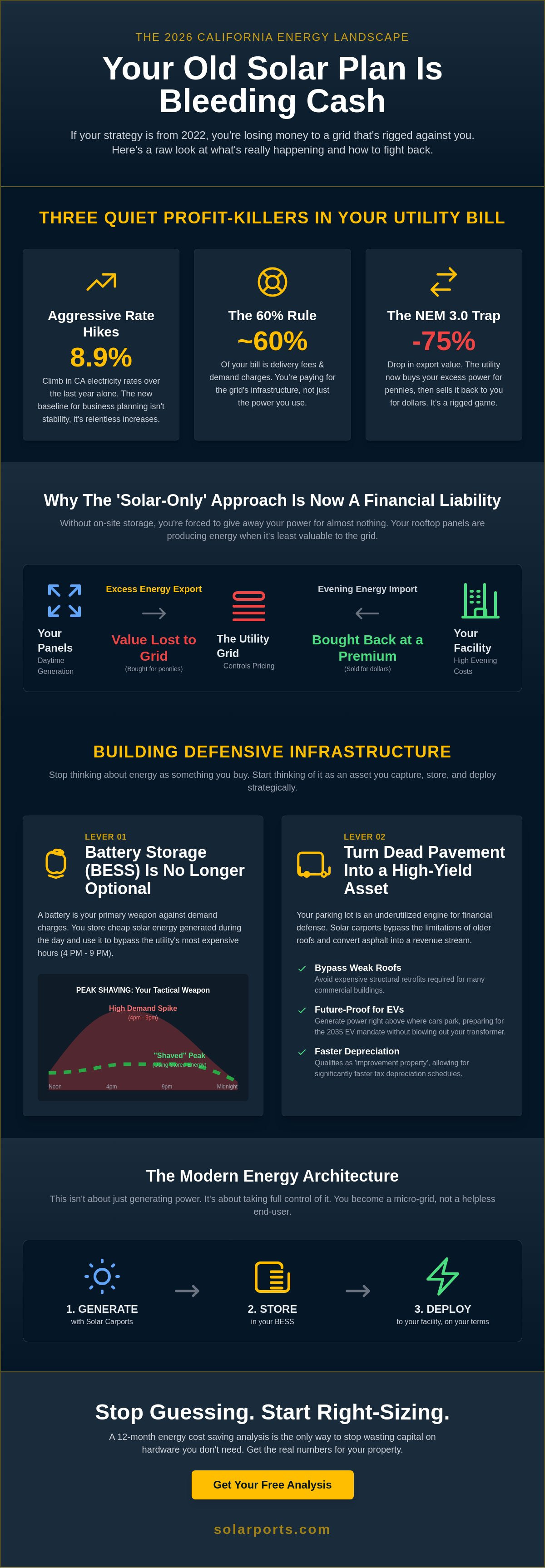
The 60% Rule: The electricity itself—the generation—is cheap. The cost that’s gutting your margins is delivery. For many California businesses, transmission, distribution, and a mess of non-bypassable charges now make up over 60% of the bill. You can't fix a delivery problem with a generation-only solution.
-
NEM 3.0 Fallout: The Net Energy Metering 3.0 transition wasn't a tweak; it was a tectonic shift. It fundamentally devalued the raw kilowatt-hours you export to the grid, making simple rooftop solar a far less compelling investment on its own. Without storage, you're fighting yesterday's war.
-
Volatility as the New Baseline: The era of predictable, incremental rate hikes is over. Wildfires, grid instability, and policy shifts mean utilities in Northern California and beyond are implementing aggressive, volatile time-of-use (TOU) rates and demand charges. Planning your budget around last year's bill is a recipe for disaster.
-
The 'Thinking Fix': You have to move from passive bill-paying to active infrastructure management. Your energy system is no longer just a utility hookup; it's a piece of capital equipment that must be managed for ROI, just like your HVAC or your roof.
The Death of the 'Solar-Only' Approach
For years, the pitch was simple: cover your roof with panels and watch the meter spin backward. That logic is now dangerously obsolete. Relying on rooftop solar alone in 2026 is like bringing a knife to a gunfight.
-
Exporting power back to the grid has become a losing game under California's current regulations; the utility buys your power for pennies during the day and sells it back to you for dollars just a few hours later.
-
This creates a massive "duck curve" problem for commercial properties. You generate a surplus of cheap energy during peak daylight hours when your own consumption might be high but utility rates are lower, only to get hammered by peak pricing in the late afternoon and evening when your solar production drops off.
-
Under NEM 3.0, net metering is no longer a primary savings driver; it's a marginal benefit that can't offset the crippling cost of peak demand charges.
Building Defensive Infrastructure: BESS and Carports as Operational Levers
A modern commercial energy management strategy in California isn't about generating more power. It's about controlling when you use it and where you get it from. This requires building defensive infrastructure that gives you leverage against the utility.
-
Battery Energy Storage Systems (BESS): This is your financial weapon against demand charges. A BESS allows you to store the cheap solar energy you generate mid-day and deploy it during the utility's most expensive peak hours, effectively insulating your operations from their punitive pricing.
-
Solar Carports: Stop thinking of your parking lot as just a place for cars. It's underutilized real estate. Solar carports turn that asphalt into a high-yield energy asset, often with better sun exposure and fewer structural limitations than an aging commercial roof.
-
Dual-Purpose Design: Carports are a masterclass in efficiency. They solve for energy generation, provide valuable vehicle shade (a real amenity for tenants and employees in the Central Valley), and improve your property's curb appeal.
-
Integrating EV Charging: The 2035 EV mandate is coming. By integrating charging stations with a solar carport and BESS, you can provide this critical amenity without needing a catastrophic transformer upgrade, because you’re managing the load onsite.
Why Battery Storage (BESS) is No Longer Optional
If you have significant afternoon energy loads, a battery isn't a luxury item; it's a financial necessity. It's the only tool that directly counters the utility's primary profit driver: peak demand charges.
-
The mechanics of peak shaving are simple: your BESS watches the grid and your building's load. When it senses you're about to enter a high-cost period, it deploys its stored energy, keeping you from pulling expensive power from the utility and thereby "shaving" the peak off your demand profile.
-
Beyond the bill, a BESS provides critical operational resiliency. When the grid goes down due to a Public Safety Power Shutoff (PSPS) or other instability, you can keep your lights on, servers running, and doors open.
-
For a deeper dive into the mechanics, see our guide on how BESS reduces peak demand charges for business.
Maximizing Real Estate with Solar Carports
For many commercial properties, the roof isn't the best place for solar. HVAC units, skylights, and structural weight limits often make rooftop installations inefficient or impossible. Carports bypass these issues entirely.
-
Carports consistently outperform rooftop solar for older commercial buildings that can't handle the load or have too many obstructions. You can build the ideal energy-generating structure without touching your existing roofline.
-
The value of shaded parking is not trivial. In a competitive market, it's a premium tenant amenity that can improve retention and satisfaction, directly impacting your property's value.
-
From a tax perspective, the IRS often lets you classify solar carports as 'qualified improvement property,' which can mean a much faster depreciation schedule than the building itself.
The Strategic Analysis: Stop Guessing and Start Right-Sizing
The biggest mistake in commercial energy projects is rushing into a quote without a deep, forensic analysis of your actual usage. Sales-led proposals almost always lead to oversized, underperforming systems because they’re based on assumptions, not data.
-
The 'Right-Sizing' Trap: Bigger is not better. An oversized solar and battery system is a waste of capital. The goal isn't to eliminate your bill; it's to achieve the maximum ROI by surgically targeting the most expensive components of your bill.
-
Energy Cost Saving Analysis: The only way to design an effective system is with a 12-month look-back at your 15-minute interval data from the utility. This reveals the hidden demand spikes and usage patterns that are actually driving your costs.
-
Turnkey Execution: A brilliant design is useless if the installation is fumbled. The gap between engineering drawings and a commissioned system is where most projects fail, get delayed, or incur massive cost overruns.
-
Navigating California Incentives: Your project's ROI is directly tied to leveraging every available dollar. A proper strategy bakes in the federal Investment Tax Credit (ITC) from day one. Learn more in our 2026 commercial solar tax credit guide for CFOs.
Moving from Vendor-Led to Data-Led Decisions
Stop listening to vendors who start the conversation with equipment. The conversation must start with your utility bills and interval data. That is the only ground truth.
-
Reading your interval data correctly is a specialized skill. It shows us exactly when your facility's demand spikes, allowing us to model a BESS discharge strategy that will neutralize those costly peaks.
-
Navigating the interconnection process with PG&E or SCE requires deep, local Northern California expertise. Each utility has its own bureaucracy and technical requirements; an inexperienced partner will get bogged down for months.
-
For a full breakdown, review these strategies to lower commercial electricity bills in California.
The Reality of Project Timelines
Anyone promising a fully operational commercial solar and storage project in a few months is either lying or incompetent. Setting realistic expectations is critical for your own operational and financial planning.
-
From the first analysis to the first kilowatt generated, a realistic timeline for a commercial project in California is 9 to 18 months. The variables are permitting and utility interconnection.
-
The difference between a 6-month and an 18-month timeline often comes down to one thing: project management. Having a team that lives and breathes this process is non-negotiable.
-
The unfiltered reality is that California permitting is a bureaucratic maze designed to stall projects; you need a partner who has navigated it dozens of times, not one who is learning on your dime.
Frequently Asked Questions
Is a commercial energy management system worth the investment in 2026?
Yes, but only if it's designed as a complete system to attack demand charges and time-of-use rates. A standalone solar array is a questionable investment. A right-sized solar + BESS system designed from a deep cost-saving analysis offers one of the most reliable, high-return capital investments you can make for your property.
How much can a business actually save with a BESS installation in California?
It's not about a simple percentage. The top 5% of your most expensive energy usage hours can account for 50% of your bill. A BESS is designed to surgically eliminate that 5%, leading to a disproportionately large impact on your total costs. The savings are directly tied to how punitive your utility's demand charges are.
What is the difference between an energy audit and a strategic cost-saving analysis?
An energy audit tells you to change your lightbulbs to LEDs and put timers on your thermostats. A strategic cost-saving analysis is a financial deep-dive that re-engineers your entire relationship with the utility, using your own interval data to build an infrastructure solution that attacks the core drivers of your bill.
Can I install solar carports if I already have rooftop solar?
Absolutely. In fact, it's one of the smartest expansion strategies. Carports can be designed as a separate system, often with their own meter and interconnection agreement. This allows you to add significant generation and storage capacity without disturbing your existing rooftop asset, while also monetizing your parking lot.
Frequently asked questions
The Death of the 'Solar-Only' Approach
For years, the pitch was simple: cover your roof with panels and watch the meter spin backward. That logic is now dangerously obsolete. Relying on rooftop solar alone in 2026 is like bringing a knife to a gunfight. A modern commercial energy management strategy in California isn't about generating more power. It's about controlling when you use it and where you get it from. This requires building defensive infrastructure that gives you leverage against the utility.
Why Battery Storage (BESS) is No Longer Optional
If you have significant afternoon energy loads, a battery isn't a luxury item; it's a financial necessity. It's the only tool that directly counters the utility's primary profit driver: peak demand charges.
Maximizing Real Estate with Solar Carports
For many commercial properties, the roof isn't the best place for solar. HVAC units, skylights, and structural weight limits often make rooftop installations inefficient or impossible. Carports bypass these issues entirely. The biggest mistake in commercial energy projects is rushing into a quote without a deep, forensic analysis of your actual usage. Sales-led proposals almost always lead to oversized, underperforming systems because they’re based on assumptions, not data.
Moving from Vendor-Led to Data-Led Decisions
Stop listening to vendors who start the conversation with equipment. The conversation must start with your utility bills and interval data. That is the only ground truth.
The Reality of Project Timelines
Anyone promising a fully operational commercial solar and storage project in a few months is either lying or incompetent. Setting realistic expectations is critical for your own operational and financial planning. Is a commercial energy management system worth the investment in 2026? Yes, but only if it's designed as a complete system to attack demand charges and time-of-use rates. A standalone solar array is a questionable investment. A right-sized solar + BESS system designed from a deep cost-saving analysis offers one of the most reliable, high-return capital investments you can make for your property. How much can a business actually save with a BESS installation in California? It's not about a simple percentage. The top 5% of your most expensive energy usage hours can account for 50% of your bill. A BESS is designed to surgically eliminate that 5%, leading to a disproportionately large impact on your total costs. The savings are directly tied to how punitive your utility's demand charges are. What is the difference between an energy audit and a strategic cost-saving analysis? An energy audit tells you to change your lightbulbs to LEDs and put timers on your thermostats. A strategic cost-saving analysis is a financial deep-dive that re-engineers your entire relationship with the utility, using your own interval data to build an infrastructure solution that attacks the core drivers of your bill. Can I install solar carports if I already have rooftop solar? Absolutely. In fact, it's one of the smartest expansion strategies. Carports can be designed as a separate system, often with their own meter and interconnection agreement. This allows you to add significant generation and storage capacity without disturbing your existing rooftop asset, while also monetizing your parking lot.