
Commercial Solar Carport Installation in Oakland: A Tactical 2026 Guide

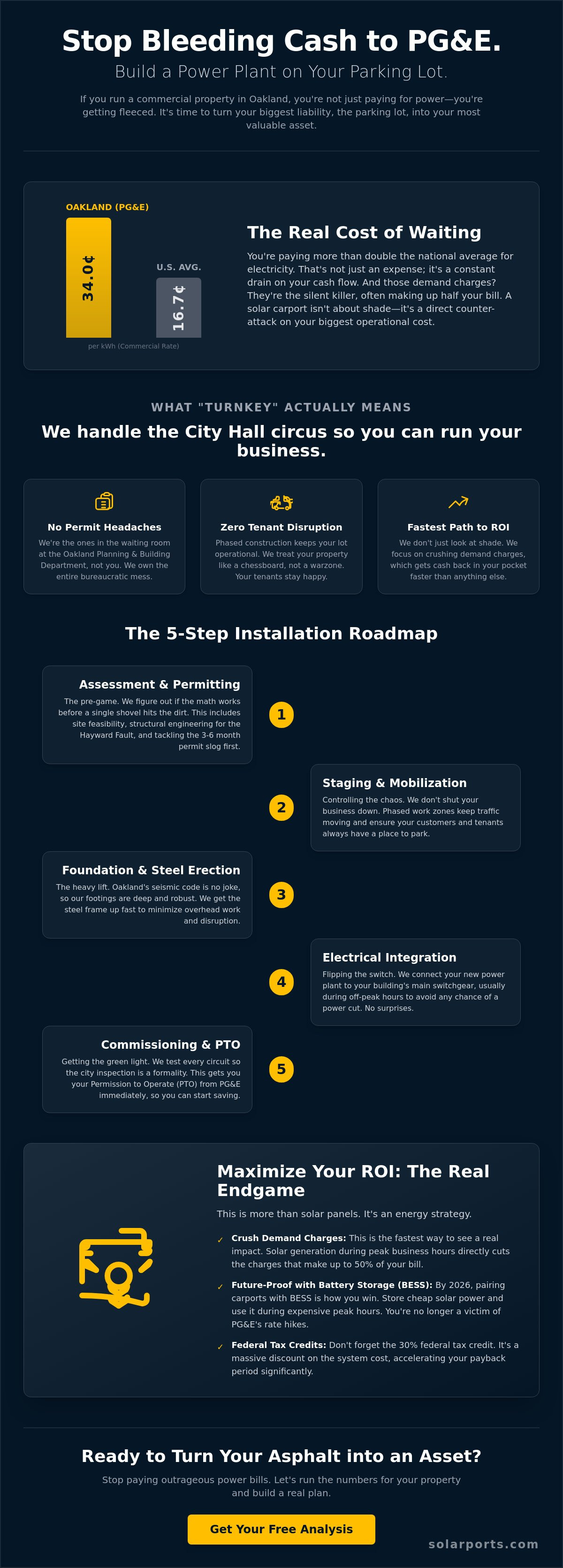
In Oakland, a parking lot isn't just a liability for asphalt maintenance; it's an underutilized power plant waiting for a permit. If you're running a commercial property, you're already feeling the weight of PG&E rates that have climbed to 34.0¢ per kWh. That's more than double what businesses pay in most other states. You're likely tired of demand charges eating your cash flow while you try to figure out a building code that seems to change every time you look at it. Planning a solar carport installation Oakland is a tactical move to stop the bleeding, but it requires a clear-eyed look at the local bureaucracy.
You probably don't have the time to babysit contractors or handle a six-month standoff with the Fire Prevention Bureau over battery storage. This guide offers a direct, no-nonsense breakdown of how to handle the engineering and logistical realities of these builds. We'll walk through the 30% federal tax credit, the 2026 Title 24 requirements, and the specific workflow needed for a turnkey execution that protects your tenant parking and your bottom line.
Key Takeaways
- Turnkey isn't a buzzword here; it means we handle the Oakland permitting mess so you don't have to spend your afternoons at City Hall.
- A successful solar carport installation Oakland depends on a staging plan that actually works, keeping your tenants happy and your lot operational while the steel goes up.
- We look past the shade and focus on demand charge mitigation, which is usually the fastest way to see a real impact on your cash flow.
- By 2026, pairing carports with battery storage (BESS) is how you actually win the game against shifting utility rates and peak-hour pricing.
Table of Contents
- The Oakland Pre-Game: Assessment and Permitting Strategy
- The 5-Step Installation Roadmap for Oakland Businesses
- Maximizing ROI: Beyond Just Shade and Shelters
The Oakland Pre-Game: Assessment and Permitting Strategy
Most contractors throw the word "turnkey" around like it's a marketing buzzword. For a solar carport installation Oakland, turnkey actually means we're the ones sitting in the waiting room at the Oakland Planning & Building Department so you don't have to. It's about owning the entire headache, from the first CAD drawing to the final inspection. If you're managing a property, you don't need a new hobby in municipal bureaucracy; you need a project that moves forward without your constant oversight.
Site feasibility is where the math either works or it doesn't. We aren't just looking at where the sun hits the pavement. We're looking at your existing electrical infrastructure. If your main switchgear is 400 feet from the parking lot, your trenching costs will murder your ROI. Then there's the PG&E interconnection hurdle. Navigating the Northern California grid requirements is a slow process; getting that application right the first time is the difference between powering up in 2026 or waiting until 2027.
Navigating Oakland Building Codes
Oakland has its own set of zoning quirks for commercial lots. You can't just bolt some panels to a frame and call it a day. A commercial energy cost saving analysis is the only way to figure out the right scale for your permit. It tells the city exactly what you're building and why. Expect the permit timeline to sit between three and six months. It's the longest part of the project, so we start it before the first piece of steel is even ordered.
Seismic and Structural Integrity
We live on the Hayward Fault. That's the reality of building in the East Bay. You can't use off-the-shelf Solar canopy technology designed for a flat parking lot in Kansas. In Oakland, foundation depth is everything. A specialized solar carport installation Oakland requires engineering for lateral loads that would snap a standard carport in half. Plus, we choose materials that won't corrode the second the Bay Area salt air hits them. It's about structural integrity that lasts thirty years, not just until the next tremor.
The 5-Step Installation Roadmap for Oakland Businesses
Nobody wants their parking lot to look like a war zone for six months. A solar carport installation Oakland shouldn't paralyze your daily operations or frustrate your tenants. We start with mobilization and staging that treats your property like a chess board. We don't fence off the entire lot at once. Instead, we work in tight, controlled phases to keep traffic moving and ensure your customers still have a place to park.
Once the site is staged, the "heavy lift" begins with foundation and steel work. This phase moves quickly but requires surgical precision. Because Oakland's seismic requirements are so strict, these footings are often deeper and more robust than what you'd see in other regions. We get the structural steel up as fast as possible to minimize the time overhead cranes are operating near your building's entrance.
Managing Tenant and Traffic Disruption
We utilize phase-based construction to ensure you never lose more than a small fraction of your parking capacity at any given time. Safety protocols are the priority here. We use dedicated spotters and clear barriers to keep pedestrians away from the overhead work. It's helpful to review our commercial solar installation timeline so you can give your tenants a realistic heads-up on when the crews will be active. If you're worried about a specific high-traffic window, we can plan your staging schedule to work around your busiest hours.
The Final Connection
The electrical integration is where the canopy finally becomes a financial asset. We run conduit from the carport to your building's main switchgear, usually during off-peak hours to avoid any chance of an unplanned power cut. We place the inverters where they're protected from the elements and secure from tampering. This meticulous setup aligns with the durability standards established by the California Solar Initiative. Finally, we move into commissioning. We test every circuit and connection before the city inspector even shows up. We don't like "fix-it" lists because they cause unnecessary delays. We want a clean sign-off so PG&E can issue your Permission to Operate (PTO) immediately.
Maximizing ROI: Beyond Just Shade and Shelters
Most property owners think carports are just about keeping cars cool. They're wrong. In the current Oakland market, a solar carport installation Oakland is actually a calculated strike against PG&E's demand charges. These charges can often account for half of your monthly commercial bill. By generating power exactly when your building's load peaks, you aren't just saving pennies on kilowatt-hours; you're fundamentally restructuring your utility overhead. It's a defensive financial move that turns a passive parking lot into an active revenue protector.
The real strategic shift for 2026 involves Battery Energy Storage System (BESS) integration. Under current NEM 3.0 rules, simply sending power back to the grid is a losing game. You're better off storing that energy and deploying it when rates are highest. This "peak shaving" approach ensures your investment works for you 24 hours a day. Beyond the direct energy savings, these structures significantly increase the lease-ability of your real estate. Tenants in the East Bay are increasingly looking for "green" amenities that actually lower their operational costs, not just look good on a brochure.
The Financial Impact of BESS and Solar
Justifying the capital expenditure requires looking at the full fiscal picture. We utilize specific strategies to lower commercial electricity bills that go beyond simple panel placement. This includes leveraging the federal Investment Tax Credit, which stays at 30% through 2032. You should also consult with your tax team on how the 2026 commercial solar tax credit applies to the structural components of the carport itself; it's a massive lever for accelerating your break-even point.
Future-Proofing with EV Charging
Don't make the mistake of ignoring EV infrastructure during the initial build. Even if you aren't ready to install chargers today, pre-wiring your carport during the main solar carport installation Oakland saves you from tearing up the pavement later. It's about being ready for the 2035 mandate without the 2035 price tag. You can see how we've handled these integrated systems in our previous Oakland solar projects. A little foresight in the trenching phase prevents a logistical nightmare three years down the road.
Turning Asphalt into an Operational Asset
Oakland's energy market doesn't reward hesitation. With utility rates consistently outpacing the national average, the cost of doing nothing is a visible line item on your monthly P&L. We've covered the tactical essentials: mastering the city's seismic codes for the Hayward Fault, phasing construction to protect tenant access, and using BESS to neutralize those exorbitant demand charges. A successful solar carport installation Oakland requires a partner who understands that a commercial parking lot is a financial instrument, not just a place for cars.
Our team brings specialized Northern California expertise to every build, ensuring your project meets local structural standards while maximizing your tax credits. We handle the heavy lifting of engineering and permitting so you get a turnkey result without the operational headache. Your property is ready for a more efficient future, and the data is the best place to start. It's time to turn your underutilized asphalt into a high-performing asset that pays you back every month.
Request your custom Oakland energy cost saving analysis to define your path toward energy independence. We're ready to help you build a smarter, more profitable property.
Frequently Asked Questions
Do I need a special permit for a solar carport in Oakland?
Yes, you'll need multiple approvals from the Oakland Planning & Building Department. It's a structured process that involves building, electrical, and sometimes zoning reviews. If your project includes energy storage over 20 kWh, the Oakland Fire Prevention Bureau must also sign off on the plans. We manage this entire stack as part of a turnkey service so you don't have to navigate the city's internal routing yourself.
How much parking space will I lose during the installation process?
You won't lose any permanent parking capacity if the columns are placed strategically. During the solar carport installation Oakland, we fence off small sections in phases to keep the rest of the lot open for your tenants and customers. Most projects only see a temporary reduction of a few stalls at a time while the concrete foundations cure. Once finished, the vertical supports occupy a negligible amount of surface area.
Can an Oakland solar carport withstand high winds and earthquakes?
These systems are specifically engineered to survive a major seismic event on the Hayward Fault. Oakland's building codes are among the toughest in the country for a reason. We use deep-drilled piers and reinforced steel frames that are designed to handle lateral forces during a tremor. They also meet local wind load standards, ensuring the panels stay securely attached even during heavy winter storms coming off the Bay.
How long is the typical payback period for a commercial carport in the Bay Area?
Payback typically lands between five and seven years for most Oakland commercial assets. This timeline depends on your ability to leverage the 30% federal investment tax credit and your current demand charge load. Because PG&E rates in Northern California are significantly higher than the national average, the avoided cost of power accelerates your ROI much faster than it would for a similar project in another state.
Frequently asked questions
Navigating Oakland Building Codes
Oakland has its own set of zoning quirks for commercial lots. You can't just bolt some panels to a frame and call it a day. A commercial energy cost saving analysis is the only way to figure out the right scale for your permit. It tells the city exactly what you're building and why. Expect the permit timeline to sit between three and six months. It's the longest part of the project, so we start it before the first piece of steel is even ordered.
Seismic and Structural Integrity
We live on the Hayward Fault. That's the reality of building in the East Bay. You can't use off-the-shelf Solar canopy technology designed for a flat parking lot in Kansas. In Oakland, foundation depth is everything. A specialized solar carport installation Oakland requires engineering for lateral loads that would snap a standard carport in half. Plus, we choose materials that won't corrode the second the Bay Area salt air hits them. It's about structural integrity that lasts thirty years, not just until the next tremor. Nobody wants their parking lot to look like a war zone for six months. A solar carport installation Oakland shouldn't paralyze your daily operations or frustrate your tenants. We start with mobilization and staging that treats your property like a chess board. We don't fence off the entire lot at once. Instead, we work in tight, controlled phases to keep traffic moving and ensure your customers still have a place to park. Once the site is staged, the "heavy lift" begins with foundation and steel work. This phase moves quickly but requires surgical precision. Because Oakland's seismic requirements are so strict, these footings are often deeper and more robust than what you'd see in other regions. We get the structural steel up as fast as possible to minimize the time overhead cranes are operating near your building's entrance.
Managing Tenant and Traffic Disruption
We utilize phase-based construction to ensure you never lose more than a small fraction of your parking capacity at any given time. Safety protocols are the priority here. We use dedicated spotters and clear barriers to keep pedestrians away from the overhead work. It's helpful to review our commercial solar installation timeline so you can give your tenants a realistic heads-up on when the crews will be active. If you're worried about a specific high-traffic window, we can plan your staging schedule to work around your busiest hours.
The Final Connection
The electrical integration is where the canopy finally becomes a financial asset. We run conduit from the carport to your building's main switchgear, usually during off-peak hours to avoid any chance of an unplanned power cut. We place the inverters where they're protected from the elements and secure from tampering. This meticulous setup aligns with the durability standards established by the California Solar Initiative. Finally, we move into commissioning. We test every circuit and connection before the city inspector even shows up. We don't like "fix-it" lists because they cause unnecessary delays. We want a clean sign-off so PG&E can issue your Permission to Operate (PTO) immediately. Most property owners think carports are just about keeping cars cool. They're wrong. In the current Oakland market, a solar carport installation Oakland is actually a calculated strike against PG&E's demand charges. These charges can often account for half of your monthly commercial bill. By generating power exactly when your building's load peaks, you aren't just saving pennies on kilowatt-hours; you're fundamentally restructuring your utility overhead. It's a defensive financial move that turns a passive parking lot into an active revenue protector. The real strategic shift for 2026 involves Battery Energy Storage System (BESS) integration. Under current NEM 3.0 rules, simply sending power back to the grid is a losing game. You're better off storing that energy and deploying it when rates are highest. This "peak shaving" approach ensures your investment works for you 24 hours a day. Beyond the direct energy savings, these structures significantly increase the lease-ability of your real estate. Tenants in the East Bay are increasingly looking for "green" amenities that actually lower their operational costs, not just look good on a brochure.
The Financial Impact of BESS and Solar
Justifying the capital expenditure requires looking at the full fiscal picture. We utilize specific strategies to lower commercial electricity bills that go beyond simple panel placement. This includes leveraging the federal Investment Tax Credit, which stays at 30% through 2032. You should also consult with your tax team on how the 2026 commercial solar tax credit applies to the structural components of the carport itself; it's a massive lever for accelerating your break-even point.
Future-Proofing with EV Charging
Don't make the mistake of ignoring EV infrastructure during the initial build. Even if you aren't ready to install chargers today, pre-wiring your carport during the main solar carport installation Oakland saves you from tearing up the pavement later. It's about being ready for the 2035 mandate without the 2035 price tag. You can see how we've handled these integrated systems in our previous Oakland solar projects. A little foresight in the trenching phase prevents a logistical nightmare three years down the road. Oakland's energy market doesn't reward hesitation. With utility rates consistently outpacing the national average, the cost of doing nothing is a visible line item on your monthly P&L. We've covered the tactical essentials: mastering the city's seismic codes for the Hayward Fault, phasing construction to protect tenant access, and using BESS to neutralize those exorbitant demand charges. A successful solar carport installation Oakland requires a partner who understands that a commercial parking lot is a financial instrument, not just a place for cars. Our team brings specialized Northern California expertise to every build, ensuring your project meets local structural standards while maximizing your tax credits. We handle the heavy lifting of engineering and permitting so you get a turnkey result without the operational headache. Your property is ready for a more efficient future, and the data is the best place to start. It's time to turn your underutilized asphalt into a high-performing asset that pays you back every month. Request your custom Oakland energy cost saving analysis to define your path toward energy independence. We're ready to help you build a smarter, more profitable property.
Do I need a special permit for a solar carport in Oakland?
Yes, you'll need multiple approvals from the Oakland Planning & Building Department. It's a structured process that involves building, electrical, and sometimes zoning reviews. If your project includes energy storage over 20 kWh, the Oakland Fire Prevention Bureau must also sign off on the plans. We manage this entire stack as part of a turnkey service so you don't have to navigate the city's internal routing yourself.
How much parking space will I lose during the installation process?
You won't lose any permanent parking capacity if the columns are placed strategically. During the solar carport installation Oakland, we fence off small sections in phases to keep the rest of the lot open for your tenants and customers. Most projects only see a temporary reduction of a few stalls at a time while the concrete foundations cure. Once finished, the vertical supports occupy a negligible amount of surface area.
Can an Oakland solar carport withstand high winds and earthquakes?
These systems are specifically engineered to survive a major seismic event on the Hayward Fault. Oakland's building codes are among the toughest in the country for a reason. We use deep-drilled piers and reinforced steel frames that are designed to handle lateral forces during a tremor. They also meet local wind load standards, ensuring the panels stay securely attached even during heavy winter storms coming off the Bay.
How long is the typical payback period for a commercial carport in the Bay Area?
Payback typically lands between five and seven years for most Oakland commercial assets. This timeline depends on your ability to leverage the 30% federal investment tax credit and your current demand charge load. Because PG&E rates in Northern California are significantly higher than the national average, the avoided cost of power accelerates your ROI much faster than it would for a similar project in another state.