
Power Outage Protection for Northern California Businesses: The 2026 Resiliency Reality

What if the next PG&E shutoff wasn't a catastrophe for your bottom line, but actually the moment your building became more profitable than the grid itself? You already know that a single afternoon of downtime in Northern California can cost you a month's worth of revenue and years of hard-earned tenant trust. It's a brutal reality in 2026, especially with commercial electricity rates averaging 25.75¢/kWh and the constant threat of public safety power shutoffs. This guide provides a no-nonsense roadmap for securing power outage protection for business Northern California operations while turning your backup infrastructure into a legitimate financial asset.
The old way of thinking about resiliency was just buying an expensive insurance policy in the form of a noisy, high-maintenance diesel generator. That doesn't work anymore. With new Title 24 mandates and rising fuel costs, you need a strategy that does more than just sit idle. We're going to break down how to achieve full operational continuity during grid failures while using battery storage to lower those aggressive monthly demand charges when the grid is functional. You'll see how to move from being at the mercy of the utility to running a sophisticated, self-sufficient energy hub that doesn't require you to be an engineer to manage.
Key Takeaways
- Stop treating backup power like a sunk cost. You'll see how to use these systems to actually shave peak demand charges when the grid is working fine.
- PG&E's shutoffs are a structural reality now. We'll explain why protecting against "flicker" is just as important as surviving a total blackout.
- Battery Energy Storage Systems (BESS) are replacing noisy generators for a reason. Learn why the 2026 regulatory landscape makes fossil fuels a liability.
- Effective power outage protection for business Northern California starts with data, not guesswork. We outline how an energy cost saving analysis finds your ideal system size.
- Don't try to power the whole building. We'll show you the methodology for isolating critical loads so you stay operational without wasting capital.
Table of Contents
- The Unfiltered Reality of Northern California’s Grid in 2026
- BESS vs. Generators: Choosing a Resiliency Strategy That Pays
- Implementing a Resilient Infrastructure: From Analysis to Turnkey Project
The Unfiltered Reality of Northern California’s Grid in 2026
Northern California isn't just dealing with occasional seasonal storms anymore. We're living in a persistent cycle of Public Safety Power Shutoffs (PSPS) that PG&E uses to mitigate wildfire risk during dry, windy conditions. For a commercial operation, this is a structural threat. In June 2026 alone, we saw PSPS events affecting 5,000 customers across nine counties. If your facility is located in a high fire-threat district, these outages aren't "accidents"; they're a standard operating procedure for the utility. Relying on the grid without a dedicated strategy for power outage protection for business Northern California is effectively gambling with your quarterly revenue.
The damage isn't always from a total blackout. Most businesses ignore the "flicker" outages. These momentary voltage drops might only last seconds, but they wreak havoc on sensitive IT infrastructure and CNC machinery. For property managers, this creates a secondary crisis: tenant churn. When a tenant loses a day of billable work or a batch of inventory because the building's power is unstable, they start looking for a new lease. Maintaining high power system reliability is now a baseline requirement for commercial real estate value in the Bay Area and Central Valley.
Beyond PSPS: Aging Infrastructure and Heat Waves
The 2026 grid is under immense strain from aggressive electrification and extreme heat waves. When the Central Valley hits triple digits, the demand for cooling pushes local distribution equipment to its breaking point. A 4-hour outage at a commercial warehouse can be catastrophic. You're facing spoiled inventory, missed shipping windows, and the cost of hourly labor standing idle while the meter is dead. With average commercial rates hitting 25.75¢/kWh, the cost of electricity is high, but the cost of not having it is exponentially higher.
The Problem with Traditional Generators in 2026
Diesel generators are increasingly becoming a liability rather than a solution. New CARB emissions standards and local noise ordinances make permitting these units a bureaucratic nightmare. Beyond the red tape, they're the ultimate "sunk cost" trap. You're paying for fuel, storage, and monthly maintenance for a machine that sits idle 99% of the year. In a competitive market, tying up capital in an asset that only provides value during a disaster is a poor strategic move. You need infrastructure that works for the bottom line every single day.
BESS vs. Generators: Choosing a Resiliency Strategy That Pays
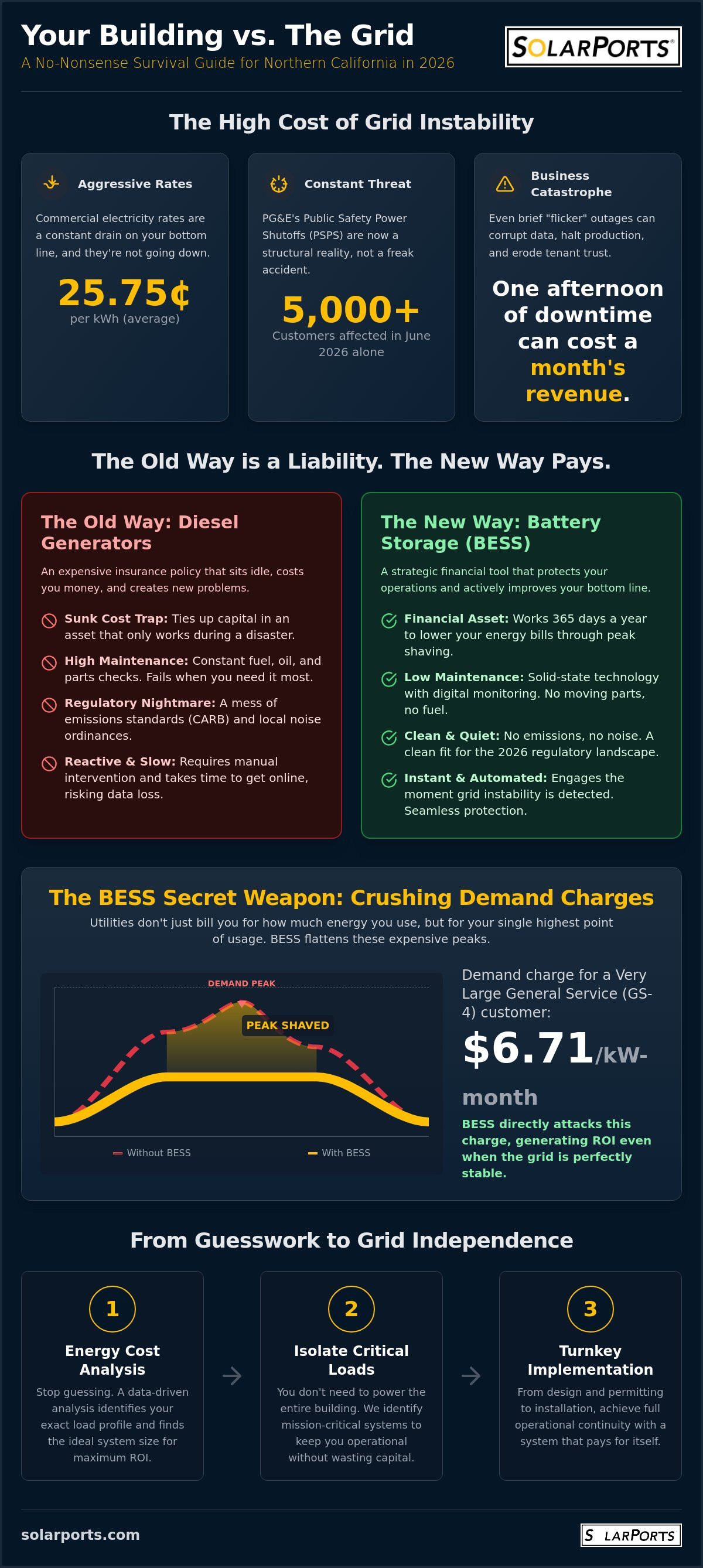
The traditional backup power playbook was simple: buy a diesel generator and hope it starts when the lights go out. In 2026, that strategy is obsolete. A generator is a depreciating asset that only provides value during a crisis. A Battery Energy Storage System (BESS) is a strategic financial tool that works 365 days a year. While traditional units require manual intervention and complex fuel logistics, BESS offers silent, automated power outage protection for business Northern California operations, engaging instantly the moment a frequency drop is detected. It's the difference between a reactive emergency kit and a proactive energy infrastructure.
Maintenance cycles further widen the gap between these technologies. A generator requires physical inspections, oil changes, and fuel stabilization to remain viable. Neglect these tasks, and the system fails when you need it most. BESS maintenance is primarily digital, focusing on software optimization and thermal management. It is a cleaner, more predictable lifecycle that aligns with the operational requirements of a modern commercial facility. You're trading a mechanical liability for a solid-state asset.
Demand Charge Mitigation: The BESS Secret Weapon
Utility bills are weighted heavily toward demand charges, which are calculated based on your highest point of usage. For Very Large General Service (GS-4) customers, that charge is $6.71/kW-month. BESS allows you to perform peak shaving, discharging stored energy to flatten your building's load profile when rates are highest. This financial arbitrage is a critical component of strategies to lower commercial electricity bills California businesses use to offset rising operational costs. As the state continues to monitor California's energy reliability, shifting your load away from the grid's most vulnerable hours provides both fiscal relief and system security.
Solar Carports: Resiliency You Can See
Parking lots are often the most underutilized assets in a commercial portfolio. Solar carport systems turn these asphalt expanses into dedicated power plants. They provide essential vehicle shade for tenants while generating the kilowatt-hours needed to keep your BESS topped off. In Northern California, carports often bypass the structural complexities and roof-penetration concerns of rooftop solar, leading to faster permitting cycles and a quicker path to resiliency. If you're weighing the ROI of these systems, you might want to schedule a resiliency strategy session to see how the localized data applies to your specific property.
Implementing a Resilient Infrastructure: From Analysis to Turnkey Project
Moving from a conceptual plan to an operational asset requires a level of precision that most general contractors simply can't provide. It starts with a commercial property energy cost saving analysis to look at your actual load profile. You can't guess your way into power outage protection for business Northern California operations. We analyze 15-minute interval data to see exactly where your demand peaks and where the grid vulnerabilities lie. This isn't a generic estimate; it's a granular look at how your building actually consumes energy.
Once we have the data, we define your critical loads. Most commercial buildings don't need 100% power during a PSPS event. You need to keep the data center cool, the security systems active, and the egress lighting on. By isolating these circuits, you reduce the required battery capacity and lower your upfront capital expenditure. Then comes the 2026 regulatory hurdle. New safety frameworks like SB 38 and SB 283 mean you need site-specific emergency plans and pre-operation fire inspections. Navigating this maze is where most DIY or amateur projects fail. A true turnkey partner like SolarPorts Development handles the interconnection with PG&E and provides the power outage protection for business Northern California buildings need to maintain continuity.
Why "Right-Sizing" Matters for Your Bottom Line
Over-buying storage capacity is a common mistake that kills ROI. You're paying for kilowatt-hours that you'll never use. We use historical data to ensure your Battery Energy Storage System (BESS) from commercial real estate is sized for your actual peaks, not a worst-case scenario that never happens. This precision ensures you aren't carrying dead weight on your balance sheet. You can review the specific methodology used by SolarPorts Development on the SolarPorts Development services page.
Financing the Future: ROI over 10 Years
The 2026 financial landscape for energy is complex. While residential credits have shifted, commercial projects in Northern California still leverage the Self-Generation Incentive Program (SGIP). As of June 2026, most commercial budgets are on a waitlist, but the general market rates of $250 to $500 per kWh still offer a path to a 10-year capital plan that makes sense. For a deeper dive into the numbers, read our commercial solar ROI analysis. If you're ready to see how this looks in practice, view recent Northern California projects by SolarPorts Development to see how your neighbors are solving the resiliency puzzle.
Securing Your Operational Future in a Volatile Grid
The grid isn't getting any more stable. Waiting for the utility to fix aging infrastructure is a losing strategy for your bottom line. You've seen that the real value in modern resiliency isn't just surviving a blackout; it's about using BESS to shave those aggressive demand charges every single day. By moving toward a turnkey integration of solar carports and storage, you're effectively building a private power plant that protects your tenants and your revenue simultaneously.
Real power outage protection for business Northern California requires a shift from reactive panic to data-driven asset management. We focus on right-sizing your system based on your building's actual interval data, ensuring you don't overspend on capacity you'll never use. It's a complex transition involving strict 2026 fire codes and interconnection hurdles, but you don't have to navigate that engineering maze alone.
The first step is understanding your specific numbers. You can Request a Commercial Energy Cost Saving Analysis to see exactly how these systems pencil out for your property. Take control of your energy overhead before the next heat wave hits. You've got the roadmap; now it's time to execute.
Commercial Resiliency FAQs
How long can a commercial BESS system power my building during a PG&E shutoff?
It depends entirely on your critical load design and the total capacity of your battery. Most commercial systems are engineered to sustain essential operations for 4 to 8 hours, but you can stretch that protection through a multi-day PSPS event if you've isolated critical circuits like security, IT, and refrigeration. We use your interval data to size the system so you aren't paying for excess capacity you don't actually need.
Are there specific tax incentives for Northern California businesses installing backup power in 2026?
Commercial incentives in 2026 are primarily driven by the Self-Generation Incentive Program (SGIP) and accelerated depreciation schedules. While the residential federal credit ended in 2025, businesses can still access SGIP rebates between $250 and $850 per kWh to offset the cost of power outage protection for business Northern California. You should be aware that most commercial SGIP categories are currently on a waitlist as of June 2026, so timing your application is critical for your capital plan.
Can I install a solar carport if my commercial property has limited roof space?
Yes, solar carports are the ideal solution for properties where roof space is obstructed by HVAC units or is structurally insufficient for a heavy solar array. These systems turn your parking lot into a productive energy asset without requiring any roof penetrations. This is often a faster route to permitting in Northern California because it doesn't interfere with the building's primary envelope or existing fire-rated assemblies.
What is the difference between a UPS and a commercial BESS for power outage protection?
A UPS is a temporary bridge for sensitive electronics, while a commercial BESS is a full-scale energy infrastructure solution. A UPS only provides minutes of runtime to allow for an orderly shutdown, but a BESS provides hours of power outage protection for business Northern California while also performing peak shaving to lower your monthly demand charges. One is a safety net; the other is a financial tool that works every day of the year.
Frequently asked questions
Beyond PSPS: Aging Infrastructure and Heat Waves
The 2026 grid is under immense strain from aggressive electrification and extreme heat waves. When the Central Valley hits triple digits, the demand for cooling pushes local distribution equipment to its breaking point. A 4-hour outage at a commercial warehouse can be catastrophic. You're facing spoiled inventory, missed shipping windows, and the cost of hourly labor standing idle while the meter is dead. With average commercial rates hitting 25.75¢/kWh, the cost of electricity is high, but the cost of not having it is exponentially higher.
The Problem with Traditional Generators in 2026
Diesel generators are increasingly becoming a liability rather than a solution. New CARB emissions standards and local noise ordinances make permitting these units a bureaucratic nightmare. Beyond the red tape, they're the ultimate "sunk cost" trap. You're paying for fuel, storage, and monthly maintenance for a machine that sits idle 99% of the year. In a competitive market, tying up capital in an asset that only provides value during a disaster is a poor strategic move. You need infrastructure that works for the bottom line every single day. The traditional backup power playbook was simple: buy a diesel generator and hope it starts when the lights go out. In 2026, that strategy is obsolete. A generator is a depreciating asset that only provides value during a crisis. A Battery Energy Storage System (BESS) is a strategic financial tool that works 365 days a year. While traditional units require manual intervention and complex fuel logistics, BESS offers silent, automated power outage protection for business Northern California operations, engaging instantly the moment a frequency drop is detected. It's the difference between a reactive emergency kit and a proactive energy infrastructure. Maintenance cycles further widen the gap between these technologies. A generator requires physical inspections, oil changes, and fuel stabilization to remain viable. Neglect these tasks, and the system fails when you need it most. BESS maintenance is primarily digital, focusing on software optimization and thermal management. It is a cleaner, more predictable lifecycle that aligns with the operational requirements of a modern commercial facility. You're trading a mechanical liability for a solid-state asset.
Demand Charge Mitigation: The BESS Secret Weapon
Utility bills are weighted heavily toward demand charges, which are calculated based on your highest point of usage. For Very Large General Service (GS-4) customers, that charge is $6.71/kW-month. BESS allows you to perform peak shaving, discharging stored energy to flatten your building's load profile when rates are highest. This financial arbitrage is a critical component of strategies to lower commercial electricity bills California businesses use to offset rising operational costs. As the state continues to monitor California's energy reliability, shifting your load away from the grid's most vulnerable hours provides both fiscal relief and system security.
Solar Carports: Resiliency You Can See
Parking lots are often the most underutilized assets in a commercial portfolio. Solar carport systems turn these asphalt expanses into dedicated power plants. They provide essential vehicle shade for tenants while generating the kilowatt-hours needed to keep your BESS topped off. In Northern California, carports often bypass the structural complexities and roof-penetration concerns of rooftop solar, leading to faster permitting cycles and a quicker path to resiliency. If you're weighing the ROI of these systems, you might want to schedule a resiliency strategy session to see how the localized data applies to your specific property. Moving from a conceptual plan to an operational asset requires a level of precision that most general contractors simply can't provide. It starts with a commercial property energy cost saving analysis to look at your actual load profile. You can't guess your way into power outage protection for business Northern California operations. We analyze 15-minute interval data to see exactly where your demand peaks and where the grid vulnerabilities lie. This isn't a generic estimate; it's a granular look at how your building actually consumes energy. Once we have the data, we define your critical loads. Most commercial buildings don't need 100% power during a PSPS event. You need to keep the data center cool, the security systems active, and the egress lighting on. By isolating these circuits, you reduce the required battery capacity and lower your upfront capital expenditure. Then comes the 2026 regulatory hurdle. New safety frameworks like SB 38 and SB 283 mean you need site-specific emergency plans and pre-operation fire inspections. Navigating this maze is where most DIY or amateur projects fail. A true turnkey partner like SolarPorts Development handles the interconnection with PG&E and provides the power outage protection for business Northern California buildings need to maintain continuity.
Why "Right-Sizing" Matters for Your Bottom Line
Over-buying storage capacity is a common mistake that kills ROI. You're paying for kilowatt-hours that you'll never use. We use historical data to ensure your Battery Energy Storage System (BESS) from commercial real estate is sized for your actual peaks, not a worst-case scenario that never happens. This precision ensures you aren't carrying dead weight on your balance sheet. You can review the specific methodology used by SolarPorts Development on the SolarPorts Development services page.
Financing the Future: ROI over 10 Years
The 2026 financial landscape for energy is complex. While residential credits have shifted, commercial projects in Northern California still leverage the Self-Generation Incentive Program (SGIP). As of June 2026, most commercial budgets are on a waitlist, but the general market rates of $250 to $500 per kWh still offer a path to a 10-year capital plan that makes sense. For a deeper dive into the numbers, read our commercial solar ROI analysis. If you're ready to see how this looks in practice, view recent Northern California projects by SolarPorts Development to see how your neighbors are solving the resiliency puzzle. The grid isn't getting any more stable. Waiting for the utility to fix aging infrastructure is a losing strategy for your bottom line. You've seen that the real value in modern resiliency isn't just surviving a blackout; it's about using BESS to shave those aggressive demand charges every single day. By moving toward a turnkey integration of solar carports and storage, you're effectively building a private power plant that protects your tenants and your revenue simultaneously. Real power outage protection for business Northern California requires a shift from reactive panic to data-driven asset management. We focus on right-sizing your system based on your building's actual interval data, ensuring you don't overspend on capacity you'll never use. It's a complex transition involving strict 2026 fire codes and interconnection hurdles, but you don't have to navigate that engineering maze alone. The first step is understanding your specific numbers. You can Request a Commercial Energy Cost Saving Analysis to see exactly how these systems pencil out for your property. Take control of your energy overhead before the next heat wave hits. You've got the roadmap; now it's time to execute.
How long can a commercial BESS system power my building during a PG&E shutoff?
It depends entirely on your critical load design and the total capacity of your battery. Most commercial systems are engineered to sustain essential operations for 4 to 8 hours, but you can stretch that protection through a multi-day PSPS event if you've isolated critical circuits like security, IT, and refrigeration. We use your interval data to size the system so you aren't paying for excess capacity you don't actually need.
Are there specific tax incentives for Northern California businesses installing backup power in 2026?
Commercial incentives in 2026 are primarily driven by the Self-Generation Incentive Program (SGIP) and accelerated depreciation schedules. While the residential federal credit ended in 2025, businesses can still access SGIP rebates between $250 and $850 per kWh to offset the cost of power outage protection for business Northern California. You should be aware that most commercial SGIP categories are currently on a waitlist as of June 2026, so timing your application is critical for your capital plan.
Can I install a solar carport if my commercial property has limited roof space?
Yes, solar carports are the ideal solution for properties where roof space is obstructed by HVAC units or is structurally insufficient for a heavy solar array. These systems turn your parking lot into a productive energy asset without requiring any roof penetrations. This is often a faster route to permitting in Northern California because it doesn't interfere with the building's primary envelope or existing fire-rated assemblies.
What is the difference between a UPS and a commercial BESS for power outage protection?
A UPS is a temporary bridge for sensitive electronics, while a commercial BESS is a full-scale energy infrastructure solution. A UPS only provides minutes of runtime to allow for an orderly shutdown, but a BESS provides hours of power outage protection for business Northern California while also performing peak shaving to lower your monthly demand charges. One is a safety net; the other is a financial tool that works every day of the year.