
Commercial Solar and Battery Backup in California: The Unfiltered 2026 Reality

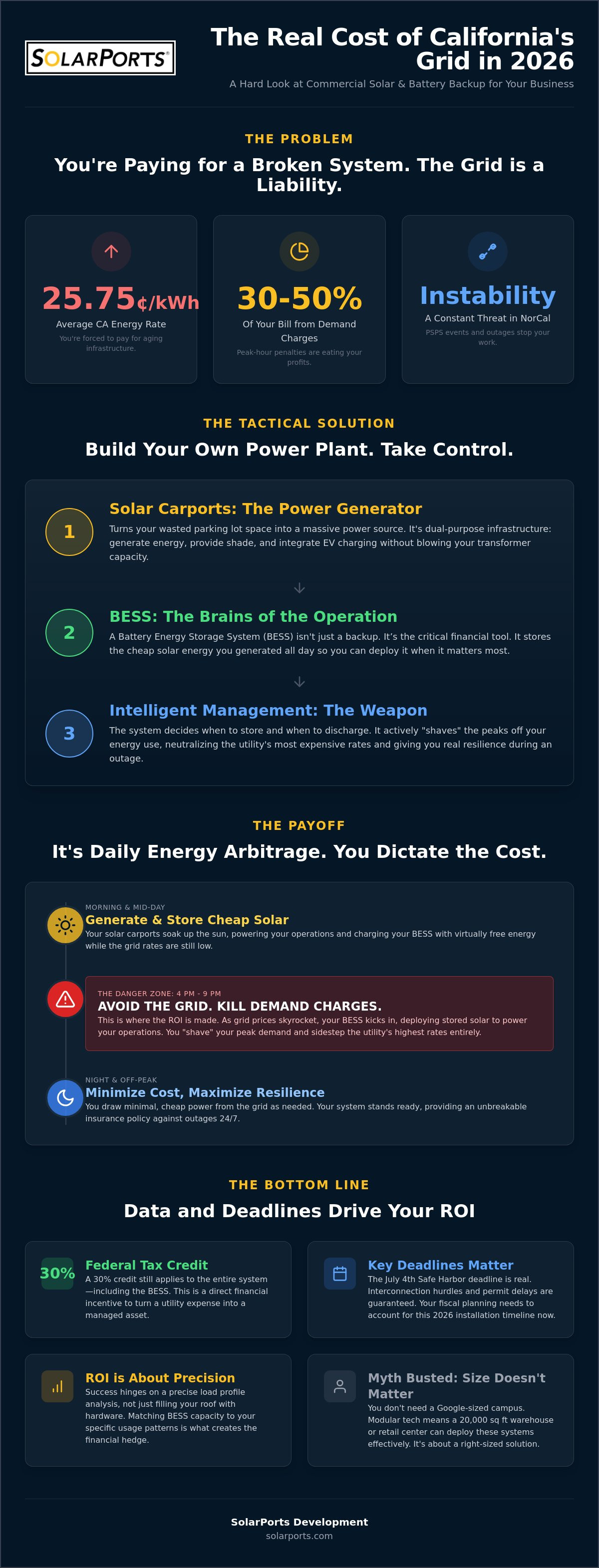
The California grid isn't a reliable partner for your business anymore. It's a volatile liability that forces you to pay for aging infrastructure through rates that have hit an average of 25.75¢/kWh. You're probably watching demand charges eat up 30% to 50% of your bill every month, and if you're operating in Northern California, grid instability is a constant threat to your actual work. This is the real landscape of commercial solar and battery backup California in 2026. It's a high-stakes mess where the difference between a vanity project and a real financial hedge comes down to timing and hard data.
It's frustrating to deal with a regulatory environment that keeps moving the goalposts. We're going to lay out a pragmatic path to lowering your OpEx and finally getting some energy resilience. You'll see how to use the 30% federal tax credit before that July 4 Safe Harbor deadline hits and how to make Title 24 mandates actually work for your bottom line. We're digging into the ROI of microgrids under the current Solar Billing Plan so you can stop paying for the utility's mistakes.
Key Takeaways
- Rethink the microgrid as more than just a disaster plan; it's a daily tool for energy arbitrage that keeps your operations running regardless of utility price hikes.
- Use a BESS and solar carports to aggressively target the 4 PM to 9 PM peak window, which is where demand charges do the most damage to your monthly OpEx.
- The ROI for commercial solar and battery backup California hinges on a precise load profile analysis rather than just filling your roof with as much hardware as possible.
- Get a clear-eyed look at the 2026 installation timeline to account for interconnection hurdles and permit delays before they impact your fiscal planning.
Table of Contents
- Decoding Commercial Microgrid Solutions in California’s 2026 Market
- The Tactical Build: BESS, Solar Carports, and Demand Charge Mitigation
- Implementing Your Microgrid: Analysis, ROI, and California Incentives
Decoding Commercial Microgrid Solutions in California’s 2026 Market
A microgrid isn't just a glorified backup generator sitting in a parking lot. It's a sophisticated, localized energy system that can disconnect from the utility whenever it makes financial sense. In the current 2026 market, the standard definition of a Microgrid has evolved. It's no longer just about keeping the lights on during a storm. It's about daily energy arbitrage. For businesses using commercial solar and battery backup California, the real value lies in the system's ability to operate as its own power plant. You're combining solar generation, a robust Battery Energy Storage System (BESS), and intelligent load management to dictate your own energy costs.
The math has changed because the grid has become too expensive to rely on 24/7. In Northern California, where rate hikes and instability are the norm, decentralized power isn't a luxury. It's a tactical necessity. You aren't just buying hardware; you're buying an insurance policy against a utility provider that can't guarantee price stability or uptime. By managing your own generation and storage, you effectively opt out of the most predatory parts of the utility's rate structure.
The "Campus-Only" Myth: Microgrids for Mid-Sized Real Estate
There's a persistent idea that you need a Google-sized campus to make this work. That's wrong. Modular technology has matured to the point where a 20,000 square foot warehouse or retail center can deploy these systems effectively. Right-sized microgrids are the sweet spot for California property owners who need to protect their bottom line without over-engineering the solution. It's about matching the storage capacity to your specific load profile, not just chasing scale for the sake of it.
Grid Independence vs. Grid-Tied Optimization
You have to distinguish between "islanding" and daily optimization. Islanding is what happens during a Public Safety Power Shutoff (PSPS) event where your building stays powered while the neighborhood goes dark. It's vital for resilience, but the daily ROI comes from grid-tied optimization. This is where your system "shaves" your demand peaks and uses stored solar to avoid the highest utility rates. Managing a commercial solar and battery backup California setup means you're constantly balancing these two modes. Understanding how commercial solar works in this dual-purpose context is the first step toward true energy independence.
The Tactical Build: BESS, Solar Carports, and Demand Charge Mitigation
The hardware is only as good as the strategy behind it. In 2026, a commercial solar and battery backup California system is defined by its ability to neutralize demand charges. While solar panels generate the power, the Battery Energy Storage System (BESS) is the actual brain. It decides when to store energy and when to discharge it to "shave" the top off your demand profile. This is critical because utility peak hours, typically 4 PM to 9 PM, are specifically designed to catch businesses when their solar production is dropping but their operational needs remain high.
Battery Energy Storage: More Than Just a Safety Net
Load shifting is the primary driver of ROI here. You aren't just storing power for a rainy day; you're buying energy when it's cheap and using it when rates are at their absolute highest. This makes the BESS the critical differentiator in a commercial grid-tied battery storage setup. Even though programs like the Self-Generation Incentive Program (SGIP) have seen budgets tighten for the general market, the federal 30% tax credit still applies to these storage units. It’s a financial move that turns a passive utility expense into a managed asset.
Dual-Purpose Infrastructure: The Solar Carport Advantage
For many properties in urban Northern California hubs, the roof isn't the best place for solar. Maybe the HVAC units take up too much space, or the roof's structural integrity won't support the weight. This is where solar carport installation becomes the superior choice. You're using existing parking lots to generate massive amounts of power while providing shade for tenant vehicles. It also allows you to integrate EV charging into your microgrid loop. You can manage that high-draw charging load through your battery system, which prevents you from blowing out your transformer capacity during peak times.
If you're trying to figure out if your parking lot has enough square footage to offset your demand charges, it's probably time to get a specific site analysis for your property.
Implementing Your Microgrid: Analysis, ROI, and California Incentives
You can't buy your way out of a high utility bill without a plan. Throwing hardware at a building without understanding its 15-minute interval data is a fast way to waste capital on a system that doesn't actually hit your peak charges. Every project has to start with a commercial energy cost saving analysis to define your specific load profile. This prevents the common mistake of over-engineering the battery capacity or undersizing the solar array. In the current 2026 market for commercial solar and battery backup California, precision is the only thing that protects your internal rate of return.
Navigating the incentive landscape requires a similar level of scrutiny. The 30% federal Investment Tax Credit (ITC) remains the heavy hitter, provided you've hit the Safe Harbor requirements. While California's Self-Generation Incentive Program (SGIP) is largely waitlisted for the general market in 2026, there are still specific equity tiers and local rebates that can shave down the initial capital outlay. You're looking for a cumulative effect where tax credits, depreciation, and avoided utility costs converge to pay for the system.
The Financial Architecture: CFO-Level ROI
Most vendors hide "soft costs" like engineering, permitting, and interconnection fees in a single lump sum. You need to see the breakdown. A rigorous commercial solar ROI analysis should account for the 25.75¢/kWh average rate and the specific demand charges your local utility imposes. It's the only way to validate that the projected savings aren't just marketing fluff but a structural reduction in OpEx.
Northern California Specifics: PG&E Interconnection and Permitting
The commercial solar installation timeline in Northern California is often dictated by PG&E's interconnection queue. You can expect that process alone to take anywhere from 15 to 90 business days. Local expertise in building codes for cities like Santa Rosa or Oakland is mandatory. If your team doesn't understand the specific fire setbacks or structural requirements for those jurisdictions, your project will stall at the permit desk for months. Moving from a theoretical plan to a turnkey commercial solar reality means having a partner who can navigate these bottlenecks without blowing your 2026 fiscal budget.
Securing Your Operational Hedge for 2026 and Beyond
The utility isn't going to lower your rates, and the grid isn't getting any more stable. By now, it's clear that a microgrid is the only way to claw back control over those 4 PM to 9 PM demand charges. You've seen how a BESS turns solar from a passive generation tool into an active financial asset. It's about shifting your load away from the utility's most expensive hours and keeping your doors open when the local grid fails. This isn't just about being green; it's about protecting your margin from a failing centralized system.
Getting commercial solar and battery backup California right depends entirely on the quality of your initial data. We specialize in right-sizing these systems for small-to-mid-scale properties, ensuring you aren't paying for more hardware than your load profile actually requires. With our turnkey expertise in Northern California, we handle the interconnection headaches and permitting stalls so you can focus on your actual business. Ready to see the real numbers for your property? Book Your Custom Commercial Energy Cost Saving Analysis today. Let's build a system that actually pays for itself.
Frequently Asked Questions
How much does a commercial microgrid cost in California?
The total capital requirement depends entirely on your building's specific load profile and the physical constraints of your site. We don't provide generic estimates because a warehouse in San Jose has vastly different operational peaks than a retail center in Oakland. The only way to determine an accurate price point is through a detailed energy cost saving analysis that scrutinizes your 15-minute interval data. This ensures you're investing in a system right-sized for your demand charges rather than just buying hardware for the sake of it.
Can a microgrid work without solar panels?
Yes, you can operate a microgrid using a standalone Battery Energy Storage System (BESS) to manage your demand charges. This configuration allows the system to charge from the grid during low-rate periods and discharge when utility prices spike. It's a viable strategy for properties with major structural roof issues or extreme shading, but adding solar is what truly maximizes the ROI for commercial solar and battery backup California. Solar provides the local generation that makes the battery far more effective over a long-term horizon.
What is the typical ROI for a commercial microgrid in Northern California?
The typical return on investment for these systems falls between 5 and 7 years. This timeline is heavily dictated by the intensity of your demand charges and how effectively the system shaves those peaks during the utility's most expensive windows. If your operations have high energy spikes during the 4 PM to 9 PM peak, your payback period will typically be on the shorter end of that range. We use actual utility rate schedules to validate these projections during the planning phase.
Will a microgrid keep my business running during a PG&E power shutoff?
Your business will stay powered during a shutoff as long as the system is engineered with islanding capabilities. This feature allows your microgrid to disconnect from the utility and operate as an independent power loop. Without islanding, a solar and battery system will automatically shut down during an outage to prevent back-feeding the grid. We prioritize this technical configuration during the design phase to ensure your energy resilience is functional and automatic when the main grid goes dark.
Frequently asked questions
The "Campus-Only" Myth: Microgrids for Mid-Sized Real Estate
There's a persistent idea that you need a Google-sized campus to make this work. That's wrong. Modular technology has matured to the point where a 20,000 square foot warehouse or retail center can deploy these systems effectively. Right-sized microgrids are the sweet spot for California property owners who need to protect their bottom line without over-engineering the solution. It's about matching the storage capacity to your specific load profile, not just chasing scale for the sake of it.
Grid Independence vs. Grid-Tied Optimization
You have to distinguish between "islanding" and daily optimization. Islanding is what happens during a Public Safety Power Shutoff (PSPS) event where your building stays powered while the neighborhood goes dark. It's vital for resilience, but the daily ROI comes from grid-tied optimization. This is where your system "shaves" your demand peaks and uses stored solar to avoid the highest utility rates. Managing a commercial solar and battery backup California setup means you're constantly balancing these two modes. Understanding how commercial solar works in this dual-purpose context is the first step toward true energy independence. The hardware is only as good as the strategy behind it. In 2026, a commercial solar and battery backup California system is defined by its ability to neutralize demand charges. While solar panels generate the power, the Battery Energy Storage System (BESS) is the actual brain. It decides when to store energy and when to discharge it to "shave" the top off your demand profile. This is critical because utility peak hours, typically 4 PM to 9 PM, are specifically designed to catch businesses when their solar production is dropping but their operational needs remain high.
Battery Energy Storage: More Than Just a Safety Net
Load shifting is the primary driver of ROI here. You aren't just storing power for a rainy day; you're buying energy when it's cheap and using it when rates are at their absolute highest. This makes the BESS the critical differentiator in a commercial grid-tied battery storage setup. Even though programs like the Self-Generation Incentive Program (SGIP) have seen budgets tighten for the general market, the federal 30% tax credit still applies to these storage units. It’s a financial move that turns a passive utility expense into a managed asset.
Dual-Purpose Infrastructure: The Solar Carport Advantage
For many properties in urban Northern California hubs, the roof isn't the best place for solar. Maybe the HVAC units take up too much space, or the roof's structural integrity won't support the weight. This is where solar carport installation becomes the superior choice. You're using existing parking lots to generate massive amounts of power while providing shade for tenant vehicles. It also allows you to integrate EV charging into your microgrid loop. You can manage that high-draw charging load through your battery system, which prevents you from blowing out your transformer capacity during peak times. If you're trying to figure out if your parking lot has enough square footage to offset your demand charges, it's probably time to get a specific site analysis for your property. You can't buy your way out of a high utility bill without a plan. Throwing hardware at a building without understanding its 15-minute interval data is a fast way to waste capital on a system that doesn't actually hit your peak charges. Every project has to start with a commercial energy cost saving analysis to define your specific load profile. This prevents the common mistake of over-engineering the battery capacity or undersizing the solar array. In the current 2026 market for commercial solar and battery backup California, precision is the only thing that protects your internal rate of return. Navigating the incentive landscape requires a similar level of scrutiny. The 30% federal Investment Tax Credit (ITC) remains the heavy hitter, provided you've hit the Safe Harbor requirements. While California's Self-Generation Incentive Program (SGIP) is largely waitlisted for the general market in 2026, there are still specific equity tiers and local rebates that can shave down the initial capital outlay. You're looking for a cumulative effect where tax credits, depreciation, and avoided utility costs converge to pay for the system.
The Financial Architecture: CFO-Level ROI
Most vendors hide "soft costs" like engineering, permitting, and interconnection fees in a single lump sum. You need to see the breakdown. A rigorous commercial solar ROI analysis should account for the 25.75¢/kWh average rate and the specific demand charges your local utility imposes. It's the only way to validate that the projected savings aren't just marketing fluff but a structural reduction in OpEx.
Northern California Specifics: PG&E Interconnection and Permitting
The commercial solar installation timeline in Northern California is often dictated by PG&E's interconnection queue. You can expect that process alone to take anywhere from 15 to 90 business days. Local expertise in building codes for cities like Santa Rosa or Oakland is mandatory. If your team doesn't understand the specific fire setbacks or structural requirements for those jurisdictions, your project will stall at the permit desk for months. Moving from a theoretical plan to a turnkey commercial solar reality means having a partner who can navigate these bottlenecks without blowing your 2026 fiscal budget. The utility isn't going to lower your rates, and the grid isn't getting any more stable. By now, it's clear that a microgrid is the only way to claw back control over those 4 PM to 9 PM demand charges. You've seen how a BESS turns solar from a passive generation tool into an active financial asset. It's about shifting your load away from the utility's most expensive hours and keeping your doors open when the local grid fails. This isn't just about being green; it's about protecting your margin from a failing centralized system. Getting commercial solar and battery backup California right depends entirely on the quality of your initial data. We specialize in right-sizing these systems for small-to-mid-scale properties, ensuring you aren't paying for more hardware than your load profile actually requires. With our turnkey expertise in Northern California, we handle the interconnection headaches and permitting stalls so you can focus on your actual business. Ready to see the real numbers for your property? Book Your Custom Commercial Energy Cost Saving Analysis today. Let's build a system that actually pays for itself.
How much does a commercial microgrid cost in California?
The total capital requirement depends entirely on your building's specific load profile and the physical constraints of your site. We don't provide generic estimates because a warehouse in Fresno has vastly different operational peaks than a retail center in Oakland. The only way to determine an accurate price point is through a detailed energy cost saving analysis that scrutinizes your 15-minute interval data. This ensures you're investing in a system right-sized for your demand charges rather than just buying hardware for the sake of it.
Can a microgrid work without solar panels?
Yes, you can operate a microgrid using a standalone Battery Energy Storage System (BESS) to manage your demand charges. This configuration allows the system to charge from the grid during low-rate periods and discharge when utility prices spike. It's a viable strategy for properties with major structural roof issues or extreme shading, but adding solar is what truly maximizes the ROI for commercial solar and battery backup California. Solar provides the local generation that makes the battery far more effective over a long-term horizon.
What is the typical ROI for a commercial microgrid in Northern California?
The typical return on investment for these systems falls between 5 and 7 years. This timeline is heavily dictated by the intensity of your demand charges and how effectively the system shaves those peaks during the utility's most expensive windows. If your operations have high energy spikes during the 4 PM to 9 PM peak, your payback period will typically be on the shorter end of that range. We use actual utility rate schedules to validate these projections during the planning phase.
Will a microgrid keep my business running during a PG&E power shutoff?
Your business will stay powered during a shutoff as long as the system is engineered with islanding capabilities. This feature allows your microgrid to disconnect from the utility and operate as an independent power loop. Without islanding, a solar and battery system will automatically shut down during an outage to prevent back-feeding the grid. We prioritize this technical configuration during the design phase to ensure your energy resilience is functional and automatic when the main grid goes dark.