
Commercial Battery Storage for PSPS Events: A No-Nonsense Resilience Guide for 2026

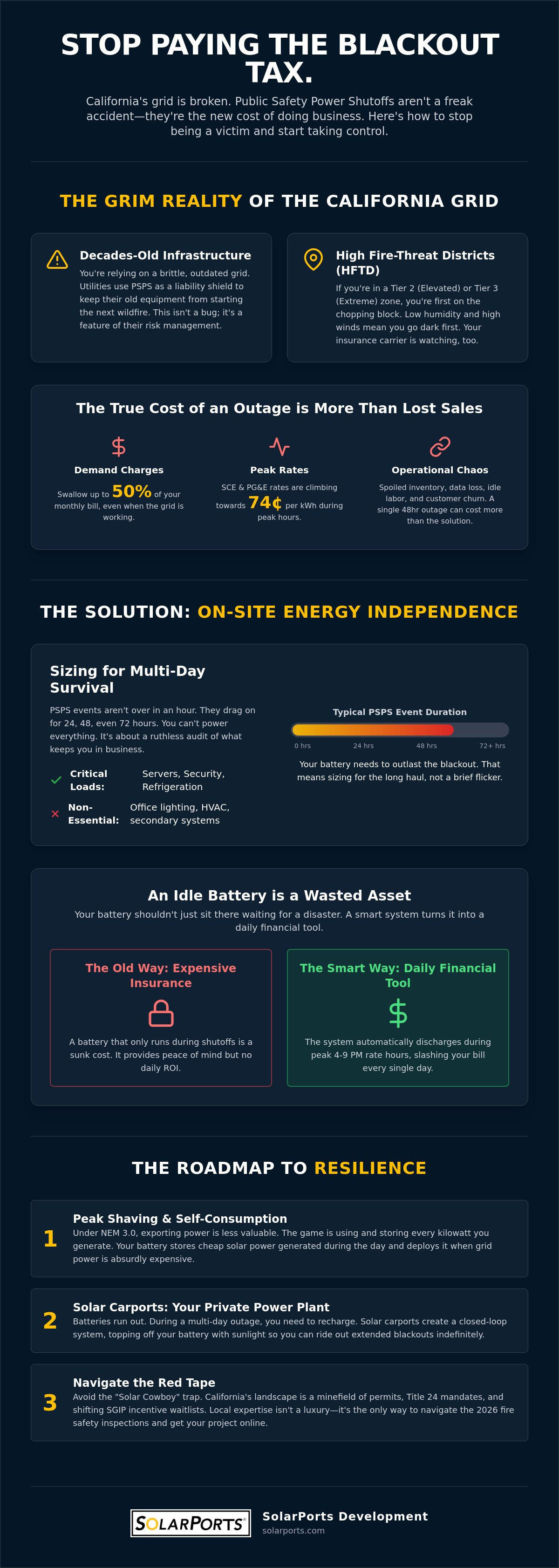
A Public Safety Power Shutoff shouldn't be treated as an unavoidable business tax that you just have to pay every wildfire season. For most California property owners, the real cost isn't just the dark windows during a blackout, it's the 50% of your monthly bill swallowed by demand charges when the grid is actually running. You already know that waiting for the utility to stabilize is a losing game. It's frustrating to watch inventory spoil or data centers go silent while SCE or PG&E peak rates climb toward 74 cents per kilowatt hour.
Investing in commercial battery storage for PSPS events is about more than just keeping the lights on. It's a strategic move to reclaim your energy independence. This guide will show you how to navigate the 2026 landscape, from the current SGIP waitlist realities to the technical requirements of Title 24. You'll learn how to transform a backup necessity into a daily financial asset through peak shaving and maximizing self-consumption under NEM 3.0. We are looking at a turnkey path to lower bills and total operational continuity without forcing you to become an energy expert.
Key Takeaways
- Stop treating utility shutoffs like freak accidents. Learn why aging infrastructure makes these proactive blackouts a permanent part of doing business in California.
- Identify which systems, like servers and security, are non-negotiable so you can properly size your commercial battery storage for PSPS events that often stretch into a second or third day.
- Move beyond simple backup power by using your system to slash demand charges and maximize self-consumption under the strict NEM 3.0 rules.
- Avoid the "Solar Cowboy" trap. Discover why local California expertise is the only way to handle complex permitting and the new 2026 fire safety inspections.
- Get the facts on the current SGIP waitlist and Title 24 mandates so you aren't caught off guard by shifting state requirements or incentive deadlines.
Table of Contents
- Why PSPS Events Are the New Operational Reality for CA Commercial Real Estate
- Sizing Commercial Battery Storage for Multi-Day Resilience
- The Roadmap to PSPS Independence: From Analysis to Activation
Why PSPS Events Are the New Operational Reality for CA Commercial Real Estate
Utilities in California don't ask for permission when the wind picks up. They just pull the plug. A Public Safety Power Shutoff (PSPS) is essentially a proactive liability shield used by providers to prevent their aging infrastructure from sparking wildfires during high-wind events. It's a calculated move. In Northern California, where the grid is particularly brittle and lines are often decades old, commercial properties face a disproportionate risk of being left in the dark for days at a time. This isn't a temporary glitch; it's the standard operating procedure for a grid that can't handle modern climate realities.
Behind-the-meter energy systems are the only logical response to this volatility. Waiting for a utility to modernize its transmission lines is a strategy built on hope, not data. Investing in commercial battery storage for PSPS events allows a business to disconnect from this instability. It turns a vulnerable property into a resilient asset that stays operational when the rest of the block goes dark. If the grid is the problem, the solution has to live on your side of the meter.
The Financial Impact of "Waiting It Out"
The true cost of a blackout isn't just the zero on the revenue report for that afternoon. It's the four hours of lost labor spent resetting equipment, the spoiled inventory in the cold storage, and the long-term customer churn when your competitors stay open and you don't. A single 48-hour outage can easily eclipse the amortized cost of a BESS installation. When you run a commercial property energy cost saving analysis, the math usually favors the one-time investment in resilience over the recurring trauma of unplanned downtime.
Navigating HFTD Tier 2 and Tier 3 Designations
The California Public Utilities Commission (CPUC) classifies regions as High Fire-Threat Districts (HFTD), and your tier dictates your risk profile. Tier 2 represents "elevated" risk, while Tier 3 is "extreme." If your property sits in these zones, you're at the front of the line for shutoffs whenever humidity drops and wind speeds climb. These designations also bleed into your insurance premiums. Carriers are increasingly skeptical of properties without a documented resilience plan. Having a battery system on-site isn't just about power; it's about proving to your insurers and stakeholders that you've mitigated the primary operational risk of the California landscape.
Sizing Commercial Battery Storage for Multi-Day Resilience
Sizing isn't a guessing game. It's a cold, hard audit of your property's survival requirements. Most utility-driven blackouts in California don't wrap up in an hour. They stretch across 24 to 48 hours, which requires a system that doesn't just start the engines but keeps them running. When you specify commercial battery storage for PSPS events, you have to be ruthless about your critical loads. Servers, security systems, and mission-critical refrigeration are non-negotiable. Everything else is a luxury you simply can't afford to power during a multi-day shutoff.
Getting the capacity right requires a commercial energy cost saving analysis to ensure you aren't over-investing in hardware you'll never use. The goal is a lean, high-performance system that matches your specific demand profile. Data from California ISO's 2024 report on battery storage shows that while the state's storage capacity is growing to stabilize the grid, your priority is the behind-the-meter resilience that keeps your doors open when the local circuit fails.
Backup Power vs. Daily Energy Arbitrage
An idle battery is a wasted financial asset. If your BESS only activates during a disaster, it's just an expensive insurance policy. A sophisticated management system uses that same battery to discharge during the brutal 4 PM to 9 PM peak windows when utility rates are highest. This daily energy arbitrage transforms your resilience strategy into a fiscal tool. You stop being a passive consumer and start dictating your own operational costs by avoiding the most expensive power of the day.
The Role of Solar Carports in PSPS Survival
Batteries have a finite limit. During a three-day PSPS event, you need a way to replenish that storage without the grid. Solar carports act as a local power plant, catching the sun to top off your BESS while providing shaded parking for your tenants. It's a closed-loop system. You can see how this infrastructure stacks up in our strategic comparison of solar carports with EV charging. If you're ready to look at your specific load profile, schedule a brief technical review with our team to see what's actually feasible for your site.
The Roadmap to PSPS Independence: From Analysis to Activation
Getting a system live in California is a grind. It's not just about buying the hardware; it's about surviving the bureaucracy. You'll likely encounter "Solar Cowboys" who promise a quick fix but don't actually understand the granular fire codes or the shifting utility hurdles in this state. Local expertise is the only thing that stands between a system that sits in a crate and one that's commissioned and saving you money. We have seen this play out across various SolarPorts projects where local BESS integration was the only way to bypass months of permitting gridlock.
The upfront capital requirement for commercial battery storage for PSPS events is high. There's no point in sugarcoating that. It's a serious investment. However, the incentives available in 2026 are at a strategic peak for those who move now. While California's grid reliability improvements are being documented by the state, the individual property owner still bears the risk of aging local circuits. You are essentially buying your way out of that risk.
Maximizing ROI with SGIP and Federal Tax Credits
The Self-Generation Incentive Program (SGIP) is currently a waitlist game, but it's a game worth playing if you're in a high-fire zone. Even with the waitlist, the federal 30% Investment Tax Credit (ITC) remains a massive financial lever that applies directly to commercial BESS. This credit significantly offsets the initial hit to your CAPEX. For a full breakdown of the fiscal implications, see our 2026 guide for CFOs on solar tax credits.
The Unfiltered Reality of Interconnection
Utilities like PG&E and SCE aren't going to make it easy for you to stop relying on them. The interconnection process is a thicket of red tape and technical requirements that can stall a project for a year if handled poorly. You need a turnkey commercial solar provider who knows which desks the paperwork needs to land on. Managing these utility relationships is half the battle in reaching true energy independence.
Future-Proof Your Property's Energy Strategy
The reality of doing business in California has changed. You can't rely on the grid to be there when the wind picks up, and you shouldn't have to accept massive demand charges as the price of staying connected. Integrating commercial battery storage for PSPS events isn't just about disaster prep; it's about taking control of your daily operational costs. By auditing your critical loads and leveraging peak shaving, you turn an "emergency only" system into a high-performance financial tool that pays for itself even when the sky is clear.
We specialize in small-scale commercial BESS and provide the turnkey California-specific expertise needed to navigate complex fire codes and utility delays. It's better to act while the 30% tax credit and SGIP waitlist options are still on the table. Our data-driven ROI modeling shows exactly how these systems stack up against your specific utility bills, giving you a clear picture of the long-term value.
Ready to see the numbers for your site? Request a custom energy cost saving analysis for your property and get a clear roadmap for 2026. Taking the first step now ensures you're ready before the next shutoff notice hits your inbox.
Common Questions About Commercial Resilience
How long can a commercial battery storage system power my building during a PSPS?
Most systems are designed to provide 4 to 6 hours of power if you are running at full load. However, if you've performed a load audit and only power critical systems like servers and security, that duration can easily stretch to 24 hours or more. When you pair commercial battery storage for PSPS events with an on-site solar carport, you can potentially stay operational indefinitely by recharging the batteries during daylight hours.
Is commercial battery storage worth it if we only have one PSPS event per year?
Yes, because the backup power is actually a secondary benefit to the daily savings. You don't want a system that just sits idle waiting for a disaster. A BESS works every day to offset high Time-of-Use rates and demand charges, which means it's generating a return on investment 365 days a year. The resilience during a blackout is essentially a "free" insurance policy provided by your cost-reduction strategy.
Can I use a commercial battery to lower my monthly demand charges?
This is the primary financial driver for most California business owners. By discharging stored energy when your building's electricity usage spikes, you "shave" the peak that the utility uses to calculate your monthly demand charge. Since these charges can account for up to 50% of your total bill, using a battery to manage these spikes is one of the fastest ways to see a drop in operating expenses.
What is the difference between a backup generator and a BESS for PSPS events?
Generators are reactive, noisy, and require constant fuel deliveries that might not be available during a widespread emergency. They also offer zero financial return when the grid is working. A BESS is silent, requires almost no maintenance, and offers an instantaneous switchover that protects sensitive electronics. Most importantly, a battery system is an active financial asset that saves you money daily, while a generator is a depreciating sunk cost.
Frequently asked questions
The Financial Impact of "Waiting It Out"
The true cost of a blackout isn't just the zero on the revenue report for that afternoon. It's the four hours of lost labor spent resetting equipment, the spoiled inventory in the cold storage, and the long-term customer churn when your competitors stay open and you don't. A single 48-hour outage can easily eclipse the amortized cost of a BESS installation. When you run a commercial property energy cost saving analysis, the math usually favors the one-time investment in resilience over the recurring trauma of unplanned downtime.
Navigating HFTD Tier 2 and Tier 3 Designations
The California Public Utilities Commission (CPUC) classifies regions as High Fire-Threat Districts (HFTD), and your tier dictates your risk profile. Tier 2 represents "elevated" risk, while Tier 3 is "extreme." If your property sits in these zones, you're at the front of the line for shutoffs whenever humidity drops and wind speeds climb. These designations also bleed into your insurance premiums. Carriers are increasingly skeptical of properties without a documented resilience plan. Having a battery system on-site isn't just about power; it's about proving to your insurers and stakeholders that you've mitigated the primary operational risk of the California landscape. Sizing isn't a guessing game. It's a cold, hard audit of your property's survival requirements. Most utility-driven blackouts in California don't wrap up in an hour. They stretch across 24 to 48 hours, which requires a system that doesn't just start the engines but keeps them running. When you specify commercial battery storage for PSPS events, you have to be ruthless about your critical loads. Servers, security systems, and mission-critical refrigeration are non-negotiable. Everything else is a luxury you simply can't afford to power during a multi-day shutoff. Getting the capacity right requires a commercial energy cost saving analysis to ensure you aren't over-investing in hardware you'll never use. The goal is a lean, high-performance system that matches your specific demand profile. Data from California ISO's 2024 report on battery storage shows that while the state's storage capacity is growing to stabilize the grid, your priority is the behind-the-meter resilience that keeps your doors open when the local circuit fails.
Backup Power vs. Daily Energy Arbitrage
An idle battery is a wasted financial asset. If your BESS only activates during a disaster, it's just an expensive insurance policy. A sophisticated management system uses that same battery to discharge during the brutal 4 PM to 9 PM peak windows when utility rates are highest. This daily energy arbitrage transforms your resilience strategy into a fiscal tool. You stop being a passive consumer and start dictating your own operational costs by avoiding the most expensive power of the day.
The Role of Solar Carports in PSPS Survival
Batteries have a finite limit. During a three-day PSPS event, you need a way to replenish that storage without the grid. Solar carports act as a local power plant, catching the sun to top off your BESS while providing shaded parking for your tenants. It's a closed-loop system. You can see how this infrastructure stacks up in our strategic comparison of solar carports with EV charging. If you're ready to look at your specific load profile, schedule a brief technical review with our team to see what's actually feasible for your site. Getting a system live in California is a grind. It's not just about buying the hardware; it's about surviving the bureaucracy. You'll likely encounter "Solar Cowboys" who promise a quick fix but don't actually understand the granular fire codes or the shifting utility hurdles in this state. Local expertise is the only thing that stands between a system that sits in a crate and one that's commissioned and saving you money. We have seen this play out across various SolarPorts projects where local BESS integration was the only way to bypass months of permitting gridlock. The upfront capital requirement for commercial battery storage for PSPS events is high. There's no point in sugarcoating that. It's a serious investment. However, the incentives available in 2026 are at a strategic peak for those who move now. While California's grid reliability improvements are being documented by the state, the individual property owner still bears the risk of aging local circuits. You are essentially buying your way out of that risk.
Maximizing ROI with SGIP and Federal Tax Credits
The Self-Generation Incentive Program (SGIP) is currently a waitlist game, but it's a game worth playing if you're in a high-fire zone. Even with the waitlist, the federal 30% Investment Tax Credit (ITC) remains a massive financial lever that applies directly to commercial BESS. This credit significantly offsets the initial hit to your CAPEX. For a full breakdown of the fiscal implications, see our 2026 guide for CFOs on solar tax credits.
The Unfiltered Reality of Interconnection
Utilities like PG&E and SCE aren't going to make it easy for you to stop relying on them. The interconnection process is a thicket of red tape and technical requirements that can stall a project for a year if handled poorly. You need a turnkey commercial solar provider who knows which desks the paperwork needs to land on. Managing these utility relationships is half the battle in reaching true energy independence. The reality of doing business in California has changed. You can't rely on the grid to be there when the wind picks up, and you shouldn't have to accept massive demand charges as the price of staying connected. Integrating commercial battery storage for PSPS events isn't just about disaster prep; it's about taking control of your daily operational costs. By auditing your critical loads and leveraging peak shaving, you turn an "emergency only" system into a high-performance financial tool that pays for itself even when the sky is clear. We specialize in small-scale commercial BESS and provide the turnkey California-specific expertise needed to navigate complex fire codes and utility delays. It's better to act while the 30% tax credit and SGIP waitlist options are still on the table. Our data-driven ROI modeling shows exactly how these systems stack up against your specific utility bills, giving you a clear picture of the long-term value. Ready to see the numbers for your site? Request a custom energy cost saving analysis for your property and get a clear roadmap for 2026. Taking the first step now ensures you're ready before the next shutoff notice hits your inbox.
How long can a commercial battery storage system power my building during a PSPS?
Most systems are designed to provide 4 to 6 hours of power if you are running at full load. However, if you've performed a load audit and only power critical systems like servers and security, that duration can easily stretch to 24 hours or more. When you pair commercial battery storage for PSPS events with an on-site solar carport, you can potentially stay operational indefinitely by recharging the batteries during daylight hours.
Is commercial battery storage worth it if we only have one PSPS event per year?
Yes, because the backup power is actually a secondary benefit to the daily savings. You don't want a system that just sits idle waiting for a disaster. A BESS works every day to offset high Time-of-Use rates and demand charges, which means it's generating a return on investment 365 days a year. The resilience during a blackout is essentially a "free" insurance policy provided by your cost-reduction strategy.
Can I use a commercial battery to lower my monthly demand charges?
This is the primary financial driver for most California business owners. By discharging stored energy when your building's electricity usage spikes, you "shave" the peak that the utility uses to calculate your monthly demand charge. Since these charges can account for up to 50% of your total bill, using a battery to manage these spikes is one of the fastest ways to see a drop in operating expenses.
What is the difference between a backup generator and a BESS for PSPS events?
Generators are reactive, noisy, and require constant fuel deliveries that might not be available during a widespread emergency. They also offer zero financial return when the grid is working. A BESS is silent, requires almost no maintenance, and offers an instantaneous switchover that protects sensitive electronics. Most importantly, a battery system is an active financial asset that saves you money daily, while a generator is a depreciating sunk cost.