
How to Get a Commercial Energy Audit: A No-Nonsense 2026 Guide

Most California business owners treat an energy audit like a routine compliance check. They do it because a mandate says so, but they rarely expect it to actually fix their overhead. This is a strategic error that leaves thousands of dollars on the table every month. If you're exhausted by unpredictable demand charges and the constant white noise from solar sales reps, you need to understand how to get a commercial energy audit that functions as a financial defensive strategy. With the Section 179D tax deduction sunsetting on June 30, 2026, for new construction, the time for "thinking about it" has officially run out.
It's hard to make a confident investment when California's utility rate structures feel like a moving target. You've likely seen enough "free" assessments to know that if the data isn't rigorous, the ROI won't be either. This guide offers a no-nonsense framework to help you navigate the process without getting buried in useless paperwork. We'll walk through the different ASHRAE audit levels and show you how to secure the validated data you need for a solar or BESS investment. By the end, you'll have a clear path to a prioritized list of upgrades that slash operational costs and protect your bottom line.
Key Takeaways
- Stop guessing which audit level fits your building. You'll learn when a basic walk-through is enough and when a Level 2 survey is mandatory for your 2026 financial planning.
- You can't fix what you haven't measured. We'll show you how to get a commercial energy audit by leveraging 24 months of California interval data to expose hidden demand charges.
- Align your audit findings with specific capital goals. Use the data to validate the exact sizing for a solar carport or a battery system instead of relying on a salesperson's estimate.
- Turn that static PDF into a live strategy. Categorize your results into immediate no-cost fixes and long-term investments that slash your operational overhead for good.
- Learn why interval data is the only metric that matters in California's complex utility market. It's the difference between a generic report and a roadmap to energy independence.
Table of Contents
- Defining the Scope: Which Commercial Energy Audit Level Do You Actually Need?
- The 2026 Checklist for Securing a High-Value Energy Audit
- Beyond the PDF: Turning Audit Findings into Strategic Energy Assets
Defining the Scope: Which Commercial Energy Audit Level Do You Actually Need?
You can't manage what you haven't measured. A commercial energy audit is essentially a forensic deep dive into where your power goes and, more importantly, where it's being wasted. If you're trying to figure out how to get a commercial energy audit that actually moves the needle, you have to start with the right scope. Most owners think an audit is just a technician with a clipboard walking around, but that's only the surface. To get results that show up on a P&L statement, you need to align the depth of the audit with your financial goals.
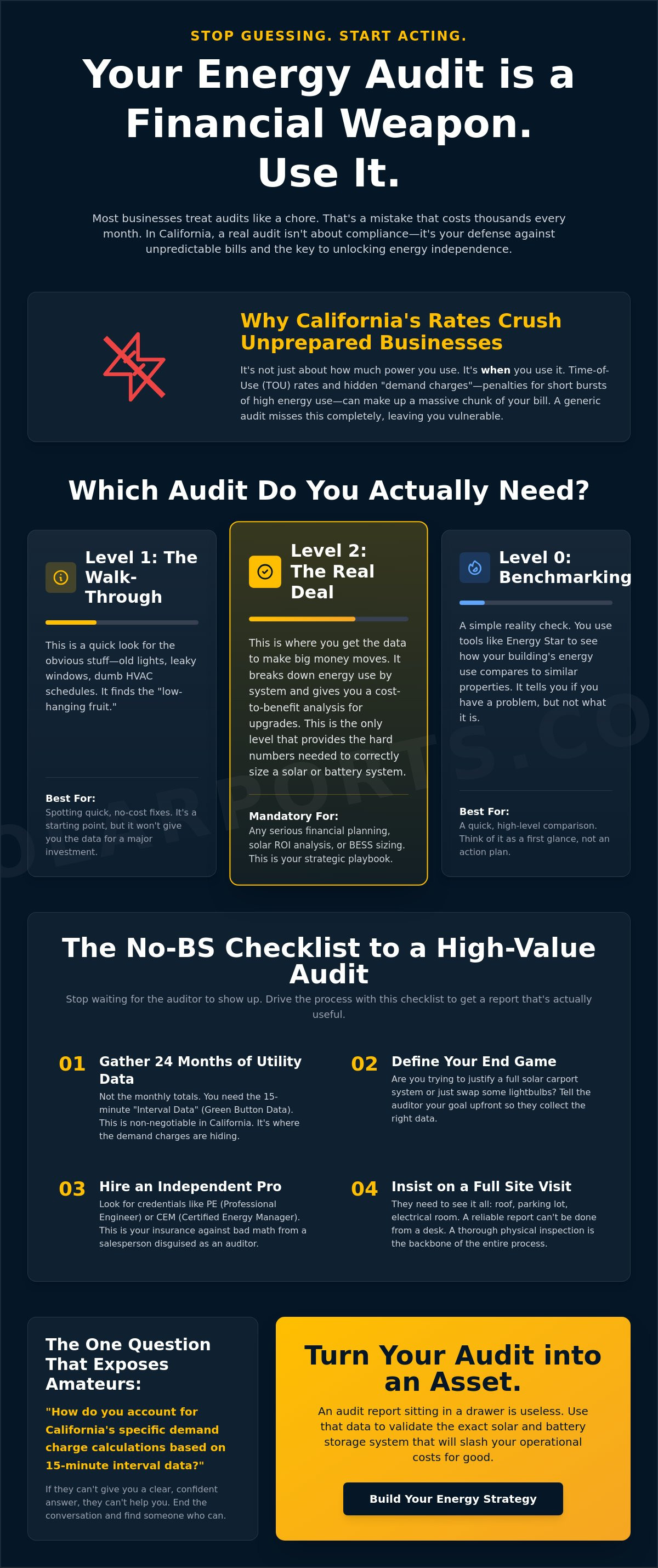
The industry generally follows specific Energy audit levels established by ASHRAE. Understanding these tiers prevents you from overpaying for data you won't use or under-investing in data that's too thin to support a big decision. Here is the breakdown of what you'll actually encounter:
- Level 0: Benchmarking. This is your baseline. You use tools like Energy Star Portfolio Manager to see how your building stacks up against similar properties. It's a reality check, but it won't tell you why your bills are high.
- Level 1: The Walk-Through. This identifies the "low-hanging fruit." It's great for spotting obvious waste like old lighting or poorly timed HVAC schedules. It's a starting point, but it lacks the rigor needed for major investments.
- Level 2: Energy Survey and Analysis. This is the sweet spot for most California businesses. It provides a detailed breakdown of energy use by system and a cost-to-benefit analysis for upgrades. When you're researching how to get a commercial energy audit, this is usually the level that provides enough data for a serious commercial solar ROI analysis.
Why California’s Rate Structures Demand More Than a Generic Walk-Through
In California, the sheer volume of energy you use is only half the problem. Our Time-of-Use (TOU) rates mean that power pulled at 5:00 PM is vastly more expensive than power pulled at 10:00 AM. A generic audit that doesn't account for these timing nuances is useless. You need an audit that identifies peak demand spikes. These short bursts of high usage can account for a massive chunk of your monthly bill. Without this granular data, you can't accurately size a battery system or a solar array to actually kill those charges.
The 2026 Checklist for Securing a High-Value Energy Audit
Hiring an auditor shouldn't feel like a shot in the dark. If you want to know how to get a commercial energy audit that actually provides a return, you have to be the one driving the data. Most property owners wait until the engineer arrives to start looking for bills. That's a mistake. You need to treat the preparation like a financial closing to ensure the final report is worth the paper it's printed on.
- Step 1: Gather 12 to 24 months of utility data. In California, monthly totals aren't enough. You need Interval Data (Green Button data) to see the 15-minute spikes that drive your demand charges.
- Step 2: Define your end game. Are you looking for quick lighting fixes or preparing for turnkey commercial solar in CA? Your auditor needs to know if they're sizing for a roof or a parking lot from day one.
- Step 3: Source an independent auditor. Look for Professional Engineer (PE) or Certified Energy Manager (CEM) credentials. Credentials aren't just alphabet soup; they're your insurance against shoddy math.
- Step 4: Conduct a comprehensive site visit. Ensure they inspect the roof, the parking lot, and the electrical room. Even organizations like NYSERDA energy assessments highlight that a thorough physical inspection is the backbone of any reliable report.
Vetting Your Auditor: Questions That Flush Out the Amateurs
Amateurs focus on consumption. Pros focus on demand. Ask them: 'How do you account for California's specific demand charge calculations?' If they can't explain how 15-minute spikes impact your bill, walk away. You should also verify if the report will include a feasibility study for Battery Energy Storage Systems (BESS). Without that, you're only getting half the story in today's market. If you're ready to stop the guesswork, you can book a strategy session to review your current utility profile.
The Pre-Audit Document Dump: What Your Engineer Actually Needs
Give your engineer what they need before they set foot on-site. Better data leads to a more accurate commercial energy cost saving analysis. You'll need to hand over single-line electrical diagrams, HVAC maintenance logs, and existing lighting schedules. If you have a building automation system, give them access. The more they know about your baseline, the less time they spend guessing and the more time they spend finding ways to cut your overhead.
Beyond the PDF: Turning Audit Findings into Strategic Energy Assets
Once you've figured out how to get a commercial energy audit and the final report lands on your desk, the real work starts. Most property owners make the mistake of treating that document like a compliance trophy. They read the summary, wince at the inefficiencies, and then bury it in a digital folder. Don't do that. You need to treat those findings as raw intelligence for your next fiscal year. A report that doesn't lead to a capital expenditure plan is just an expensive stack of paper.
Start by triaging the results into two distinct buckets. Bucket one contains the "No-Cost/Low-Cost" fixes. These are the operational adjustments like recalibrating HVAC economizers or tightening up lighting schedules that should happen within 30 days. Bucket two contains the "Capital Investment" projects. This is where the real fiscal optimization happens. The load profile provided in a Level 2 audit is exactly what you need to validate the sizing for solar carport systems. Without this verified data, you're just guessing how many parking stalls you actually need to cover to hit your offset targets.
Integrating BESS and Solar to Neutralize Demand Charges
California's "Duck Curve" has shifted the financial burden from energy volume to energy timing. It's no longer enough to just generate power during the day; you have to manage when that power hits the meter. Your audit data acts as the foundation for a Battery Energy Storage System (BESS) strategy by identifying the exact hours where your demand charges peak. When you understand how commercial solar works to chew through your base load, you can then use batteries to surgically strike those expensive spikes. It's about precision. If the audit shows your biggest spike is at 6:00 PM, that's when your BESS needs to discharge. An audit is only as good as the action you take on the data. If you aren't using the report to build a multi-year energy roadmap, you haven't really finished the job.
Stop Treating Energy as an Uncontrollable Expense
California’s utility rates aren't going down. Demand charges will continue to be the silent killer of your operational budget until you have the data to fight back. By now, you should see that a generic walk-through is a waste of time. You need an ASHRAE Level 2 survey backed by 24 months of interval data to build a real financial defense. This isn't about finding old lightbulbs. It's about validating the ROI for turnkey BESS and solar carport systems that actually protect your bottom line.
Understanding how to get a commercial energy audit is only the start. The real value lies in the execution. You need a partner with California-specific expertise who can turn a static report into a commissioned project. We focus on data-driven ROI and seamless integration to ensure your upgrades pay for themselves. Don't let another quarter of unpredictable utility spikes erode your margins while you wait for a "better time" to act.
If you're ready to see exactly where your building is leaking cash, Request a Professional Energy Cost Saving Analysis today. Taking control of your overhead starts with one clear, data-backed decision.
Common Questions Regarding Commercial Energy Audits
How much does a commercial energy audit cost in California?
Costs are almost entirely dependent on the square footage of your property and the ASHRAE level you select. A basic walk-through is the entry-level option, while a Level 2 survey involves significantly more engineering hours and data analysis. You should view this as a strategic investment rather than a sunk cost. Industry data shows a typical audit pays for itself in 8 to 16 months through the energy savings identified in the report.
How long does the auditing process typically take from start to finish?
The timeline usually spans four to eight weeks from the moment you hand over your data to the day you get the final report. The physical site visit is the short part, often wrapping up in a single afternoon. The real work happens afterward. Engineers need time to run load simulations and cross-reference your usage patterns against California's volatile rates. If you want to know how to get a commercial energy audit moving faster, have your diagrams and two years of interval data ready.
Can I perform a DIY energy audit for my business?
You can benchmark your own building using free tools, but a professional audit is non-negotiable for capital planning. DIY checklists are fine for spotting a broken window seal or a light left on in an empty warehouse. They won't, however, give you the rigorous data required to size a BESS or a rooftop solar array. If you need a report that a CFO or a lender will actually trust, you need a Certified Energy Manager to sign off on the math.
What is the difference between an energy audit and a building commissioning report?
An energy audit is a search for new savings opportunities, whereas commissioning is a verification that your current systems are running at peak efficiency. Audit reports tell you what you should install or upgrade to cut costs. Commissioning reports tell you if your existing HVAC or lighting controls are actually following the schedules you've set. Think of the audit as the strategic plan and commissioning as the quality control for your current operations.
Frequently asked questions
Why California’s Rate Structures Demand More Than a Generic Walk-Through
In California, the sheer volume of energy you use is only half the problem. Our Time-of-Use (TOU) rates mean that power pulled at 5:00 PM is vastly more expensive than power pulled at 10:00 AM. A generic audit that doesn't account for these timing nuances is useless. You need an audit that identifies peak demand spikes. These short bursts of high usage can account for a massive chunk of your monthly bill. Without this granular data, you can't accurately size a battery system or a solar array to actually kill those charges. Hiring an auditor shouldn't feel like a shot in the dark. If you want to know how to get a commercial energy audit that actually provides a return, you have to be the one driving the data. Most property owners wait until the engineer arrives to start looking for bills. That's a mistake. You need to treat the preparation like a financial closing to ensure the final report is worth the paper it's printed on.
Vetting Your Auditor: Questions That Flush Out the Amateurs
Amateurs focus on consumption. Pros focus on demand. Ask them: 'How do you account for California's specific demand charge calculations?' If they can't explain how 15-minute spikes impact your bill, walk away. You should also verify if the report will include a feasibility study for Battery Energy Storage Systems (BESS). Without that, you're only getting half the story in today's market. If you're ready to stop the guesswork, you can book a strategy session to review your current utility profile.
The Pre-Audit Document Dump: What Your Engineer Actually Needs
Give your engineer what they need before they set foot on-site. Better data leads to a more accurate commercial energy cost saving analysis. You'll need to hand over single-line electrical diagrams, HVAC maintenance logs, and existing lighting schedules. If you have a building automation system, give them access. The more they know about your baseline, the less time they spend guessing and the more time they spend finding ways to cut your overhead. Once you've figured out how to get a commercial energy audit and the final report lands on your desk, the real work starts. Most property owners make the mistake of treating that document like a compliance trophy. They read the summary, wince at the inefficiencies, and then bury it in a digital folder. Don't do that. You need to treat those findings as raw intelligence for your next fiscal year. A report that doesn't lead to a capital expenditure plan is just an expensive stack of paper. Start by triaging the results into two distinct buckets. Bucket one contains the "No-Cost/Low-Cost" fixes. These are the operational adjustments like recalibrating HVAC economizers or tightening up lighting schedules that should happen within 30 days. Bucket two contains the "Capital Investment" projects. This is where the real fiscal optimization happens. The load profile provided in a Level 2 audit is exactly what you need to validate the sizing for solar carport systems. Without this verified data, you're just guessing how many parking stalls you actually need to cover to hit your offset targets.
Integrating BESS and Solar to Neutralize Demand Charges
California's "Duck Curve" has shifted the financial burden from energy volume to energy timing. It's no longer enough to just generate power during the day; you have to manage when that power hits the meter. Your audit data acts as the foundation for a Battery Energy Storage System (BESS) strategy by identifying the exact hours where your demand charges peak. When you understand how commercial solar works to chew through your base load, you can then use batteries to surgically strike those expensive spikes. It's about precision. If the audit shows your biggest spike is at 6:00 PM, that's when your BESS needs to discharge. An audit is only as good as the action you take on the data. If you aren't using the report to build a multi-year energy roadmap, you haven't really finished the job. California’s utility rates aren't going down. Demand charges will continue to be the silent killer of your operational budget until you have the data to fight back. By now, you should see that a generic walk-through is a waste of time. You need an ASHRAE Level 2 survey backed by 24 months of interval data to build a real financial defense. This isn't about finding old lightbulbs. It's about validating the ROI for turnkey BESS and solar carport systems that actually protect your bottom line. Understanding how to get a commercial energy audit is only the start. The real value lies in the execution. You need a partner with California-specific expertise who can turn a static report into a commissioned project. We focus on data-driven ROI and seamless integration to ensure your upgrades pay for themselves. Don't let another quarter of unpredictable utility spikes erode your margins while you wait for a "better time" to act. If you're ready to see exactly where your building is leaking cash, Request a Professional Energy Cost Saving Analysis today. Taking control of your overhead starts with one clear, data-backed decision.
How much does a commercial energy audit cost in California?
Costs are almost entirely dependent on the square footage of your property and the ASHRAE level you select. A basic walk-through is the entry-level option, while a Level 2 survey involves significantly more engineering hours and data analysis. You should view this as a strategic investment rather than a sunk cost. Industry data shows a typical audit pays for itself in 8 to 16 months through the energy savings identified in the report.
How long does the auditing process typically take from start to finish?
The timeline usually spans four to eight weeks from the moment you hand over your data to the day you get the final report. The physical site visit is the short part, often wrapping up in a single afternoon. The real work happens afterward. Engineers need time to run load simulations and cross-reference your usage patterns against California's volatile rates. If you want to know how to get a commercial energy audit moving faster, have your diagrams and two years of interval data ready.
Can I perform a DIY energy audit for my business?
You can benchmark your own building using free tools, but a professional audit is non-negotiable for capital planning. DIY checklists are fine for spotting a broken window seal or a light left on in an empty warehouse. They won't, however, give you the rigorous data required to size a BESS or a rooftop solar array. If you need a report that a CFO or a lender will actually trust, you need a Certified Energy Manager to sign off on the math.
What is the difference between an energy audit and a building commissioning report?
An energy audit is a search for new savings opportunities, whereas commissioning is a verification that your current systems are running at peak efficiency. Audit reports tell you what you should install or upgrade to cut costs. Commissioning reports tell you if your existing HVAC or lighting controls are actually following the schedules you've set. Think of the audit as the strategic plan and commissioning as the quality control for your current operations.