
Commercial Grid-Tied Battery Storage: A Strategic Financial Asset for 2026

Is your energy bill a fixed cost or a variable drain on your 2026 margins? Most executives still view commercial grid-tied battery storage as a simple insurance policy against blackouts. That's a fundamental misunderstanding of the current California market. With PG&E and SCE pushing rate hikes as high as 12.9 percent this year, the real value of storage isn't in backup power; it's in the aggressive financial arbitrage of peak demand windows.
We know the frustration of watching operational budgets get squeezed by utility charges that feel more like a penalty than a service. Between the 75 percent drop in export credits under NEM 3.0 and the complexity of new time-of-use schedules, the old way of managing power is dead. This article explains how to turn energy storage into a high-performance financial engine. You'll learn the mechanics of mitigating exorbitant demand charges, capturing the 30 percent ITC before the July construction deadline, and engineering a system that reflects your actual property load. It's time to stop paying for utility inefficiency and start optimizing your own ROI.
Key Takeaways
- Stop thinking about batteries as emergency backups and start treating commercial grid-tied battery storage as a financial engine that offsets high-tariff windows every single day.
- Discover how the shift to NEM 3.0 has changed the math on solar, making integrated storage the only viable way to protect your long-term energy ROI in California.
- Get a clear breakdown of the 2026 utility landscape, including how to shield your margins from the aggressive demand charge increases implemented by PG&E and SCE.
- Learn why a "plug-and-play" approach fails and how a detailed commercial property energy cost saving analysis ensures your system is right-sized for your specific operational load.
Table of Contents
- Beyond Backup: Why Grid-Tied Storage is a Financial Asset
- Navigating the 2026 California Utility Landscape
- Implementing a Turnkey BESS: From Analysis to Interconnection
Beyond Backup: Why Grid-Tied Storage is a Financial Asset
A backup battery is an expense. A commercial grid-tied battery storage system is a strategic asset. Most executives confuse the two, assuming a battery's only job is to keep the lights on during a blackout. That perspective ignores the daily reality of the California energy market. A true Battery Energy Storage System (BESS) is synchronized with the utility grid to actively manage your facility's load profile. It doesn't wait for an emergency to provide value. It works 365 days a year to manipulate your utility meter in your favor.
The grid is a market. You need to trade it. By making your energy "dispatchable," batteries allow you to choose when to use your power and when to pull from the utility. You aren't at the mercy of the sun's schedule or the utility's pricing whims. You're using stored energy as a buffer that protects your bottom line from the volatility of the California grid.
The Mechanics of Peak Shaving
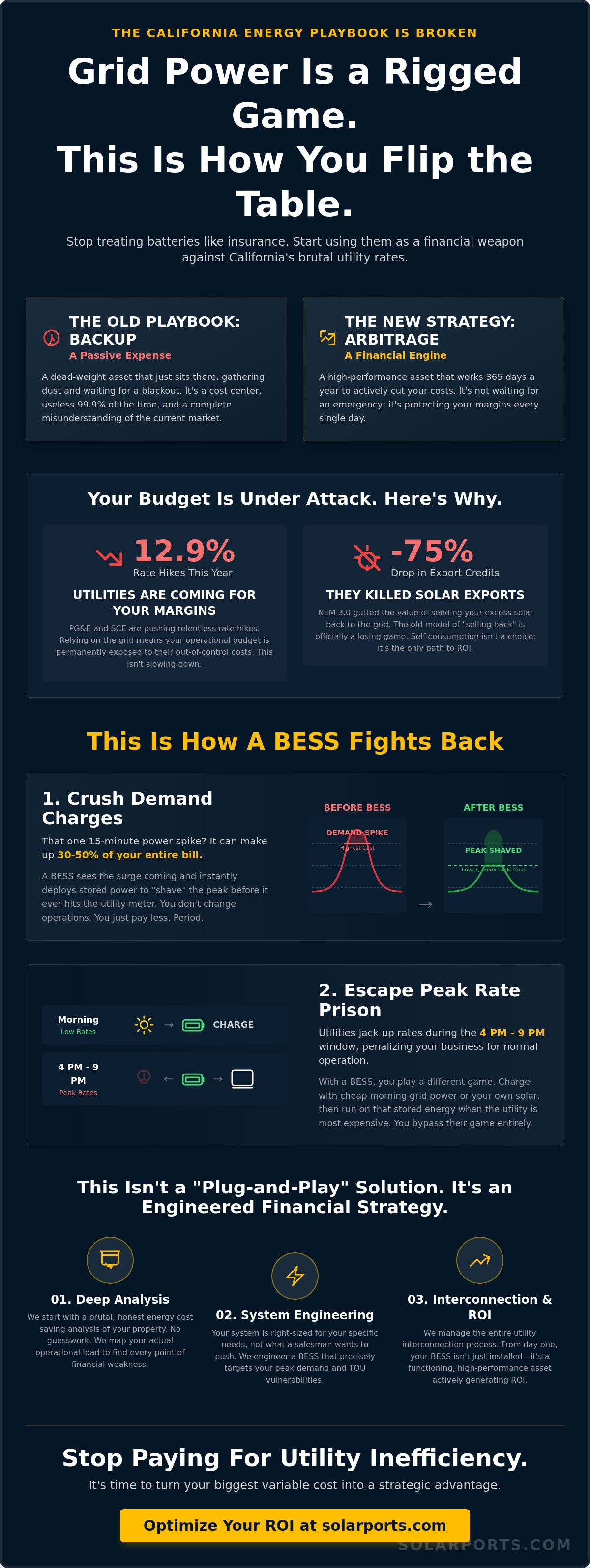
California utilities like PG&E and SCE don't just charge for what you use; they charge for your highest point of demand. One 15-minute spike can account for up to 50 percent of your monthly commercial bill. A BESS uses high-speed analytics to monitor building load in real-time. When it sees a surge coming, it discharges stored power to "shave" the peak before it ever hits the utility meter. This requires a precise commercial property energy cost saving analysis to ensure the battery capacity matches your specific operational spikes. By flattening your load profile, you effectively move your facility into a lower, more predictable tariff tier.
Load Shifting and Time-of-Use (TOU) Optimization
Time-of-Use (TOU) rates are designed to penalize businesses during the 4:00 PM to 9:00 PM window. With PG&E rates projected to rise by an average of 12.4 percent annually through 2027, the cost of doing nothing is climbing. Batteries allow for energy arbitrage. You store cheap morning power and discharge it when rates are at their highest. This bypasses high TOU rates without requiring you to change a single business operation. Instead of selling your solar power back to the grid for a pittance under NEM 3.0, you keep it. You use your own energy exactly when the utility wants to charge you the most.
Navigating the 2026 California Utility Landscape
California's utility market has become a hostile environment for commercial solar-only installations. If you're relying on the old model of selling excess power back to the grid, you're operating on an obsolete playbook. With the 75 percent reduction in export credits under NEM 3.0, the financial logic has shifted entirely from generation to retention. Commercial grid-tied battery storage is no longer a luxury "add-on" for the environmentally conscious; it's the only way to make the numbers work in a post-NEM 2.0 world.
The math is simple but brutal. PG&E rates are projected to climb by an average of 12.4 percent annually through 2027, and SCE is implementing a 12.9 percent hike this year alone. You can't out-generate these increases with solar panels alone because the utility simply won't pay you enough for the overage. You have to keep your electrons on-site. It's the only way to insulate your operational budget from the volatility of the state's investor-owned utilities.
NEM 3.0 and the Shift to Self-Consumption
The goal is no longer to be a mini-power plant for the utility. Under the current Net Billing Tariff, the credits you receive for sending energy back to the grid are worth pennies compared to what you pay to pull that same energy out later. Storage changes the equation. By capturing your solar production and using it internally during high-tariff windows, you effectively "buy back" your own energy at the retail rate. For a deeper look at the hardware requirements for this transition, see our guide on BESS Solutions for Commercial Real Estate.
Demand Charge Reduction: The Silent ROI
Commercial bills are split between energy charges (kWh) and demand charges (kW). While most people focus on the usage, the demand charges, based on your single highest 15-minute window of the month, often represent 30 to 50 percent of the total cost. California utilities are increasingly using these charges to maintain grid stability as they struggle with peak load. Organizations like the GSA have proven the efficacy of this tech, specifically for reducing electric charges driven by peak demand through intelligent storage discharge. It's a surgical strike against the most expensive part of your bill.
To offset the capital expenditure, the Self-Generation Incentive Program (SGIP) remains a critical tool, though funding is tightening. As of June 2026, many general market budgets are waitlisted, but Equity Resiliency tiers still offer up to $1.10/Wh. When you stack these state incentives with the 30 percent federal Investment Tax Credit (ITC), the payback period for a commercial grid-tied battery storage system drops significantly. To see how these incentives apply to your specific facility, you can schedule a strategy session with our analytical team.
Implementing a Turnkey BESS: From Analysis to Interconnection
Commercial storage is not a "plug-and-play" appliance. It is a high-voltage engineering project that requires deep integration with your facility's existing electrical infrastructure. If a vendor suggests you can simply drop a containerized battery onto your property without a rigorous commercial grid-tied battery storage strategy, they are ignoring the complexities of the California fire code and utility interconnection standards. A successful implementation requires a structured, data-first methodology that begins long before the first piece of hardware arrives on-site.
The foundation of any viable project is a Commercial Energy Cost Saving Analysis. We don't guess at your needs. We ingest your historical utility data to model exactly how a battery will interact with your specific load profile. This isn't just about picking a capacity number; it's about engineering a solution that can transform it into a predictable financial asset. Without this granular level of planning, you're essentially gambling with your capital expenditure.
The Role of Data in Right-Sizing
We rely on 15-minute interval data from your utility meter to inform the BESS configuration. This high-resolution view of your energy consumption allows us to identify the exact moments your demand charges spike. Precision matters here. If you oversize the system, your ROI is buried under unnecessary equipment costs. If you undersize it, the battery will deplete before the peak window closes, leaving you exposed to the very charges you're trying to avoid. Right-sizing ensures that every kilowatt-hour of capacity is actively working to lower your bill.
Turnkey Execution in California
Permitting and interconnection in Northern California are notoriously difficult. Navigating the local Authorities Having Jurisdiction (AHJs) and utility bureaucracies requires a partner who understands the specific regional requirements for commercial grid-tied battery storage. A turnkey approach means we handle the entire lifecycle: from the initial engineering and permitting to the final utility commissioning and ongoing performance monitoring. This ensures your business operations remain undisrupted while we move the project through the pipeline. To see how this execution translates into measurable savings, you can review our Commercial Battery Storage Case Studies for real-world examples of California businesses that have already made the transition.
Securing Your Energy ROI in a Volatile California Market
The 2026 utility landscape doesn't reward passive energy management. We've seen how PG&E and SCE are aggressively shifting costs onto commercial properties through demand charges and reduced export credits. Relying on solar alone is a strategy of the past. Implementing commercial grid-tied battery storage is how you reclaim control over your operational expenses. It turns your facility into an active participant in the energy market rather than a victim of it.
We specialize exclusively in California commercial real estate, focusing on turnkey BESS and solar carport solutions that actually deliver. Our process isn't about selling hardware; it's about data-driven right-sizing that ensures your system matches your specific load profile for maximum ROI. You don't need a generic battery. You need a financial asset engineered for your property's reality. There's no reason to leave your margins at the mercy of the next utility rate hike.
It's time to stop overpaying for utility inefficiency and start optimizing your own power. You can Request Your Commercial Energy Cost Saving Analysis today to see the exact numbers for your facility. Let's build a more predictable, cost-effective future for your property.
Frequently Asked Questions
Is grid-tied battery storage the same as a backup generator for my business?
No, they serve completely different strategic purposes. A generator is a reactive tool that sits idle until the power goes out. In contrast, commercial grid-tied battery storage is a proactive financial instrument that works every day. While it can provide backup power, its primary job is to interact with the grid to shave peak demand and arbitrage time-of-use rates. It's a tool for daily cost suppression, not just emergency insurance.
How long does a commercial grid-tied battery system typically last?
You should expect a high-quality system to remain operational for 10 to 15 years. Most commercial-grade Lithium Iron Phosphate (LFP) batteries are rated for 6,000 to 10,000 cycles. While the capacity will naturally degrade slightly over time, sophisticated thermal management systems help preserve the cells. We focus on right-sizing the system during the engineering phase so it continues to hit your ROI targets well into its second decade of service.
Do I need to install solar panels to benefit from commercial battery storage?
You don't need solar to see a financial return, but the two technologies are more effective when paired together. Standalone commercial grid-tied battery storage can still lower your bills through demand charge management and energy arbitrage. However, adding solar allows you to capture the 30 percent federal Investment Tax Credit (ITC) and offsets the low export rates mandated by NEM 3.0. It's about keeping your own generated power on-site rather than selling it back to the utility for pennies.
What is the typical ROI period for a BESS in California in 2026?
Payback periods generally land between four and seven years for most California commercial properties. This timeline depends heavily on your specific utility territory and how aggressively you can stack incentives like the ITC and the Self-Generation Incentive Program (SGIP). With SCE and PG&E implementing double-digit rate hikes this year, the avoided costs are growing. We model these variables during our initial analysis to give you a definitive timeline based on your actual 15-minute interval data.
Frequently asked questions
The Mechanics of Peak Shaving
California utilities like PG&E and SCE don't just charge for what you use; they charge for your highest point of demand. One 15-minute spike can account for up to 50 percent of your monthly commercial bill. A BESS uses high-speed analytics to monitor building load in real-time. When it sees a surge coming, it discharges stored power to "shave" the peak before it ever hits the utility meter. This requires a precise commercial property energy cost saving analysis to ensure the battery capacity matches your specific operational spikes. By flattening your load profile, you effectively move your facility into a lower, more predictable tariff tier.
Load Shifting and Time-of-Use (TOU) Optimization
Time-of-Use (TOU) rates are designed to penalize businesses during the 4:00 PM to 9:00 PM window. With PG&E rates projected to rise by an average of 12.4 percent annually through 2027, the cost of doing nothing is climbing. Batteries allow for energy arbitrage. You store cheap morning power and discharge it when rates are at their highest. This bypasses high TOU rates without requiring you to change a single business operation. Instead of selling your solar power back to the grid for a pittance under NEM 3.0, you keep it. You use your own energy exactly when the utility wants to charge you the most. California's utility market has become a hostile environment for commercial solar-only installations. If you're relying on the old model of selling excess power back to the grid, you're operating on an obsolete playbook. With the 75 percent reduction in export credits under NEM 3.0, the financial logic has shifted entirely from generation to retention. Commercial grid-tied battery storage is no longer a luxury "add-on" for the environmentally conscious; it's the only way to make the numbers work in a post-NEM 2.0 world. The math is simple but brutal. PG&E rates are projected to climb by an average of 12.4 percent annually through 2027, and SCE is implementing a 12.9 percent hike this year alone. You can't out-generate these increases with solar panels alone because the utility simply won't pay you enough for the overage. You have to keep your electrons on-site. It's the only way to insulate your operational budget from the volatility of the state's investor-owned utilities.
NEM 3.0 and the Shift to Self-Consumption
The goal is no longer to be a mini-power plant for the utility. Under the current Net Billing Tariff, the credits you receive for sending energy back to the grid are worth pennies compared to what you pay to pull that same energy out later. Storage changes the equation. By capturing your solar production and using it internally during high-tariff windows, you effectively "buy back" your own energy at the retail rate. For a deeper look at the hardware requirements for this transition, see our guide on BESS Solutions for Commercial Real Estate.
Demand Charge Reduction: The Silent ROI
Commercial bills are split between energy charges (kWh) and demand charges (kW). While most people focus on the usage, the demand charges, based on your single highest 15-minute window of the month, often represent 30 to 50 percent of the total cost. California utilities are increasingly using these charges to maintain grid stability as they struggle with peak load. Organizations like the GSA have proven the efficacy of this tech, specifically for reducing electric charges driven by peak demand through intelligent storage discharge. It's a surgical strike against the most expensive part of your bill. To offset the capital expenditure, the Self-Generation Incentive Program (SGIP) remains a critical tool, though funding is tightening. As of June 2026, many general market budgets are waitlisted, but Equity Resiliency tiers still offer up to $1.10/Wh. When you stack these state incentives with the 30 percent federal Investment Tax Credit (ITC), the payback period for a commercial grid-tied battery storage system drops significantly. To see how these incentives apply to your specific facility, you can schedule a strategy session with our analytical team. Commercial storage is not a "plug-and-play" appliance. It is a high-voltage engineering project that requires deep integration with your facility's existing electrical infrastructure. If a vendor suggests you can simply drop a containerized battery onto your property without a rigorous commercial grid-tied battery storage strategy, they are ignoring the complexities of the California fire code and utility interconnection standards. A successful implementation requires a structured, data-first methodology that begins long before the first piece of hardware arrives on-site. The foundation of any viable project is a Commercial Energy Cost Saving Analysis. We don't guess at your needs. We ingest your historical utility data to model exactly how a battery will interact with your specific load profile. This isn't just about picking a capacity number; it's about engineering a solution that can transform it into a predictable financial asset. Without this granular level of planning, you're essentially gambling with your capital expenditure.
The Role of Data in Right-Sizing
We rely on 15-minute interval data from your utility meter to inform the BESS configuration. This high-resolution view of your energy consumption allows us to identify the exact moments your demand charges spike. Precision matters here. If you oversize the system, your ROI is buried under unnecessary equipment costs. If you undersize it, the battery will deplete before the peak window closes, leaving you exposed to the very charges you're trying to avoid. Right-sizing ensures that every kilowatt-hour of capacity is actively working to lower your bill.
Turnkey Execution in California
Permitting and interconnection in Northern California are notoriously difficult. Navigating the local Authorities Having Jurisdiction (AHJs) and utility bureaucracies requires a partner who understands the specific regional requirements for commercial grid-tied battery storage. A turnkey approach means we handle the entire lifecycle: from the initial engineering and permitting to the final utility commissioning and ongoing performance monitoring. This ensures your business operations remain undisrupted while we move the project through the pipeline. To see how this execution translates into measurable savings, you can review our Commercial Battery Storage Case Studies for real-world examples of California businesses that have already made the transition. The 2026 utility landscape doesn't reward passive energy management. We've seen how PG&E and SCE are aggressively shifting costs onto commercial properties through demand charges and reduced export credits. Relying on solar alone is a strategy of the past. Implementing commercial grid-tied battery storage is how you reclaim control over your operational expenses. It turns your facility into an active participant in the energy market rather than a victim of it. We specialize exclusively in California commercial real estate, focusing on turnkey BESS and solar carport solutions that actually deliver. Our process isn't about selling hardware; it's about data-driven right-sizing that ensures your system matches your specific load profile for maximum ROI. You don't need a generic battery. You need a financial asset engineered for your property's reality. There's no reason to leave your margins at the mercy of the next utility rate hike. It's time to stop overpaying for utility inefficiency and start optimizing your own power. You can Request Your Commercial Energy Cost Saving Analysis today to see the exact numbers for your facility. Let's build a more predictable, cost-effective future for your property.
Is grid-tied battery storage the same as a backup generator for my business?
No, they serve completely different strategic purposes. A generator is a reactive tool that sits idle until the power goes out. In contrast, commercial grid-tied battery storage is a proactive financial instrument that works every day. While it can provide backup power, its primary job is to interact with the grid to shave peak demand and arbitrage time-of-use rates. It's a tool for daily cost suppression, not just emergency insurance.
How long does a commercial grid-tied battery system typically last?
You should expect a high-quality system to remain operational for 10 to 15 years. Most commercial-grade Lithium Iron Phosphate (LFP) batteries are rated for 6,000 to 10,000 cycles. While the capacity will naturally degrade slightly over time, sophisticated thermal management systems help preserve the cells. We focus on right-sizing the system during the engineering phase so it continues to hit your ROI targets well into its second decade of service.
Do I need to install solar panels to benefit from commercial battery storage?
You don't need solar to see a financial return, but the two technologies are more effective when paired together. Standalone commercial grid-tied battery storage can still lower your bills through demand charge management and energy arbitrage. However, adding solar allows you to capture the 30 percent federal Investment Tax Credit (ITC) and offsets the low export rates mandated by NEM 3.0. It's about keeping your own generated power on-site rather than selling it back to the utility for pennies.
What is the typical ROI period for a BESS in California in 2026?
Payback periods generally land between four and seven years for most California commercial properties. This timeline depends heavily on your specific utility territory and how aggressively you can stack incentives like the ITC and the Self-Generation Incentive Program (SGIP). With SCE and PG&E implementing double-digit rate hikes this year, the avoided costs are growing. We model these variables during our initial analysis to give you a definitive timeline based on your actual 15-minute interval data.