
Solar Canopies for Commercial Properties: Turning Parking Lots into Strategic Energy Assets

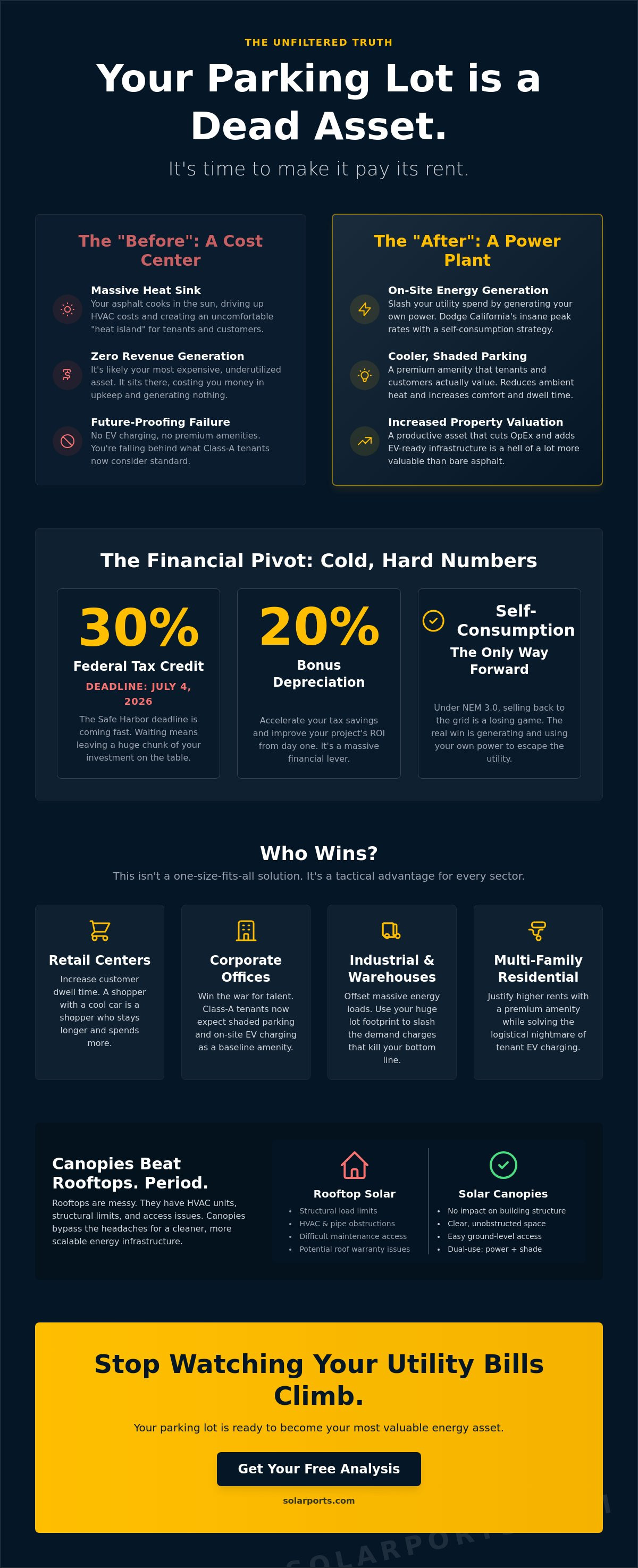
Your parking lot is likely the most expensive underutilized asset on your balance sheet. It sits there, absorbing heat and generating zero revenue, while California utility rates continue their aggressive climb. It's frustrating to watch operational expenses spike because of a grid you can't control. You're probably also hearing it from tenants who want shade and reliable EV charging yesterday. Investing in solar canopies for commercial properties isn't just about being green; it's a cold, hard financial pivot that turns a passive liability into a high-yield energy asset.
I get it. You've looked at the costs and wondered if it's just expensive shade. The reality is that with the July 4, 2026, Safe Harbor deadline for the 30% tax credit fast approaching and new Title 24 mandates in effect, the math has changed. This article breaks down how to slash your utility spend, capture 20% bonus depreciation, and finally build the infrastructure your property needs to stay competitive. We'll look at the specific ROI of pairing carports with battery storage and why waiting past this year could mean leaving significant federal and state incentives on the table.
Key Takeaways
- Stop treating your parking lot as a passive liability; learn how to convert underutilized asphalt into a revenue-generating power plant without losing a single parking space.
- Discover how solar canopies for commercial properties increase property valuation by providing the shaded parking and EV-ready infrastructure that top-tier tenants now demand.
- Understand why the "sell back to the grid" model is dead under NEM 3.0 and how a self-consumption strategy is the only way to truly dodge California's rising utility rates.
- See how different sectors, from retail to corporate offices, use canopy systems to increase customer dwell time and meet strict new Title 24 energy mandates.
Table of Contents
- Beyond Shade: Why Solar Canopies are a Strategic Necessity for CA Commercial Real Estate
- Practical Examples: How Different Commercial Sectors Deploy Solar Canopy Systems
- The Unfiltered Logic of ROI: Financing and BESS Integration in 2026
Beyond Shade: Why Solar Canopies are a Strategic Necessity for CA Commercial Real Estate
Asphalt is a liability. It sits there, absorbing heat and doing exactly nothing for your bottom line. By installing solar canopies, you're putting a roof over a dead asset and turning it into a grid-independent power plant. These aren't just tents; they are elevated steel structures designed to generate megawatt-hours while keeping 100% of your parking capacity. It's a tactical reclassification of space that moves a property from "passive" to "productive."
In Northern California, the irradiance levels are often high enough that parking lots actually outperform rooftops for energy production. Roofs are messy. They have HVAC units, structural limits, and maintenance schedules that don't always play nice with glass panels. Solar canopies for commercial properties bypass these headaches entirely. You get easy ground-level access for maintenance and you don't have to worry about whether a 20-year-old roof can handle the dead load of a new solar array. It's a cleaner, more accessible way to scale your energy infrastructure.
The Asset Monetization Factor
Parking is usually a utility, not a draw. That changes when you offer covered, premium spots that shield vehicles from the sun while simultaneously offsetting your building’s peak load. It's a dual-use benefit that high-value tenants actually notice and value. Integrating these systems requires a specific commercial property energy cost saving analysis to ensure the system is sized for maximum ROI. Property appraisal metrics generally favor a system that slashes operational expenses and adds functional infrastructure over a bare, sun-baked lot.
Solving the "Hot Asphalt" Problem
Large parking lots act as massive thermal sponges. This heat island effect doesn't just make the walk to the office miserable; it forces your HVAC system to work overtime to combat the ambient heat radiating from the ground. Shading that asphalt reduces the thermal impact on the building footprint. It also ensures that when employees or customers leave, they aren't starting up heat-soaked vehicles that require immediate air conditioning, which helps stabilize your site's overall energy demand during those critical peak hours.
Practical Examples: How Different Commercial Sectors Deploy Solar Canopy Systems
Asphalt doesn't pay rent. Solar does. For retail owners, the strategy is about dwell time. If a customer stays an extra twenty minutes because their car isn't baking in the California sun, that's a direct win for the anchor tenant. In the office sector, it's about the war for talent. Class A tenants now view shaded parking and on-site charging as a baseline expectation, not a luxury. Deploying solar canopies for commercial properties transforms a standard parking lot into a visible signal of property quality and operational efficiency.
Industrial and warehouse operators face a different set of pressures. These facilities often have massive lot footprints and equally massive energy loads from cold storage or heavy machinery. Using that open space to generate power allows for a significant reduction in demand charges, which often make up half of a utility bill. Multi-family residential developers are also pivoting to this model. It's a way to provide a premium amenity that justifies higher rents while solving the logistical nightmare of tenant EV charging. The strategic benefits of solar canopies go far beyond simple energy production; they are a tool for land-use optimization in markets where every square foot of real estate is at a premium.
The EV Charging Synergy
Canopies are the natural host for EV charging infrastructure. Trenching across an existing, uncovered lot is expensive and disruptive, but running conduit through a canopy structure is straightforward. It's a cleaner installation that provides immediate shade for vehicles while they charge, which is better for battery health and user comfort. You can check out our recent projects to see how these integrated systems look in a real-world commercial environment.
Design and Structural Considerations
You can't just throw panels on a frame and call it a day. Traffic flow is the priority. T-Frame structures use a single central column to minimize the impact on parking stalls, while Long-Span designs can cover multiple rows but require more careful placement. Getting the geometry right is just as important as the electrical engineering. Every project should start with a rigorous commercial energy cost saving analysis to ensure the system is sized correctly for your specific load profile. If you're ready to see how the numbers look for your specific site, you can book a brief technical review with our team.
The Unfiltered Logic of ROI: Financing and BESS Integration in 2026
NEM 3.0 effectively killed the dream of making a profit by selling power back to the grid. In Northern California, the financial play is now 100% about self-consumption. By using solar canopies for commercial properties, you're essentially locking in your energy costs and avoiding the retail rate hikes that PG&E continues to push through. The goal is to generate exactly what you need and use it on-site, which is the only way to protect your operating margins in the current regulatory environment.
The 2026 incentive landscape provides a massive tailwind for those who can move before the deadlines. To secure the full 30% Federal Investment Tax Credit, construction must begin by July 4, 2026. This isn't just about the ITC; you're also looking at 20% bonus depreciation and a property tax exclusion that won't last forever. Current incentives include:
- 30% Federal ITC: A direct credit against your tax liability that scales with the total project cost.
- 20% Bonus Depreciation: This allows you to front-load the tax benefits by deducting a significant portion of the asset cost in the first year.
- SGIP Rebates: California’s Self-Generation Incentive Program provides upfront cash for storage systems, which is vital for making the battery math pencil out.
Pairing Canopies with Battery Energy Storage Systems (BESS)
Solar alone can't touch demand charges. Those expensive spikes in your bill happen when your building pulls massive power from the grid regardless of the sun. Pairing your canopy with a BESS allows you to "shave" those peaks by discharging stored energy during high-demand intervals. It's a strategy we detailed in our look at commercial solar carport installation in Oakland, where demand charge mitigation often accounts for nearly half of the total system savings.
Maintenance and Longevity
I've seen too many rooftop systems fail because they were simply too hard to get to. Canopies are different. They're accessible from a standard scissor lift, which makes cleaning and electrical inspections a routine task rather than a major logistical hurdle. Modern structures are built for a 25 year lifespan with minimal oversight, meaning you don't need a dedicated team to manage your energy asset. It’s a set-and-forget infrastructure play that stays out of the way of your daily operations.
Securing Your Property’s Energy Independence Before the Deadlines
Your parking lot doesn't have to be a drain on your balance sheet. We've seen how solar canopies for commercial properties transform underutilized asphalt into high-yield energy assets that actually lower your operational spend. By integrating battery storage and EV charging, you're not just checking a sustainability box; you're future-proofing your real estate against a utility grid that only gets more expensive. The window to capture the full 30% federal credit and the California property tax exclusion is closing fast.
Navigating the permitting and utility interconnection process in Northern California is a significant operational burden that requires a specialized partner. We provide turnkey solutions specifically for the California commercial market, handling everything from the initial engineering to high-capacity BESS integration. It's about precision and logical, data-backed planning that protects your bottom line. Get a custom energy cost saving analysis for your property to see the real numbers behind your lot's potential. It's time to stop paying for shade and start generating value.
Frequently Asked Questions
How much does a commercial solar canopy cost compared to rooftop solar?
Solar canopies carry a higher upfront price tag than rooftop systems because you're paying for the substantial steel support structures required to elevate the panels. While rooftop solar is often cheaper per watt, you have to account for the hidden costs of roof structural reinforcements or the risk of voiding your roof warranty. Canopies are a standalone asset that doesn't touch your building's envelope, which often simplifies the long-term maintenance of the property.
Do solar canopies require a lot of maintenance in California's climate?
Maintenance is actually more straightforward for canopies because they are easily accessible from ground level. In California, your biggest operational hurdle is dust accumulation, which can significantly sap your energy production if left unmanaged. A regular cleaning schedule and a quick annual check of the electrical connections are usually all it takes to keep the system running at peak efficiency. It's much safer and faster than sending a crew onto a high-slope roof.
Can I install EV charging stations directly into the solar canopy structure?
You can absolutely integrate EV charging stations directly into the steel columns of solar canopies for commercial properties. It's the most efficient way to build out charging infrastructure because the canopy acts as a natural conduit path and protects the charging hardware from direct sun. This configuration avoids the high cost of trenching through your existing asphalt and provides a much better experience for tenants or customers who want to charge in the shade.
What is the typical ROI period for a commercial solar canopy in California?
The average payback period for these systems in California currently sits between 3 to 7 years. This timeline is heavily influenced by how aggressively you use the 30% federal tax credit and the 20% bonus depreciation available for 2026. Because California has some of the highest utility rates in the country, the delta between what you pay the utility and what you generate yourself is wide enough to drive a very fast return on investment.
Will a solar canopy interfere with my parking lot's traffic flow or drainage?
A well-engineered canopy system is designed to be invisible to your traffic flow. We use T-frame structures that place columns at the head of parking stalls so they don't interfere with car doors or tight turning radiuses. Drainage is also handled through integrated gutter systems within the structure itself. This prevents water from sheeting off the panels and creating puddles or ice patches in your drive aisles, keeping the lot safe for pedestrians.
Do I need to upgrade my electrical panel to install a solar parking canopy?
It depends on your building's existing capacity, but many solar canopies for commercial properties do require some level of electrical infrastructure adjustment. We look at your current switchgear and load profile during the initial analysis to see if a full upgrade is necessary or if we can use a line-side tap. The goal is always to find the most cost-effective way to tie the new energy asset into your building's main power distribution without over-engineering the hardware.
Frequently asked questions
The Asset Monetization Factor
Parking is usually a utility, not a draw. That changes when you offer covered, premium spots that shield vehicles from the sun while simultaneously offsetting your building’s peak load. It's a dual-use benefit that high-value tenants actually notice and value. Integrating these systems requires a specific commercial property energy cost saving analysis to ensure the system is sized for maximum ROI. Property appraisal metrics generally favor a system that slashes operational expenses and adds functional infrastructure over a bare, sun-baked lot.
Solving the "Hot Asphalt" Problem
Large parking lots act as massive thermal sponges. This heat island effect doesn't just make the walk to the office miserable; it forces your HVAC system to work overtime to combat the ambient heat radiating from the ground. Shading that asphalt reduces the thermal impact on the building footprint. It also ensures that when employees or customers leave, they aren't starting up heat-soaked vehicles that require immediate air conditioning, which helps stabilize your site's overall energy demand during those critical peak hours. Asphalt doesn't pay rent. Solar does. For retail owners, the strategy is about dwell time. If a customer stays an extra twenty minutes because their car isn't baking in the California sun, that's a direct win for the anchor tenant. In the office sector, it's about the war for talent. Class A tenants now view shaded parking and on-site charging as a baseline expectation, not a luxury. Deploying solar canopies for commercial properties transforms a standard parking lot into a visible signal of property quality and operational efficiency. Industrial and warehouse operators face a different set of pressures. These facilities often have massive lot footprints and equally massive energy loads from cold storage or heavy machinery. Using that open space to generate power allows for a significant reduction in demand charges, which often make up half of a utility bill. Multi-family residential developers are also pivoting to this model. It's a way to provide a premium amenity that justifies higher rents while solving the logistical nightmare of tenant EV charging. The strategic benefits of solar canopies go far beyond simple energy production; they are a tool for land-use optimization in markets where every square foot of real estate is at a premium.
The EV Charging Synergy
Canopies are the natural host for EV charging infrastructure. Trenching across an existing, uncovered lot is expensive and disruptive, but running conduit through a canopy structure is straightforward. It's a cleaner installation that provides immediate shade for vehicles while they charge, which is better for battery health and user comfort. You can check out our recent projects to see how these integrated systems look in a real-world commercial environment.
Design and Structural Considerations
You can't just throw panels on a frame and call it a day. Traffic flow is the priority. T-Frame structures use a single central column to minimize the impact on parking stalls, while Long-Span designs can cover multiple rows but require more careful placement. Getting the geometry right is just as important as the electrical engineering. Every project should start with a rigorous commercial energy cost saving analysis to ensure the system is sized correctly for your specific load profile. If you're ready to see how the numbers look for your specific site, you can book a brief technical review with our team. NEM 3.0 effectively killed the dream of making a profit by selling power back to the grid. In Northern California, the financial play is now 100% about self-consumption. By using solar canopies for commercial properties, you're essentially locking in your energy costs and avoiding the retail rate hikes that PG&E continues to push through. The goal is to generate exactly what you need and use it on-site, which is the only way to protect your operating margins in the current regulatory environment. The 2026 incentive landscape provides a massive tailwind for those who can move before the deadlines. To secure the full 30% Federal Investment Tax Credit, construction must begin by July 4, 2026. This isn't just about the ITC; you're also looking at 20% bonus depreciation and a property tax exclusion that won't last forever. Current incentives include:
Pairing Canopies with Battery Energy Storage Systems (BESS)
Solar alone can't touch demand charges. Those expensive spikes in your bill happen when your building pulls massive power from the grid regardless of the sun. Pairing your canopy with a BESS allows you to "shave" those peaks by discharging stored energy during high-demand intervals. It's a strategy we detailed in our look at commercial solar carport installation in Oakland, where demand charge mitigation often accounts for nearly half of the total system savings.
Maintenance and Longevity
I've seen too many rooftop systems fail because they were simply too hard to get to. Canopies are different. They're accessible from a standard scissor lift, which makes cleaning and electrical inspections a routine task rather than a major logistical hurdle. Modern structures are built for a 25 year lifespan with minimal oversight, meaning you don't need a dedicated team to manage your energy asset. It’s a set-and-forget infrastructure play that stays out of the way of your daily operations. Your parking lot doesn't have to be a drain on your balance sheet. We've seen how solar canopies for commercial properties transform underutilized asphalt into high-yield energy assets that actually lower your operational spend. By integrating battery storage and EV charging, you're not just checking a sustainability box; you're future-proofing your real estate against a utility grid that only gets more expensive. The window to capture the full 30% federal credit and the California property tax exclusion is closing fast. Navigating the permitting and utility interconnection process in Northern California is a significant operational burden that requires a specialized partner. We provide turnkey solutions specifically for the California commercial market, handling everything from the initial engineering to high-capacity BESS integration. It's about precision and logical, data-backed planning that protects your bottom line. Get a custom energy cost saving analysis for your property to see the real numbers behind your lot's potential. It's time to stop paying for shade and start generating value.
How much does a commercial solar canopy cost compared to rooftop solar?
Solar canopies carry a higher upfront price tag than rooftop systems because you're paying for the substantial steel support structures required to elevate the panels. While rooftop solar is often cheaper per watt, you have to account for the hidden costs of roof structural reinforcements or the risk of voiding your roof warranty. Canopies are a standalone asset that doesn't touch your building's envelope, which often simplifies the long-term maintenance of the property.
Do solar canopies require a lot of maintenance in California's climate?
Maintenance is actually more straightforward for canopies because they are easily accessible from ground level. In California, your biggest operational hurdle is dust accumulation, which can significantly sap your energy production if left unmanaged. A regular cleaning schedule and a quick annual check of the electrical connections are usually all it takes to keep the system running at peak efficiency. It's much safer and faster than sending a crew onto a high-slope roof.
Can I install EV charging stations directly into the solar canopy structure?
You can absolutely integrate EV charging stations directly into the steel columns of solar canopies for commercial properties. It's the most efficient way to build out charging infrastructure because the canopy acts as a natural conduit path and protects the charging hardware from direct sun. This configuration avoids the high cost of trenching through your existing asphalt and provides a much better experience for tenants or customers who want to charge in the shade.
What is the typical ROI period for a commercial solar canopy in California?
The average payback period for these systems in California currently sits between 3 to 7 years. This timeline is heavily influenced by how aggressively you use the 30% federal tax credit and the 20% bonus depreciation available for 2026. Because California has some of the highest utility rates in the country, the delta between what you pay the utility and what you generate yourself is wide enough to drive a very fast return on investment.
Will a solar canopy interfere with my parking lot's traffic flow or drainage?
A well-engineered canopy system is designed to be invisible to your traffic flow. We use T-frame structures that place columns at the head of parking stalls so they don't interfere with car doors or tight turning radiuses. Drainage is also handled through integrated gutter systems within the structure itself. This prevents water from sheeting off the panels and creating puddles or ice patches in your drive aisles, keeping the lot safe for pedestrians.
Do I need to upgrade my electrical panel to install a solar parking canopy?
It depends on your building's existing capacity, but many solar canopies for commercial properties do require some level of electrical infrastructure adjustment. We look at your current switchgear and load profile during the initial analysis to see if a full upgrade is necessary or if we can use a line-side tap. The goal is always to find the most cost-effective way to tie the new energy asset into your building's main power distribution without over-engineering the hardware.