
EV Charging Station Revenue for Retail Centers in CA: The 2026 Strategic Reality

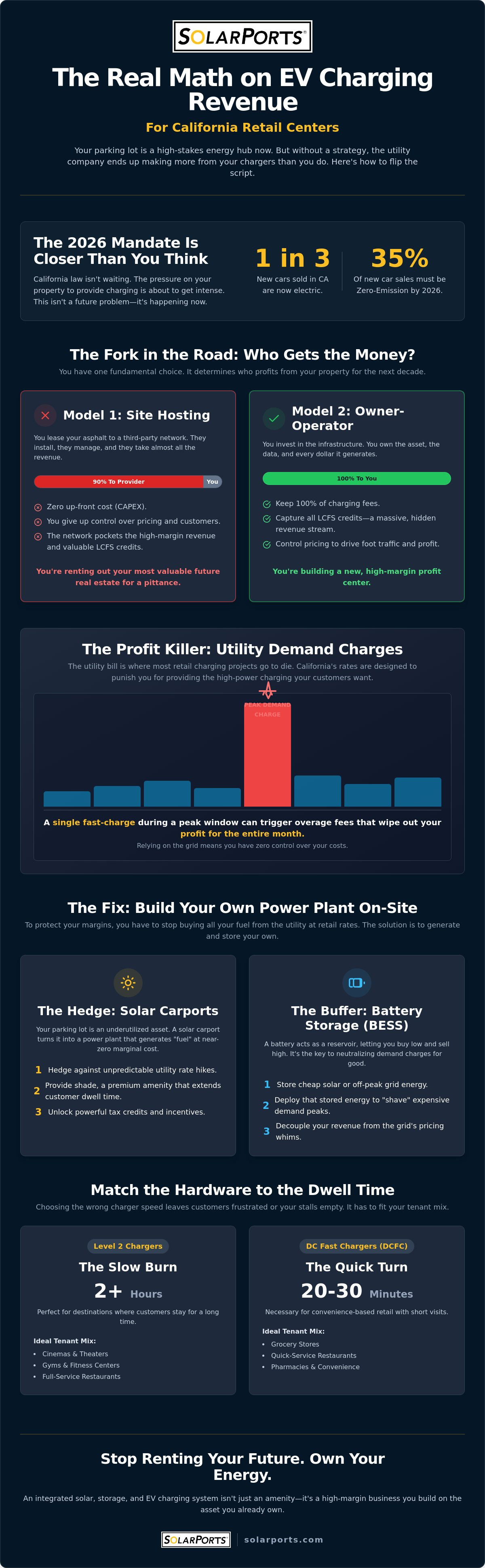
In California, nearly one out of every three new cars hitting the road is now electric. By the end of 2026, state law mandates that 35% of all new light-duty sales must be zero-emission vehicles. If you own a retail center, your parking lot is no longer just a place for cars to sit; it's a high-stakes energy hub. But the math of EV charging station revenue for retail centers CA is often buried under opaque utility pricing and the looming threat of peak demand charges. You're right to be skeptical of the "plug and play" promises. Most owners realize that without a strategy, the utility company ends up making more from your chargers than you do.
This guide cuts through the noise to show you exactly how to turn those stalls into high-margin assets. We're going to look at why relying on the grid alone is a losing game in 2026. You'll see how integrating solar and battery storage creates a buffer against the subscription-based rate hikes from utilities like PG&E and SDG&E. We'll break down the 2026 tax credits, the reality of 97% uptime requirements, and how to choose a charging speed that actually fits your tenant mix. It's about engineering a path to ROI that doesn't vanish the moment a customer plugs in.
Key Takeaways
- Decide whether to trade away your long-term margins for the ease of site hosting or take the owner-operator route to keep 100% of the charging fees.
- Stop letting utility demand charges eat your profits by using solar carports and battery storage to lock in predictable energy costs.
- Maximize your EV charging station revenue for retail centers CA by starting with a rigorous cost saving analysis rather than just picking a hardware vendor.
- Right-size your infrastructure now to avoid the massive expense of retrofitting your lot when California's 2026 zero-emission mandates really start to squeeze your tenants.
Table of Contents
- The Retail Revenue Split: Site Hosting vs. Owner-Operator Models
- California’s Margin Killer: Neutralizing Demand Charges with Solar
- Executing Your 2026 Strategy: From Analysis to Turnkey ROI
The Retail Revenue Split: Site Hosting vs. Owner-Operator Models
California retail owners are currently staring at a fundamental choice. You can either lease your asphalt to a third party or own the infrastructure yourself. While hosting sounds like an easy win, it often dilutes the potential for EV charging station revenue for retail centers CA by siphoning off the highest margins to the network provider. Site hosting is the "easy" button. A provider pays for the hardware and installation, gives you a small slice of the fees, and handles the maintenance. It's zero CAPEX. But you're essentially handing over your most valuable future real estate for a pittance. By 2026, as 35% of new cars sold in the state go electric, that parking spot becomes a profit center you no longer control.
Ownership is the play for those focused on long term gains. You take on the initial cost, but you keep every cent of the charging fees. More importantly, you own the data and the customer relationship. You decide if a charge is free with a $50 grocery receipt or if it's a premium DC fast charge for a commuter in a hurry. Matching the hardware to your tenant mix is critical here. A cinema or a gym works perfectly with Level 2 chargers because customers stay for hours. A grocery store or a quick-service restaurant needs DCFC to match a 20 minute dwell time. Choosing the wrong speed for your electric vehicle charging station setup will either leave customers frustrated or leave your stalls empty.
Direct Revenue: Fees, Memberships, and Credits
In California, you aren't just selling electrons. You're selling Low Carbon Fuel Standard (LCFS) credits. These credits are a massive revenue stream that third party hosts usually pocket. When you own the meter, you generate these credits for every kilowatt hour delivered. Add in per-kWh pricing and membership tiers, and the margin starts to look very different than a flat lease check. It's about capturing the full value of the energy you're moving.
Indirect Revenue: The Foot Traffic Multiplier
The real win is the halo effect. EV drivers generally have higher disposable income and they shop where they can charge. They don't just sit in the car; they walk into your stores. Data suggests these drivers stay longer and spend more, making charging a sticky amenity that helps you land and keep high quality anchor tenants. You can see how we've integrated these systems into actual sites on our projects page.
California’s Margin Killer: Neutralizing Demand Charges with Solar
The utility bill is usually where retail charging projects go to die. You might think you're making a spread on the electricity you sell, but California's rate structures are designed to penalize the exact kind of high-power draw that EV chargers require. If you're on PG&E’s BEV2 rate, for example, you're paying a subscription for every 50 kW block of power. If a driver’s session pushes you over that limit, you're hit with overage fees that are double the normal rate. This volatility is the single greatest threat to EV charging station revenue for retail centers CA. Without a way to manage these spikes, a single fast-charge session during a peak window can effectively wipe out your profit for the entire month.
Southern California Edison (SCE) customers have a temporary reprieve with demand charges paused until 2030, but that's a short window in the life of a commercial asset. Smart owners are already looking at how to decouple their revenue from the grid's pricing whims. Relying solely on the utility means you're a middleman with no control over your COGS (Cost of Goods Sold). To actually protect your margins, you have to stop buying all your fuel from the utility at retail rates.
The Solar Carport Synergy
Your parking lot is currently an underutilized asset that absorbs heat and requires maintenance. By installing solar carport systems for commercial properties, you turn that asphalt into a dedicated power plant. This isn't just about "going green"; it's a cold-blooded financial hedge. You're generating "fuel" for $0 marginal cost. Beyond the energy, these structures provide shade that keeps cars cool and customers happy, which naturally extends dwell time. When you combine this with various California EV charging incentives, the math for a combined solar and charging rollout becomes much more attractive than a standalone install.
Peak Shaving with BESS
Battery Energy Storage Systems (BESS) act as the ultimate buffer for your bottom line. Think of a battery as a reservoir. You fill it up when solar production is high or when grid prices are at their lowest. When multiple EVs plug in at once and threaten to trigger a massive demand spike, the BESS "shaves" that peak by discharging stored energy. This prevents you from crossing into those expensive utility overage tiers. You can even play the arbitrage game: store cheap midnight power and sell it to drivers at a premium during the afternoon rush. If you want to see if your site is a candidate for this kind of setup, it's worth scheduling a brief strategy session to look at your current load profile.
Executing Your 2026 Strategy: From Analysis to Turnkey ROI
Hardware is the final step of a successful rollout, not the beginning. Most retail owners rush to pick a charging brand before they've even looked at their switchgear. This is a fast way to blow your budget on unplanned transformer upgrades. Maximizing EV charging station revenue for retail centers CA requires a cold, hard look at your current infrastructure and your long term energy profile. You don't want to overbuild for 2030 demand today; however, you also can't afford to tear up your lot twice because you didn't lay enough conduit the first time.
Navigating the incentive landscape is equally critical. The Federal Section 30C tax credit offers a 30% credit for qualified property, capped at $100,000 per item, but it's tied to specific census tracts. Combine that with California's strict 97% uptime requirements for state-funded chargers, and the operational burden starts to look heavy. This is why a turnkey approach is the only way to maintain sanity. Managing separate contractors for trenching, electrical, solar, and software integration is a project management nightmare that usually leads to finger-pointing when the chargers go offline.
The Critical Role of Property Analysis
Before you sign a hardware contract, you need to know exactly what your site can handle. A professional commercial energy cost saving analysis identifies where you can find capacity without triggering a massive utility overhaul. It's about finding the "sweet spot" where your charging speed matches customer dwell time without blowing your peak demand limit. We look for the path of least resistance in your existing electrical room to keep installation costs from eating your ROI.
Future-Proofing and Scaling
Modular designs are your best friend. You might start with four stalls today, but with California's 35% ZEV sales requirement hitting in 2026, you'll need to scale quickly. We focus on "make-ready" infrastructure that allows you to add ports as adoption grows. This strategy should be part of your broader strategies to lower commercial electricity bills. By integrating charging into your total energy footprint, you turn a potential liability into a controlled, high-margin asset.
Turning Your Parking Lot into a Strategic Asset
The 2026 mandates aren't a suggestion; they're a deadline for every retail owner in California. Your parking lot is either going to be a drain on your operational budget or a significant profit center. Securing long-term EV charging station revenue for retail centers CA depends on whether you're willing to move past the simple leasing models and take control of your infrastructure. By combining ownership with solar carports and battery storage, you bypass the grid's volatility and keep the margins for yourself. It's the difference between being a landlord and being an energy producer.
Execution requires a partner who understands the nuance of BESS integration and how to model ROI using real utility load profiles. We specialize in providing turnkey solutions for California commercial real estate that actually make sense on a balance sheet. Before you commit to a hardware vendor or tear up your asphalt, get the numbers right. You can Request a Turnkey Energy Cost Saving Analysis to see exactly how these integrated systems perform at your specific location. Let's build something that actually pays for itself.
Common Questions on California Retail Charging
Is EV charging profitable for retail centers in California?
Yes, but profitability depends on your ownership model and how you handle utility costs. Direct EV charging station revenue for retail centers CA is generated through a combination of charging fees and Low Carbon Fuel Standard (LCFS) credits. The real profit multiplier is the "retail halo" effect. High-income EV drivers tend to stay longer and spend more at your tenants' businesses while their vehicles are plugged in, which increases the overall value of your commercial asset.
How much does it cost to install a commercial EV charging station in CA?
Costs vary significantly based on the charging speed and the amount of asphalt you have to move. A single Level 2 port usually costs between $4,500 and $12,000, while a DC fast charging port ranges from $90,000 to $200,000. You also have to account for infrastructure work. Trenching across a paved lot typically adds $40 to $120 per linear foot, which is why a thorough energy cost saving analysis is necessary to avoid overspending on electrical upgrades.
Can I use solar panels to power my retail EV chargers?
You absolutely can, and in California, it's often the only way to protect your margins. Solar carports allow you to generate "free" fuel for your chargers, effectively bypassing the utility's demand charges. When you pair these panels with a battery energy storage system, you can store cheap solar power during the day and sell it to drivers at a premium during peak hours. It turns your parking lot into a self-sustaining power plant that isn't at the mercy of grid price hikes.
What is the difference between Level 2 and DC Fast Charging for retail?
The main difference is the "dwell time" they require from your customers. Level 2 chargers are slower and best suited for malls or cinemas where people naturally stay for two to four hours. DC Fast Charging provides a significant charge in 20 to 60 minutes, making it the better choice for grocery stores or quick-service restaurants. If you install Level 2 chargers at a convenience store, they won't get used; if you put DCFC at a cinema, drivers will have to leave their movie to move their car.
Frequently asked questions
Direct Revenue: Fees, Memberships, and Credits
In California, you aren't just selling electrons. You're selling Low Carbon Fuel Standard (LCFS) credits. These credits are a massive revenue stream that third party hosts usually pocket. When you own the meter, you generate these credits for every kilowatt hour delivered. Add in per-kWh pricing and membership tiers, and the margin starts to look very different than a flat lease check. It's about capturing the full value of the energy you're moving.
Indirect Revenue: The Foot Traffic Multiplier
The real win is the halo effect. EV drivers generally have higher disposable income and they shop where they can charge. They don't just sit in the car; they walk into your stores. Data suggests these drivers stay longer and spend more, making charging a sticky amenity that helps you land and keep high quality anchor tenants. You can see how we've integrated these systems into actual sites on our projects page. The utility bill is usually where retail charging projects go to die. You might think you're making a spread on the electricity you sell, but California's rate structures are designed to penalize the exact kind of high-power draw that EV chargers require. If you're on PG&E’s BEV2 rate, for example, you're paying a subscription for every 50 kW block of power. If a driver’s session pushes you over that limit, you're hit with overage fees that are double the normal rate. This volatility is the single greatest threat to EV charging station revenue for retail centers CA. Without a way to manage these spikes, a single fast-charge session during a peak window can effectively wipe out your profit for the entire month. Southern California Edison (SCE) customers have a temporary reprieve with demand charges paused until 2030, but that's a short window in the life of a commercial asset. Smart owners are already looking at how to decouple their revenue from the grid's pricing whims. Relying solely on the utility means you're a middleman with no control over your COGS (Cost of Goods Sold). To actually protect your margins, you have to stop buying all your fuel from the utility at retail rates.
The Solar Carport Synergy
Your parking lot is currently an underutilized asset that absorbs heat and requires maintenance. By installing solar carport systems for commercial properties, you turn that asphalt into a dedicated power plant. This isn't just about "going green"; it's a cold-blooded financial hedge. You're generating "fuel" for $0 marginal cost. Beyond the energy, these structures provide shade that keeps cars cool and customers happy, which naturally extends dwell time. When you combine this with various California EV charging incentives, the math for a combined solar and charging rollout becomes much more attractive than a standalone install.
Peak Shaving with BESS
Battery Energy Storage Systems (BESS) act as the ultimate buffer for your bottom line. Think of a battery as a reservoir. You fill it up when solar production is high or when grid prices are at their lowest. When multiple EVs plug in at once and threaten to trigger a massive demand spike, the BESS "shaves" that peak by discharging stored energy. This prevents you from crossing into those expensive utility overage tiers. You can even play the arbitrage game: store cheap midnight power and sell it to drivers at a premium during the afternoon rush. If you want to see if your site is a candidate for this kind of setup, it's worth scheduling a brief strategy session to look at your current load profile. Hardware is the final step of a successful rollout, not the beginning. Most retail owners rush to pick a charging brand before they've even looked at their switchgear. This is a fast way to blow your budget on unplanned transformer upgrades. Maximizing EV charging station revenue for retail centers CA requires a cold, hard look at your current infrastructure and your long term energy profile. You don't want to overbuild for 2030 demand today; however, you also can't afford to tear up your lot twice because you didn't lay enough conduit the first time. Navigating the incentive landscape is equally critical. The Federal Section 30C tax credit offers a 30% credit for qualified property, capped at $100,000 per item, but it's tied to specific census tracts. Combine that with California's strict 97% uptime requirements for state-funded chargers, and the operational burden starts to look heavy. This is why a turnkey approach is the only way to maintain sanity. Managing separate contractors for trenching, electrical, solar, and software integration is a project management nightmare that usually leads to finger-pointing when the chargers go offline.
The Critical Role of Property Analysis
Before you sign a hardware contract, you need to know exactly what your site can handle. A professional commercial energy cost saving analysis identifies where you can find capacity without triggering a massive utility overhaul. It's about finding the "sweet spot" where your charging speed matches customer dwell time without blowing your peak demand limit. We look for the path of least resistance in your existing electrical room to keep installation costs from eating your ROI.
Future-Proofing and Scaling
Modular designs are your best friend. You might start with four stalls today, but with California's 35% ZEV sales requirement hitting in 2026, you'll need to scale quickly. We focus on "make-ready" infrastructure that allows you to add ports as adoption grows. This strategy should be part of your broader strategies to lower commercial electricity bills. By integrating charging into your total energy footprint, you turn a potential liability into a controlled, high-margin asset. The 2026 mandates aren't a suggestion; they're a deadline for every retail owner in California. Your parking lot is either going to be a drain on your operational budget or a significant profit center. Securing long-term EV charging station revenue for retail centers CA depends on whether you're willing to move past the simple leasing models and take control of your infrastructure. By combining ownership with solar carports and battery storage, you bypass the grid's volatility and keep the margins for yourself. It's the difference between being a landlord and being an energy producer. Execution requires a partner who understands the nuance of BESS integration and how to model ROI using real utility load profiles. We specialize in providing turnkey solutions for California commercial real estate that actually make sense on a balance sheet. Before you commit to a hardware vendor or tear up your asphalt, get the numbers right. You can Request a Turnkey Energy Cost Saving Analysis to see exactly how these integrated systems perform at your specific location. Let's build something that actually pays for itself.
Is EV charging profitable for retail centers in California?
Yes, but profitability depends on your ownership model and how you handle utility costs. Direct EV charging station revenue for retail centers CA is generated through a combination of charging fees and Low Carbon Fuel Standard (LCFS) credits. The real profit multiplier is the "retail halo" effect. High-income EV drivers tend to stay longer and spend more at your tenants' businesses while their vehicles are plugged in, which increases the overall value of your commercial asset.
How much does it cost to install a commercial EV charging station in CA?
Costs vary significantly based on the charging speed and the amount of asphalt you have to move. A single Level 2 port usually costs between $4,500 and $12,000, while a DC fast charging port ranges from $90,000 to $200,000. You also have to account for infrastructure work. Trenching across a paved lot typically adds $40 to $120 per linear foot, which is why a thorough energy cost saving analysis is necessary to avoid overspending on electrical upgrades.
Can I use solar panels to power my retail EV chargers?
You absolutely can, and in California, it's often the only way to protect your margins. Solar carports allow you to generate "free" fuel for your chargers, effectively bypassing the utility's demand charges. When you pair these panels with a battery energy storage system, you can store cheap solar power during the day and sell it to drivers at a premium during peak hours. It turns your parking lot into a self-sustaining power plant that isn't at the mercy of grid price hikes.
What is the difference between Level 2 and DC Fast Charging for retail?
The main difference is the "dwell time" they require from your customers. Level 2 chargers are slower and best suited for malls or cinemas where people naturally stay for two to four hours. DC Fast Charging provides a significant charge in 20 to 60 minutes, making it the better choice for grocery stores or quick-service restaurants. If you install Level 2 chargers at a convenience store, they won't get used; if you put DCFC at a cinema, drivers will have to leave their movie to move their car.