
Level 3 EV Charger Installation for Sacramento Businesses: A 2026 Strategic Blueprint

Installing a Level 3 charger is often the fastest way to wreck a commercial property's operating budget. You've likely seen the data on the 94,000 EVs already moving through the SMUD service territory, but what the sales brochures don't mention is how a single DC fast charger can trigger utility demand charges that devour your ROI. It's a frustrating reality where providing a necessary service for your tenants feels like a financial penalty from the grid.
We're here to fix that. This blueprint offers a direct, no-nonsense roadmap for level 3 EV charger installation for business Sacramento, focusing on the infrastructure and financial hurdles property owners actually face in 2026. You'll learn how to navigate local permitting bottlenecks and how to use commercial solar or battery energy storage systems (BESS) to kill demand charges before they hit your statement. We're moving past the basic installation steps and focusing on the strategic energy management required to keep your facility's overhead under control.
Key Takeaways
- SMUD and PG&E have completely different playbooks for high-capacity power, so you need to map your property’s panel limits before committing to hardware.
- We break down the "Sacramento Streamline" permitting process to help you bypass the typical bureaucratic bottlenecks that stall local infrastructure projects.
- A level 3 EV charger installation for business Sacramento only makes financial sense if you have a plan to neutralize the massive demand charges that come with fast charging.
- Learn why modular power cabinets are often a smarter long-term bet than standalone units if you plan on scaling your charging capacity through 2026 and beyond.
- Discover how pairing your chargers with BESS or solar carports allows you to shave peak loads and keep your monthly utility bills predictable.
Table of Contents
- Assessing the Sacramento Grid: Power Capacity and Utility Realities
- The Installation Process: A Practical Roadmap for DC Fast Charging
- Protecting Your Bottom Line: Mitigation of Demand Charges through Solar and BESS
Assessing the Sacramento Grid: Power Capacity and Utility Realities
Level 3 charging isn't just a hardware upgrade; it's a massive infrastructure overhaul. Most Sacramento commercial panels are built to handle lighting, HVAC, and standard office equipment. They aren't designed for the instantaneous, heavy draw of DC fast charging. When you look at different EV charging levels, it becomes clear that Level 3 requires a direct current feed that completely bypasses the vehicle's onboard charger. This puts a tremendous strain on your existing electrical service that standard switchgear simply can't handle.
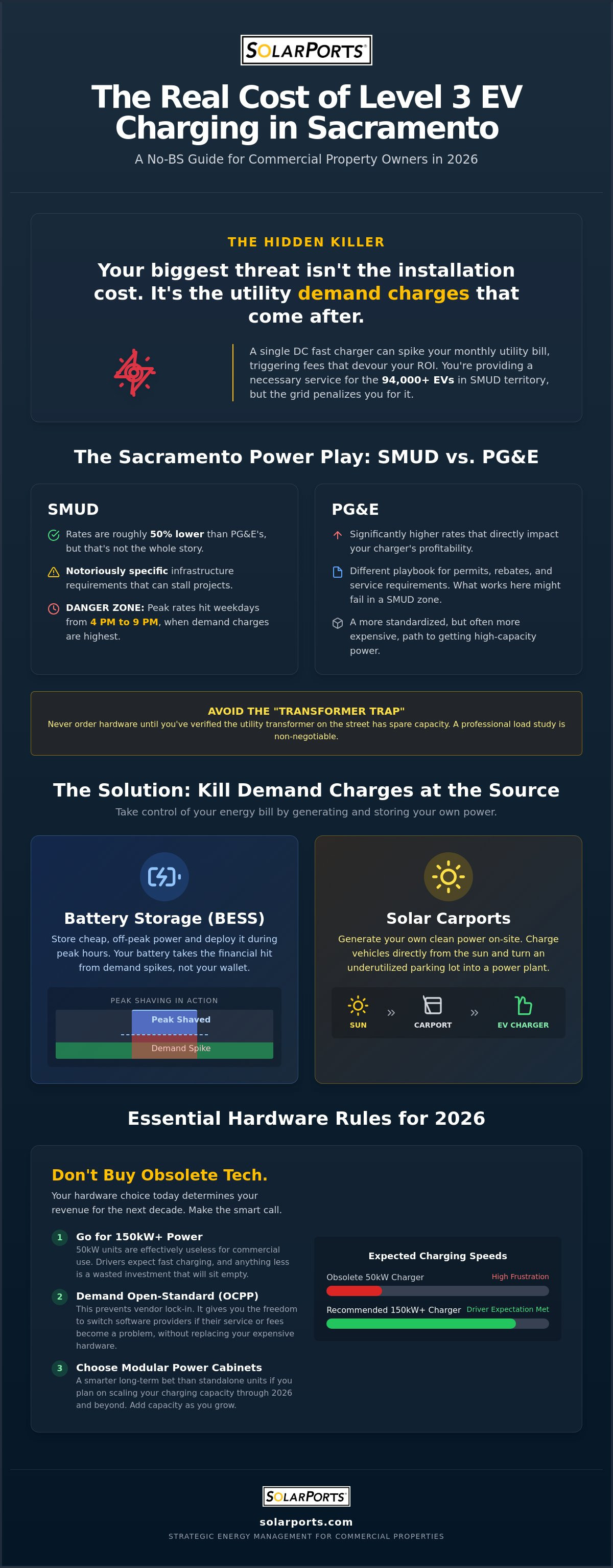
The utility landscape in the Sacramento metro area is split between SMUD and PG&E. This matters more than most owners realize. SMUD’s rates are roughly 50% lower than PG&E’s, but their infrastructure requirements for a level 3 EV charger installation for business Sacramento are notoriously specific. You might find that a configuration approved in a PG&E territory won't fly in a SMUD zone. Navigating these different rebate structures and service requirements requires a localized strategy rather than a generic template.
We often see owners fall into the "Transformer Trap." They order expensive hardware before verifying if the utility transformer on the street has the spare capacity to feed it. If it doesn't, you're looking at months of delays and a potentially massive bill for a utility-side upgrade. A professional load study is the only way to avoid this. Beyond the electrical capacity, you have to account for the physical site constraints. Long trenching runs through reinforced concrete or the need for new pad-mounted switchgear can easily double your initial budget estimates if you haven't mapped the site properly.
The Crucial Role of an Energy Cost Saving Analysis
You shouldn't pick a charger brand until you've completed a commercial energy cost saving analysis. This step ensures the project is right-sized for your actual needs. It also helps you evaluate how a Level 3 draw will impact your specific utility rate schedule. For instance, SMUD’s 2026 summer peak rates are highest between 4 p.m. and 9 p.m. weekdays. Without a plan to manage that load, a single charging session during those hours could trigger demand charges that wipe out your monthly profit margins.
The Installation Process: A Practical Roadmap for DC Fast Charging
Once you've confirmed your property can actually take the load, the focus shifts to the physical and bureaucratic grind. A level 3 EV charger installation for business Sacramento depends heavily on the "Sacramento Streamline" process. This isn't just a fancy name for a permit queue; it's a specific set of building codes that dictate everything from conduit depth to the exact placement of your disconnect switches. If you miss a detail in the initial plan check, you aren't just looking at a week's delay. You're looking at potentially digging up fresh asphalt because a city inspector didn't like your trenching route.
The physical build out is where budgets often bleed. Trenching through a parking lot is expensive, and pad mounting a modular power cabinet requires precision that standard contractors might overlook. You also have to deal with the reality of commissioning. Your chargers need to be networked for payment and monitoring from day one, which means your IT infrastructure needs to be as robust as your electrical feed. We've seen projects stall for weeks simply because the cellular signal at the back of the lot wasn't strong enough to process a credit card transaction.
Navigating Permitting and ADA Compliance
California accessibility standards are some of the strictest in the country. When we look at previous projects, the biggest challenge is often placing chargers so they meet ADA requirements without losing three or four valuable parking stalls. Sacramento has specific rules about "path of travel" and van-accessible spaces that can force you to rethink your entire site layout. It's a balancing act between compliance and convenience.
Hardware Selection and Future-Proofing
Don't buy 50kW units. They are effectively obsolete for commercial use in 2026. Drivers expect 150kW or higher, and anything less will lead to underutilized equipment. You should also insist on open-standard (OCPP) hardware. This prevents vendor lock-in, allowing you to switch software providers if their service or fees become a problem. Since SMUD commercial rates are tied so closely to how and when you draw power, having hardware that talks to your management software is non-negotiable. If this feels like too many moving parts, you might want to speak with an infrastructure specialist before signing any equipment contracts.
Protecting Your Bottom Line: Mitigation of Demand Charges through Solar and BESS
The fastest way to lose money on a charger is to ignore the meter. Most owners treat a DCFC unit like a big appliance, but it's actually a localized grid event. When you pull the trigger on a level 3 EV charger installation for business Sacramento, you're adding a massive, intermittent load to your property. If that load spikes during SMUD's summer peak hours, 4 p.m. to 9 p.m., your bill is effectively ruined. You aren't just paying for the kilowatt-hours; you're paying a massive demand charge for the "capacity" to provide that power. It's a structural trap that can turn a necessary amenity into a permanent fiscal drain.
You have to break the link between the charger and the grid's peak rates. By integrating commercial battery storage, you can engage in "peak shaving." The battery handles the heavy, instantaneous draw of the charging session while your building’s pull from the utility remains flat and predictable. This turns a volatile expense into a managed operational cost.
The Strategic Advantage of Solar Carports
Parking lots are usually just dead space that absorbs heat. Installing commercial solar carports turns that asphalt into a localized power plant. This setup provides dual value by giving tenants shaded parking while feeding your chargers with "behind-the-meter" power. It’s a logical way to reduce the need for expensive utility service upgrades because you're generating a significant chunk of that high-draw energy on-site.
Integrating Battery Storage (BESS)
A BESS for commercial resiliency is the only way to truly future-proof high-speed charging. It manages the California "duck curve" by storing solar energy during the day and discharging it when the sun drops but charging demand stays high. With the federal 30C tax credit offering up to 30% back for projects placed in service by June 30, 2026, the financial argument for these integrated systems is finally catching up to the technology. You're moving from being a passive utility customer to a strategic energy manager.
Securing Your 2026 Energy Infrastructure
High-speed charging isn't a luxury amenity anymore. It's a fundamental shift in how Sacramento commercial property is valued. A level 3 EV charger installation for business Sacramento requires more than just a hardware purchase; it demands a deep understanding of the local grid and the financial foresight to neutralize demand charges. You've likely seen how one bad month of utility spikes can wreck your quarterly projections. The goal is to move from reactive infrastructure to proactive energy management that pays for itself.
We specialize in Northern California commercial real estate, providing the turnkey BESS and solar integration that generic vendors often overlook. Our data-driven ROI modeling ensures you aren't guessing at the numbers or the grid capacity. If you're ready to stop worrying about the meter and start maximizing your property’s potential, let's look at the data. Request your Sacramento Commercial Energy Cost Saving Analysis today. You have a path to a self-sustaining asset, and we're here to help you build it.
Frequently Asked Questions
How much power does a Level 3 charger actually require for a Sacramento business?
A single Level 3 charger typically pulls between 50kW and 350kW depending on the hardware you select. For context, a standard Level 2 unit only draws about 7kW to 19kW. This massive jump in power is why you can't just plug these into existing commercial panels. You're essentially adding the equivalent of a small industrial facility's load to your property with just one or two charging handles.
Do I need a new transformer from SMUD for DC fast charging installation?
Most businesses will need a transformer upgrade from SMUD because the existing local grid infrastructure isn't built for high-speed DC charging. If your site is already running near its peak capacity, adding a Level 3 unit will likely exceed the transformer's thermal limits. You'll want to coordinate with SMUD early to see if they need to drop a new pad-mounted transformer to support the installation.
How long does the permitting process take for EV chargers in Sacramento?
The permitting process in Sacramento generally takes between two and four months for a complex DC fast charge project. While the city's "Streamline" process helps move things along, you still have to clear planning, building, and utility reviews. It's the utility side that often drags on the longest, especially when you're waiting for SMUD to approve a service upgrade for a level 3 EV charger installation for business Sacramento.
Can I use solar carports to power my Level 3 chargers directly?
You can use solar carports to feed your chargers, but they work best when paired with a battery system. Since Level 3 chargers pull way more power than a few solar panels can produce in real-time, the battery acts as a buffer. It collects solar energy all day and dumps it into the vehicle during a charge. This setup is the most effective way to handle a level 3 EV charger installation for business Sacramento without triggering utility spikes.
What are the current California incentives for commercial Level 3 EVSE in 2026?
As of 2026, the federal 30C tax credit offers up to 30% of the project cost, capped at $100,000 per charger, provided you meet prevailing wage rules. Locally, SMUD offers rebates up to $30,000 for public DC fast chargers. CALeVIP also remains a major player, offering up to $80,000 per charger in disadvantaged communities. Just remember that the federal credit is currently set to expire on June 30, 2026.
What is the difference between Level 2 and Level 3 charging for my customers?
The main difference for your customers is speed and how the power is delivered. Level 2 uses alternating current (AC) and takes several hours to top off a battery, making it better for long-term parking or employees. Level 3 uses direct current (DC) and can deliver an 80% charge in about 20 to 40 minutes. It turns your property into a destination for quick stops rather than just a place to park.
Frequently asked questions
The Crucial Role of an Energy Cost Saving Analysis
You shouldn't pick a charger brand until you've completed a commercial energy cost saving analysis. This step ensures the project is right-sized for your actual needs. It also helps you evaluate how a Level 3 draw will impact your specific utility rate schedule. For instance, SMUD’s 2026 summer peak rates are highest between 4 p.m. and 9 p.m. weekdays. Without a plan to manage that load, a single charging session during those hours could trigger demand charges that wipe out your monthly profit margins. Once you've confirmed your property can actually take the load, the focus shifts to the physical and bureaucratic grind. A level 3 EV charger installation for business Sacramento depends heavily on the "Sacramento Streamline" process. This isn't just a fancy name for a permit queue; it's a specific set of building codes that dictate everything from conduit depth to the exact placement of your disconnect switches. If you miss a detail in the initial plan check, you aren't just looking at a week's delay. You're looking at potentially digging up fresh asphalt because a city inspector didn't like your trenching route. The physical build out is where budgets often bleed. Trenching through a parking lot is expensive, and pad mounting a modular power cabinet requires precision that standard contractors might overlook. You also have to deal with the reality of commissioning. Your chargers need to be networked for payment and monitoring from day one, which means your IT infrastructure needs to be as robust as your electrical feed. We've seen projects stall for weeks simply because the cellular signal at the back of the lot wasn't strong enough to process a credit card transaction.
Navigating Permitting and ADA Compliance
California accessibility standards are some of the strictest in the country. When we look at previous projects, the biggest challenge is often placing chargers so they meet ADA requirements without losing three or four valuable parking stalls. Sacramento has specific rules about "path of travel" and van-accessible spaces that can force you to rethink your entire site layout. It's a balancing act between compliance and convenience.
Hardware Selection and Future-Proofing
Don't buy 50kW units. They are effectively obsolete for commercial use in 2026. Drivers expect 150kW or higher, and anything less will lead to underutilized equipment. You should also insist on open-standard (OCPP) hardware. This prevents vendor lock-in, allowing you to switch software providers if their service or fees become a problem. Since SMUD commercial rates are tied so closely to how and when you draw power, having hardware that talks to your management software is non-negotiable. If this feels like too many moving parts, you might want to speak with an infrastructure specialist before signing any equipment contracts. The fastest way to lose money on a charger is to ignore the meter. Most owners treat a DCFC unit like a big appliance, but it's actually a localized grid event. When you pull the trigger on a level 3 EV charger installation for business Sacramento, you're adding a massive, intermittent load to your property. If that load spikes during SMUD's summer peak hours, 4 p.m. to 9 p.m., your bill is effectively ruined. You aren't just paying for the kilowatt-hours; you're paying a massive demand charge for the "capacity" to provide that power. It's a structural trap that can turn a necessary amenity into a permanent fiscal drain. You have to break the link between the charger and the grid's peak rates. By integrating commercial battery storage, you can engage in "peak shaving." The battery handles the heavy, instantaneous draw of the charging session while your building’s pull from the utility remains flat and predictable. This turns a volatile expense into a managed operational cost.
The Strategic Advantage of Solar Carports
Parking lots are usually just dead space that absorbs heat. Installing commercial solar carports turns that asphalt into a localized power plant. This setup provides dual value by giving tenants shaded parking while feeding your chargers with "behind-the-meter" power. It’s a logical way to reduce the need for expensive utility service upgrades because you're generating a significant chunk of that high-draw energy on-site.
Integrating Battery Storage (BESS)
A BESS for commercial resiliency is the only way to truly future-proof high-speed charging. It manages the California "duck curve" by storing solar energy during the day and discharging it when the sun drops but charging demand stays high. With the federal 30C tax credit offering up to 30% back for projects placed in service by June 30, 2026, the financial argument for these integrated systems is finally catching up to the technology. You're moving from being a passive utility customer to a strategic energy manager. High-speed charging isn't a luxury amenity anymore. It's a fundamental shift in how Sacramento commercial property is valued. A level 3 EV charger installation for business Sacramento requires more than just a hardware purchase; it demands a deep understanding of the local grid and the financial foresight to neutralize demand charges. You've likely seen how one bad month of utility spikes can wreck your quarterly projections. The goal is to move from reactive infrastructure to proactive energy management that pays for itself. We specialize in Northern California commercial real estate, providing the turnkey BESS and solar integration that generic vendors often overlook. Our data-driven ROI modeling ensures you aren't guessing at the numbers or the grid capacity. If you're ready to stop worrying about the meter and start maximizing your property’s potential, let's look at the data. Request your Sacramento Commercial Energy Cost Saving Analysis today. You have a path to a self-sustaining asset, and we're here to help you build it.
How much power does a Level 3 charger actually require for a Sacramento business?
A single Level 3 charger typically pulls between 50kW and 350kW depending on the hardware you select. For context, a standard Level 2 unit only draws about 7kW to 19kW. This massive jump in power is why you can't just plug these into existing commercial panels. You're essentially adding the equivalent of a small industrial facility's load to your property with just one or two charging handles.
Do I need a new transformer from SMUD for DC fast charging installation?
Most businesses will need a transformer upgrade from SMUD because the existing local grid infrastructure isn't built for high-speed DC charging. If your site is already running near its peak capacity, adding a Level 3 unit will likely exceed the transformer's thermal limits. You'll want to coordinate with SMUD early to see if they need to drop a new pad-mounted transformer to support the installation.
How long does the permitting process take for EV chargers in Sacramento?
The permitting process in Sacramento generally takes between two and four months for a complex DC fast charge project. While the city's "Streamline" process helps move things along, you still have to clear planning, building, and utility reviews. It's the utility side that often drags on the longest, especially when you're waiting for SMUD to approve a service upgrade for a level 3 EV charger installation for business Sacramento.
Can I use solar carports to power my Level 3 chargers directly?
You can use solar carports to feed your chargers, but they work best when paired with a battery system. Since Level 3 chargers pull way more power than a few solar panels can produce in real-time, the battery acts as a buffer. It collects solar energy all day and dumps it into the vehicle during a charge. This setup is the most effective way to handle a level 3 EV charger installation for business Sacramento without triggering utility spikes.
What are the current California incentives for commercial Level 3 EVSE in 2026?
As of 2026, the federal 30C tax credit offers up to 30% of the project cost, capped at $100,000 per charger, provided you meet prevailing wage rules. Locally, SMUD offers rebates up to $30,000 for public DC fast chargers. CALeVIP also remains a major player, offering up to $80,000 per charger in disadvantaged communities. Just remember that the federal credit is currently set to expire on June 30, 2026.
What is the difference between Level 2 and Level 3 charging for my customers?
The main difference for your customers is speed and how the power is delivered. Level 2 uses alternating current (AC) and takes several hours to top off a battery, making it better for long-term parking or employees. Level 3 uses direct current (DC) and can deliver an 80% charge in about 20 to 40 minutes. It turns your property into a destination for quick stops rather than just a place to park.