
Commercial Solar PPA Benefits in Northern California: The 2026 Executive Reality

By June 2026, PG&E electricity rates reached nearly $0.50 per kWh. This surge represents a fundamental decoupling from operational reality, transforming utility expenses from a standard line item into a volatile liability that threatens corporate margins. You likely recognize that traditional energy procurement has become a gamble against a monopoly you can't control. This article demonstrates how to regain fiscal authority by leveraging Power Purchase Agreements (PPAs) to optimize your commercial solar ROI Northern California while bypassing the typical barriers of high capital requirements.
We agree that unpredictable peak demand charges and aging infrastructure create an unacceptable level of financial risk for your portfolio. We promise to provide a pragmatic roadmap for eliminating upfront costs and securing predictable energy forecasting for the next two decades. We'll explore the mechanics of 2026 PPA structures, the critical integration of Battery Energy Storage Systems (BESS), and the specific regulatory deadlines that make immediate action a fiduciary necessity.
Key Takeaways
- Assess how a zero-down PPA structure hedges against volatile utility rates by transferring all system maintenance and performance risks to a specialized provider.
- Discover how integrating Battery Energy Storage Systems (BESS) optimizes your commercial solar ROI Northern California by neutralizing expensive 4 PM to 9 PM peak demand charges.
- Identify the critical performance guarantees and turnkey management requirements necessary to navigate Northern California's complex permitting and interconnection backlogs.
- Explore the strategic advantage of solar carports in transforming underutilized parking assets into high-yield energy generation zones for properties with limited roof space.
Table of Contents
- The Financial Logic: Why Northern California Commercial PPAs Outperform Ownership in 2026
- Vetting PPA Providers: What Actually Moves the Needle for Your Property
- Maximizing the Agreement: BESS and Solar Carport Integration
The Financial Logic: Why Northern California Commercial PPAs Outperform Ownership in 2026
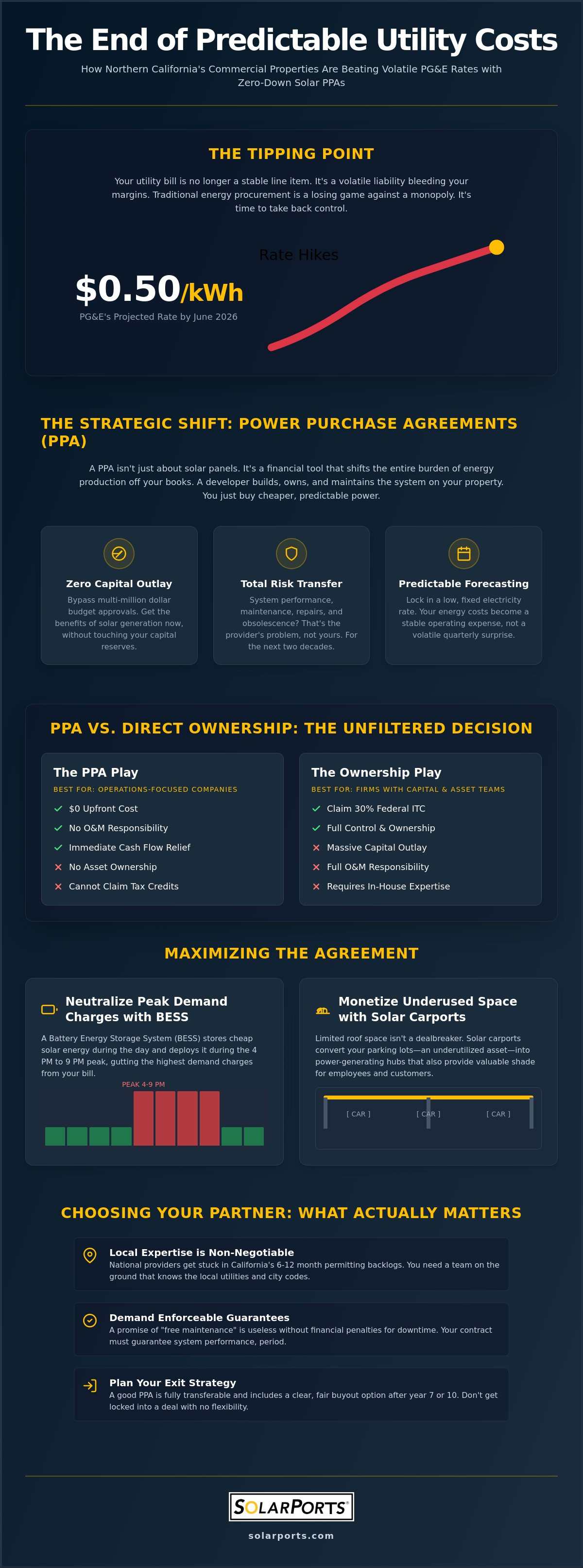
Utility rates are no longer a predictable overhead cost. In Northern California, electricity prices have decoupled from historical norms, turning energy procurement into a high-stakes financial risk. A Power Purchase Agreement (PPA) is a long-term contract where a developer handles everything from permitting to repairs while you only pay for the power generated. This structure shifts the entire burden of system performance, maintenance, and technical obsolescence away from your balance sheet. By converting energy from a variable capital expense into a predictable operating cost, you secure immediate cash flow relief without the friction of major infrastructure debt.
Beating Local Rate Hikes Without Capital Outlay
Volatile utility pricing is the new baseline. With PG&E rates reaching nearly $0.50 per kWh in June 2026, the cost of inaction far outweighs the potential benefits of waiting for marginal hardware improvements. PPAs bypass the exhaustive internal budget approvals typically required for multi-million dollar capital projects. You gain the benefits of localized generation today, effectively locking in a fixed rate that hedges against the aggressive rate hikes seen across the state. This approach stabilizes your commercial solar ROI Northern California by neutralizing the impact of a monopoly grid.
PPA vs. Purchase: A Pragmatic Decision Matrix
Strategic asset management requires choosing the right financing vehicle for your specific tax position. Direct ownership allows you to claim the 30% Federal Investment Tax Credit (ITC), but it also demands a dedicated team for asset management and technical upkeep. Conversely, a PPA allows the provider to monetize these credits and bonus depreciation, passing the value to you through a significantly lower per-kWh rate. Conducting a thorough commercial solar ROI analysis is the essential first step to determine which model maximizes your long-term fiscal stability. It's a choice between managing a power plant or simply purchasing cheaper, more reliable electricity.
Vetting PPA Providers: What Actually Moves the Needle for Your Property
Selecting a partner is a high-stakes operational decision. While many firms offer a standardized PPA, the execution of these agreements in Northern California requires a granular understanding of local grid constraints and municipal codes. The "turnkey trap" occurs when a provider lacks the technical depth to navigate regional interconnection backlogs. Initiating a commercial energy cost saving analysis ensures your system is right-sized for your load profile before you commit to a multi-decade contract. This precision is vital for protecting your commercial solar ROI Northern California from day one.
Performance guarantees must be enforceable. A contract that promises free maintenance without specific penalties for system downtime is a liability. You need proactive Operations & Maintenance (O&M) that identifies inverter failures or shading issues before they impact your monthly bill. According to the Solar Energy Industries Association, standardizing these agreements helps ensure transparency, but local accountability remains the primary driver of system uptime.
Local Expertise vs. National Aggregators
National aggregators often struggle with the 6 to 12-month project timelines typical for California installations. Local expertise is the only way to avoid the permitting friction that degrades project schedules. Effective commercial solar project management in CA requires boots on the ground to manage the relationship with local utilities and building departments. This regional focus prevents the common delays that erode the financial benefits of your PPA.
Contract Flexibility and Exit Strategies
Asset management requires a clear path for future property transactions. Ensure your PPA is fully transferable to new building owners without punitive fees or complex re-evaluations. A robust agreement should also include a transparent buy-out clause, typically starting in year 7 or 10, allowing you to transition from a PPA to direct ownership if your capital strategy shifts. To understand how these clauses impact your specific portfolio, you may want to schedule a strategic energy review.
Maximizing the Agreement: BESS and Solar Carport Integration
Generation is only half the equation. In Northern California, the most punitive utility costs occur during the 4 PM to 9 PM peak window, a period when solar production naturally declines. Relying solely on rooftop panels leaves your facility exposed to these surging demand charges. Integrating a Battery Energy Storage System (BESS) into your PPA allows you to capture midday surplus and deploy it when grid prices are highest. BESS shaves peak demand by discharging stored energy during high-cost intervals to prevent the utility from spiking your monthly bill. This technical synergy is fundamental to securing a competitive commercial solar ROI Northern California in the current regulatory environment.
Underutilized parking assets represent a significant opportunity for fiscal optimization. Solar carport systems transform asphalt into high-yield generation zones while providing the tangible amenity of shaded parking. When rolled into a PPA, these structures increase the total energy offset without requiring additional roof space or structural reinforcements. This approach aligns with the U.S. EPA overview of solar PPA financing, which highlights how diversified generation assets can stabilize long-term energy procurement costs.
The 2026 Resilience Requirement
Grid reliability is no longer a given. Integrated storage provides the critical backup power that Northern California's aging infrastructure currently fails to guarantee for commercial tenants. By adopting hybrid PPA structures, you protect your operations from both price volatility and physical outages. You can explore more specific strategies to lower commercial electricity bills in California to see how storage-backed agreements outperform traditional solar-only models.
The SolarPorts Turnkey Approach
Precision engineering dictates financial performance. We right-size every PPA to match your property's actual load profile rather than simply maximizing the available square footage. This methodology ensures you don't overpay for capacity you can't utilize. As EV adoption accelerates, our turnkey solutions also integrate charging infrastructure into the PPA framework. This future-proofs your real estate assets for the next decade, ensuring your commercial solar ROI Northern California remains robust as your facility's energy needs evolve.
Securing Fiscal Authority Over Volatile Utility Markets
The current energy environment in California demands a transition from traditional procurement to strategic asset management. You've seen how the zero-down PPA model effectively transfers technical and maintenance risks to a specialized partner while providing immediate OpEx relief. By integrating BESS and carport infrastructure, you aren't just installing panels; you're building a resilient hedge against a grid that no longer guarantees price stability. This approach ensures your facility remains competitive as utility volatility continues to escalate.
Achieving a superior commercial solar ROI Northern California depends on the precision of your initial data. As specialists in Northern California commercial real estate, we provide the turnkey BESS and carport expertise necessary to navigate this complex market. Our data-driven ROI modeling ensures your agreement is calibrated to your specific load profile rather than generic industry averages. This level of granular planning is what separates a standard vendor from a strategic financial partner.
The first step toward energy independence is a rigorous evaluation of your current exposure. Request a custom Energy Cost Saving Analysis for your property to identify exactly where your portfolio is losing value. We're ready to help you convert these operational inefficiencies into long-term financial strength.
Frequently Asked Questions
What is the typical length of a commercial solar PPA in Northern California?
Commercial solar PPA terms in Northern California typically range from 20 to 25 years. This timeframe reflects the long-term nature of the infrastructure and ensures the developer can offer a competitive rate that stays consistently below utility prices. It's a strategic duration that allows for predictable energy forecasting across multiple business cycles.
Do I still get the federal tax credit (ITC) if I use a PPA?
You don't claim the federal Investment Tax Credit (ITC) because the PPA provider retains ownership of the system. The provider utilizes the 30% credit and any accelerated depreciation to lower the price you pay for power. This arrangement is particularly beneficial if your organization doesn't have the immediate tax appetite to offset the full value of the credit. It streamlines your commercial solar ROI Northern California by delivering immediate savings rather than a complex tax filing process.
Who is responsible for repairs if the solar panels are damaged by a storm?
The PPA provider is contractually obligated to handle all repairs and ongoing maintenance. If a storm damages the array, the provider covers the costs of parts and labor to restore generation as quickly as possible. Since the developer only earns revenue when the system produces electricity, their interests are perfectly aligned with yours regarding system uptime and technical integrity.
Can a PPA include battery storage and EV charging stations?
Comprehensive PPAs now regularly include Battery Energy Storage Systems (BESS) and EV charging stations as part of a turnkey energy solution. Incorporating storage is a vital strategy for neutralizing the high peak demand charges that often spike during the 4 PM to 9 PM window. Expanding the agreement to include EV infrastructure helps you meet state mandates and tenant expectations while maintaining a high commercial solar ROI Northern California through integrated asset management.
Frequently asked questions
What is the typical length of a commercial solar PPA in Northern California?
Most commercial solar PPAs in Northern California run for a term of 20 to 25 years. This duration aligns with the expected operational lifespan of the hardware and allows the provider to offer a lower, fixed energy rate. While it’s a long-term commitment, it provides the cost certainty needed for accurate fiscal forecasting. Most agreements include options to extend or purchase the system at fair market value once the initial term concludes.
Do I still get the federal tax credit (ITC) if I use a PPA?
You don't receive the federal Investment Tax Credit (ITC) directly because the PPA provider remains the system owner. Instead, the developer claims the 30% tax credit and uses that capital to lower your per-kWh contract rate. This is often the most efficient way to maximize your commercial solar ROI Northern California if your business cannot currently utilize large tax offsets. It effectively passes the tax benefit to you through immediate operational savings.
Who is responsible for repairs if the solar panels are damaged by a storm?
The PPA provider is contractually responsible for all repairs and system maintenance. Since you only pay for the electricity the system produces, the developer has a massive financial incentive to keep the equipment running at peak efficiency. They take on the risk of ownership and all associated maintenance costs. You avoid the headache of managing specialized electrical contractors or budgeting for unexpected equipment replacements over the next two decades.
Can a PPA include battery storage and EV charging stations?
Yes, a PPA can definitely be structured to include Battery Energy Storage Systems (BESS) and supporting infrastructure for EV charging. Adding storage is actually essential for mitigating those 4 PM to 9 PM peak demand charges that drive up utility costs in California. While the PPA covers the solar and battery generation, EV chargers can be bundled into the overall project management to future-proof your parking lot. This creates a comprehensive energy solution that protects your long-term commercial solar ROI Northern California.