
Reducing Common Area Energy Costs for Apartments in CA: A 2026 Strategic Guide

Your common area energy bill isn't high because your tenants are leaving the hallway lights on. It’s high because the utility companies are punishing you for when you use power, not just how much of it you consume. If you’re managing multifamily assets in 2026, you’re already feeling the weight of PG&E rates hitting 44¢/kWh and the confusing fallout of NEM 3.0. You know that reducing common area energy costs for apartments CA is the only way to protect your Net Operating Income, but the old playbook of LED retrofits and "turning things off" just doesn't cut it anymore.
We agree that the current energy landscape feels like a rigged game. It's frustrating to watch demand charges eat your margins while you try to figure out if batteries actually pay off. This guide is here to simplify that math. You’ll learn how to identify hidden leaks in your operational expenses and why hardware like BESS and solar carports are the new standard for fiscal control. We’re going to walk through the July 2026 ITC deadlines, the reality of battery ROI under the new export rules, and how to turn your parking lot into a cost-saving engine before the next rate hike hits.
Key Takeaways
- Demand charges, not just total usage, are the real reason your utility bills are skyrocketing. Focus on high-intensity loads like elevators and HVAC to protect your NOI.
- Solar carports and BESS are the most effective tools for reducing common area energy costs for apartments CA. These systems allow you to bypass the most expensive peak rates from PG&E or SCE.
- Federal incentives like the 30% ITC and 100% bonus depreciation have strict 2026 deadlines. You'll need to move quickly to maximize the financial return on your infrastructure investment.
- A professional energy cost saving analysis is your starting point. It's the only way to move from guesswork to a data-backed strategy that actually moves the needle on operating expenses.
Table of Contents
- Analyzing the Common Area Load: Identifying Your Highest Expenses
- Strategic Infrastructure: Solar Carports and BESS
- Executing the Transition: ROI and Turnkey Implementation
Analyzing the Common Area Load: Identifying Your Highest Expenses
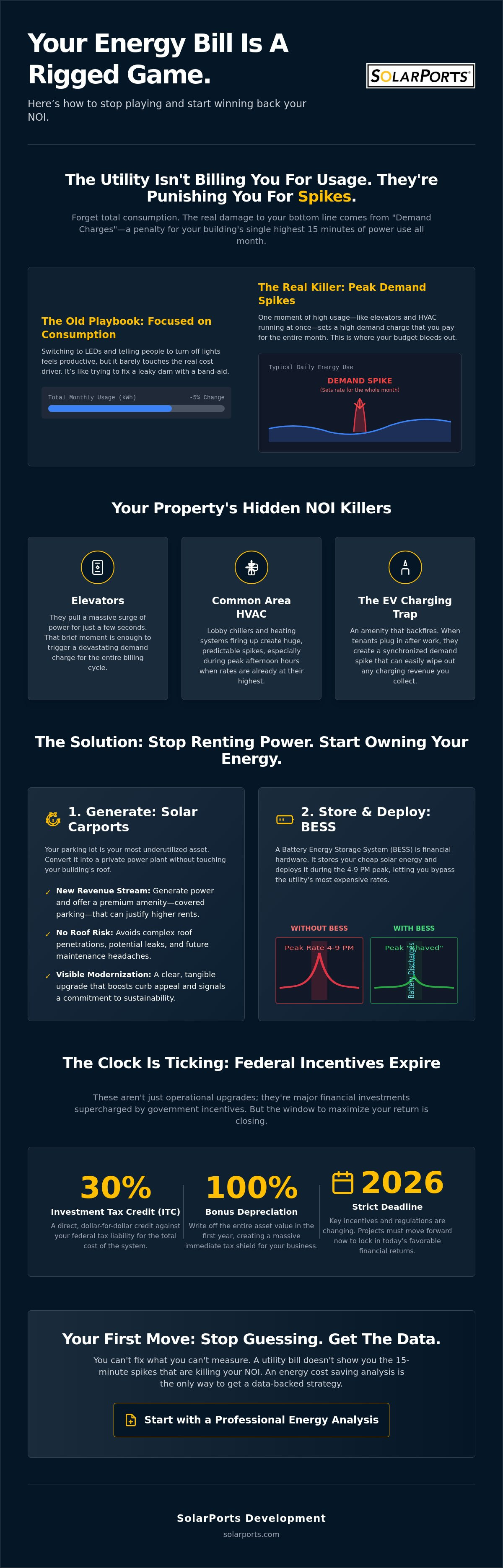
Most owners look at their monthly bill and see a single number. That's a mistake. You're being billed for two distinct things: total consumption and peak demand. While energy conservation strategies like switching to LEDs help with consumption, they do almost nothing to lower the demand charges that make up a massive chunk of your bill. Reducing common area energy costs for apartments CA requires looking at the "spikes" rather than just the totals.
Elevators are notorious for this. They pull a massive amount of power for a few seconds; this creates a peak that the utility uses to set your rate for the entire month. HVAC systems in lobbies and high-intensity parking lot lighting often do the same. Then there's the EV Charging Trap. If your tenants are all plugging in their cars when they get home from work, they're triggering demand charges that can easily wipe out the revenue from the charging fees themselves. Without a plan, your amenities are actually working against your bottom line.
The Demand Charge Trap in California
California utilities like PG&E and SCE measure your usage in 15-minute intervals. They take the highest 15-minute window of the month and bill you a premium based on that single moment. Demand charges are the price of readiness, not just consumption. It's the utility charging you for the infrastructure they have to keep on standby just in case your elevators, lobby chillers, and EV chargers all fire at once. Even if you use very little power the rest of the month, that one spike dictates your costs.
Data Over Guesswork: The Energy Audit
You can't fix what you can't see. A standard bill doesn't show you these 15-minute spikes; you need interval data, often called Green Button data. This is why a commercial property energy cost saving analysis is the only way to get an accurate baseline. By mapping your usage down to the minute, we can identify exactly which loads are "spiky" enough to be neutralized by a battery system. It's about finding the specific moments that are draining your NOI and fixing them with data, not guesses.
Strategic Infrastructure: Solar Carports and BESS
Data tells you where the leaks are. Hardware stops them. For most CA multifamily properties, the path to reducing common area energy costs for apartments CA isn't found on the roof. It's in the parking lot. Rooftop solar often hits a ceiling because of limited space, fire codes, or mechanical obstructions. Your parking area, however, is a massive, untapped asset. By installing solar carport systems, you're effectively building a private power plant over your most underutilized real estate without touching the building's envelope.
The math has changed significantly under the current Net Billing Tariff (NBT). Exporting solar energy to the grid now pays roughly 75% less than it did under previous rules, which makes "self-consumption" the only metric that actually moves the NOI needle. You have to store what you generate during the day to use it when the sun goes down. This is the logic behind the integrated SolarPorts Development projects we've deployed across the state. We pair generation with storage to ensure every kilowatt stays behind the meter where it's worth the most, rather than selling it back to the utility for pennies.
Why Solar Carports Win for Multifamily
Carports are a visible commitment to your property's value. They provide generation without the risk of rooftop leaks or penetrations that complicate building maintenance. Beyond the power, you're offering a premium amenity. Covered parking protects tenant vehicles from the California sun, which improves curb appeal and can even support modest rent premiums. It's a rare case where an operational upgrade doubles as a marketing win that tenants can actually see and appreciate.
BESS: Your Financial Hedge Against Time-of-Use Rates
Think of a Battery Energy Storage System (BESS) as financial hardware for your electrical room. It doesn't just sit there waiting for a blackout. It's an active tool that discharges during the 4 PM to 9 PM window when utility rates are at their absolute highest. By "shaving" these peaks, the battery prevents you from hitting the most expensive tiers of the CA rate structure. If you want to see how this fits your specific load profile, you can schedule a brief strategy session to review your options.
Executing the Transition: ROI and Turnkey Implementation
Calculating the return on investment for reducing common area energy costs for apartments CA isn't just about totaling up the solar panels. It's a sophisticated financial equation. You have to account for the 30% federal Investment Tax Credit (ITC), 100% bonus depreciation at the federal level, and the massive amount of avoided demand charges. If you miss the July 4, 2026, "begin construction" deadline for that 30% credit, the financial profile of your project changes instantly. This isn't a "wait and see" situation; the tax benefits are front-loaded to reward early movers.
The biggest mistake owners make is trying to piece this together with three different contractors. Managing separate vendors for solar, battery storage, and EV infrastructure is a recipe for delays and finger-pointing when the utility interconnection gets stuck. A turnkey approach ensures that the system is designed as a single, cohesive unit. This moves you faster through the commercial solar installation timeline, getting your BESS online before the next scheduled PG&E or SCE rate hike hits your ledger.
The Financial Framework for 2026
Navigating the 2026 commercial solar tax credit in California requires looking beyond the base 30%. There are "adders" for projects in specific energy communities that can push the credit even higher. It's also important to understand that commercial solar ROI analysis is fundamentally different from residential models. You're balancing MACRS depreciation schedules against operational expense reductions to maximize your asset's valuation.
Choosing a Specialized Partner
You need a partner who understands the granular details of Title 24 and the specific interconnection hurdles of California utilities. "Right-sizing" is the goal. We don't just try to cover every square inch of the roof; we design the system to neutralize your specific demand spikes. This precision ensures you aren't overspending on hardware that doesn't actually lower your bill. It’s about building a system that serves your bottom line, not just the grid.
Securing Your Asset's Financial Future
Stop letting demand charges erode your NOI. It's a solvable problem, but it requires moving past the basic "energy efficiency" mindset. You've seen why the 15-minute peaks matter, how solar carports turn parking lots into power plants, and why the 2026 tax window is closing fast. Reducing common area energy costs for apartments CA isn't about hope; it's about deploying the right financial hardware at the right time.
At SolarPorts Development, we provide California-exclusive commercial expertise. We don't guess. As turnkey BESS and solar carport specialists, we use your actual interval data to generate ROI projections you can actually take to the bank. You don't have to figure out the NBT rules or interconnection hurdles on your own. Request your Commercial Energy Cost Saving Analysis today to get a clear, unfiltered look at your potential savings. Your electrical room should be an asset, not a liability.
Frequently Asked Questions
How much can I actually save on common area costs with solar in CA?
Savings depend almost entirely on your ability to mitigate demand charges rather than just total kilowatt-hour usage. By targeting the 15-minute peaks that trigger high utility rates, property owners often see a substantial reduction in their monthly common area bills. Under the current 2026 rate structures, the real value lies in avoiding retail rates that can reach 44¢/kWh during peak windows. It's about keeping your own power behind the meter to offset the most expensive tiers of your utility's schedule.
Do I need a battery if I already have solar panels?
Under the current Net Billing Tariff (NBT) rules, a battery is no longer optional if you want a viable ROI. Without storage, you're forced to sell your excess solar generation back to the grid at a roughly 75% discount compared to previous policies. A Battery Energy Storage System (BESS) allows you to capture that energy and discharge it when the sun goes down. This is the most effective method for reducing common area energy costs for apartments CA because it bypasses the high evening rates when common area lighting and HVAC loads are highest.
What is the typical payback period for a commercial solar carport?
Payback timelines are driven by the 30% federal ITC and 100% bonus depreciation available for projects starting in 2026. When you combine these tax incentives with the avoided cost of high-tier utility rates, the financial profile usually aligns with a mid-term hold strategy. The exact period varies based on your specific load profile and whether you're being hit with heavy demand charges. Since carports also serve as a tenant amenity, the "payback" often includes improved retention and curb appeal alongside the direct energy savings.
Can I use solar to power tenant units or just common areas?
You can technically do both, but common area loads are the most direct path to increasing your Net Operating Income. Recent regulatory shifts in California have made self-consumption for multi-meter properties more complex, often requiring owners to sell power low and buy it back high for tenant use. Focusing on common areas allows you to bypass these hurdles. It keeps the savings on your side of the ledger by directly lowering the operating expenses you are responsible for as the property owner.
Frequently asked questions
How much can I actually save on common area costs with solar in CA?
Savings depend almost entirely on your ability to mitigate demand charges rather than just total kilowatt-hour usage. By targeting the 15-minute peaks that trigger high utility rates, property owners often see a substantial reduction in their monthly common area bills. Under the current 2026 rate structures, the real value lies in avoiding retail rates that can reach 44¢/kWh during peak windows. It's about keeping your own power behind the meter to offset the most expensive tiers of your utility's schedule.
Do I need a battery if I already have solar panels?
Under the current Net Billing Tariff (NBT) rules, a battery is no longer optional if you want a viable ROI. Without storage, you're forced to sell your excess solar generation back to the grid at a roughly 75% discount compared to previous policies. A Battery Energy Storage System (BESS) allows you to capture that energy and discharge it when the sun goes down. This is the most effective method for reducing common area energy costs for apartments CA because it bypasses the high evening rates when common area lighting and HVAC loads are highest.
What is the typical payback period for a commercial solar carport?
Payback timelines are driven by the 30% federal ITC and 100% bonus depreciation available for projects starting in 2026. When you combine these tax incentives with the avoided cost of high-tier utility rates, the financial profile usually aligns with a mid-term hold strategy. The exact period varies based on your specific load profile and whether you're being hit with heavy demand charges. Since carports also serve as a tenant amenity, the "payback" often includes improved retention and curb appeal alongside the direct energy savings.
Can I use solar to power tenant units or just common areas?
You can technically do both, but common area loads are the most direct path to increasing your Net Operating Income. Recent regulatory shifts in California have made self-consumption for multi-meter properties more complex, often requiring owners to sell power low and buy it back high for tenant use. Focusing on common areas allows you to bypass these hurdles. It keeps the savings on your side of the ledger by directly lowering the operating expenses you are responsible for as the property owner.