
Commercial Solar Lease vs. Buy: A Strategic Analysis for Bay Area Retailers

The standard logic says that leasing solar is the safest way to preserve capital, but for many retailers, that "safe" path is just an expensive way to leave 30% of the project's value on the table. In Northern California, where PG&E retail rates can spike to $0.55 per kWh, the math for commercial solar for retail stores Bay Area has fundamentally shifted. You aren't just buying panels; you're trying to outmaneuver a NEM 3.0 structure that pays you as little as $0.05 per kWh for the energy you send back to the grid. It's a strategic decision that pits immediate cash flow against long-term asset value, and the July 4, 2026, tax credit deadline makes the timing non-negotiable.
It's frustrating to navigate utility demand charges that feel like a moving target, especially when Title 24 mandates are already forcing your hand on new construction. We know that every dollar spent on rooftop hardware is a dollar not spent on inventory or store improvements. This breakdown offers a clear financial framework to help you choose between owning your solar assets or utilizing a lease to keep debt off the books. We will examine how to maximize the 2026 tax incentives, why battery storage is now a requirement for ROI, and how to secure predictable energy costs across your entire retail footprint.
Key Takeaways
- Ownership converts a recurring utility bill into a depreciable asset. Leasing is the better play if you need to keep capital liquid for inventory or store expansion.
- Exporting power under NEM 3.0 is a losing game. You must pair solar with battery storage (BESS) to store your own energy and avoid PG&E's highest retail rates.
- The 30% federal tax credit is a massive incentive, but it only helps if you have the tax liability to use it. If not, a lease allows the provider to take the credit and pass the savings to you.
- Implementing commercial solar for retail stores Bay Area requires a precise data analysis first. You need to verify that your building's remaining lease term is long enough to justify the investment.
- The July 4, 2026, deadline is the finish line for the full tax credit. Starting your energy cost saving analysis now is the only way to hit that window.
Table of Contents
- The Financial Fork in the Road: Understanding Ownership vs. Leasing
- The 2026 California Reality: NEM 3.0 and the BESS Requirement
- The Retailer’s Decision Matrix: Which Path Should You Take?
The Financial Fork in the Road: Understanding Ownership vs. Leasing
Don't let a salesperson's commission structure dictate your energy strategy. Most reps push the product that pays them the fastest, but for commercial solar for retail stores Bay Area, the decision to buy or lease is a high-stakes choice between building an asset or managing an operational expense. Retailers face a unique math problem compared to industrial warehouse owners. While a warehouse might have a predictable, steady load, a retail storefront deals with fluctuating foot traffic, high-intensity lighting, and HVAC systems that work overtime during peak PG&E price windows. You aren't just looking for "green energy." You're looking for a hedge against utility volatility.
Capital Purchase: Maximizing Long-Term Asset Value
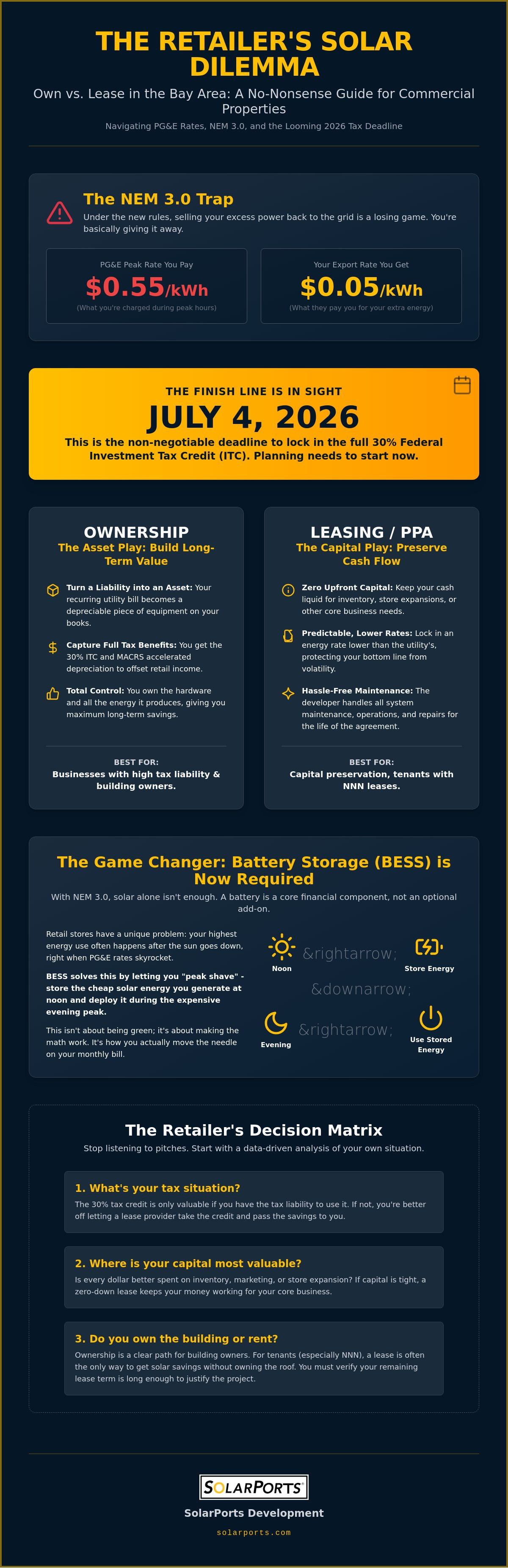
Ownership is the play for the retailer who wants to turn a recurring liability into a depreciable piece of equipment. By purchasing the system, you capture the full 30% Federal Investment Tax Credit (ITC) before the July 4, 2026, deadline. You also get the benefit of MACRS accelerated depreciation, which can significantly offset your retail income in the first year. It's a pure asset play. If you're looking for the granular numbers on payback periods, check out this commercial solar ROI analysis to see how the math actually shakes out in Northern California. Ownership gives you total control over the hardware, but it requires the tax appetite to actually use the credits you're earning.
Solar Leases and PPAs: Preserving Retail Capital
Leasing is the strategic move for retailers who need to keep their cash liquid for inventory or store expansions. You get a lower energy rate with zero upfront capital, and the developer handles the maintenance. It's a common route for businesses with "triple net" leases who don't own their building but want to lock in predictable costs. The trade-off is clear. You give up the tax credits to the developer in exchange for a lower monthly rate. Given the history of Solar power in California, these third-party agreements have become a standard way to bypass the high entry cost of infrastructure while still protecting the bottom line from PG&E's retail rates, which currently sit between $0.35 and $0.55 per kWh.
- Ownership: Best for high-tax-liability businesses and building owners.
- Leasing: Best for capital preservation and NNN lease tenants.
- The Risk: Choosing a path based on a generic pitch rather than a data-driven energy cost saving analysis.
The 2026 California Reality: NEM 3.0 and the BESS Requirement
NEM 3.0 changed everything. Selling power back to PG&E is basically a donation now. You get maybe $0.05 to $0.07 per kWh while they charge you ten times that during the evening peak. For commercial solar for retail stores Bay Area, the goal isn't just generation. It's retention. If you don't use what you make, you're wasting capital. A commercial energy cost saving analysis is no longer optional. It's the only way to size a system that doesn't bleed value by overproducing energy you can't sell back for a profit.
Why Retailers Need Batteries to Make the Math Work
Retail stores have a specific problem. Your peak usage often hits right as the sun goes down and the "duck curve" spikes. Solar alone can't touch those evening demand charges. A Battery Energy Storage System (BESS) is a core financial component of a 2026 retail project, not an optional add-on. You store the cheap noon-time sun and deploy it when PG&E rates are at their $0.55 peak. This "peak shaving" is what actually moves the needle on your monthly bill. It's about shifting your load to avoid the most expensive hours of the day.
Comparing the ROI: Buy vs. Lease with BESS
Buying your BESS increases the upfront hit, but it often triples long-term savings by eliminating those demand charges entirely. You own the asset and the savings. If you lease, you're essentially paying a predictable monthly service fee. It's usually lower than the demand charges it replaces, which helps your cash flow immediately. For the technical side of how these units actually sit on your property, take a look at commercial BESS installation California. It's about finding the right balance between capital outlay and operational relief. If you're trying to figure out which side of that line you fall on, you might want to book a quick strategy session to look at your specific load profile.
- The NEM 3.0 Gap: Export credits have dropped by about 75% compared to the old NEM 2.0 rules.
- Self-Consumption: Using your own stored energy is now the only way to see a meaningful ROI.
- Demand Charges: BESS allows you to cap your peak pull from the grid, which is often the largest part of a retail bill.
The Retailer’s Decision Matrix: Which Path Should You Take?
Deciding on commercial solar for retail stores Bay Area isn't a simple equipment purchase. It's a capital allocation problem. You shouldn't make this move based on a generic pitch. You need a framework that respects your specific tax position and your real estate strategy. Before you sign anything, run your numbers through these three filters. First, analyze your tax liability. If your business doesn't have the tax appetite to absorb a 30% credit, buying is a mistake. Second, look at your lease term. Buying solar for a building where you only have three years left on the lease is a fast way to lose money. Finally, consider your alternative use of capital. If that $200,000 could generate a higher return by opening a new store location, then a lease is the logically superior play.
When Buying is the Only Rational Choice
Ownership is the standard for owner-occupied retail buildings with high taxable income. It's the ultimate hedge against utility inflation. When you own the system, you aren't just saving on power; you're increasing the underlying value of the property. For retailers with large parking footprints, solar carport systems for commercial properties represent a high-visibility asset play. They provide shaded parking, which improves the customer experience, while generating the exact power needed to offset those heavy midday cooling loads. It's a double win for the balance sheet and the brand.
The Case for the Turnkey Lease
Leasing is the right move for multi-unit retailers who need to scale energy savings across several sites without hitting the balance sheet with massive debt. It's "Energy as a Service." You let the provider handle the 20-year maintenance and the technical risks while you enjoy a lower, predictable rate. This path is particularly effective for those navigating the complexities of the 2026 mandates. If you want to understand how the logistics of a large-scale rollout work, this guide on turnkey commercial solar CA offers a deep dive into the process. It's about getting the results of solar without the operational burden of owning it.
- The Tax Filter: Don't buy if you can't use the ITC.
- The Real Estate Filter: Match the system's life to your lease term.
- The Opportunity Cost Filter: Deploy capital where it grows the fastest.
Securing Your Energy Independence Before the 2026 Deadline
The transition toward commercial solar for retail stores Bay Area isn't about following a trend. It's about building a defense against utility rates that have no ceiling. We've established that NEM 3.0 has stripped the value from simple solar-only systems, making integrated battery storage the only logical bridge to a real ROI. Whether you choose the asset-heavy path of ownership to capture tax credits or the capital-preserving route of a lease, the math has to be precise from day one. You can't afford to guess on sizing or load profiles when the July 4, 2026, tax credit cliff is approaching.
Our team provides California-specific expertise to ensure your project is a right-sized solution rather than a generic installation. Through turnkey BESS integration and data-backed financial modeling, we eliminate the ambiguity of the lease-versus-buy debate. It's time to stop reacting to PG&E demand charges and start controlling your operational costs. Request a custom Commercial Energy Cost Saving Analysis to secure your strategy. You've got a clear path to energy independence, and the data is ready when you are.
Frequently Asked Questions
Is a commercial solar lease better than a loan for a Bay Area retail store?
A lease is generally superior for retailers prioritizing liquidity and cash flow, while a loan favors those seeking the highest total return through tax incentives. Leases keep the equipment off your balance sheet and preserve your credit lines for core operations like inventory or store expansion. Loans allow you to claim the 30% tax credit directly, but you take on the debt and the long-term maintenance responsibility yourself.
How does NEM 3.0 affect the payback period for retail solar in California?
NEM 3.0 has extended the payback period for solar-only systems by reducing export credits by approximately 75% compared to previous rules. To maintain a competitive ROI for commercial solar for retail stores Bay Area, you must integrate battery storage. This allows you to avoid PG&E's $0.55 per kWh peak rates, shifting the payback back toward a range that justifies the capital outlay by focusing on self-consumption rather than grid exports.
Can I transfer a solar lease if I sell my retail property?
Solar leases are designed to be transferable to a new building owner, provided they meet the credit requirements of the original agreement. Most contracts also include a buyout option that can be triggered during the property sale. This flexibility is critical for retailers who might consolidate locations or sell the real estate while the system still has 15 years of operational life remaining.
What are the 2026 tax incentives for commercial solar and battery storage?
The primary incentive is the 30% Federal Investment Tax Credit, which requires construction to start by July 4, 2026. You can stack 10% bonus credits for domestic content or projects located in designated energy communities. Combined with five-year MACRS depreciation, these incentives can effectively cover over half the project cost for a profitable retail business with sufficient tax liability to utilize the credits.
Frequently asked questions
Is a commercial solar lease better than a loan for a Bay Area retail store?
A lease is generally superior for retailers prioritizing liquidity and cash flow, while a loan favors those seeking the highest total return through tax incentives. Leases keep the equipment off your balance sheet and preserve your credit lines for core operations like inventory or store expansion. Loans allow you to claim the 30% tax credit directly, but you take on the debt and the long-term maintenance responsibility yourself.
How does NEM 3.0 affect the payback period for retail solar in California?
NEM 3.0 has extended the payback period for solar-only systems by reducing export credits by approximately 75% compared to previous rules. To maintain a competitive ROI for commercial solar for retail stores Bay Area, you must integrate battery storage. This allows you to avoid PG&E's $0.55 per kWh peak rates, shifting the payback back toward a range that justifies the capital outlay by focusing on self-consumption rather than grid exports.
Can I transfer a solar lease if I sell my retail property?
Solar leases are designed to be transferable to a new building owner, provided they meet the credit requirements of the original agreement. Most contracts also include a buyout option that can be triggered during the property sale. This flexibility is critical for retailers who might consolidate locations or sell the real estate while the system still has 15 years of operational life remaining.
What are the 2026 tax incentives for commercial solar and battery storage?
The primary incentive is the 30% Federal Investment Tax Credit, which requires construction to start by July 4, 2026. You can stack 10% bonus credits for domestic content or projects located in designated energy communities. Combined with five-year MACRS depreciation, these incentives can effectively cover over half the project cost for a profitable retail business with sufficient tax liability to utilize the credits.