
Commercial BESS Installation in California: A Strategic 2026 Guide for Property Owners

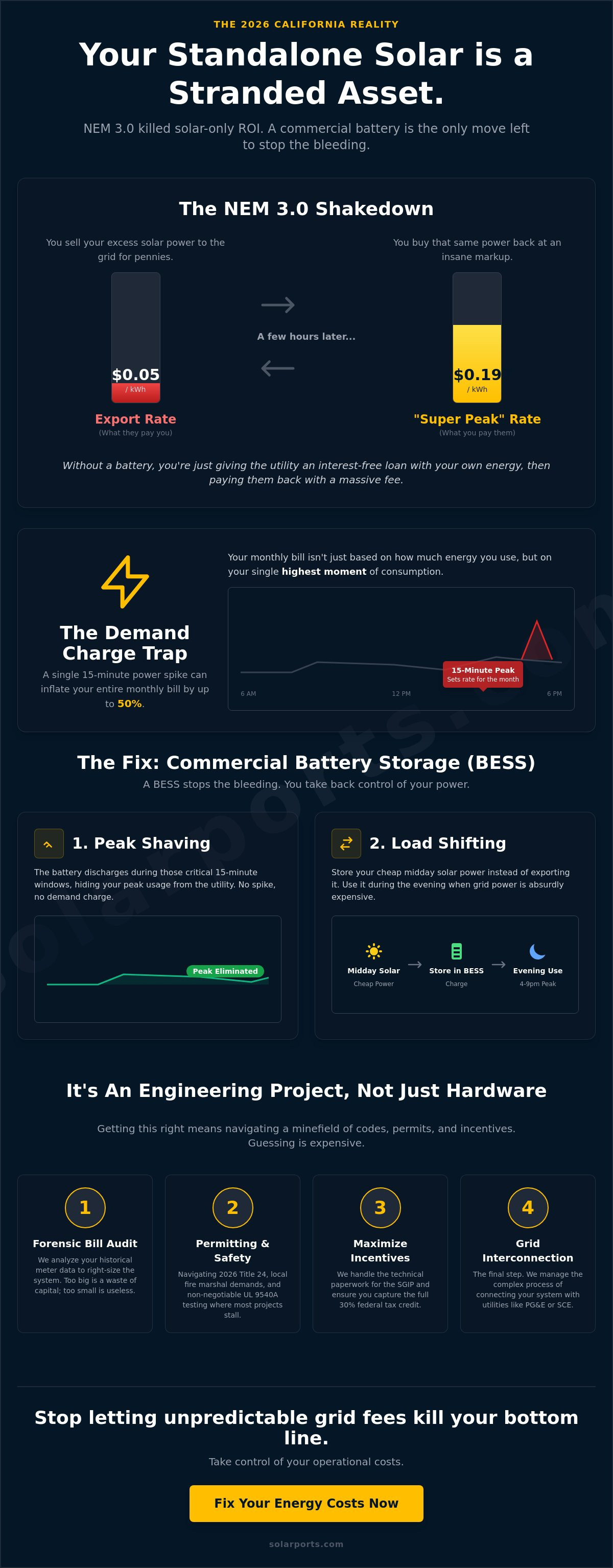
In 2026, a standalone solar array on a California commercial roof is no longer a strategic asset; it is a stranded investment. With NEM 3.0 export rates now sitting as low as $0.05 per kilowatt-hour while "Super Peak" utility charges hit $0.1969, the math for simple solar has fundamentally broken. You likely feel the frustration of watching export credits crater while your demand charges continue to climb. A commercial BESS installation in California is the only move left to claw back that value. It stops you from selling cheap power to the grid only to buy it back at a massive markup a few hours later.
This guide provides a direct look at how battery storage offsets these rising demand charges and secures your property's ROI. We will walk through the 2026 Title 24 building standards and the UL 9540 safety certifications that now dictate permitting. You'll see how to navigate limited SGIP funding and use the 30% federal tax credit to fix your operational costs. It is a pragmatic roadmap for owners who are done letting unpredictable grid fees erode their bottom line.
Key Takeaways
- Neutralize the "demand charge trap" where a single 15-minute spike in power usage can bloat your entire monthly utility bill by as much as 50%.
- A successful commercial BESS installation in California requires a forensic audit of your bill history to match battery discharge rates with your actual operational spikes.
- Navigate the unfiltered reality of 2026 Title 24 and local fire safety requirements that often derail projects during the engineering and permitting phase.
- Maximize your solar carport systems by shifting excess midday generation to the evening hours when utility rates are at their most aggressive.
- Leverage battery storage as a strategic hedge against grid instability and the operational chaos caused by California’s Public Safety Power Shutoffs.
Table of Contents
- The Financial Logic of Commercial BESS in California’s 2026 Energy Market
- Navigating the California Commercial BESS Installation Process
- Maximizing ROI: Integrating BESS with Solar Carports and Rooftops
The Financial Logic of Commercial BESS in California’s 2026 Energy Market
Most property owners view energy as a fixed operational cost. It isn't. In 2026, California's electricity market is a series of financial traps designed to penalize high-intensity usage. A battery energy storage system (BESS) is the only tool that gives you control over when you buy power and how much you pay for it. Without storage, you're at the mercy of a grid that's becoming increasingly expensive and volatile.
Look at your utility bill. You'll likely see "demand charges" that account for nearly 50% of the total cost. One 15-minute window of peak usage, perhaps when the HVAC and heavy machinery ramp up simultaneously, sets the rate for the entire month. It's a brutal system. A commercial BESS installation in California allows you to "shave" those peaks by discharging stored energy during those critical minutes, effectively hiding your highest consumption from the utility's meter.
Utility rates in California have historically outpaced inflation, and the shift to NEM 3.0 has only made things worse. The value of exporting solar power has dropped by roughly 75% compared to previous years. You're now getting as little as $0.05 per kWh for exports while paying nearly $0.20 during peak windows. Storing your own generation is no longer optional for ROI; it's the baseline requirement to protect your bottom line.
Peak Shaving vs. Load Shifting
Load shifting is about moving consumption from expensive times to cheaper times. Peak shaving is about capping your maximum draw. Both are essential, but they require different hardware configurations. You don't want to overspend on capacity you won't use. Getting a commercial energy cost saving analysis is the only way to right-size your system based on your historical load profile. If the battery is too small, you still hit those demand spikes. If it's too large, your payback period stretches unnecessarily.
The NEM 3.0 Reality for California Commercial Real Estate
The grid doesn't want your extra solar power during the day anymore. Under the current Net Billing Tariff, the goal has shifted entirely toward self-consumption. A commercial BESS installation in California transforms intermittent solar into a dispatchable asset. You decide when to use your power. By holding that energy until the 4:00 pm to 9:00 pm window, you avoid the most expensive TOU rates and ensure your solar investment actually pays for itself.
Navigating the California Commercial BESS Installation Process
Execution matters more than the gear. A commercial BESS installation in California isn't just about bolting a battery to a concrete pad; it's a multi-stage engineering project that starts with a forensic audit of your meter data. We look for the optimal discharge rate because guessing here is expensive. If you miss the mark on your historical peak analysis, the system won't clear the demand charges it was built to eliminate. It's a waste of capital.
Once the data is set, we move into the unfiltered reality of California's 2026 building codes. You'll need to clear Title 24 standards and navigate the specific fire safety protocols of your local Authority Having Jurisdiction (AHJ). This is where projects often stall. The Self-Generation Incentive Program (SGIP) can provide significant financial relief, but the application process requires technical documentation that many general contractors simply can't produce. You don't want to leave that money on the table because of a paperwork error.
Procurement follows. We source UL-certified hardware that fits the specific mid-range needs of commercial properties, avoiding the market gap between residential toys and utility-scale monsters. Finally, the physical installation leads to grid interconnection with utilities like PG&E or Southern California Edison. If you're ready to see how this fits your facility, you can book a technical review of your site's capacity.
The Permitting and Safety Hurdle
Safety is the primary gatekeeper for California regulators. Specifically, UL 9540A thermal runaway testing is non-negotiable for commercial sites. Most fire departments in Northern California won't even look at your plans if the hardware hasn't been through large-scale fire testing. You need a partner who speaks the language of the local fire marshal and understands the specific setback requirements that keep your building compliant and your insurance premiums stable.
Right-Sizing: Why the 'Market Gap' Matters
There's a massive gap in the current market. Most vendors want to sell you a massive utility-scale system that's overkill or a bank of residential batteries that will fail under heavy commercial loads. The sweet spot for most commercial properties is between 60kWh and 300kWh. This range provides the necessary punch for peak shaving without the bloated capital expense. It's often the missing piece in a turnkey commercial solar project, turning a simple rooftop array into a high-performance financial asset.
Maximizing ROI: Integrating BESS with Solar Carports and Rooftops
Combining storage with generation is where the financial logic really starts to work. Many California properties have limited roof space, making solar carport systems the only viable way to reach high generation capacity. A commercial BESS installation in California captures that massive midday surge from your parking lot and holds it until the sun goes down and utility rates skyrocket. It's the difference between having a green roof and having a high-yield financial instrument.
Resiliency is the other side of this coin. California’s Public Safety Power Shutoffs (PSPS) are a persistent operational threat. If your business relies on refrigeration, data centers, or constant manufacturing, a power outage isn't just an inconvenience; it's a massive liability. BESS provides a critical layer of backup, allowing your facility to remain operational when the grid goes dark. It also acts as a buffer for EV charging. When multiple employees or customers plug in at once, the battery absorbs the spike, preventing your demand charges from hitting the ceiling.
The Solar Carport + BESS Synergy
Carports provide the square footage that rooftops often lack. They turn an underutilized parking lot into a powerhouse. However, generation without timing is inefficient. Our commercial solar ROI analysis shows that pairing these structures with storage maximizes the "avoided cost" of grid power. By using the California Self-Generation Incentive Program (SGIP), property owners can often offset a significant chunk of the upfront cost, making the combined system the most profitable configuration for 2026.
Maintenance and Long-Term Performance
A battery isn't a "set and forget" appliance. It requires active monitoring through an Energy Management System (EMS) to ensure the discharge cycles are actually hitting the peaks. This is the lived-in reality of energy management. Degraded cells or misconfigured software can quietly bleed your ROI over time. This is why professional commercial solar project management is vital. You need a partner who stays involved after the commissioning phase to verify that the commercial BESS installation in California continues to perform as a long-term asset that increases property valuation.
Securing Your Property’s Energy Future in 2026
The California energy landscape has fundamentally shifted. You can't rely on the outdated model of selling power back to the grid and hoping for a fair credit. Between the 2026 Title 24 building codes and the aggressive peak rates from utilities, the margin for error has disappeared. A commercial BESS installation in California is now the primary mechanism for protecting your property's net operating income against a grid that's designed to penalize high-intensity users.
We focus on the small-scale commercial projects that larger vendors often ignore, providing the specialized, data-driven ROI modeling Northern California owners need. We don't guess at your load profile; we audit it. This ensures your battery system works in tandem with your solar carports or rooftop arrays to kill demand charges at the source. It’s a turnkey approach that handles the technical reality so you can focus on the fiscal result.
Stop the bleed of unpredictable electricity costs. You can Request a Commercial Energy Cost Saving Analysis today to see the unfiltered reality of your site's potential. It's time to put your facility back in a position of strategic control.
Frequently Asked Questions
How much does a commercial BESS installation cost in California?
Industry data for June 2026 shows that the average installed cost for a commercial system typically ranges from $360 to $690 per kWh. This price includes the lithium iron phosphate (LFP) battery modules, which alone cost between $140 and $240 per kWh, plus the necessary inverters and site engineering. Total project costs fluctuate based on your facility's existing electrical infrastructure and the complexity of the required fire suppression systems.
It's important to remember that these are market averages for the hardware and labor. Your final investment will be significantly offset by the federal Investment Tax Credit (ITC), which currently covers 30% to 40% of the total project cost. State level incentives like SGIP can further reduce the net capital outlay for qualifying properties in high fire threat districts.
What is the typical ROI for commercial battery storage in 2026?
Most commercial properties see a full return on investment in under nine years when storage is paired with solar. Under the current NEM 3.0 framework, the ROI is no longer driven by selling power back to the utility; it's driven by avoiding "Super Peak" charges that hit $0.1969 per kWh. By shifting your load away from these windows, you're effectively locking in a lower energy rate for the next decade.
A commercial BESS installation in California also protects your bottom line from demand charge spikes. Since these charges can represent half of your monthly bill, the "peak shaving" capability of a battery often provides the highest financial impact. When you factor in the 30% federal tax credit, the internal rate of return becomes highly competitive for most real estate assets.
How long does the permitting process for BESS take in Northern California?
You should plan for a permitting and interconnection timeline of four to eight months. While the California Energy Commission has moved to accelerate some approvals, local fire departments and building officials must still verify compliance with the 2025 California Building Standards Code that went into effect on January 1, 2026. These local reviews are often the most time consuming part of the project.
Working with an experienced partner is the only way to keep this timeline from stretching. Utilities like PG&E have specific interconnection application fees, such as $800 for non-export battery storage, and their technical review queues can be long. Getting your UL 9540 safety certifications and site plans right the first time is the only way to avoid repeated "corrections" that stall your installation.
Can BESS provide backup power during a grid outage for my business?
Yes, but the system must be specifically engineered with "islanding" capabilities to function during a Public Safety Power Shutoff (PSPS). Not all battery systems are configured for backup by default. You need an automatic transfer switch and an inverter capable of creating a local microgrid so your facility can stay powered when the utility lines are de-energized for safety.
This resiliency factor is a major priority for California businesses in 2026. While the primary goal is often cost savings, the ability to keep critical machinery, security systems, or refrigeration running during an outage prevents massive operational losses. We recommend identifying your "critical load" during the design phase so your commercial BESS installation in California is sized to keep your most vital equipment online.
Frequently asked questions
Peak Shaving vs. Load Shifting
Load shifting is about moving consumption from expensive times to cheaper times. Peak shaving is about capping your maximum draw. Both are essential, but they require different hardware configurations. You don't want to overspend on capacity you won't use. Getting a commercial energy cost saving analysis is the only way to right-size your system based on your historical load profile. If the battery is too small, you still hit those demand spikes. If it's too large, your payback period stretches unnecessarily.
The NEM 3.0 Reality for California Commercial Real Estate
The grid doesn't want your extra solar power during the day anymore. Under the current Net Billing Tariff, the goal has shifted entirely toward self-consumption. A commercial BESS installation in California transforms intermittent solar into a dispatchable asset. You decide when to use your power. By holding that energy until the 4:00 pm to 9:00 pm window, you avoid the most expensive TOU rates and ensure your solar investment actually pays for itself. Execution matters more than the gear. A commercial BESS installation in California isn't just about bolting a battery to a concrete pad; it's a multi-stage engineering project that starts with a forensic audit of your meter data. We look for the optimal discharge rate because guessing here is expensive. If you miss the mark on your historical peak analysis, the system won't clear the demand charges it was built to eliminate. It's a waste of capital. Once the data is set, we move into the unfiltered reality of California's 2026 building codes. You'll need to clear Title 24 standards and navigate the specific fire safety protocols of your local Authority Having Jurisdiction (AHJ). This is where projects often stall. The Self-Generation Incentive Program (SGIP) can provide significant financial relief, but the application process requires technical documentation that many general contractors simply can't produce. You don't want to leave that money on the table because of a paperwork error. Procurement follows. We source UL-certified hardware that fits the specific mid-range needs of commercial properties, avoiding the market gap between residential toys and utility-scale monsters. Finally, the physical installation leads to grid interconnection with utilities like PG&E or Southern California Edison. If you're ready to see how this fits your facility, you can book a technical review of your site's capacity.
The Permitting and Safety Hurdle
Safety is the primary gatekeeper for California regulators. Specifically, UL 9540A thermal runaway testing is non-negotiable for commercial sites. Most fire departments in Northern California won't even look at your plans if the hardware hasn't been through large-scale fire testing. You need a partner who speaks the language of the local fire marshal and understands the specific setback requirements that keep your building compliant and your insurance premiums stable.
Right-Sizing: Why the 'Market Gap' Matters
There's a massive gap in the current market. Most vendors want to sell you a massive utility-scale system that's overkill or a bank of residential batteries that will fail under heavy commercial loads. The sweet spot for most commercial properties is between 60kWh and 300kWh. This range provides the necessary punch for peak shaving without the bloated capital expense. It's often the missing piece in a turnkey commercial solar project, turning a simple rooftop array into a high-performance financial asset. Combining storage with generation is where the financial logic really starts to work. Many California properties have limited roof space, making solar carport systems the only viable way to reach high generation capacity. A commercial BESS installation in California captures that massive midday surge from your parking lot and holds it until the sun goes down and utility rates skyrocket. It's the difference between having a green roof and having a high-yield financial instrument. Resiliency is the other side of this coin. California’s Public Safety Power Shutoffs (PSPS) are a persistent operational threat. If your business relies on refrigeration, data centers, or constant manufacturing, a power outage isn't just an inconvenience; it's a massive liability. BESS provides a critical layer of backup, allowing your facility to remain operational when the grid goes dark. It also acts as a buffer for EV charging. When multiple employees or customers plug in at once, the battery absorbs the spike, preventing your demand charges from hitting the ceiling.
The Solar Carport + BESS Synergy
Carports provide the square footage that rooftops often lack. They turn an underutilized parking lot into a powerhouse. However, generation without timing is inefficient. Our commercial solar ROI analysis shows that pairing these structures with storage maximizes the "avoided cost" of grid power. By using the California Self-Generation Incentive Program (SGIP), property owners can often offset a significant chunk of the upfront cost, making the combined system the most profitable configuration for 2026.
Maintenance and Long-Term Performance
A battery isn't a "set and forget" appliance. It requires active monitoring through an Energy Management System (EMS) to ensure the discharge cycles are actually hitting the peaks. This is the lived-in reality of energy management. Degraded cells or misconfigured software can quietly bleed your ROI over time. This is why professional commercial solar project management is vital. You need a partner who stays involved after the commissioning phase to verify that the commercial BESS installation in California continues to perform as a long-term asset that increases property valuation. The California energy landscape has fundamentally shifted. You can't rely on the outdated model of selling power back to the grid and hoping for a fair credit. Between the 2026 Title 24 building codes and the aggressive peak rates from utilities, the margin for error has disappeared. A commercial BESS installation in California is now the primary mechanism for protecting your property's net operating income against a grid that's designed to penalize high-intensity users. We focus on the small-scale commercial projects that larger vendors often ignore, providing the specialized, data-driven ROI modeling Northern California owners need. We don't guess at your load profile; we audit it. This ensures your battery system works in tandem with your solar carports or rooftop arrays to kill demand charges at the source. It’s a turnkey approach that handles the technical reality so you can focus on the fiscal result. Stop the bleed of unpredictable electricity costs. You can Request a Commercial Energy Cost Saving Analysis today to see the unfiltered reality of your site's potential. It's time to put your facility back in a position of strategic control.
How much does a commercial BESS installation cost in California?
Industry data for June 2026 shows that the average installed cost for a commercial system typically ranges from $360 to $690 per kWh. This price includes the lithium iron phosphate (LFP) battery modules, which alone cost between $140 and $240 per kWh, plus the necessary inverters and site engineering. Total project costs fluctuate based on your facility's existing electrical infrastructure and the complexity of the required fire suppression systems. It's important to remember that these are market averages for the hardware and labor. Your final investment will be significantly offset by the federal Investment Tax Credit (ITC), which currently covers 30% to 40% of the total project cost. State level incentives like SGIP can further reduce the net capital outlay for qualifying properties in high fire threat districts.
What is the typical ROI for commercial battery storage in 2026?
Most commercial properties see a full return on investment in under nine years when storage is paired with solar. Under the current NEM 3.0 framework, the ROI is no longer driven by selling power back to the utility; it's driven by avoiding "Super Peak" charges that hit $0.1969 per kWh. By shifting your load away from these windows, you're effectively locking in a lower energy rate for the next decade. A commercial BESS installation in California also protects your bottom line from demand charge spikes. Since these charges can represent half of your monthly bill, the "peak shaving" capability of a battery often provides the highest financial impact. When you factor in the 30% federal tax credit, the internal rate of return becomes highly competitive for most real estate assets.
How long does the permitting process for BESS take in Northern California?
You should plan for a permitting and interconnection timeline of four to eight months. While the California Energy Commission has moved to accelerate some approvals, local fire departments and building officials must still verify compliance with the 2025 California Building Standards Code that went into effect on January 1, 2026. These local reviews are often the most time consuming part of the project. Working with an experienced partner is the only way to keep this timeline from stretching. Utilities like PG&E have specific interconnection application fees, such as $800 for non-export battery storage, and their technical review queues can be long. Getting your UL 9540 safety certifications and site plans right the first time is the only way to avoid repeated "corrections" that stall your installation.
Can BESS provide backup power during a grid outage for my business?
Yes, but the system must be specifically engineered with "islanding" capabilities to function during a Public Safety Power Shutoff (PSPS). Not all battery systems are configured for backup by default. You need an automatic transfer switch and an inverter capable of creating a local microgrid so your facility can stay powered when the utility lines are de-energized for safety. This resiliency factor is a major priority for California businesses in 2026. While the primary goal is often cost savings, the ability to keep critical machinery, security systems, or refrigeration running during an outage prevents massive operational losses. We recommend identifying your "critical load" during the design phase so your commercial BESS installation in California is sized to keep your most vital equipment online.