
Commercial Rooftop Solar in California: The Strategic 2026 Reality for Property Owners

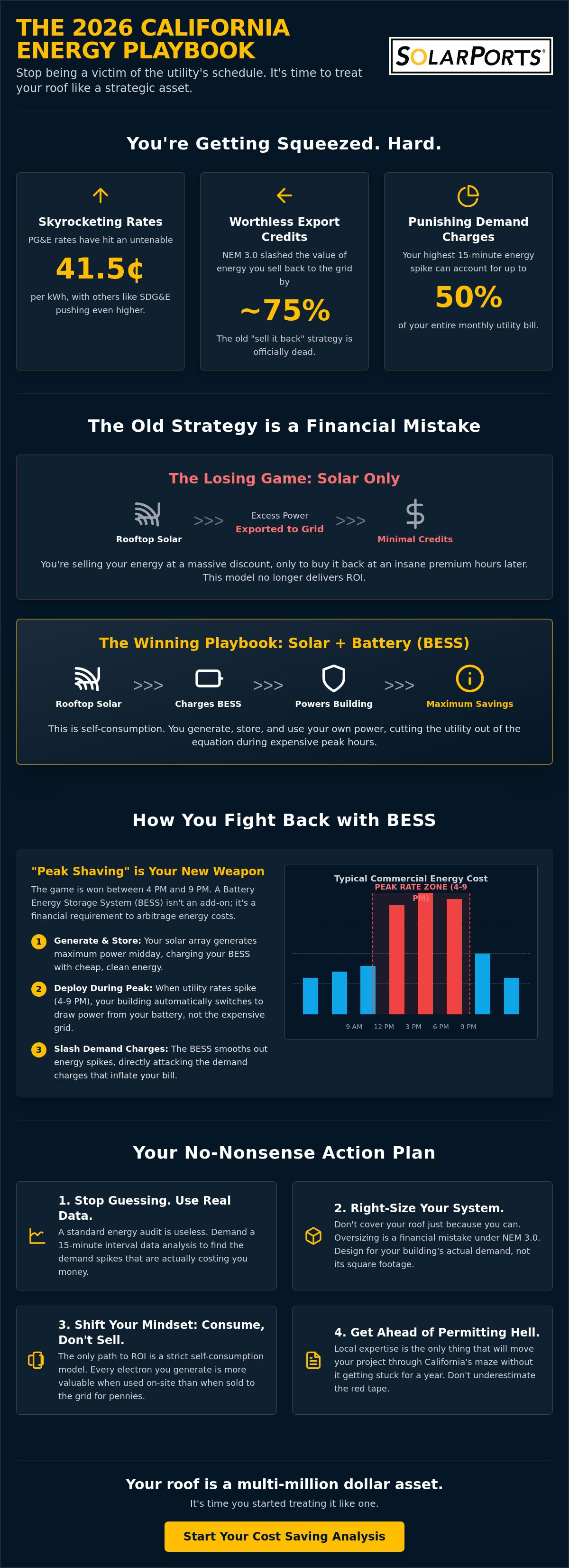
If you are still viewing commercial rooftop solar in California as a "green" initiative, you are missing the financial reality of 2026. It is no longer about corporate social responsibility. It is a cold, hard hedge against utility rates that have effectively decoupled from reality. You have likely noticed that your properties are being squeezed by PG&E rates hitting 41.5 cents per kWh while NEM 3.0 has slashed your export credits by roughly 75 percent. The old strategy of just throwing panels on a roof and selling power back to the grid is dead.
We all agree that the complexity of the new Title 24 mandates and those skyrocketing peak-demand charges feel like a moving target. This article provides a no-nonsense breakdown of how to pair solar with Battery Energy Storage Systems (BESS) to actually lower your operating expenses. We will look at why self-consumption is the only path to ROI under the current Solar Billing Plan and how to navigate the 2025 building standards without overextending your capital. It is time to stop being a victim of the utility's schedule and start treating your roof like the strategic asset it is.
Key Takeaways
- Shift your mindset from selling power back to the grid to a strict self-consumption model. Exporting energy under NEM 3.0 is a losing game compared to using it yourself.
- Recognize why battery storage isn't optional anymore. It's the only buffer that keeps those 45-cent peak rates from gutting your monthly OpEx.
- Learn why over-sizing your commercial rooftop solar California project is a financial mistake. You've got to design for your building's actual demand, not the total square footage of your roof.
- Use 15-minute interval data to find your real waste. A standard energy audit won't catch the demand spikes that are actually driving your utility costs higher.
- Get ahead of the permitting red tape. Local expertise is the only thing that's going to move your project through the California maze without it getting stuck for a year.
Table of Contents
- The 2026 Financial Landscape for California Commercial Solar
- Designing for ROI: Why Rooftop Solar Needs BESS in 2026
- From Analysis to Activation: Executing Your Rooftop Project
The 2026 Financial Landscape for California Commercial Solar
California's commercial energy market has become a gauntlet of punitive pricing. With PG&E rates hovering around 41.5 cents per kWh and SDG&E pushing past 45 cents, your business is likely paying at least 50 percent more than the national average. It isn't just a cost of doing business anymore; it's a structural leak in your balance sheet. The introduction of NEM 3.0, officially called the Solar Billing Plan, ended the era where you could treat the grid like a high-interest savings account. Exporting power now yields roughly 75 percent less than it did under previous rules. Success with commercial rooftop solar California now requires a "self-consumption" strategy where every electron generated stays inside your building—a priority that Cardenas & Company Real Estate Group highlights as essential for protecting asset value in the high-cost San Diego market.
The history of Solar Power in California shows a steady march toward mandate-driven adoption, but the 2026 landscape is uniquely aggressive. Ignoring this shift is the most expensive path you can take. While you wait, utility inflation continues to compound at rates that far outpace the cost of capital. Doing nothing is effectively a decision to subsidize the utility's aging infrastructure with your profits.
Why Utility Rates are the Real Enemy
The bill you get at the end of the month is deceptive. In Northern California, the actual energy consumed is often overshadowed by peak-demand charges that can represent up to 50 percent of the total cost. These charges are based on your highest 15-minute window of usage; it's a metric designed to punish businesses for simply operating during the day. Transitioning to commercial rooftop solar California allows you to lock in a fixed cost of energy for decades, turning a volatile, inflationary liability into a predictable asset. It's the only way to stop the bleeding from those 4 p.m. to 9 p.m. rate spikes.
Compliance vs. Strategy: The Title 24 Factor
The 2025 update to Title 24, which went into effect on January 1, 2026, has removed the option of ignoring energy efficiency. If you are planning a significant renovation or a new build, "Solar Ready" is no longer a suggestion; it's a mandate for most commercial structures. The threshold for these requirements has tightened, forcing property owners to integrate solar and battery systems during the design phase rather than as an afterthought. You can either build for compliance and do the bare minimum, or you can build for strategy and actually capture the ROI that these mandates are trying to push you toward.
When developing a long-term strategy for your assets, consulting with experts like County Properties can help ensure your Southern California commercial real estate decisions are informed by both market trends and evolving energy requirements.
Designing for ROI: Why Rooftop Solar Needs BESS in 2026
Designing a commercial rooftop solar California system used to be a simple math problem: maximize the roof space to maximize the credits. Those days are gone. Under NEM 3.0, building a massive array to sell power back to the grid is a losing game. You're effectively selling energy at a deep discount only to buy it back at full price hours later. The strategic goal has shifted from generation to arbitrage. You need to capture every unit of midday energy and hold it until the utility tries to charge you those punishing evening rates.
This is where a Battery Energy Storage System (BESS) transforms from an "add-on" to a financial requirement. It acts as a buffer between your generation and the grid's volatility. Without it, you are subject to "clipping," where your system produces more than your building can use, and that excess value simply evaporates into the utility's pocket. A precise commercial energy cost saving analysis is the only way to determine exactly how much storage you need to zero out those peak charges without over-investing in unnecessary hardware.
The Self-Consumption Model Explained
In the current market, a "Solar Only" system often sees its ROI timeline stretched thin because the export credits don't cover the initial capital expenditure. By contrast, a "Solar + BESS" configuration focuses on self-consumption. While the upfront cost is higher, the daily savings are significantly more aggressive. This isn't just about utility bills; it's about grid resilience. As programs like California's Solar for All Program highlight the state's push for broader energy equity, businesses must ensure their own infrastructure remains stable during the inevitable brownouts and grid instability of a transition period.
Mitigating Demand Charges with Intelligent Storage
For a CFO, the most compelling argument for BESS is "peak shaving." This isn't just a technical term; it's a direct attack on your highest bill line items. Sophisticated software manages your battery's discharge, ensuring that when your building's demand spikes, you draw from your own stored energy instead of the grid. This lowers your 15-minute demand threshold and protects your bottom line. If you're ready to see how these numbers actually land on your balance sheet, you can book a technical review of your current load profile to find the inefficiencies.
From Analysis to Activation: Executing Your Rooftop Project
Executing a commercial rooftop solar California project is where the spreadsheet meets the street. Most property owners fail because they start with a hardware quote instead of a data audit. You need your 15-minute interval data, not just the last twelve months of bills. Total kWh tells you how much energy you use; interval data tells you exactly when you're being penalized by the utility. This data is the foundation of your entire ROI strategy.
Managing this yourself is a recipe for project failure. You're looking at a permitting maze that would give a seasoned developer a headache. This is why commercial solar project management CA is about more than just oversight. It's about having a partner who knows which specific desk at the utility holds your PTO paperwork. A turnkey commercial solar CA approach prevents the inevitable finger-pointing that happens when you try to juggle five different vendors for engineering, procurement, and construction.
The 2026 commercial rooftop solar California market doesn't reward those who rush into hardware. Even after the panels are up, you need a realistic Operations and Maintenance (O&M) plan. It is not a "set it and forget it" asset. Dust, debris, and inverter wear will degrade your output faster than you think if you aren't monitoring the system at a granular level.
The Energy Cost Saving Analysis
A proper analysis looks for the "why" behind your costs. Your consultant should be identifying the specific equipment or operational shifts causing your demand spikes. Sometimes, the roof isn't actually the best place for your investment. If your roof is nearing its end of life or is too cluttered with HVAC units, a solar carport might offer a cleaner installation path and higher energy yield.
Interconnection and the Final ROI Reality
The unfiltered reality is that Permission to Operate (PTO) from utilities like PG&E or SCE can take months. You have to factor this delay into your cash flow models. However, the 30 percent federal tax credit remains your strongest financial lever. To secure the full commercial solar tax credit California benefit, you must commence construction by July 4, 2026. Missing that window means leaving significant capital on the table.
Securing Your 2026 Energy Strategy
The window for treating energy as a passive expense is closed. If you aren't integrating storage with your commercial rooftop solar California project, you're essentially handing your capital back to the utility in the form of peak-demand charges. Success in 2026 comes down to two things: moving away from the "sell-back" myth and using granular, 15-minute interval data to size your system for actual consumption. It's about protecting your NOI from a utility market that has become increasingly punitive.
Managing these moving parts is a significant operational burden. We specialize in Northern California commercial real estate, providing turnkey BESS and solar integration that actually pencils out. Our ROI modeling is built on 2026 utility rates, not outdated figures from two years ago. You can stop guessing and start making decisions based on verified load profiles.
Request a Professional Energy Cost Saving Analysis to get a clear, data-driven path to energy independence. It is time to take control of your property's overhead before the next rate hike hits.
Frequently Asked Questions
Is commercial rooftop solar still worth it in California after NEM 3.0?
Yes, it's still a viable financial hedge, but the math has shifted from selling power back to the grid to maximizing self-consumption. Under the new Solar Billing Plan, export credits have dropped by about 75 percent. To make your investment pencil out, you have to pair the panels with a Battery Energy Storage System (BESS) so you can use your own power during the expensive peak hours instead of selling it for pennies.
How much does a commercial rooftop solar system cost in 2026?
The total investment depends entirely on your building's load profile and whether you are integrating storage, but you should focus on the net cost after the 30 percent ITC. While we don't give "ballpark" quotes because they are usually inaccurate, keep in mind that utility interconnection fees alone range from $94 for small systems to $800 for those over 1 MW. A detailed cost saving analysis is the only way to get a number that actually reflects your property's reality.
Does my California business qualify for the Federal Investment Tax Credit (ITC)?
Most for-profit businesses qualify for the full 30 percent credit as long as they "commence construction" by July 4, 2026. This isn't just a deduction; it's a dollar-for-dollar credit against your federal tax liability. If you're running a tax-exempt organization, you can now take advantage of "direct pay" provisions to receive that 30 percent as a cash payment from the IRS for your commercial rooftop solar California project.
How long does the average commercial solar installation take in California?
Expect the total timeline to run between six and nine months from the initial audit to the final Permission to Operate (PTO). The actual physical construction on your roof might only take three or four weeks. The real time sink is the administrative "maze" of local permitting and the utility's interconnection queue, which is why having local project management is mandatory to keep things moving.
Can I install rooftop solar on an older commercial building in CA?
You can, but the roof's age and structural integrity are the deciding factors. If your roof has less than 10 or 15 years of life left, it's a mistake to install solar without replacing the roof first because the cost to remove and reinstall the panels later is prohibitive. We also have to verify that your building can support the extra weight, especially with the 2025 Title 24 updates requiring more integrated hardware.
What is the difference between rooftop solar and a solar carport for my business?
Rooftop solar uses your building's existing footprint, while a solar carport is a new structure built over your parking stalls. Rooftop is usually the cheaper entry point because you aren't paying for steel supports. However, carports are better if your roof is too small or cluttered with HVAC units, plus they offer the added benefit of shade and an easy way to integrate EV charging for your employees or tenants.
Frequently asked questions
Why Utility Rates are the Real Enemy
The bill you get at the end of the month is deceptive. In Northern California, the actual energy consumed is often overshadowed by peak-demand charges that can represent up to 50 percent of the total cost. These charges are based on your highest 15-minute window of usage; it's a metric designed to punish businesses for simply operating during the day. Transitioning to commercial rooftop solar California allows you to lock in a fixed cost of energy for decades, turning a volatile, inflationary liability into a predictable asset. It's the only way to stop the bleeding from those 4 p.m. to 9 p.m. rate spikes.
Compliance vs. Strategy: The Title 24 Factor
The 2025 update to Title 24, which went into effect on January 1, 2026, has removed the option of ignoring energy efficiency. If you are planning a significant renovation or a new build, "Solar Ready" is no longer a suggestion; it's a mandate for most commercial structures. The threshold for these requirements has tightened, forcing property owners to integrate solar and battery systems during the design phase rather than as an afterthought. You can either build for compliance and do the bare minimum, or you can build for strategy and actually capture the ROI that these mandates are trying to push you toward. Designing a commercial rooftop solar California system used to be a simple math problem: maximize the roof space to maximize the credits. Those days are gone. Under NEM 3.0, building a massive array to sell power back to the grid is a losing game. You're effectively selling energy at a deep discount only to buy it back at full price hours later. The strategic goal has shifted from generation to arbitrage. You need to capture every unit of midday energy and hold it until the utility tries to charge you those punishing evening rates. This is where a Battery Energy Storage System (BESS) transforms from an "add-on" to a financial requirement. It acts as a buffer between your generation and the grid's volatility. Without it, you are subject to "clipping," where your system produces more than your building can use, and that excess value simply evaporates into the utility's pocket. A precise commercial energy cost saving analysis is the only way to determine exactly how much storage you need to zero out those peak charges without over-investing in unnecessary hardware.
The Self-Consumption Model Explained
In the current market, a "Solar Only" system often sees its ROI timeline stretched thin because the export credits don't cover the initial capital expenditure. By contrast, a "Solar + BESS" configuration focuses on self-consumption. While the upfront cost is higher, the daily savings are significantly more aggressive. This isn't just about utility bills; it's about grid resilience. As programs like California's Solar for All Program highlight the state's push for broader energy equity, businesses must ensure their own infrastructure remains stable during the inevitable brownouts and grid instability of a transition period.
Mitigating Demand Charges with Intelligent Storage
For a CFO, the most compelling argument for BESS is "peak shaving." This isn't just a technical term; it's a direct attack on your highest bill line items. Sophisticated software manages your battery's discharge, ensuring that when your building's demand spikes, you draw from your own stored energy instead of the grid. This lowers your 15-minute demand threshold and protects your bottom line. If you're ready to see how these numbers actually land on your balance sheet, you can book a technical review of your current load profile to find the inefficiencies. Executing a commercial rooftop solar California project is where the spreadsheet meets the street. Most property owners fail because they start with a hardware quote instead of a data audit. You need your 15-minute interval data, not just the last twelve months of bills. Total kWh tells you how much energy you use; interval data tells you exactly when you're being penalized by the utility. This data is the foundation of your entire ROI strategy. Managing this yourself is a recipe for project failure. You're looking at a permitting maze that would give a seasoned developer a headache. This is why commercial solar project management CA is about more than just oversight. It's about having a partner who knows which specific desk at the utility holds your PTO paperwork. A turnkey commercial solar CA approach prevents the inevitable finger-pointing that happens when you try to juggle five different vendors for engineering, procurement, and construction. The 2026 commercial rooftop solar California market doesn't reward those who rush into hardware. Even after the panels are up, you need a realistic Operations and Maintenance (O&M) plan. It is not a "set it and forget it" asset. Dust, debris, and inverter wear will degrade your output faster than you think if you aren't monitoring the system at a granular level.
The Energy Cost Saving Analysis
A proper analysis looks for the "why" behind your costs. Your consultant should be identifying the specific equipment or operational shifts causing your demand spikes. Sometimes, the roof isn't actually the best place for your investment. If your roof is nearing its end of life or is too cluttered with HVAC units, a solar carport might offer a cleaner installation path and higher energy yield.
Interconnection and the Final ROI Reality
The unfiltered reality is that Permission to Operate (PTO) from utilities like PG&E or SCE can take months. You have to factor this delay into your cash flow models. However, the 30 percent federal tax credit remains your strongest financial lever. To secure the full commercial solar tax credit California benefit, you must commence construction by July 4, 2026. Missing that window means leaving significant capital on the table. The window for treating energy as a passive expense is closed. If you aren't integrating storage with your commercial rooftop solar California project, you're essentially handing your capital back to the utility in the form of peak-demand charges. Success in 2026 comes down to two things: moving away from the "sell-back" myth and using granular, 15-minute interval data to size your system for actual consumption. It's about protecting your NOI from a utility market that has become increasingly punitive. Managing these moving parts is a significant operational burden. We specialize in Northern California commercial real estate, providing turnkey BESS and solar integration that actually pencils out. Our ROI modeling is built on 2026 utility rates, not outdated figures from two years ago. You can stop guessing and start making decisions based on verified load profiles. Request a Professional Energy Cost Saving Analysis to get a clear, data-driven path to energy independence. It is time to take control of your property's overhead before the next rate hike hits.
Is commercial rooftop solar still worth it in California after NEM 3.0?
Yes, it's still a viable financial hedge, but the math has shifted from selling power back to the grid to maximizing self-consumption. Under the new Solar Billing Plan, export credits have dropped by about 75 percent. To make your investment pencil out, you have to pair the panels with a Battery Energy Storage System (BESS) so you can use your own power during the expensive peak hours instead of selling it for pennies.
How much does a commercial rooftop solar system cost in 2026?
The total investment depends entirely on your building's load profile and whether you are integrating storage, but you should focus on the net cost after the 30 percent ITC. While we don't give "ballpark" quotes because they are usually inaccurate, keep in mind that utility interconnection fees alone range from $94 for small systems to $800 for those over 1 MW. A detailed cost saving analysis is the only way to get a number that actually reflects your property's reality.
Does my California business qualify for the Federal Investment Tax Credit (ITC)?
Most for-profit businesses qualify for the full 30 percent credit as long as they "commence construction" by July 4, 2026. This isn't just a deduction; it's a dollar-for-dollar credit against your federal tax liability. If you're running a tax-exempt organization, you can now take advantage of "direct pay" provisions to receive that 30 percent as a cash payment from the IRS for your commercial rooftop solar California project.
How long does the average commercial solar installation take in California?
Expect the total timeline to run between six and nine months from the initial audit to the final Permission to Operate (PTO). The actual physical construction on your roof might only take three or four weeks. The real time sink is the administrative "maze" of local permitting and the utility's interconnection queue, which is why having local project management is mandatory to keep things moving.
Can I install rooftop solar on an older commercial building in CA?
You can, but the roof's age and structural integrity are the deciding factors. If your roof has less than 10 or 15 years of life left, it's a mistake to install solar without replacing the roof first because the cost to remove and reinstall the panels later is prohibitive. We also have to verify that your building can support the extra weight, especially with the 2025 Title 24 updates requiring more integrated hardware.
What is the difference between rooftop solar and a solar carport for my business?
Rooftop solar uses your building's existing footprint, while a solar carport is a new structure built over your parking stalls. Rooftop is usually the cheaper entry point because you aren't paying for steel supports. However, carports are better if your roof is too small or cluttered with HVAC units, plus they offer the added benefit of shade and an easy way to integrate EV charging for your employees or tenants.