
SGIP for Commercial Battery Storage: A 2026 Strategic Guide for CA Property Owners

Waiting for the "perfect time" to fix your utility bill is a strategy that usually ends in a bigger bill. In California, securing SGIP for commercial battery storage has turned into a game of strategic patience because every budget category is currently operating on a waitlist. You probably already know that demand charges are the single biggest line item eating your margins, and seeing the program "fully reserved" feels like another door closing. It's a complex, bureaucratic hurdle that leaves many property owners wondering if the ROI on a battery still makes sense in the current market.
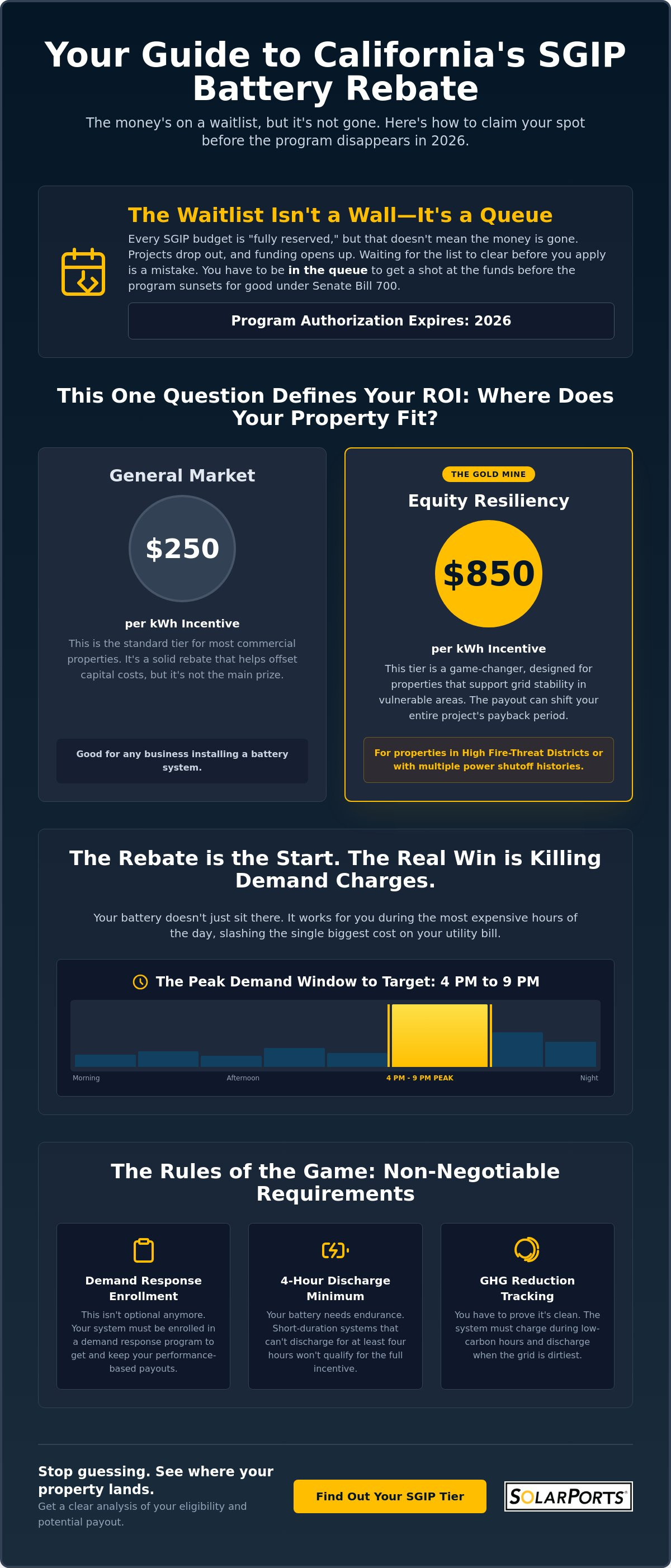
A waitlist isn't a dead end; it's a queue you need to join before the program's 2026 sunset under Senate Bill 700. This guide shows you how to leverage the Self-Generation Incentive Program to offset the capital costs of a battery system and finally put a cap on those skyrocketing demand charges. We'll break down the specific 2026 incentive rates, from the $250 general market tier to the $850 equity rates, and map out the mandatory demand response requirements you'll need to follow to protect your investment and ensure your project actually lands.
Key Takeaways
- The 2026 funding landscape is currently a waitlist game, making it critical to secure your spot in the queue before the program's authorization expires.
- Identify whether your property fits into the General Market or the high-incentive Equity Resiliency tier to maximize the rebate for SGIP for commercial battery storage.
- Shift your focus from simple backup power to active peak shaving, targeting the 4 PM to 9 PM utility spikes that drive the highest demand charges.
- Learn the mandatory demand response enrollment rules that are now a non-negotiable requirement for receiving and keeping your performance-based payouts.
Table of Contents
- What is SGIP for Commercial Battery Storage in 2026?
- Navigating Eligibility: General Market vs. Equity Resiliency
- Maximizing ROI: Pairing SGIP with Demand Charge Reduction
What is SGIP for Commercial Battery Storage in 2026?
SGIP for commercial battery storage is a capital offset tool designed to lower the barrier for California properties adopting high-capacity energy systems. It's not a simple handout or a "green" trophy. The California Public Utilities Commission (CPUC) uses this fund to incentivize "behind-the-meter" storage, which means the battery sits on your side of the utility meter to manage your specific load. By 2026, the program has evolved from a broad tech subsidy into a precision instrument focused on grid resiliency and performance-based payouts. If your system doesn't actually perform during peak stress, you won't see the full financial benefit.
How the 2026 Funding Cycle Works
The funding follows a "step" system where the dollar-per-kilowatt-hour rate drops as more capacity is reserved across the state. As of June 2026, the reality is that nearly all budgets are fully subscribed. New applications are currently placed on a waitlist, moving forward only when existing reservations are canceled. Waiting for the waitlist to clear before applying is a strategic error. You have to be in the queue to have any chance at the remaining $250 to $500 per kWh rates available in the general market categories. It's a first-come, first-served environment that rewards those who have their technical audits ready to go.
Why Commercial Properties are Priority Targets
Utilities like PG&E and SCE view commercial properties as high-leverage assets for grid stabilization. A single large-scale BESS at a warehouse or office park does more for the local grid than dozens of residential units. This is why commercial buildings often qualify for higher incentive tiers, especially if they carry "critical facility" status. If your property provides essential community services or is located in a high fire-threat district, the incentive amounts can jump significantly. It's about moving from a passive energy consumer to an active grid partner. You can see how this fits into a broader commercial property energy cost saving analysis to determine your exact eligibility and potential payout.
Navigating Eligibility: General Market vs. Equity Resiliency
Distinguishing between tiers is where the real money is won or lost. Most property owners default to the General Market bucket, which offers a standard rebate for any business installing a BESS. While that's better than nothing, the Equity Resiliency tier is the "gold mine" that transforms the financial model. This tier targets properties in High Fire-Threat Districts (HFTD) or those that have experienced multiple Public Safety Power Shutoffs (PSPS). A surprising number of business parks in Northern California sit inside these zones without the owners ever realizing they're eligible for a massive capital offset.
The rules established by California's Self-Generation Incentive Program are strict, but they're designed to reward properties that help the grid survive. If you are in an HFTD, your incentive for SGIP for commercial battery storage could cover a significant portion of the system cost, provided you meet the performance benchmarks. Correctly identifying your tier for SGIP for commercial battery storage is the difference between a modest discount and a complete shift in your project’s payback period. It’s worth mapping your specific parcel to see where you land before assuming you’re stuck with the general market rates.
The "Critical Facility" Advantage
Being labeled a "critical facility" is a major strategic win. This isn't limited to hospitals or police stations. Grocery stores, cooling centers, and even some large-scale refrigerated warehouses can qualify if they serve a vital role during emergencies. When a critical facility is located in a PSPS-prone area, it unlocks the maximum possible SGIP funding. The state wants these buildings powered during a blackout, and they’re willing to pay a premium to make it happen.
Technical Requirements You Can’t Ignore
The state doesn't just cut a check for hardware sitting idle. Your system must meet specific discharge duration requirements, typically four hours, to capture the full incentive. Short-duration batteries won't cut it. You also need smart software that tracks Greenhouse Gas (GHG) reductions. The program requires proof that your battery is charging during off-peak hours when renewable energy is abundant and discharging when the grid is under heavy, carbon-intensive stress.
Maximizing ROI: Pairing SGIP with Demand Charge Reduction
Securing the rebate is just the first move. While SGIP for commercial battery storage covers a massive portion of your initial capital expenditure, the sustained financial return comes from aggressive peak shaving. In California, demand charges can account for up to 50% of a commercial utility bill. By deploying stored energy during the 4 PM to 9 PM window, you effectively bypass the most expensive electricity of the day. This isn't just about saving pennies on kilowatt-hours; it's about structurally lowering your facility’s peak load profile to reset your monthly baseline.
Precision is everything here. You can't just guess at the battery size and hope for the best. A comprehensive commercial energy cost saving analysis is the only way to align your system's capacity with the specific rebate steps managed by the California Public Utilities Commission (CPUC). If you undersize the system, you leave demand charge savings on the table. If you oversize it without a clear operational need, you dilute your ROI. Turnkey partners handle the heavy lifting of this technical modeling and the exhaustive SGIP paperwork, allowing you to focus on core operations while the hardware works in the background.
The Synergy of Solar Carports and BESS
Pairing a battery with solar carport systems creates a closed-loop financial engine. Instead of charging your battery from the grid during mid-day hours, you’re filling it with free, onsite solar power. This maximizes the "green" performance metrics required by the state. It also ensures that when the 4 PM peak hits, you aren't just discharging energy; you're discharging energy that cost you nothing to generate. It turns your parking lot into a high-yield power plant.
Next Steps for California Property Owners
The window for these incentives is narrowing. To protect your bottom line, follow this sequence:
- Step 1: Conduct a data-driven usage assessment to confirm if you qualify for the Equity Resiliency tier.
- Step 2: Secure your place in the queue for SGIP for commercial battery storage immediately to lock in current rates before the next step-down.
Choosing a path through turnkey commercial solar in CA is the most efficient way to handle this. It's a single point of accountability for a complex financial transition.
Securing Your 2026 Capital Offset
The queue isn't getting any shorter. While the program is authorized through 2026, the reality of fully reserved budgets means that waiting for a "better time" is a recipe for missing out entirely. Securing SGIP for commercial battery storage now requires a level of technical precision that goes beyond standard utility paperwork. You need a partner who understands the granular fire-threat maps of Northern California and knows how to build a data-driven ROI model that actually holds up under executive scrutiny. We've spent years refining this process, specializing in the Equity Resiliency tier to ensure our clients capture every available dollar.
Our turnkey BESS expertise is built on results, not theories. We handle the complex bureaucracy so you can focus on running your business without the constant threat of skyrocketing demand charges. It's about taking control of your energy profile before the next step-down in funding occurs. You've got the roadmap; now it's time to execute.
Request your Commercial Energy Cost Saving Analysis to see exactly what the numbers look like for your property. Let's get your project into the queue while the window is still open.
Frequently Asked Questions
Is there still money left in the SGIP fund for 2026?
The program is authorized through 2026 under Senate Bill 700, but "available" money is a moving target. As of June 2026, most budget categories are fully reserved and operating on a waitlist basis. This means you won't get an immediate check, but you must join the queue to receive funding as older reservations are canceled or expire. It's a game of strategic positioning rather than instant gratification.
How much does SGIP actually pay for a commercial battery system?
The incentive amount depends entirely on your project size and eligibility tier. For large-scale SGIP for commercial battery storage systems over 30 kWh, the general market rates typically range from $250 to $500 per kWh. If your property qualifies for the Non-Residential Equity tier, the rate can be as high as $850 per kWh. This higher tier is designed to cover a much larger percentage of the total hardware cost for vulnerable properties.
Do I need to have solar panels to get the SGIP battery rebate?
You don't need solar panels to qualify, but you do need a plan to reduce greenhouse gas emissions. Stand-alone batteries can qualify if they are programmed to charge when grid carbon intensity is low and discharge during peak stress. That said, most owners find that pairing storage with onsite generation makes meeting these strict CPUC performance requirements much simpler. It also happens to be the most effective way to maximize your long-term demand charge savings.
What is a "Critical Facility" under the SGIP Equity Resiliency guidelines?
A critical facility is any building that provides essential community services during an emergency or power outage. This includes grocery stores, cooling centers, police stations, and even refrigerated warehouses that protect the local food supply. If your business falls into this category and you're located in a high fire-threat district, you unlock the most aggressive funding tiers available. The state's goal is to keep these specific buildings operational when the rest of the grid goes dark.
Frequently asked questions
How the 2026 Funding Cycle Works
The funding follows a "step" system where the dollar-per-kilowatt-hour rate drops as more capacity is reserved across the state. As of June 2026, the reality is that nearly all budgets are fully subscribed. New applications are currently placed on a waitlist, moving forward only when existing reservations are canceled. Waiting for the waitlist to clear before applying is a strategic error. You have to be in the queue to have any chance at the remaining $250 to $500 per kWh rates available in the general market categories. It's a first-come, first-served environment that rewards those who have their technical audits ready to go.
Why Commercial Properties are Priority Targets
Utilities like PG&E and SCE view commercial properties as high-leverage assets for grid stabilization. A single large-scale BESS at a warehouse or office park does more for the local grid than dozens of residential units. This is why commercial buildings often qualify for higher incentive tiers, especially if they carry "critical facility" status. If your property provides essential community services or is located in a high fire-threat district, the incentive amounts can jump significantly. It's about moving from a passive energy consumer to an active grid partner. You can see how this fits into a broader commercial property energy cost saving analysis to determine your exact eligibility and potential payout. Distinguishing between tiers is where the real money is won or lost. Most property owners default to the General Market bucket, which offers a standard rebate for any business installing a BESS. While that's better than nothing, the Equity Resiliency tier is the "gold mine" that transforms the financial model. This tier targets properties in High Fire-Threat Districts (HFTD) or those that have experienced multiple Public Safety Power Shutoffs (PSPS). A surprising number of business parks in Northern California sit inside these zones without the owners ever realizing they're eligible for a massive capital offset. The rules established by California's Self-Generation Incentive Program are strict, but they're designed to reward properties that help the grid survive. If you are in an HFTD, your incentive for SGIP for commercial battery storage could cover a significant portion of the system cost, provided you meet the performance benchmarks. Correctly identifying your tier for SGIP for commercial battery storage is the difference between a modest discount and a complete shift in your project’s payback period. It’s worth mapping your specific parcel to see where you land before assuming you’re stuck with the general market rates.
The "Critical Facility" Advantage
Being labeled a "critical facility" is a major strategic win. This isn't limited to hospitals or police stations. Grocery stores, cooling centers, and even some large-scale refrigerated warehouses can qualify if they serve a vital role during emergencies. When a critical facility is located in a PSPS-prone area, it unlocks the maximum possible SGIP funding. The state wants these buildings powered during a blackout, and they’re willing to pay a premium to make it happen.
Technical Requirements You Can’t Ignore
The state doesn't just cut a check for hardware sitting idle. Your system must meet specific discharge duration requirements, typically four hours, to capture the full incentive. Short-duration batteries won't cut it. You also need smart software that tracks Greenhouse Gas (GHG) reductions. The program requires proof that your battery is charging during off-peak hours when renewable energy is abundant and discharging when the grid is under heavy, carbon-intensive stress. Securing the rebate is just the first move. While SGIP for commercial battery storage covers a massive portion of your initial capital expenditure, the sustained financial return comes from aggressive peak shaving. In California, demand charges can account for up to 50% of a commercial utility bill. By deploying stored energy during the 4 PM to 9 PM window, you effectively bypass the most expensive electricity of the day. This isn't just about saving pennies on kilowatt-hours; it's about structurally lowering your facility’s peak load profile to reset your monthly baseline. Precision is everything here. You can't just guess at the battery size and hope for the best. A comprehensive commercial energy cost saving analysis is the only way to align your system's capacity with the specific rebate steps managed by the California Public Utilities Commission (CPUC). If you undersize the system, you leave demand charge savings on the table. If you oversize it without a clear operational need, you dilute your ROI. Turnkey partners handle the heavy lifting of this technical modeling and the exhaustive SGIP paperwork, allowing you to focus on core operations while the hardware works in the background.
The Synergy of Solar Carports and BESS
Pairing a battery with solar carport systems creates a closed-loop financial engine. Instead of charging your battery from the grid during mid-day hours, you’re filling it with free, onsite solar power. This maximizes the "green" performance metrics required by the state. It also ensures that when the 4 PM peak hits, you aren't just discharging energy; you're discharging energy that cost you nothing to generate. It turns your parking lot into a high-yield power plant.
Next Steps for California Property Owners
The window for these incentives is narrowing. To protect your bottom line, follow this sequence: Choosing a path through turnkey commercial solar in CA is the most efficient way to handle this. It's a single point of accountability for a complex financial transition. The queue isn't getting any shorter. While the program is authorized through 2026, the reality of fully reserved budgets means that waiting for a "better time" is a recipe for missing out entirely. Securing SGIP for commercial battery storage now requires a level of technical precision that goes beyond standard utility paperwork. You need a partner who understands the granular fire-threat maps of Northern California and knows how to build a data-driven ROI model that actually holds up under executive scrutiny. We've spent years refining this process, specializing in the Equity Resiliency tier to ensure our clients capture every available dollar. Our turnkey BESS expertise is built on results, not theories. We handle the complex bureaucracy so you can focus on running your business without the constant threat of skyrocketing demand charges. It's about taking control of your energy profile before the next step-down in funding occurs. You've got the roadmap; now it's time to execute. Request your Commercial Energy Cost Saving Analysis to see exactly what the numbers look like for your property. Let's get your project into the queue while the window is still open.
Is there still money left in the SGIP fund for 2026?
The program is authorized through 2026 under Senate Bill 700, but "available" money is a moving target. As of June 2026, most budget categories are fully reserved and operating on a waitlist basis. This means you won't get an immediate check, but you must join the queue to receive funding as older reservations are canceled or expire. It's a game of strategic positioning rather than instant gratification.
How much does SGIP actually pay for a commercial battery system?
The incentive amount depends entirely on your project size and eligibility tier. For large-scale SGIP for commercial battery storage systems over 30 kWh, the general market rates typically range from $250 to $500 per kWh. If your property qualifies for the Non-Residential Equity tier, the rate can be as high as $850 per kWh. This higher tier is designed to cover a much larger percentage of the total hardware cost for vulnerable properties.
Do I need to have solar panels to get the SGIP battery rebate?
You don't need solar panels to qualify, but you do need a plan to reduce greenhouse gas emissions. Stand-alone batteries can qualify if they are programmed to charge when grid carbon intensity is low and discharge during peak stress. That said, most owners find that pairing storage with onsite generation makes meeting these strict CPUC performance requirements much simpler. It also happens to be the most effective way to maximize your long-term demand charge savings.
What is a "Critical Facility" under the SGIP Equity Resiliency guidelines?
A critical facility is any building that provides essential community services during an emergency or power outage. This includes grocery stores, cooling centers, police stations, and even refrigerated warehouses that protect the local food supply. If your business falls into this category and you're located in a high fire-threat district, you unlock the most aggressive funding tiers available. The state's goal is to keep these specific buildings operational when the rest of the grid goes dark.