
Top Commercial Solar Installers in Sacramento: Cutting Through the 2026 Noise

The biggest mistake you can make right now is hiring a solar company that thinks in kilowatts instead of cash flow. Most of the so-called top commercial solar installers Sacramento has on the map are just trying to hit a panel quota. You're likely staring at those unpredictable SMUD and PG&E rate hikes and wondering why your underutilized parking lot isn't paying for itself yet. It's frustrating. Watching peak-demand charges eat your margins while vendors talk about "sustainability" like it's some sort of charity project is a waste of your time.
We know you're looking for a hedge against volatility, not a feel-good story. This guide is a no-nonsense look at how to identify Sacramento solar partners who actually prioritize your financial ROI over simple hardware counts. We're stripping away the noise to show you what really matters in 2026. You'll see how to vet installers based on their grasp of the current tax landscape, the actual impact of SMUD’s Solar and Storage Rate, and why a Battery Energy Storage System (BESS) is now the linchpin of any serious commercial energy strategy.
Key Takeaways
- Stop trusting generic "best of" lists that are usually just residential companies out of their depth. You'll learn why commercial projects require a "thinking fix" that prioritizes load profile analysis over simple hardware counts.
- Don't sign a contract without a thorough commercial property energy cost saving analysis. It's the only way to ensure your system is actually sized for financial ROI rather than just filling up roof space.
- You'll discover why Battery Energy Storage Systems (BESS) have become mandatory in 2026. Solar alone can't touch the peak-demand charges that are currently eating your margins.
- We'll show you how to identify the top commercial solar installers Sacramento has to offer by looking for a "turnkey" approach. A real partner handles everything from the initial audit through the complex SMUD or PG&E interconnection process.
Table of Contents
- Why Sacramento's Top Solar Lists Often Fail Commercial Owners
- The 2026 Criteria for Selecting a Sacramento Commercial Partner
- Executing Your Project in the Sacramento Market
Why Sacramento's Top Solar Lists Often Fail Commercial Owners
Most "best of" guides for Sacramento solar are just popularity contests for residential roofers. If you're managing a warehouse in Natomas or a retail center in Roseville, those lists are useless. Most residential installers are optimized for high volume and simple bill offsets. They simply don't understand that a commercial project is a financial instrument, not just a hardware installation. When you look for the top commercial solar installers Sacramento has to offer, you aren't looking for someone who can nail panels to a roof; you're looking for a firm that understands your balance sheet.
Commercial solar requires a thinking fix. This means analyzing load profiles and operational data before a single piece of equipment is ordered. Sacramento is a split reality. Depending on which side of the street your property is on, you're dealing with either SMUD or PG&E. The rules, the rates, and the interconnection hurdles are completely different for each. While solar power in California continues to lead the nation, the local nuances in the Sacramento Valley are where projects succeed or fail. A vendor wants to sell you hardware. A strategic partner wants to fix your operational expenses.
Residential vs. Commercial Installers: The Strategic Divide
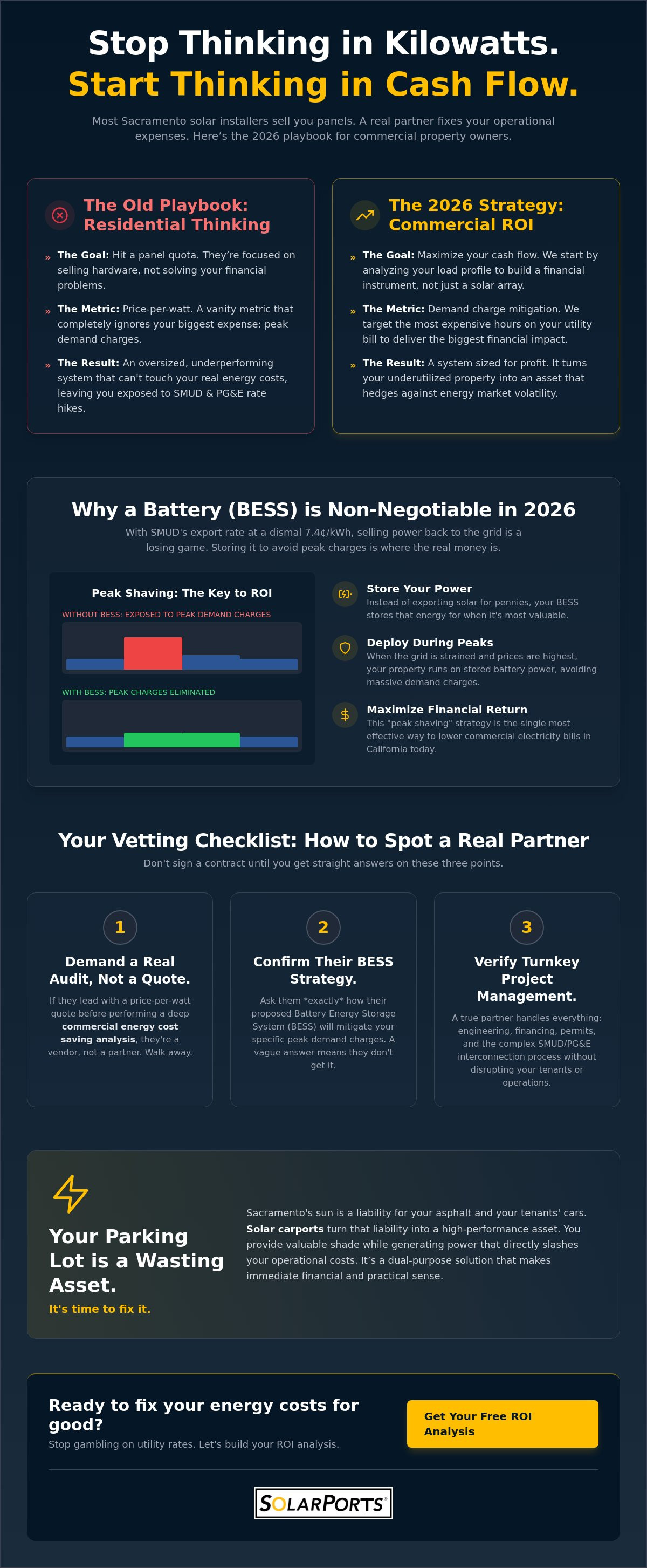
The difference is in the goal. Residential installers focus on total energy offset to zero out a homeowner's bill. For a business, total offset is often secondary to demand charge mitigation and peak shaving. You need an installer who starts with a commercial energy cost saving analysis to identify exactly when your building pulls the most power from the grid. If they aren't looking at your interval data, they aren't building a commercial system.
Execution matters just as much as the math. Commercial projects require turnkey project management that respects your tenants and your schedule. You can't have a crew blocking parking lot access or disrupting operations in a busy business district because they didn't plan the staging correctly. We define commercial-grade as a synthesis of engineering, financing, and long-term asset management. It's about building a system that performs for twenty years, not just one that passes an inspection today.
The 2026 Criteria for Selecting a Sacramento Commercial Partner
Stop looking at price-per-watt. It's a vanity metric that hides the real cost of a poorly designed system. In 2026, the top commercial solar installers Sacramento businesses actually benefit from are those who refuse to talk about hardware until they've performed a commercial energy cost saving analysis. You don't need more panels; you need a more intelligent load profile. If an installer leads with a quote instead of an audit, they're just a vendor trying to move inventory.
Real transparency is found in a commercial solar ROI analysis that accounts for the hard truth of SMUD's Solar and Storage Rate (SSR). With export rates sitting at just 7.4¢/kWh, selling power back to the grid is a losing game. The financial logic has shifted from generation to preservation. While programs like the California Solar Initiative paved the way for adoption, current success depends on how well you navigate the specific demand charges on your bill.
BESS and Demand Charge Mitigation
Storing energy is now more profitable than generating it. In the 2026 regulatory environment, the real ROI is found in peak shaving. You should ask any potential installer exactly how their design lowers your peak demand charges. It's not about the sun; it's about the battery. A Battery Energy Storage System (BESS) ensures your property stays resilient during Northern California grid strains while keeping you out of the most expensive utility tiers. If you're curious about how this fits your specific site, you might want to schedule a brief strategy session to look at your data.
Solar Carports: Turning Parking Lots into Assets
Sacramento's sun is usually a liability for asphalt and parked cars. It's time to turn that heat into a financial asset. Solar carports offer a dual-purpose solution that provides vehicle shade while delivering significant strategies to lower commercial electricity bills. This isn't just about energy. It's about property value. By integrating EV charging infrastructure into the carport design, you aren't just saving on power; you're future-proofing your real estate for a tenant base that increasingly demands on-site charging.
Executing Your Project in the Sacramento Market
Sacramento's permitting landscape is a maze of municipal codes and utility specific hurdles. If you're operating in the city proper or the surrounding jurisdictions, you're dealing with a system that has specific caps on fees and strict requirements for commercial-grade hardware. The top commercial solar installers Sacramento property owners trust are those who have already navigated these local bottlenecks. They don't just hand you a set of plans and wish you luck. They manage the entire lifecycle from the first site walk to the final permit sign-off.
A true turnkey partner handles everything from the initial audit to the final interconnection. This level of accountability is vital because commercial projects are too complex for a fragmented approach. You need someone who adheres to SEIA installation standards to ensure the long-term integrity of the asset. It's also about the money. Proper documentation is the only way to maximize the 2026 commercial solar tax credit. Missing a filing deadline or failing to document a construction start before the July 4, 2026 deadline could cost you 30% of your project's value. You can see how other local businesses handled these transitions by reviewing our past projects.
The Reality of Project Timelines and Logistics
Commercial solar isn't a quick fix. It's a 6 to 12 month strategic deployment. The hardware installation is often the shortest part of the journey. The real work happens in the months of engineering, permitting, and the unfiltered reality of utility interconnection delays. SMUD and PG&E have their own rhythms; a partner who knows how to push through those queues is worth their weight in gold. The best time to start an energy audit was yesterday; the second best time is right now. Waiting until your demand charges spike again is just throwing money at a problem that could have been solved months ago.
Moving Beyond the Panel Count to Real Financial Resilience
Sacramento's energy market isn't getting any simpler. The distinction between a vendor who sells hardware and a partner who builds value has never been more critical. You've seen why generic "best of" lists usually lead to residential-grade mistakes and why 2026 requires a focus on battery storage and parking lot optimization. Identifying the top commercial solar installers Sacramento has to offer means finding a firm that leads with data-driven ROI modeling rather than sales pitches.
We bring California-exclusive commercial expertise to every project, specializing in the complex BESS and carport engineering that urban properties actually need. It's about protecting your bottom line from the next round of rate hikes. If you're ready to stop guessing and start measuring, you can Request a Strategic Energy Cost Saving Analysis to see exactly where your inefficiencies are hiding. The transition to a more resilient building starts with a single audit. Let's get to work.
Frequently Asked Questions
How do SMUD and PG&E solar policies differ for Sacramento businesses?
SMUD operates as a community-owned utility and isn't regulated by the CPUC, which means it sets its own rules independent of the NEM 3.0 policies affecting PG&E customers. As of March 2026, SMUD's commercial rates are approximately 44.3% lower than PG&E's, but their Solar and Storage Rate (SSR) compensates exports at a flat 7.4¢/kWh. Businesses in PG&E territory face much more volatile time-of-use structures, making the financial engineering of a system look entirely different depending on which side of the city line your property sits.
What is the typical ROI for a commercial solar carport in Northern California?
ROI for a carport is a multi-layered calculation that goes beyond simple energy production. While the hardware costs more than rooftop mounts, you're gaining property value through shaded parking and the ability to integrate EV charging infrastructure. When you factor in the 30% federal tax credit and the reduction in asphalt maintenance, the payback period remains competitive. It's often the best way to maximize a property's footprint when roof space is limited or obstructed by HVAC equipment.
Can I install solar on a commercial roof that is more than 10 years old?
You can, but you probably shouldn't without a full roof replacement or a structural reinforcement. Putting a 25-year energy asset on a roof with less than a decade of life left is a recipe for a financial disaster when you have to pay to remove and reinstall the system for a leak repair. The top commercial solar installers Sacramento property managers work with will always insist on a professional roof audit first. If the roof is aging, we often pivot the strategy toward carports to avoid disturbing the building envelope.
How does BESS help my business avoid peak demand charges?
Battery Energy Storage Systems (BESS) allow you to perform peak shaving by drawing from stored power instead of the grid during the most expensive hours of the day. In 2026, utility bills aren't just about how much energy you use; they're about when you use it. By discharging your batteries during high-demand windows, you effectively lower the "peak" that the utility uses to calculate your demand charges. It's a strategic buffer that turns a rooftop solar system from a passive generator into an active financial tool.
What are the specific 2026 incentives for commercial solar in Sacramento?
The most pressing incentive is the 30% federal Investment Tax Credit (ITC), which requires you to begin construction by July 4, 2026, to guarantee the full rate. Locally, Sacramento businesses can still benefit from the state's property tax exclusion for solar systems, though this is currently set to expire after 2026. SMUD also offers storage incentives through the My Energy Optimizer Partner program. Navigating these deadlines is why choosing from the top commercial solar installers Sacramento is vital for capturing every available dollar before the window closes.
Frequently asked questions
Residential vs. Commercial Installers: The Strategic Divide
The difference is in the goal. Residential installers focus on total energy offset to zero out a homeowner's bill. For a business, total offset is often secondary to demand charge mitigation and peak shaving. You need an installer who starts with a commercial energy cost saving analysis to identify exactly when your building pulls the most power from the grid. If they aren't looking at your interval data, they aren't building a commercial system. Execution matters just as much as the math. Commercial projects require turnkey project management that respects your tenants and your schedule. You can't have a crew blocking parking lot access or disrupting operations in a busy business district because they didn't plan the staging correctly. We define commercial-grade as a synthesis of engineering, financing, and long-term asset management. It's about building a system that performs for twenty years, not just one that passes an inspection today. Stop looking at price-per-watt. It's a vanity metric that hides the real cost of a poorly designed system. In 2026, the top commercial solar installers Sacramento businesses actually benefit from are those who refuse to talk about hardware until they've performed a commercial energy cost saving analysis. You don't need more panels; you need a more intelligent load profile. If an installer leads with a quote instead of an audit, they're just a vendor trying to move inventory. Real transparency is found in a commercial solar ROI analysis that accounts for the hard truth of SMUD's Solar and Storage Rate (SSR). With export rates sitting at just 7.4¢/kWh, selling power back to the grid is a losing game. The financial logic has shifted from generation to preservation. While programs like the California Solar Initiative paved the way for adoption, current success depends on how well you navigate the specific demand charges on your bill.
BESS and Demand Charge Mitigation
Storing energy is now more profitable than generating it. In the 2026 regulatory environment, the real ROI is found in peak shaving. You should ask any potential installer exactly how their design lowers your peak demand charges. It's not about the sun; it's about the battery. A Battery Energy Storage System (BESS) ensures your property stays resilient during Northern California grid strains while keeping you out of the most expensive utility tiers. If you're curious about how this fits your specific site, you might want to schedule a brief strategy session to look at your data.
Solar Carports: Turning Parking Lots into Assets
Sacramento's sun is usually a liability for asphalt and parked cars. It's time to turn that heat into a financial asset. Solar carports offer a dual-purpose solution that provides vehicle shade while delivering significant strategies to lower commercial electricity bills. This isn't just about energy. It's about property value. By integrating EV charging infrastructure into the carport design, you aren't just saving on power; you're future-proofing your real estate for a tenant base that increasingly demands on-site charging. Sacramento's permitting landscape is a maze of municipal codes and utility specific hurdles. If you're operating in the city proper or the surrounding jurisdictions, you're dealing with a system that has specific caps on fees and strict requirements for commercial-grade hardware. The top commercial solar installers Sacramento property owners trust are those who have already navigated these local bottlenecks. They don't just hand you a set of plans and wish you luck. They manage the entire lifecycle from the first site walk to the final permit sign-off. A true turnkey partner handles everything from the initial audit to the final interconnection. This level of accountability is vital because commercial projects are too complex for a fragmented approach. You need someone who adheres to SEIA installation standards to ensure the long-term integrity of the asset. It's also about the money. Proper documentation is the only way to maximize the 2026 commercial solar tax credit. Missing a filing deadline or failing to document a construction start before the July 4, 2026 deadline could cost you 30% of your project's value. You can see how other local businesses handled these transitions by reviewing our past projects.
The Reality of Project Timelines and Logistics
Commercial solar isn't a quick fix. It's a 6 to 12 month strategic deployment. The hardware installation is often the shortest part of the journey. The real work happens in the months of engineering, permitting, and the unfiltered reality of utility interconnection delays. SMUD and PG&E have their own rhythms; a partner who knows how to push through those queues is worth their weight in gold. The best time to start an energy audit was yesterday; the second best time is right now. Waiting until your demand charges spike again is just throwing money at a problem that could have been solved months ago. Sacramento's energy market isn't getting any simpler. The distinction between a vendor who sells hardware and a partner who builds value has never been more critical. You've seen why generic "best of" lists usually lead to residential-grade mistakes and why 2026 requires a focus on battery storage and parking lot optimization. Identifying the top commercial solar installers Sacramento has to offer means finding a firm that leads with data-driven ROI modeling rather than sales pitches. We bring California-exclusive commercial expertise to every project, specializing in the complex BESS and carport engineering that urban properties actually need. It's about protecting your bottom line from the next round of rate hikes. If you're ready to stop guessing and start measuring, you can Request a Strategic Energy Cost Saving Analysis to see exactly where your inefficiencies are hiding. The transition to a more resilient building starts with a single audit. Let's get to work.
How do SMUD and PG&E solar policies differ for Sacramento businesses?
SMUD operates as a community-owned utility and isn't regulated by the CPUC, which means it sets its own rules independent of the NEM 3.0 policies affecting PG&E customers. As of March 2026, SMUD's commercial rates are approximately 44.3% lower than PG&E's, but their Solar and Storage Rate (SSR) compensates exports at a flat 7.4¢/kWh. Businesses in PG&E territory face much more volatile time-of-use structures, making the financial engineering of a system look entirely different depending on which side of the city line your property sits.
What is the typical ROI for a commercial solar carport in Northern California?
ROI for a carport is a multi-layered calculation that goes beyond simple energy production. While the hardware costs more than rooftop mounts, you're gaining property value through shaded parking and the ability to integrate EV charging infrastructure. When you factor in the 30% federal tax credit and the reduction in asphalt maintenance, the payback period remains competitive. It's often the best way to maximize a property's footprint when roof space is limited or obstructed by HVAC equipment.
Can I install solar on a commercial roof that is more than 10 years old?
You can, but you probably shouldn't without a full roof replacement or a structural reinforcement. Putting a 25-year energy asset on a roof with less than a decade of life left is a recipe for a financial disaster when you have to pay to remove and reinstall the system for a leak repair. The top commercial solar installers Sacramento property managers work with will always insist on a professional roof audit first. If the roof is aging, we often pivot the strategy toward carports to avoid disturbing the building envelope.
How does BESS help my business avoid peak demand charges?
Battery Energy Storage Systems (BESS) allow you to perform peak shaving by drawing from stored power instead of the grid during the most expensive hours of the day. In 2026, utility bills aren't just about how much energy you use; they're about when you use it. By discharging your batteries during high-demand windows, you effectively lower the "peak" that the utility uses to calculate your demand charges. It's a strategic buffer that turns a rooftop solar system from a passive generator into an active financial tool.
What are the specific 2026 incentives for commercial solar in Sacramento?
The most pressing incentive is the 30% federal Investment Tax Credit (ITC), which requires you to begin construction by July 4, 2026, to guarantee the full rate. Locally, Sacramento businesses can still benefit from the state's property tax exclusion for solar systems, though this is currently set to expire after 2026. SMUD also offers storage incentives through the My Energy Optimizer Partner program. Navigating these deadlines is why choosing from the top commercial solar installers Sacramento is vital for capturing every available dollar before the window closes.