
BESS Solutions for Commercial Real Estate: A Pragmatic 2026 Buyer’s Guide

Your backup generator won't save your balance sheet when the mid-afternoon utility spikes hit. In California, treating a battery like a simple emergency fail-safe is a massive financial oversight. It's actually a defense mechanism designed to kill demand charges before they ever land on your desk. Most property owners are currently drowning in the technical weeds of LFP versus NMC chemistry or getting stuck in the permitting mud. You're likely tired of seeing those exorbitant peak-period charges and wondering if BESS solutions for commercial real estate are actually worth the headache.
You don't need to over-invest in hardware that sits idle. This guide is about stopping the overpayment cycle and integrating a system that matches how your building actually operates day to day. We're going to break down a clear framework for sizing your battery so you aren't paying for capacity you'll never use. It's time to establish a path toward lower monthly operational expenses and a level of energy independence that keeps your facility stable when the grid starts to flicker.
Key Takeaways
- Stop viewing your battery as a simple backup generator. It's actually a strategic buffer meant to neutralize the peak-period spikes that inflate your utility bill every month.
- Avoid the trap of over-sizing your hardware. A battery that's too big is just an expensive paperweight, so you'll learn how to right-size BESS solutions for commercial real estate to match your actual load profile.
- Prioritize LFP chemistry over NMC for your facility. While density matters, the safety profile and longevity of Lithium Iron Phosphate make it the only logical choice for long-term asset management.
- Shift your focus from hardware lead times to the utility interconnection process. The real bottleneck isn't the equipment delivery; it's the paperwork and grid agreements that can stall your ROI for months.
Table of Contents
- Beyond Backup: Using BESS to Neutralize California’s Demand Charges
- Choosing Your BESS: Capacity, Chemistry, and the "Right-Size" Trap
- The Execution Gap: Turning a BESS Proposal into a Functional Asset
Beyond Backup: Using BESS to Neutralize California’s Demand Charges
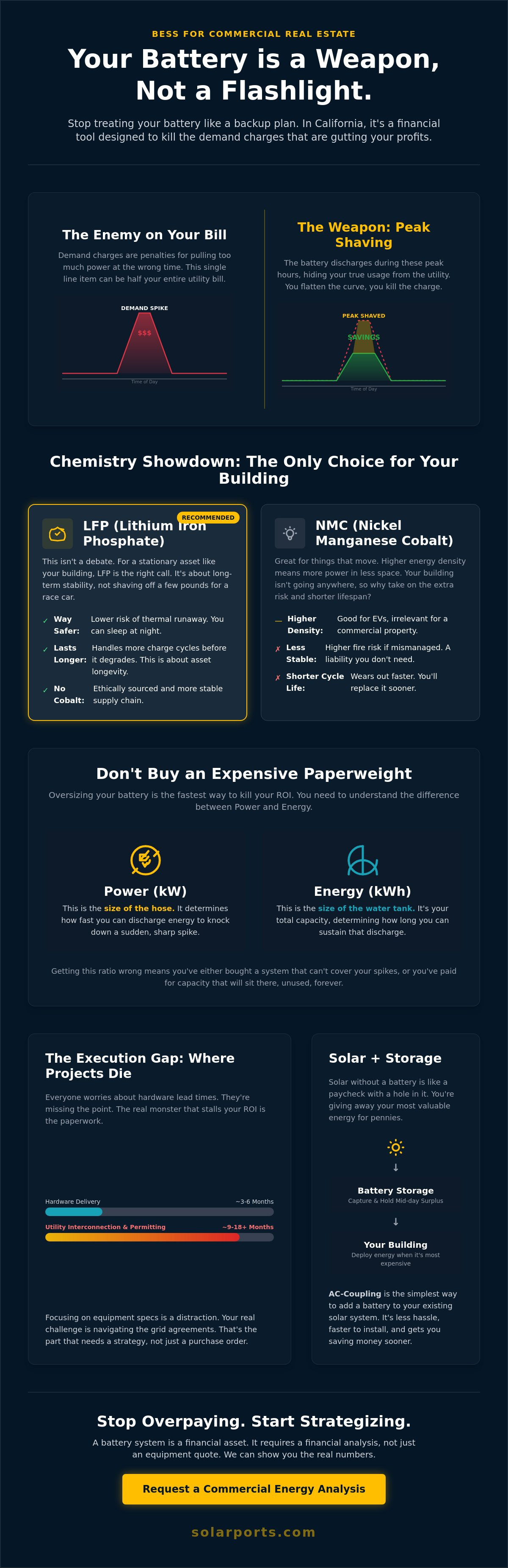
Stop thinking about batteries as fancy flashlights for when the power goes out. In California, a Battery energy storage system (BESS) isn't a backup tool; it's a financial buffer. It sits between the utility's aggressive rate hikes and your building's operational needs. Most commercial owners get blindsided by demand charges. These are the massive spikes on your bill that happen because you pulled too much power at the wrong time. It's a penalty for being productive.
Peak shaving is the primary weapon here. You discharge the battery when the grid is most expensive, usually in that afternoon window when rates skyrocket. By doing this, you're effectively hiding your real energy usage from the utility. Load shifting is the practice of buying power when it is cheap and using it when it is not. It sounds simple because it is. You're just playing the utility's game better than they do.
The "Invisible" Bill Killer: Demand Charge Mitigation
A battery system doesn't just sit there. It's constantly monitoring your meter. When it sees your building's load start to climb toward a new peak, it kicks in to level things out. This flattening of your load profile is where the real money is made. You aren't just saving a few cents per kilowatt hour; you're avoiding the peak multiplier that can make up half of a commercial bill in some utility territories.
Finding the right size for these systems is a balancing act. You don't want to pay for capacity you won't use, but you need enough to cover your actual spikes. This is why a commercial energy cost saving analysis is the first step. It finds that sweet spot where the hardware cost doesn't eat your ROI. Effective BESS solutions for commercial real estate are built around data, not guesswork.
Choosing Your BESS: Capacity, Chemistry, and the "Right-Size" Trap
People get weirdly hung up on battery chemistry. For a commercial building, the debate between LFP (Lithium Iron Phosphate) and NMC is actually pretty short. LFP is winning because it's safer and lasts longer. NMC has higher energy density, which is great if you're building a Tesla, but your building isn't going anywhere. You don't need to save weight; you need a system that won't degrade after five years of heavy cycling. Stick with LFP for BESS solutions for commercial real estate if you value asset longevity over theoretical density.
Don't fall for the "bigger is better" pitch. An oversized battery is just a heavy, expensive paperweight that will never pay for itself. You're looking for the minimum amount of hardware required to shave your specific peaks. If your demand spikes are short but high, you need "Power" (kW). If you're trying to run the whole building for four hours, you need "Energy" (kWh). Think of kW as the diameter of a garden hose and kWh as the size of the water tank. According to NREL's guide to battery storage, getting this ratio wrong is the fastest way to tank your ROI.
Modular design is your best friend if you have a growth plan. If you're planning to scale up fleet electrification in two years, buy a system that lets you slide in more battery racks later. It keeps your upfront costs down while protecting your future options. You can start with a preliminary cost saving analysis to see what you actually need today versus what you might need when the EV chargers arrive.
Integrating Storage with Commercial Solar Assets
Solar without storage is a missed opportunity. If you've already invested in a commercial solar carport with EV charging California, adding a battery lets you capture that mid-day surplus instead of selling it back to the utility for pennies. For retrofits, you'll likely look at an AC-coupled system. It’s usually easier to drop into an existing electrical room without ripping out your current solar inverters. DC-coupling is theoretically more efficient for new construction, but for most existing BESS solutions for commercial real estate, the simplicity of AC-coupling wins every time.
The Execution Gap: Turning a BESS Proposal into a Functional Asset
Permitting is the excuse most projects use to die on the vine. You've likely heard the common objection: "The permitting takes too long." It's a real hurdle, but it's often a failure of strategy rather than just city red tape. A proper "thinking fix" involves designing the system to meet the specific safety codes of your local jurisdiction before you ever submit a drawing. Most people wait for the city to tell them what's wrong. You can't afford to work that way if you want an operational asset.
Hardware delivery is rarely the issue these days. The real bottleneck is the interconnection agreement with the utility. This is the legal and technical bridge between your battery and the grid. If your partner doesn't have a direct line to the utility's engineering department, your project will stall for months. You need the 2026 commercial solar tax credit California to maximize your ROI, but you can't claim those credits if the system isn't energized. A turnkey approach is the only way to ensure BESS solutions for commercial real estate actually cross the finish line within a reasonable window.
Navigating the California Grid Reality
The commercial solar installation timeline gets significantly more crowded when you add storage. You aren't just dealing with a roof mount; you're dealing with high-voltage electrical rooms and fire suppression requirements. This is why local knowledge matters. If you're in Northern California, the utility districts have quirks that will blindside a generalist. BESS solutions for commercial real estate require a partner who has been through the trenches with your specific utility provider.
Commissioning is the final hurdle. Once the hardware is bolted down, the first 90 days of monitoring are vital. We look at the actual savings versus the proposal. If the demand charges aren't dropping as predicted, the software needs tuning. It's a living system, not a set-it-and-forget-it appliance. You want to see that load profile flatten out immediately.
Securing Your Building's Financial Defense
California utilities aren't going to lower their rates just because it's convenient for your budget. If you're still paying those massive mid-afternoon demand charge spikes, you're essentially allowing a predictable profit leak to continue. We've established that BESS solutions for commercial real estate are most effective when they're right-sized to your specific load and built with LFP chemistry for long-term safety. The execution gap, especially the utility interconnection process, is where most projects fail; however, it's a hurdle that can be managed with the right technical partner.
Stop leaving your operational expenses to chance. You need a strategy that combines turnkey California-based engineering with data-backed demand charge reduction strategies. Request your data-driven BESS feasibility analysis today to identify exactly how much you can shave off your monthly utility bill. Our team understands the local grid quirks and the engineering required to turn a proposal into a functional asset. You have the tools to take control of your energy costs and protect your bottom line. It's time to put them to work.
Frequently Asked Questions
How much space does a commercial BESS actually require?
A standard outdoor enclosure usually occupies the footprint of about two parking stalls, but the actual site impact is larger. You have to account for concrete pads and specific fire department access clearances that vary by city. It isn't just about the cabinet size; you're designing for safety buffers and maintenance lanes that can double the physical footprint of the hardware itself. Indoor setups are even more demanding because of structural weight limits and specialized ventilation needs.
Can a battery storage system provide full backup power during a CA grid outage?
Technically it can, but most commercial systems aren't sized for that level of intensity. Running an entire facility during a blackout requires a massive amount of energy that usually exceeds what you need for simple demand charge management. Most owners choose to isolate "critical loads" like servers, security, and emergency lighting. If you want to keep the HVAC running for six hours during a grid failure, you'll need to invest in significantly more capacity than a standard bill-shaving system provides.
What is the expected lifespan of a commercial-grade LFP battery in 2026?
You should expect about 10 to 15 years of operational life, or roughly 7,000 cycles, before the capacity drops below 80 percent. LFP chemistry is the industry standard for a reason. It handles the daily stress of deep discharging much better than older NMC options. The real secret to longevity is the thermal management system. If the cooling racks are maintained, the battery will likely outlast the original financial projections in your ROI model.
How does the Investment Tax Credit (ITC) apply to standalone battery storage?
Standalone storage now qualifies for the 30 percent federal Investment Tax Credit without needing to be connected to a solar array. This shift makes BESS solutions for commercial real estate much easier to justify for properties with shaded roofs or limited solar potential. It's a direct credit against your tax liability, not just a deduction. For California owners, this is the primary mechanism that brings the payback period into a range that actually makes sense for a CFO.
Frequently asked questions
The "Invisible" Bill Killer: Demand Charge Mitigation
A battery system doesn't just sit there. It's constantly monitoring your meter. When it sees your building's load start to climb toward a new peak, it kicks in to level things out. This flattening of your load profile is where the real money is made. You aren't just saving a few cents per kilowatt hour; you're avoiding the peak multiplier that can make up half of a commercial bill in some utility territories. Finding the right size for these systems is a balancing act. You don't want to pay for capacity you won't use, but you need enough to cover your actual spikes. This is why a commercial energy cost saving analysis is the first step. It finds that sweet spot where the hardware cost doesn't eat your ROI. Effective BESS solutions for commercial real estate are built around data, not guesswork. People get weirdly hung up on battery chemistry. For a commercial building, the debate between LFP (Lithium Iron Phosphate) and NMC is actually pretty short. LFP is winning because it's safer and lasts longer. NMC has higher energy density, which is great if you're building a Tesla, but your building isn't going anywhere. You don't need to save weight; you need a system that won't degrade after five years of heavy cycling. Stick with LFP for BESS solutions for commercial real estate if you value asset longevity over theoretical density. Don't fall for the "bigger is better" pitch. An oversized battery is just a heavy, expensive paperweight that will never pay for itself. You're looking for the minimum amount of hardware required to shave your specific peaks. If your demand spikes are short but high, you need "Power" (kW). If you're trying to run the whole building for four hours, you need "Energy" (kWh). Think of kW as the diameter of a garden hose and kWh as the size of the water tank. According to NREL's guide to battery storage, getting this ratio wrong is the fastest way to tank your ROI. Modular design is your best friend if you have a growth plan. If you're planning to scale up fleet electrification in two years, buy a system that lets you slide in more battery racks later. It keeps your upfront costs down while protecting your future options. You can start with a preliminary cost saving analysis to see what you actually need today versus what you might need when the EV chargers arrive.
Integrating Storage with Commercial Solar Assets
Solar without storage is a missed opportunity. If you've already invested in a commercial solar carport with EV charging California, adding a battery lets you capture that mid-day surplus instead of selling it back to the utility for pennies. For retrofits, you'll likely look at an AC-coupled system. It’s usually easier to drop into an existing electrical room without ripping out your current solar inverters. DC-coupling is theoretically more efficient for new construction, but for most existing BESS solutions for commercial real estate, the simplicity of AC-coupling wins every time. Permitting is the excuse most projects use to die on the vine. You've likely heard the common objection: "The permitting takes too long." It's a real hurdle, but it's often a failure of strategy rather than just city red tape. A proper "thinking fix" involves designing the system to meet the specific safety codes of your local jurisdiction before you ever submit a drawing. Most people wait for the city to tell them what's wrong. You can't afford to work that way if you want an operational asset. Hardware delivery is rarely the issue these days. The real bottleneck is the interconnection agreement with the utility. This is the legal and technical bridge between your battery and the grid. If your partner doesn't have a direct line to the utility's engineering department, your project will stall for months. You need the 2026 commercial solar tax credit California to maximize your ROI, but you can't claim those credits if the system isn't energized. A turnkey approach is the only way to ensure BESS solutions for commercial real estate actually cross the finish line within a reasonable window.
Navigating the California Grid Reality
The commercial solar installation timeline gets significantly more crowded when you add storage. You aren't just dealing with a roof mount; you're dealing with high-voltage electrical rooms and fire suppression requirements. This is why local knowledge matters. If you're in Northern California, the utility districts have quirks that will blindside a generalist. BESS solutions for commercial real estate require a partner who has been through the trenches with your specific utility provider. Commissioning is the final hurdle. Once the hardware is bolted down, the first 90 days of monitoring are vital. We look at the actual savings versus the proposal. If the demand charges aren't dropping as predicted, the software needs tuning. It's a living system, not a set-it-and-forget-it appliance. You want to see that load profile flatten out immediately. California utilities aren't going to lower their rates just because it's convenient for your budget. If you're still paying those massive mid-afternoon demand charge spikes, you're essentially allowing a predictable profit leak to continue. We've established that BESS solutions for commercial real estate are most effective when they're right-sized to your specific load and built with LFP chemistry for long-term safety. The execution gap, especially the utility interconnection process, is where most projects fail; however, it's a hurdle that can be managed with the right technical partner. Stop leaving your operational expenses to chance. You need a strategy that combines turnkey California-based engineering with data-backed demand charge reduction strategies. Request your data-driven BESS feasibility analysis today to identify exactly how much you can shave off your monthly utility bill. Our team understands the local grid quirks and the engineering required to turn a proposal into a functional asset. You have the tools to take control of your energy costs and protect your bottom line. It's time to put them to work.
How much space does a commercial BESS actually require?
A standard outdoor enclosure usually occupies the footprint of about two parking stalls, but the actual site impact is larger. You have to account for concrete pads and specific fire department access clearances that vary by city. It isn't just about the cabinet size; you're designing for safety buffers and maintenance lanes that can double the physical footprint of the hardware itself. Indoor setups are even more demanding because of structural weight limits and specialized ventilation needs.
Can a battery storage system provide full backup power during a CA grid outage?
Technically it can, but most commercial systems aren't sized for that level of intensity. Running an entire facility during a blackout requires a massive amount of energy that usually exceeds what you need for simple demand charge management. Most owners choose to isolate "critical loads" like servers, security, and emergency lighting. If you want to keep the HVAC running for six hours during a grid failure, you'll need to invest in significantly more capacity than a standard bill-shaving system provides.
What is the expected lifespan of a commercial-grade LFP battery in 2026?
You should expect about 10 to 15 years of operational life, or roughly 7,000 cycles, before the capacity drops below 80 percent. LFP chemistry is the industry standard for a reason. It handles the daily stress of deep discharging much better than older NMC options. The real secret to longevity is the thermal management system. If the cooling racks are maintained, the battery will likely outlast the original financial projections in your ROI model.
How does the Investment Tax Credit (ITC) apply to standalone battery storage?
Standalone storage now qualifies for the 30 percent federal Investment Tax Credit without needing to be connected to a solar array. This shift makes BESS solutions for commercial real estate much easier to justify for properties with shaded roofs or limited solar potential. It's a direct credit against your tax liability, not just a deduction. For California owners, this is the primary mechanism that brings the payback period into a range that actually makes sense for a CFO.