
Commercial Battery Storage ROI under NEM 3.0: The Unfiltered 2026 Reality for California Businesses

NEM 3.0 didn’t kill the financial case for solar in California. It simply moved the profit center from the panels on your roof to the battery cabinet on the ground. Most businesses saw export compensation crater by 75% under the new Net Billing Tariff and assumed the window for energy independence had closed. That frustration is real. If you’re staring at a 13 year payback for a solar-only system, the math stops making sense. This is where commercial battery storage ROI California NEM 3.0 becomes the only metric that actually matters for a serious bottom line.
We're going to skip the marketing fluff and look at how a BESS recovers the ROI lost to these utility shifts. You’ll see why the strategic focus has moved from selling power back to the grid to mitigating those aggressive peak-demand charges from providers like PG&E. This guide provides a clear framework for evaluating solar and storage as one integrated financial asset. We’ll also cover the 2026 reality of Northern California incentives so you can make a decision based on hard data rather than guesswork.
Key Takeaways
- Solar-only systems are now hitting payback periods of 12 years or more. You'll learn why the Net Billing Tariff makes daytime exports a losing game for the bottom line.
- Shifting your focus to self-consumption is the key to a healthy commercial battery storage ROI California NEM 3.0. You need to use your own power when rates are highest instead of selling it back for pennies.
- Peak shaving targets your most aggressive operational expenses. We'll show how a BESS flattens the demand spikes that lead to massive utility charges from providers like PG&E.
- Precision in system sizing is non-negotiable. Over-building your solar array or under-sizing the battery will quickly erode your project's internal rate of return.
- Every project should start with a commercial property energy cost saving analysis. It’s the only way to treat your energy infrastructure as a strategic financial asset rather than just another utility bill.
Table of Contents
- The NEM 3.0 ROI Gap: Why Solar-Only No Longer Makes Sense
- How Commercial Battery Storage Fixes the ROI Equation
- Strategic Implementation: Getting the Math Right the First Time
The NEM 3.0 ROI Gap: Why Solar-Only No Longer Makes Sense
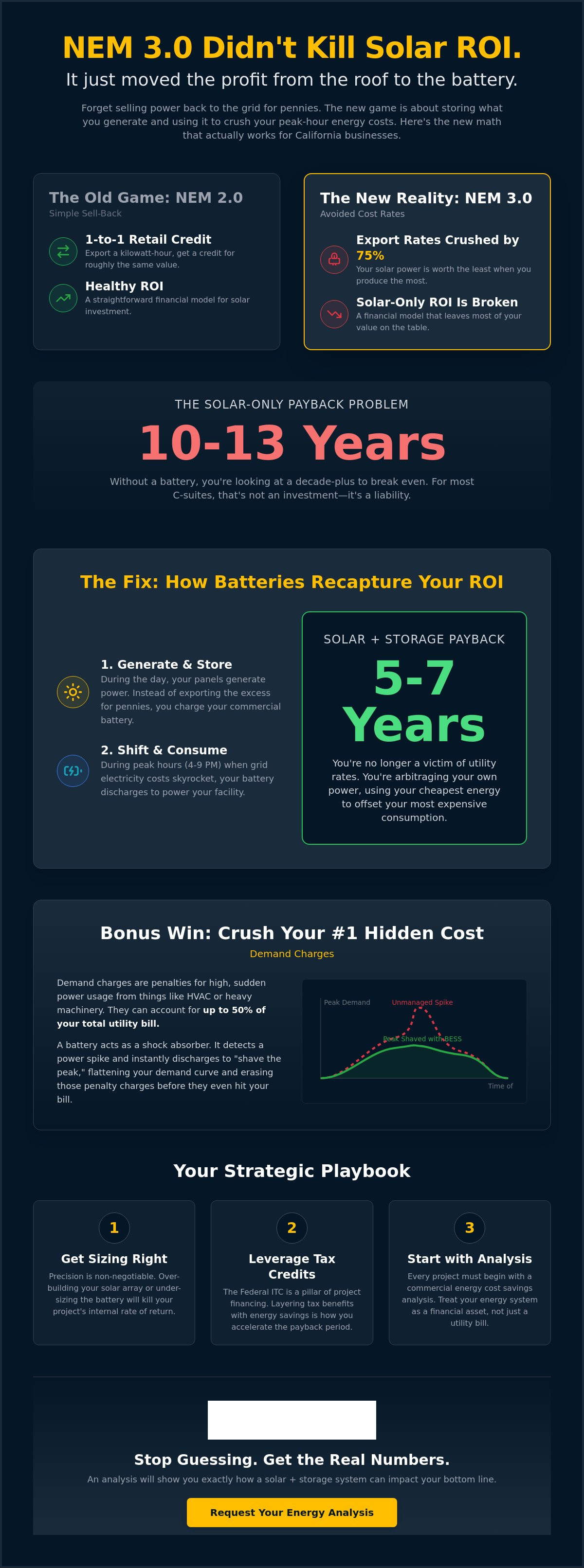
The "sell-back" model is over. California officially moved to the Net Billing Tariff on April 15, 2023, and the fallout for commercial solar has been swift. This change isn't a minor regulatory tweak; it's a fundamental restructuring of the financial math behind every commercial rooftop in the state. Under the old Net metering (NEM) rules, you could offset your utility bill at retail rates. Now, you’re exporting power at "avoided cost" rates. These rates are lowest when your panels are most productive, creating a massive ROI hole. If you’re looking at a solar-only install in 2026, you’re likely staring at a payback period of 10 to 13 years. That's a non-starter for most executive boards.
NEM 2.0 vs. NEM 3.0: A Financial Comparison
The shift is stark. NEM 2.0 offered a roughly 1:1 credit for every kilowatt-hour you sent to the grid. NEM 3.0 uses the Avoided Cost Calculator (ACC). Think of the ACC as a live market price that fluctuates by the hour based on what the utility "avoids" by not buying power elsewhere. When the sun is high and everyone’s solar is pumping, the grid doesn't need your power. The price drops to near zero, sometimes as low as $0.05 per kWh. You’re essentially giving away your generation. This is why the commercial battery storage ROI California NEM 3.0 calculation has become the primary driver of project viability. Without storage, you're leaving 75% of your potential export value on the table.
The Impact on Commercial Property Valuation
Energy efficiency isn't just a utility line item anymore. It’s a valuation lever. An inefficient energy profile acts as a direct drag on your Net Operating Income (NOI). In 2026, institutional buyers and REITs are scrutinizing energy infrastructure during due diligence. They aren't looking for just solar panels; they’re looking for an integrated BESS. A property that can't manage its own demand spikes is a liability. Before committing to any hardware, a commercial property energy cost saving analysis is mandatory. It ensures you aren't building a legacy system that will be obsolete before the first year is up.
How Commercial Battery Storage Fixes the ROI Equation
A battery isn't just a backup plan. It's a strategic asset designed to capture the value that California's Net Billing Tariff tries to claw back. By integrating storage, you stop being a passive victim of utility rate schedules. You start controlling when you buy power and, more importantly, when you don't. This shift can pull the commercial battery storage ROI California NEM 3.0 timeline from a bloated 12 years back down into the 5 to 7 year range. It transforms solar from a depreciating export product into a high-value internal resource.
The mechanics are straightforward but powerful. Instead of exporting excess solar energy at noon for pennies, you store it. When the 4 PM to 9 PM peak window hits and utility rates triple, your BESS discharges. This is self-consumption at its most profitable. You're effectively "arbitraging" your own energy, using your cheapest power to offset your most expensive consumption. It’s a logical fix for a broken export market.
Mitigating Demand Charges in Northern California
Demand charges are the silent killer of Northern California operational budgets. For many businesses, these charges account for up to 50% of the total monthly utility bill. A commercial grid-tied battery storage system acts as a high-speed buffer. It detects a spike in your facility's power draw and instantly discharges, flattening the peak before the utility can register it. This isn't just about saving energy. It's about avoiding the penalty rates triggered by heavy machinery, refrigeration, or HVAC cooling cycles. If you want to see how these numbers look for your specific facility, you can book a strategic data review to map out your potential savings.
The 2026 Tax Credit Landscape
The math gets even more compelling when you layer in the federal Investment Tax Credit (ITC). In 2026, the credit remains a pillar of project financing, whether you're looking at standalone storage or pairing it with solar. Understanding the nuances of the 2026 commercial solar tax credit in California is essential for any CFO trying to maximize the internal rate of return. When you combine these tax benefits with peak shaving and self-consumption, the hardware pays for itself significantly faster than a traditional solar array ever could under the current rules.
Strategic Implementation: Getting the Math Right the First Time
The hardware is secondary to the math. If you over-build your solar array or under-size your battery, you're effectively subsidizing the utility's grid with your own capital. Precision in sizing is the only way to protect your internal rate of return. Nailing the commercial battery storage ROI California NEM 3.0 equation requires moving past the broad strokes estimates found on generic blogs. You need a granular commercial property energy cost saving analysis that looks at how your specific building breathes throughout the day. Securing a predictable commercial battery storage ROI California NEM 3.0 is about more than just buying the latest LFP cabinets; it’s about aligning discharge cycles with your highest-cost demand windows.
The Role of Data-Driven Analysis
Generic ROI calculators aren't built for the complexity of California's commercial tariffs. They often miss the nuance of 15-minute interval data, which is the only way to accurately model how a BESS will interact with your facility's load. We use this data to simulate exactly how much of those expensive peak-demand charges you can actually shave off. It's the difference between a project that looks good on paper and one that actually performs in your quarterly reports. Without this level of detail, you're just guessing at your future savings.
Next Steps for Northern California Property Owners
Don't wait for the next rate hike to start planning. While many SGIP general market budgets closed or moved to waitlists by late 2025, there are still strategic pathways for certain equity-focused projects or leftover funds that require expert navigation. Transitioning to a turnkey commercial solar CA implementation ensures that your solar carports and battery systems are engineered as a single, cohesive unit. You can see how this looks in practice by reviewing our recent projects where integrated BESS has already stabilized operational costs for other property owners. The goal isn't just to install panels; it's to build a permanent defense against utility volatility.
Securing Your Facility’s Financial Future
The math behind California energy has shifted, but the opportunity for long-term savings is still very much alive. You've seen that a solar-only approach is now a legacy strategy that leaves your capital at the mercy of the Net Billing Tariff. To lock in a strong commercial battery storage ROI California NEM 3.0, you have to move from a mindset of grid-exporting to one of facility-wide energy management. This isn't just about panels. It's about using a BESS to flatten demand spikes and keep your power where it belongs: on-site.
We specialize in the complex modeling required for Northern California commercial real estate. Our team focuses on turnkey solar carports and storage systems that turn utility volatility into a predictable operational advantage. Don't let your energy strategy be dictated by the next rate hike from the utility. You can Request Your Custom Energy Cost Saving Analysis now to see exactly how these numbers play out for your specific property. Let's get the math right and start recovering your energy independence.
Frequently Asked Questions
Is NEM 3.0 retroactive for existing commercial solar systems?
No, NEM 3.0 isn't retroactive. If your system was interconnected under NEM 1.0 or 2.0, you're grandfathered into those legacy export rates for 20 years from your original permission to operate date. This provides a significant level of protection for early adopters. Unless you decide to significantly expand your solar array's capacity, your existing financial structure remains intact regardless of the new Net Billing Tariff rules.
How much does a commercial BESS typically add to the total project cost?
Integrating a BESS typically increases the total project's capital requirement by roughly 30% to 50% depending on the required discharge duration. While the upfront cost is higher, the investment is necessary to fix the commercial battery storage ROI California NEM 3.0 gap. You're essentially spending more on day one to prevent the utility from taking 75% of your export value over the next decade. It’s a strategic trade-off.
Can I add battery storage to an existing NEM 2.0 solar system without losing my status?
You can absolutely add storage to a NEM 2.0 system without losing your grandfathered status. The key is ensuring you don't increase the size of your solar array by more than 10% or 1 kW. Adding a battery is actually a smart way to future-proof a legacy site. It allows you to hedge against rising demand charges while still enjoying the 1:1 export credits you secured years ago.
What is the typical lifespan of a commercial battery storage system in 2026?
In 2026, the standard lifespan for a commercial Lithium Iron Phosphate (LFP) system is between 10 and 15 years. These systems are designed for heavy daily cycling, typically maintaining at least 70% of their original capacity through the end of the warranty period. While the battery cells are durable, you should still factor in at least one inverter replacement during the system's life to keep everything running at peak efficiency.
Frequently asked questions
NEM 2.0 vs. NEM 3.0: A Financial Comparison
The shift is stark. NEM 2.0 offered a roughly 1:1 credit for every kilowatt-hour you sent to the grid. NEM 3.0 uses the Avoided Cost Calculator (ACC). Think of the ACC as a live market price that fluctuates by the hour based on what the utility "avoids" by not buying power elsewhere. When the sun is high and everyone’s solar is pumping, the grid doesn't need your power. The price drops to near zero, sometimes as low as $0.05 per kWh. You’re essentially giving away your generation. This is why the commercial battery storage ROI California NEM 3.0 calculation has become the primary driver of project viability. Without storage, you're leaving 75% of your potential export value on the table.
The Impact on Commercial Property Valuation
Energy efficiency isn't just a utility line item anymore. It’s a valuation lever. An inefficient energy profile acts as a direct drag on your Net Operating Income (NOI). In 2026, institutional buyers and REITs are scrutinizing energy infrastructure during due diligence. They aren't looking for just solar panels; they’re looking for an integrated BESS. A property that can't manage its own demand spikes is a liability. Before committing to any hardware, a commercial property energy cost saving analysis is mandatory. It ensures you aren't building a legacy system that will be obsolete before the first year is up. A battery isn't just a backup plan. It's a strategic asset designed to capture the value that California's Net Billing Tariff tries to claw back. By integrating storage, you stop being a passive victim of utility rate schedules. You start controlling when you buy power and, more importantly, when you don't. This shift can pull the commercial battery storage ROI California NEM 3.0 timeline from a bloated 12 years back down into the 5 to 7 year range. It transforms solar from a depreciating export product into a high-value internal resource. The mechanics are straightforward but powerful. Instead of exporting excess solar energy at noon for pennies, you store it. When the 4 PM to 9 PM peak window hits and utility rates triple, your BESS discharges. This is self-consumption at its most profitable. You're effectively "arbitraging" your own energy, using your cheapest power to offset your most expensive consumption. It’s a logical fix for a broken export market.
Mitigating Demand Charges in Northern California
Demand charges are the silent killer of Northern California operational budgets. For many businesses, these charges account for up to 50% of the total monthly utility bill. A commercial grid-tied battery storage system acts as a high-speed buffer. It detects a spike in your facility's power draw and instantly discharges, flattening the peak before the utility can register it. This isn't just about saving energy. It's about avoiding the penalty rates triggered by heavy machinery, refrigeration, or HVAC cooling cycles. If you want to see how these numbers look for your specific facility, you can book a strategic data review to map out your potential savings.
The 2026 Tax Credit Landscape
The math gets even more compelling when you layer in the federal Investment Tax Credit (ITC). In 2026, the credit remains a pillar of project financing, whether you're looking at standalone storage or pairing it with solar. Understanding the nuances of the 2026 commercial solar tax credit in California is essential for any CFO trying to maximize the internal rate of return. When you combine these tax benefits with peak shaving and self-consumption, the hardware pays for itself significantly faster than a traditional solar array ever could under the current rules. The hardware is secondary to the math. If you over-build your solar array or under-size your battery, you're effectively subsidizing the utility's grid with your own capital. Precision in sizing is the only way to protect your internal rate of return. Nailing the commercial battery storage ROI California NEM 3.0 equation requires moving past the broad strokes estimates found on generic blogs. You need a granular commercial property energy cost saving analysis that looks at how your specific building breathes throughout the day. Securing a predictable commercial battery storage ROI California NEM 3.0 is about more than just buying the latest LFP cabinets; it’s about aligning discharge cycles with your highest-cost demand windows.
The Role of Data-Driven Analysis
Generic ROI calculators aren't built for the complexity of California's commercial tariffs. They often miss the nuance of 15-minute interval data, which is the only way to accurately model how a BESS will interact with your facility's load. We use this data to simulate exactly how much of those expensive peak-demand charges you can actually shave off. It's the difference between a project that looks good on paper and one that actually performs in your quarterly reports. Without this level of detail, you're just guessing at your future savings.
Next Steps for Northern California Property Owners
Don't wait for the next rate hike to start planning. While many SGIP general market budgets closed or moved to waitlists by late 2025, there are still strategic pathways for certain equity-focused projects or leftover funds that require expert navigation. Transitioning to a turnkey commercial solar CA implementation ensures that your solar carports and battery systems are engineered as a single, cohesive unit. You can see how this looks in practice by reviewing our recent projects where integrated BESS has already stabilized operational costs for other property owners. The goal isn't just to install panels; it's to build a permanent defense against utility volatility. The math behind California energy has shifted, but the opportunity for long-term savings is still very much alive. You've seen that a solar-only approach is now a legacy strategy that leaves your capital at the mercy of the Net Billing Tariff. To lock in a strong commercial battery storage ROI California NEM 3.0, you have to move from a mindset of grid-exporting to one of facility-wide energy management. This isn't just about panels. It's about using a BESS to flatten demand spikes and keep your power where it belongs: on-site. We specialize in the complex modeling required for Northern California commercial real estate. Our team focuses on turnkey solar carports and storage systems that turn utility volatility into a predictable operational advantage. Don't let your energy strategy be dictated by the next rate hike from the utility. You can Request Your Custom Energy Cost Saving Analysis now to see exactly how these numbers play out for your specific property. Let's get the math right and start recovering your energy independence.
Is NEM 3.0 retroactive for existing commercial solar systems?
No, NEM 3.0 isn't retroactive. If your system was interconnected under NEM 1.0 or 2.0, you're grandfathered into those legacy export rates for 20 years from your original permission to operate date. This provides a significant level of protection for early adopters. Unless you decide to significantly expand your solar array's capacity, your existing financial structure remains intact regardless of the new Net Billing Tariff rules.
How much does a commercial BESS typically add to the total project cost?
Integrating a BESS typically increases the total project's capital requirement by roughly 30% to 50% depending on the required discharge duration. While the upfront cost is higher, the investment is necessary to fix the commercial battery storage ROI California NEM 3.0 gap. You're essentially spending more on day one to prevent the utility from taking 75% of your export value over the next decade. It’s a strategic trade-off.
Can I add battery storage to an existing NEM 2.0 solar system without losing my status?
You can absolutely add storage to a NEM 2.0 system without losing your grandfathered status. The key is ensuring you don't increase the size of your solar array by more than 10% or 1 kW. Adding a battery is actually a smart way to future-proof a legacy site. It allows you to hedge against rising demand charges while still enjoying the 1:1 export credits you secured years ago.
What is the typical lifespan of a commercial battery storage system in 2026?
In 2026, the standard lifespan for a commercial Lithium Iron Phosphate (LFP) system is between 10 and 15 years. These systems are designed for heavy daily cycling, typically maintaining at least 70% of their original capacity through the end of the warranty period. While the battery cells are durable, you should still factor in at least one inverter replacement during the system's life to keep everything running at peak efficiency.