
How NEM 3.0 Affects Commercial Solar ROI in the Bay Area: A 2026 Strategic Reality Check

The era of using the PG&E grid as a free virtual battery is over, and frankly, it isn't coming back. If you're looking at your latest utility bill and wondering why your neighbor's 2021 solar array looks like a genius move while your 2026 projections feel like a liability, you aren't imagining things. You're likely trying to figure out how NEM 3.0 affects commercial solar ROI Bay Area businesses are seeing today. It's frustrating to watch export credits drop by 75 percent while operational costs climb. It leaves many executives feeling like the math for renewable energy simply doesn't pencil out anymore.
We're here to tell you that the traditional solar-only model is effectively dead, but the opportunity for energy independence has never been sharper. This guide explains why a Battery Energy Storage System (BESS) is no longer an optional add-on. It's the primary engine for achieving a sub-7-year ROI in the current regulatory environment. We'll look at the data behind avoided cost rates, the strategic use of the 30 percent federal tax credit, and how shifting from simple energy generation to intelligent orchestration can finally kill those predatory demand charges for good.
Key Takeaways
- The era of selling power back to PG&E for a profit is over; you're now operating under a model where export credits have dropped by roughly 75 percent.
- You'll see why Battery Energy Storage Systems (BESS) aren't just a luxury anymore, they're the actual engine that makes the financial math work for a modern project.
- We break down exactly how NEM 3.0 affects commercial solar ROI Bay Area businesses and why "self-consumption" is the only metric that matters in 2026.
- Learn to stack the 30 percent federal ITC with bonus depreciation and local incentives to bring your payback period back under the seven-year mark.
- Stop thinking about rooftops alone and start looking at solar carports as a way to scale your capacity while dodging some of the highest peak rates in the country.
Table of Contents
- The Bay Area Reality: Why NEM 3.0 Decoupled Generation from Value
- Engineering the Recovery: Why BESS is the New Engine of Commercial ROI
- Strategic Implementation: Using the IRA and Solar Carports to Beat Rate Hikes
The Bay Area Reality: Why NEM 3.0 Decoupled Generation from Value
The transition from NEM 2.0 to NEM 3.0 wasn't a minor policy tweak; it was a fundamental restructuring of how energy is valued. Under the old rules, every kilowatt-hour you pushed back to the grid was worth roughly what you paid for it. Now, you're dealing with a Net Billing Tariff. This shift essentially decoupled the act of generating power from the financial value of that power. If you are trying to understand how NEM 3.0 affects commercial solar ROI Bay Area projects, the first thing to accept is that the grid is no longer your piggy bank.
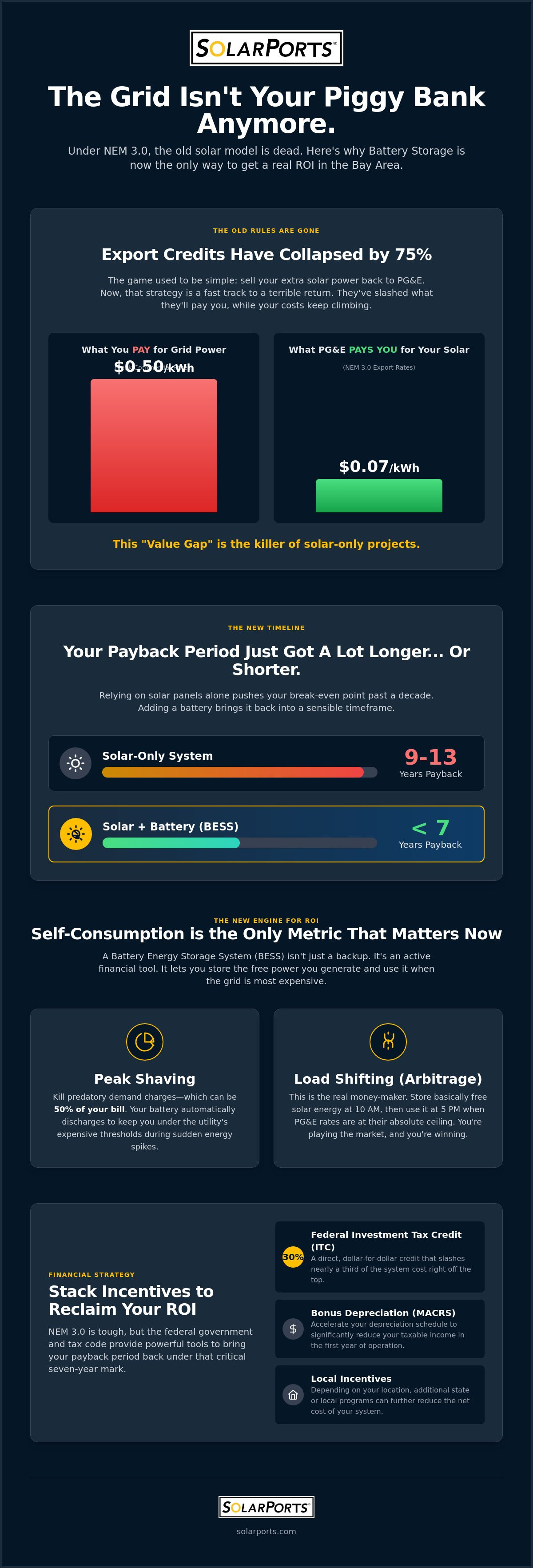
In the Bay Area, we've seen export credits plummet by roughly 75 percent compared to previous years. While PG&E’s retail rates for commercial imports continue to climb toward $0.50 per kWh during peak windows, they’re only cutting you a check for maybe $0.05 to $0.09 per kWh. This "value gap" is the silent killer of traditional solar projects. If your system is designed to just oversize and export, you're essentially donating high-value infrastructure to the utility company for pennies on the dollar. A proper commercial property energy cost saving analysis is now the only way to find the actual break-even point.
The Death of the 'Solar-Only' Payback Model
The math has changed for good. A traditional rooftop solar system without storage now faces payback periods often stretching between 9 and 13 years. Calling it Net metering (NEM) is technically a misnomer in 2026; it is a billing arrangement that prioritizes the utility's avoided costs over your generation capacity. Relying on generic California averages is a mistake. San Francisco’s microclimates and specific PG&E rate schedules mean your peak generation often happens when the grid needs it least, further depressing those export values.
Understanding the Avoided Cost Calculator (ACC)
The Avoided Cost Calculator is the new gatekeeper of your ROI. It’s a complex algorithm that values your solar export based on what it would cost PG&E to buy that power elsewhere. For 2026, the ACC Adder for commercial customers is a mere $0.0088 per kWh, which barely moves the needle. The system only rewards you when the grid is under extreme stress, which usually happens on late summer afternoons. This structure actively penalizes standard 9-to-5 businesses. If your facility is humming during the day and dark by 6 PM, you're exporting energy during the "cheap" hours and buying it back when the rates are highest.
Engineering the Recovery: Why BESS is the New Engine of Commercial ROI
If you’re still thinking of a Battery Energy Storage System (BESS) as a backup for when the grid goes down, you’re missing the point. In 2026, storage is the only way to fix the math. Under California's Net Billing Tariff, the strategy isn't about how much power you can sell back to PG&E. It’s about how much of their expensive peak power you can avoid buying. This shift is fundamental to understanding how NEM 3.0 affects commercial solar ROI Bay Area businesses are trying to protect. We focus on BESS-integrated feasibility studies because a solar-only system in this environment is essentially half a solution.
Peak Shaving and Demand Charge Mitigation
Demand charges can make up 50 percent of a commercial bill in San Jose or Oakland. Solar alone can't stop those spikes if a cloud passes over or your machinery ramps up at 4 PM. Peak Shaving is the process of using stored battery power to stay under utility-imposed thresholds. It’s a surgical strike against your highest costs. For manufacturing and retail centers, this is often more valuable than the actual solar generation because it directly addresses the volatile "spikes" that trigger massive monthly penalties.
Load Shifting: Arbitraging the Rate Schedule
Arbitrage is the name of the game. You store energy at 10 AM when it's basically free to produce and discharge it at 5 PM when PG&E rates are at their absolute ceiling. This load shifting strategy pulls a NEM 3.0 payback period back under 7 years by maximizing self-consumption. It turns your facility into a self-sustaining ecosystem that only touches the grid when it's financially advantageous to do so. Seeing exactly how NEM 3.0 affects commercial solar ROI Bay Area projects requires looking past the rooftop panels and into the software managing your battery. If you're curious about the numbers for your specific site, you can book a strategy session to see the data.
Strategic Implementation: Using the IRA and Solar Carports to Beat Rate Hikes
Complaining about PG&E rates is a common pastime in San Francisco and San Jose, but it doesn't solve the problem of a bloated operational budget. While the export credits are lower, the federal government has essentially stepped in to bridge the capital gap. The 2026 Investment Tax Credit (ITC) remains a rock-solid 30 percent baseline for commercial projects; however, you have to actually start construction by July 4, 2026, to guarantee that rate. When you factor in bonus depreciation and local Bay Area incentives, the initial capital expenditure often drops by half before the first panel is even installed.
The real secret to understanding how NEM 3.0 affects commercial solar ROI Bay Area businesses is realizing that you can't just slap panels on a roof and call it a day. You need a structure that maximizes every available tax credit while serving a dual purpose. We see this most clearly in our Northern California carport and BESS projects, where the infrastructure does more than just generate power. It protects assets and creates new revenue streams that rooftop systems simply can't touch.
Maximizing the Inflation Reduction Act (IRA)
The 30 percent ITC is just the floor. You can stack an additional 10 percent "Domestic Content" bonus if your equipment meets federal sourcing requirements, or another 10 percent if your property sits in a designated "Energy Community." Navigating these Inflation Reduction Act incentives requires precision. A granular commercial energy cost saving analysis is the only way to right-size your system. If you build too large, you're wasting capital on low-value exports; build too small, and you leave tax credits on the table. This balance is the pivot point for how NEM 3.0 affects commercial solar ROI Bay Area calculations in 2026.
Solar Carports: The Bay Area Real Estate Play
Rooftops are often crowded with HVAC units or limited by structural load capacities. Solar carports solve this by turning an underutilized parking lot into a high-yield power plant. They are often more efficient than rooftop solar for office buildings because the panels stay cooler with better airflow and can be tilted for perfect sun exposure. Beyond the power, you're adding EV charging infrastructure. This isn't just a "green" perk anymore; it's a critical tenant amenity that can drive lease rates and provide a secondary revenue stream to further accelerate your ROI.
Stop Reacting to PG&E and Start Orchestrating Your ROI
The reality of 2026 is that the old "set it and forget it" solar model is a relic. You've seen the numbers; export credits are down, but the cost of doing nothing is higher than ever. To truly master how NEM 3.0 affects commercial solar ROI Bay Area properties, you have to prioritize self-consumption and intelligent storage. It's about beating the utility at their own game by using your own power when their rates are at their peak.
We specialize in Northern California commercial real estate because we know the granular details of this specific market. From turnkey BESS and carport integration to data-driven ROI modeling designed for CFO-level approval, our focus is on fiscal logic, not marketing hype. You don't need a vendor; you need a strategic partner to protect your bottom line. It's time to stop letting volatile grid rates dictate your operational budget.
Request Your Unfiltered Commercial Energy Cost Saving Analysis and get a clear look at what your energy future actually looks like. There's a path to energy independence that still makes financial sense, and we're ready to help you find it.
Frequently Asked Questions
Is commercial solar still worth it in California under NEM 3.0?
Commercial solar remains a highly viable investment, but the strategy has shifted from energy production to energy orchestration. The value is no longer in selling power back to the grid for credits; it is in avoiding PG&E’s retail rates, which can exceed $0.50 per kWh during peak windows. If your system is engineered for self-consumption rather than grid export, the financial logic remains strong. It simply requires more analytical precision than the old models did.
How much did NEM 3.0 increase the payback period for Bay Area businesses?
For a solar-only system, the payback period has stretched to an estimated 9 to 13 years because export credits dropped by roughly 75 percent. This is a significant jump from the old five-year timelines. However, when you integrate a Battery Energy Storage System (BESS), you can often pull that ROI back down to a 7 to 9 year range. This is the most direct way how NEM 3.0 affects commercial solar ROI Bay Area businesses are calculating today.
Do I need a battery for my commercial solar system to be profitable now?
You don't strictly need a battery, but you will likely find the ROI unacceptable without one. Without storage, you're forced to export excess daytime power at "avoided cost" rates that are pennies on the dollar. A BESS allows you to store that cheap energy and discharge it during the expensive 4 to 9 PM peak. This pivot from selling power to avoiding expensive power is what makes a project profitable in a post-NEM 2.0 environment.
What is the 2026 federal tax credit for commercial solar installations?
The baseline Investment Tax Credit (ITC) for 2026 is 30 percent of the total system cost. To lock this in, your project needs to begin construction by July 4, 2026, or be placed in service by the end of 2027. You can also stack 10 percent bonus credits for using domestic content or locating in an energy community. These federal incentives are the primary hedge against the lower export values seen under the current Net Billing Tariff.
How does PG&E’s rate hike affect my solar ROI analysis?
Rising utility rates actually improve your ROI because they increase the value of every kilowatt-hour you generate and consume on-site. When PG&E raises their retail prices, the "avoided cost" of your solar power goes up. This makes self-generation a more powerful tool for controlling operational expenses. Your ROI analysis should account for these projected hikes to show the true long-term protection against a volatile and expensive grid.
Can solar carports qualify for the same tax incentives as rooftop solar?
Solar carports qualify for the exact same 30 percent ITC as rooftop systems. Since the carport structure is essential for mounting the solar panels, the entire cost of the steel and foundation is typically eligible for the credit. This makes carports a highly efficient real estate play. You are essentially getting a subsidized parking structure that doubles as a high-yield energy asset, which is often easier to scale than crowded rooftop space.
Frequently asked questions
The Death of the 'Solar-Only' Payback Model
The math has changed for good. A traditional rooftop solar system without storage now faces payback periods often stretching between 9 and 13 years. Calling it Net metering (NEM) is technically a misnomer in 2026; it is a billing arrangement that prioritizes the utility's avoided costs over your generation capacity. Relying on generic California averages is a mistake. San Francisco’s microclimates and specific PG&E rate schedules mean your peak generation often happens when the grid needs it least, further depressing those export values.
Understanding the Avoided Cost Calculator (ACC)
The Avoided Cost Calculator is the new gatekeeper of your ROI. It’s a complex algorithm that values your solar export based on what it would cost PG&E to buy that power elsewhere. For 2026, the ACC Adder for commercial customers is a mere $0.0088 per kWh, which barely moves the needle. The system only rewards you when the grid is under extreme stress, which usually happens on late summer afternoons. This structure actively penalizes standard 9-to-5 businesses. If your facility is humming during the day and dark by 6 PM, you're exporting energy during the "cheap" hours and buying it back when the rates are highest. If you’re still thinking of a Battery Energy Storage System (BESS) as a backup for when the grid goes down, you’re missing the point. In 2026, storage is the only way to fix the math. Under California's Net Billing Tariff, the strategy isn't about how much power you can sell back to PG&E. It’s about how much of their expensive peak power you can avoid buying. This shift is fundamental to understanding how NEM 3.0 affects commercial solar ROI Bay Area businesses are trying to protect. We focus on BESS-integrated feasibility studies because a solar-only system in this environment is essentially half a solution.
Peak Shaving and Demand Charge Mitigation
Demand charges can make up 50 percent of a commercial bill in San Jose or Oakland. Solar alone can't stop those spikes if a cloud passes over or your machinery ramps up at 4 PM. Peak Shaving is the process of using stored battery power to stay under utility-imposed thresholds. It’s a surgical strike against your highest costs. For manufacturing and retail centers, this is often more valuable than the actual solar generation because it directly addresses the volatile "spikes" that trigger massive monthly penalties.
Load Shifting: Arbitraging the Rate Schedule
Arbitrage is the name of the game. You store energy at 10 AM when it's basically free to produce and discharge it at 5 PM when PG&E rates are at their absolute ceiling. This load shifting strategy pulls a NEM 3.0 payback period back under 7 years by maximizing self-consumption. It turns your facility into a self-sustaining ecosystem that only touches the grid when it's financially advantageous to do so. Seeing exactly how NEM 3.0 affects commercial solar ROI Bay Area projects requires looking past the rooftop panels and into the software managing your battery. If you're curious about the numbers for your specific site, you can book a strategy session to see the data. Complaining about PG&E rates is a common pastime in San Francisco and San Jose, but it doesn't solve the problem of a bloated operational budget. While the export credits are lower, the federal government has essentially stepped in to bridge the capital gap. The 2026 Investment Tax Credit (ITC) remains a rock-solid 30 percent baseline for commercial projects; however, you have to actually start construction by July 4, 2026, to guarantee that rate. When you factor in bonus depreciation and local Bay Area incentives, the initial capital expenditure often drops by half before the first panel is even installed. The real secret to understanding how NEM 3.0 affects commercial solar ROI Bay Area businesses is realizing that you can't just slap panels on a roof and call it a day. You need a structure that maximizes every available tax credit while serving a dual purpose. We see this most clearly in our Northern California carport and BESS projects, where the infrastructure does more than just generate power. It protects assets and creates new revenue streams that rooftop systems simply can't touch.
Maximizing the Inflation Reduction Act (IRA)
The 30 percent ITC is just the floor. You can stack an additional 10 percent "Domestic Content" bonus if your equipment meets federal sourcing requirements, or another 10 percent if your property sits in a designated "Energy Community." Navigating these Inflation Reduction Act incentives requires precision. A granular commercial energy cost saving analysis is the only way to right-size your system. If you build too large, you're wasting capital on low-value exports; build too small, and you leave tax credits on the table. This balance is the pivot point for how NEM 3.0 affects commercial solar ROI Bay Area calculations in 2026.
Solar Carports: The Bay Area Real Estate Play
Rooftops are often crowded with HVAC units or limited by structural load capacities. Solar carports solve this by turning an underutilized parking lot into a high-yield power plant. They are often more efficient than rooftop solar for office buildings because the panels stay cooler with better airflow and can be tilted for perfect sun exposure. Beyond the power, you're adding EV charging infrastructure. This isn't just a "green" perk anymore; it's a critical tenant amenity that can drive lease rates and provide a secondary revenue stream to further accelerate your ROI. The reality of 2026 is that the old "set it and forget it" solar model is a relic. You've seen the numbers; export credits are down, but the cost of doing nothing is higher than ever. To truly master how NEM 3.0 affects commercial solar ROI Bay Area properties, you have to prioritize self-consumption and intelligent storage. It's about beating the utility at their own game by using your own power when their rates are at their peak. We specialize in Northern California commercial real estate because we know the granular details of this specific market. From turnkey BESS and carport integration to data-driven ROI modeling designed for CFO-level approval, our focus is on fiscal logic, not marketing hype. You don't need a vendor; you need a strategic partner to protect your bottom line. It's time to stop letting volatile grid rates dictate your operational budget. Request Your Unfiltered Commercial Energy Cost Saving Analysis and get a clear look at what your energy future actually looks like. There's a path to energy independence that still makes financial sense, and we're ready to help you find it.
Is commercial solar still worth it in California under NEM 3.0?
Commercial solar remains a highly viable investment, but the strategy has shifted from energy production to energy orchestration. The value is no longer in selling power back to the grid for credits; it is in avoiding PG&E’s retail rates, which can exceed $0.50 per kWh during peak windows. If your system is engineered for self-consumption rather than grid export, the financial logic remains strong. It simply requires more analytical precision than the old models did.
How much did NEM 3.0 increase the payback period for Bay Area businesses?
For a solar-only system, the payback period has stretched to an estimated 9 to 13 years because export credits dropped by roughly 75 percent. This is a significant jump from the old five-year timelines. However, when you integrate a Battery Energy Storage System (BESS), you can often pull that ROI back down to a 7 to 9 year range. This is the most direct way how NEM 3.0 affects commercial solar ROI Bay Area businesses are calculating today.
Do I need a battery for my commercial solar system to be profitable now?
You don't strictly need a battery, but you will likely find the ROI unacceptable without one. Without storage, you're forced to export excess daytime power at "avoided cost" rates that are pennies on the dollar. A BESS allows you to store that cheap energy and discharge it during the expensive 4 to 9 PM peak. This pivot from selling power to avoiding expensive power is what makes a project profitable in a post-NEM 2.0 environment.
What is the 2026 federal tax credit for commercial solar installations?
The baseline Investment Tax Credit (ITC) for 2026 is 30 percent of the total system cost. To lock this in, your project needs to begin construction by July 4, 2026, or be placed in service by the end of 2027. You can also stack 10 percent bonus credits for using domestic content or locating in an energy community. These federal incentives are the primary hedge against the lower export values seen under the current Net Billing Tariff.
How does PG&E’s rate hike affect my solar ROI analysis?
Rising utility rates actually improve your ROI because they increase the value of every kilowatt-hour you generate and consume on-site. When PG&E raises their retail prices, the "avoided cost" of your solar power goes up. This makes self-generation a more powerful tool for controlling operational expenses. Your ROI analysis should account for these projected hikes to show the true long-term protection against a volatile and expensive grid.
Can solar carports qualify for the same tax incentives as rooftop solar?
Solar carports qualify for the exact same 30 percent ITC as rooftop systems. Since the carport structure is essential for mounting the solar panels, the entire cost of the steel and foundation is typically eligible for the credit. This makes carports a highly efficient real estate play. You are essentially getting a subsidized parking structure that doubles as a high-yield energy asset, which is often easier to scale than crowded rooftop space.