
How to Reduce PG&E Demand Charges: A Strategic 2026 Guide for California Businesses

Your PG&E bill isn't high because you're using too much power. It's high because of what happened during one single fifteen minute window last month. This demand charge is essentially a tax on your operational momentum, penalizing your facility for the brief spikes required to actually do your job. It's an exhausting cycle. You watch rates climb over 104% since 2015 while trying to decode a bill that feels intentionally confusing. You want predictable costs and a system that doesn't require you to shut down operations just to avoid a massive surcharge.
Finding a real PG&E demand charge reduction for business isn't about turning off the lights; it's about strategic control. We're going to show you exactly how to analyze your usage and use battery storage to automate your peak shaving. This guide covers the 2026 rate restructuring, the new $24 base services charge, and how to maximize your ROI from solar assets. We will move past the theory and get into the data-backed steps that turn your utility bill from an unpredictable liability into a managed expense.
Key Takeaways
- Spikes happen fast. We'll show you how to identify these 15-minute windows and why they usually represent nearly half of your monthly utility budget.
- Data is the starting point. Real PG&E demand charge reduction for business starts with a commercial energy cost saving analysis that maps your facility's unique load profile.
- Storage provides control. We'll explain how a BESS setup automates peak shaving so you can stop worrying about when your facility is pulling the most power.
- Integration maximizes ROI. We'll look at how to combine rooftop solar and carports with storage to prevent EV charging from creating new, expensive spikes in your bill.
Table of Contents
- The PG&E Demand Charge Trap: Why Your Bill Is Spiking
- How to Reduce Demand Charges: A 3-Step Implementation Strategy
- Maximizing ROI: Combining Solar Carports and Storage
The PG&E Demand Charge Trap: Why Your Bill Is Spiking
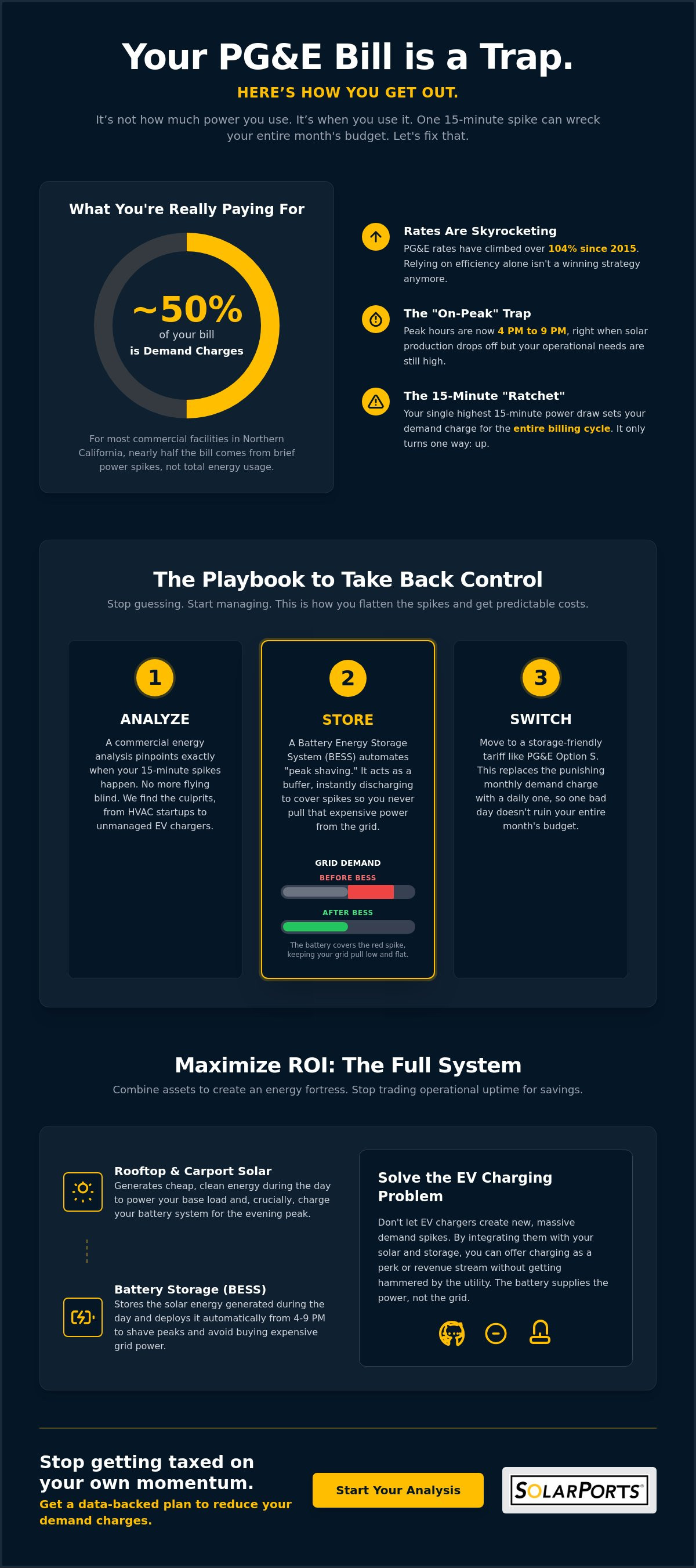
Most California business owners look at their energy consumption and wonder why the bill keeps climbing even when they're being efficient. The truth is that PG&E doesn't just charge you for the total volume of power you use. They charge you for the speed at which you pull it. For a lot of Northern California facilities, these demand charges now make up over 40% of the entire monthly statement. It's a structural tax on your operations that is becoming harder to avoid as legacy rate plans are phased out in favor of mandatory B-rates like B-10, B-19, and B-20.
The shift in "On-Peak" hours to the 4:00 p.m. to 9:00 p.m. window has essentially broken the old strategy of using only rooftop solar to lower costs. By the time peak pricing hits, the sun is setting, but your facility demand remains high. Understanding Peak Demand is the first step toward a real PG&E demand charge reduction for business. If you aren't managing that peak window, you're effectively paying a premium for the privilege of staying open through the late afternoon.
How 15 Minutes Can Ruin Your Monthly Budget
Think of it like a ratchet that only turns one way. If you start up a heavy piece of machinery or your HVAC system kicks into high gear during a hot afternoon, that 15-minute spike sets your rate for the rest of the billing cycle. Common culprits like unmanaged EV charging stations or industrial equipment startups create these invisible cliffs in your load profile. To stop the bleed, you need a commercial energy cost saving analysis to see exactly when these spikes occur and how to flatten them before they hit your bottom line.
How to Reduce Demand Charges: A 3-Step Implementation Strategy
Stopping the bleed on your utility bill requires a shift from passive consumption to active management. You can't simply hope for lower rates. You have to change how your facility interacts with the grid. This starts with a commercial energy cost saving analysis to map your load profile in granular detail. Without this data, you're just guessing at which equipment is causing your 15-minute spikes. Once we identify the exact moments your demand peaks, we can deploy the hardware and rate strategies needed to flatten them.
The Power of Peak Shaving with BESS
A Battery Energy Storage System (BESS) acts as a high-speed buffer for your facility. When your machinery or HVAC systems create a sudden usage spike, the batteries discharge instantly to cover that load. This keeps your pull from the grid below a specific, pre-set threshold. The beauty of this technology is that it's entirely automated. Your operations continue without disruption, but the "ratchet" effect on your bill is neutralized. This is why modern turnkey commercial solar CA projects almost always include storage; the solar provides the cheap energy, while the BESS provides the demand control.
Leveraging PG&E Option S (Storage-Friendly Rates)
Hardware is only half the battle. To get the best PG&E demand charge reduction for business, you have to switch to a storage-friendly rate tariff like Option S. This specific plan replaces the traditional, punitive monthly demand charge with a daily demand charge. It significantly reduces your financial exposure. If you have one outlier day of high usage, it doesn't ruin your entire month's budget. Option S is designed to reward businesses that use batteries to manage their load every day. You might also look into PG&E demand response programs to stack additional incentives on top of these savings. If you're ready to see how these steps apply to your specific facility, you can schedule a data review to start the process.
Maximizing ROI: Combining Solar Carports and Storage
PG&E often pushes programs that ask you to shut down your business during grid emergencies to save money. That's just trading one loss for another. A real PG&E demand charge reduction for business involves protecting your operations, not pausing them. By combining rooftop solar with solar carport systems, you create a multi-layered defense against peak pricing. Rooftop panels handle your base load during the morning and early afternoon, while carports provide the additional capacity needed to charge your BESS for the expensive late-day hours.
This approach also solves the EV charging problem. If you install charging stations without a management strategy, you're essentially handing the grid a blank check every time a vehicle plugs in. Integrating these chargers with your storage system ensures that cars pull from the battery, not the grid, during those critical 15-minute windows. You can see how this looks in practice by reviewing our recent projects where we've integrated these assets to secure long-term energy independence.
Turning Parking Lots into Power Plants
Your parking lot is likely your most underutilized asset. Solar carports capture energy that would otherwise just heat up the pavement, funneling it into your storage system to prepare for the 4:00 p.m. peak. It's a dual-threat strategy. You get shade for employees and a significant boost to your commercial solar ROI analysis because you're attacking the most expensive hours of the day with "free" stored power.
The Final Step: Professional Energy Audit
Generic, off-the-shelf battery solutions rarely hit the mark. Every facility has a different load signature, and a system that's too small won't stop the spikes, while one that's too large wastes capital. Right-sizing requires a deep dive into your actual PG&E meter data. We don't just eyeball your monthly total and call it a day. We dig into the 15-minute interval data to see what's actually happening under the hood. This data-driven approach is the only way to ensure the hardware actually performs when the grid is at its most expensive.
Stop Letting 15-Minute Spikes Dictate Your Bottom Line
The math on California utility bills has changed. You can't rely on the same solar strategies from five years ago to manage today's B-rate structures. Real PG&E demand charge reduction for business is now a game of precision and automated storage. By shifting your load with a BESS and aligning your tariff with Option S, you're no longer at the mercy of a single equipment startup or a hot afternoon.
It's about making your infrastructure work for you instead of against you. We specialize in turnkey BESS solutions for California commercial real estate and small-scale commercial projects that need expert rate optimization. There's no reason to keep guessing at your energy costs when the data is right there in your meter. We've seen how these systems transform operational budgets when they're sized correctly from the start.
Request your custom Energy Cost Saving Analysis to see the exact numbers for your facility. You've spent enough time reacting to high bills; it's time to start predicting them.
Frequently Asked Questions
What is the difference between energy charges and demand charges on a PG&E bill?
Energy charges represent the total volume of electricity your business consumes over the entire month, measured in kilowatt-hours. Demand charges are different because they measure the intensity of your usage during your highest fifteen minute window. It's the difference between how far you drive and the highest speed you hit during the trip; PG&E charges a premium for that top speed regardless of your total mileage.
Can I reduce demand charges without installing a battery system?
It's possible, but it usually requires manual intervention that disrupts your daily operations. You would have to stagger the startup times for heavy machinery or HVAC units to ensure they never run simultaneously. Most businesses find this level of micromanagement impossible to maintain, which is why a hardware-based PG&E demand charge reduction for business is the standard for long-term, automated results.
How much can a business realistically save by switching to PG&E Option S?
The savings come from changing the fundamental math of your bill. Option S moves you from a monthly demand charge to a daily one, which means one high-usage day won't ruin your entire month's budget. When you pair this rate with a BESS, you can isolate and neutralize spikes on a day-by-day basis. This specifically rewards facilities that use stored energy to stay under a set grid threshold every afternoon.
Will solar panels alone reduce my demand charges?
Solar panels are effective for reducing your total energy consumption, but they rarely solve the demand charge problem on their own. Since peak hours now run from 4:00 p.m. to 9:00 p.m., your facility is often pulling the most expensive power just as the sun goes down. To get a real PG&E demand charge reduction for business, you need a battery to capture daytime solar and discharge it during that late-day peak window.
Frequently asked questions
How 15 Minutes Can Ruin Your Monthly Budget
Think of it like a ratchet that only turns one way. If you start up a heavy piece of machinery or your HVAC system kicks into high gear during a hot afternoon, that 15-minute spike sets your rate for the rest of the billing cycle. Common culprits like unmanaged EV charging stations or industrial equipment startups create these invisible cliffs in your load profile. To stop the bleed, you need a commercial energy cost saving analysis to see exactly when these spikes occur and how to flatten them before they hit your bottom line. Stopping the bleed on your utility bill requires a shift from passive consumption to active management. You can't simply hope for lower rates. You have to change how your facility interacts with the grid. This starts with a commercial energy cost saving analysis to map your load profile in granular detail. Without this data, you're just guessing at which equipment is causing your 15-minute spikes. Once we identify the exact moments your demand peaks, we can deploy the hardware and rate strategies needed to flatten them.
The Power of Peak Shaving with BESS
A Battery Energy Storage System (BESS) acts as a high-speed buffer for your facility. When your machinery or HVAC systems create a sudden usage spike, the batteries discharge instantly to cover that load. This keeps your pull from the grid below a specific, pre-set threshold. The beauty of this technology is that it's entirely automated. Your operations continue without disruption, but the "ratchet" effect on your bill is neutralized. This is why modern turnkey commercial solar CA projects almost always include storage; the solar provides the cheap energy, while the BESS provides the demand control.
Leveraging PG&E Option S (Storage-Friendly Rates)
Hardware is only half the battle. To get the best PG&E demand charge reduction for business, you have to switch to a storage-friendly rate tariff like Option S. This specific plan replaces the traditional, punitive monthly demand charge with a daily demand charge. It significantly reduces your financial exposure. If you have one outlier day of high usage, it doesn't ruin your entire month's budget. Option S is designed to reward businesses that use batteries to manage their load every day. You might also look into PG&E demand response programs to stack additional incentives on top of these savings. If you're ready to see how these steps apply to your specific facility, you can schedule a data review to start the process. PG&E often pushes programs that ask you to shut down your business during grid emergencies to save money. That's just trading one loss for another. A real PG&E demand charge reduction for business involves protecting your operations, not pausing them. By combining rooftop solar with solar carport systems, you create a multi-layered defense against peak pricing. Rooftop panels handle your base load during the morning and early afternoon, while carports provide the additional capacity needed to charge your BESS for the expensive late-day hours. This approach also solves the EV charging problem. If you install charging stations without a management strategy, you're essentially handing the grid a blank check every time a vehicle plugs in. Integrating these chargers with your storage system ensures that cars pull from the battery, not the grid, during those critical 15-minute windows. You can see how this looks in practice by reviewing our recent projects where we've integrated these assets to secure long-term energy independence.
Turning Parking Lots into Power Plants
Your parking lot is likely your most underutilized asset. Solar carports capture energy that would otherwise just heat up the pavement, funneling it into your storage system to prepare for the 4:00 p.m. peak. It's a dual-threat strategy. You get shade for employees and a significant boost to your commercial solar ROI analysis because you're attacking the most expensive hours of the day with "free" stored power.
The Final Step: Professional Energy Audit
Generic, off-the-shelf battery solutions rarely hit the mark. Every facility has a different load signature, and a system that's too small won't stop the spikes, while one that's too large wastes capital. Right-sizing requires a deep dive into your actual PG&E meter data. We don't just eyeball your monthly total and call it a day. We dig into the 15-minute interval data to see what's actually happening under the hood. This data-driven approach is the only way to ensure the hardware actually performs when the grid is at its most expensive. The math on California utility bills has changed. You can't rely on the same solar strategies from five years ago to manage today's B-rate structures. Real PG&E demand charge reduction for business is now a game of precision and automated storage. By shifting your load with a BESS and aligning your tariff with Option S, you're no longer at the mercy of a single equipment startup or a hot afternoon. It's about making your infrastructure work for you instead of against you. We specialize in turnkey BESS solutions for California commercial real estate and small-scale commercial projects that need expert rate optimization. There's no reason to keep guessing at your energy costs when the data is right there in your meter. We've seen how these systems transform operational budgets when they're sized correctly from the start. Request your custom Energy Cost Saving Analysis to see the exact numbers for your facility. You've spent enough time reacting to high bills; it's time to start predicting them.
What is the difference between energy charges and demand charges on a PG&E bill?
Energy charges represent the total volume of electricity your business consumes over the entire month, measured in kilowatt-hours. Demand charges are different because they measure the intensity of your usage during your highest fifteen minute window. It's the difference between how far you drive and the highest speed you hit during the trip; PG&E charges a premium for that top speed regardless of your total mileage.
Can I reduce demand charges without installing a battery system?
It's possible, but it usually requires manual intervention that disrupts your daily operations. You would have to stagger the startup times for heavy machinery or HVAC units to ensure they never run simultaneously. Most businesses find this level of micromanagement impossible to maintain, which is why a hardware-based PG&E demand charge reduction for business is the standard for long-term, automated results.
How much can a business realistically save by switching to PG&E Option S?
The savings come from changing the fundamental math of your bill. Option S moves you from a monthly demand charge to a daily one, which means one high-usage day won't ruin your entire month's budget. When you pair this rate with a BESS, you can isolate and neutralize spikes on a day-by-day basis. This specifically rewards facilities that use stored energy to stay under a set grid threshold every afternoon.
Will solar panels alone reduce my demand charges?
Solar panels are effective for reducing your total energy consumption, but they rarely solve the demand charge problem on their own. Since peak hours now run from 4:00 p.m. to 9:00 p.m., your facility is often pulling the most expensive power just as the sun goes down. To get a real PG&E demand charge reduction for business, you need a battery to capture daytime solar and discharge it during that late-day peak window.