
Solar for Office Buildings in California: A Strategic 2026 Roadmap

In 2026, a California office roof is no longer just a structural necessity; it's an underutilized balance sheet asset. Most owners view state mandates like Title 24 as a regulatory burden that erodes margins. You're likely facing the triple threat of rising peak demand charges, complex compliance deadlines, and the persistent split-incentive friction between you and your tenants. Implementing solar for office buildings California doesn't have to be a sunk cost.
This guide demonstrates how to leverage the 30% Federal ITC and the expiring state property tax exclusion to transform these liabilities into a predictable source of Net Operating Income. We'll analyze the 2026 regulatory landscape, break down the economics of battery integration under NEM 3.0, and outline the lease structures that finally align owner and tenant interests. By the end of this roadmap, you'll have a clear methodology for converting rooftop square footage into a high-yield financial hedge.
Key Takeaways
- Learn how to navigate the 2026 Title 24 Part 6 standards by selecting the strategic compliance path that best protects your asset's market valuation.
- Discover lease restructuring strategies that resolve the split-incentive problem, allowing owners to reclaim utility savings as increased Net Operating Income.
- Maximize the ROI of solar for office buildings California by utilizing 15-minute interval data to eliminate over-engineering and mitigate peak demand charges.
- Identify the critical 2026 deadlines for federal tax credits and state property tax exclusions to ensure your energy project yields the highest possible fiscal return.
Table of Contents
- California Title 24 Mandates: What Office Owners Must Face in 2026
- Solving the Split Incentive: Aligning Solar ROI with Office Leases
- The Implementation Blueprint: Integrating Rooftop Solar and BESS
California Title 24 Mandates: What Office Owners Must Face in 2026
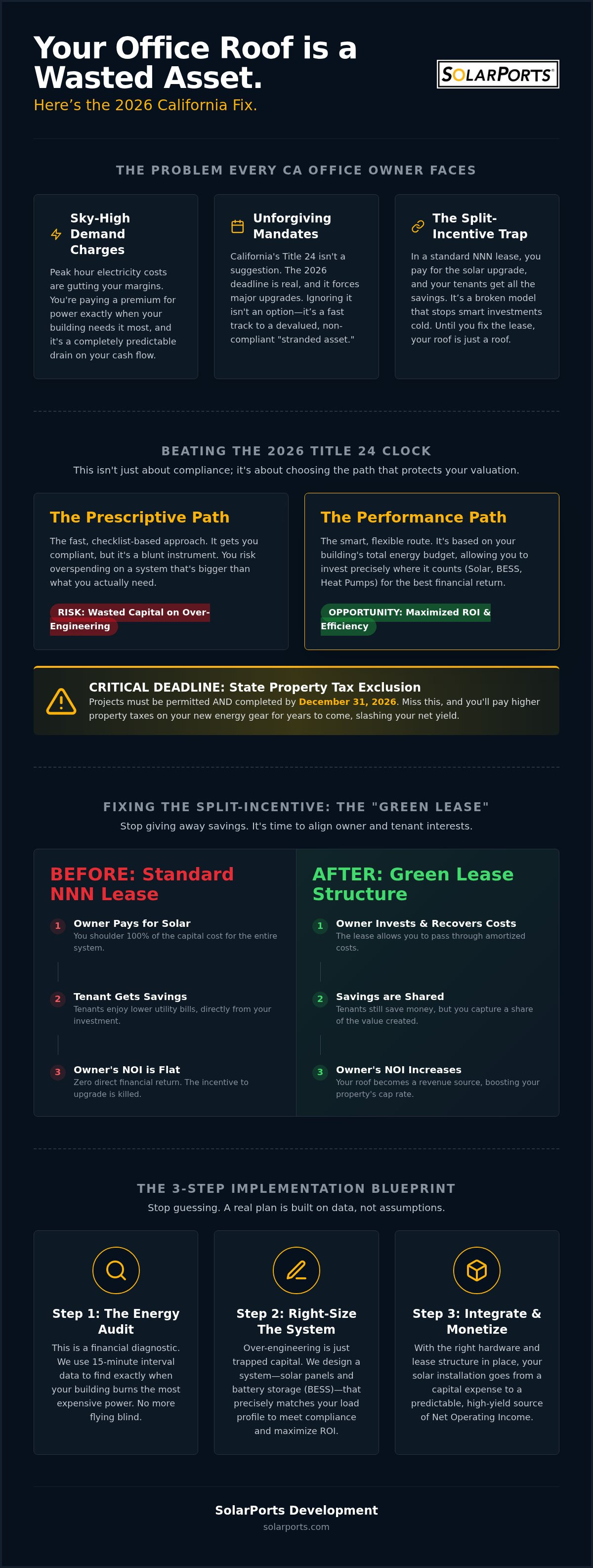
The 2025 Building Energy Efficiency Standards, effective January 1, 2026, represent a fundamental shift in asset management. Regulatory compliance is no longer a peripheral concern for new development. It's now a central operational requirement for major renovations. The history of Solar power in California shows a steady progression toward total electrification, making solar for office buildings California a necessary regulatory shield. Owners who fail to modernize risk their properties becoming "stranded assets" as efficiency benchmarks tighten.
Prescriptive Compliance for Existing Office Retrofits
Renovations exceeding specific square footage thresholds trigger mandatory solar and battery storage installations under the current code. The prescriptive path offers a rigid, checklist-based approach to compliance. It's often the fastest route for simple retrofits, yet it risks over-engineering the system capacity. You should utilize a commercial energy cost saving analysis to determine your minimum compliance threshold. This data-driven approach ensures you meet legal standards without wasting capital on hardware that exceeds your building's actual load profile.
The performance path provides strategic flexibility by focusing on the building's total energy budget. This custom approach to solar for office buildings California allows for trade-offs between different efficiency measures, such as heat pump integration and BESS capacity. 2026 is the critical window for these capital improvements. Projects permitted and completed by December 31, 2026, qualify for the state property tax exclusion. Missing this deadline increases the long-term cost of compliance. It also reduces the net yield of the asset by exposing the property to higher tax assessments on the new energy infrastructure.
Solving the Split Incentive: Aligning Solar ROI with Office Leases
The split-incentive problem has long stalled the adoption of solar for office buildings California. In traditional Triple Net (NNN) leases, owners bear the initial capital expenditure while tenants reap the primary benefit of reduced utility bills. This mismatch creates a financial stalemate that prevents asset optimization. Shifting to Modified Gross or Full Service leases allows owners to internalize the fiscal benefits of renewable production, turning the roof into a revenue-generating surface.
A green lease is a contractual agreement that enables property owners to recover capital costs by sharing the verified utility savings generated by on-site energy systems with their tenants.
Strategic investment in solar for office buildings California directly enhances Net Operating Income (NOI) by reducing common area maintenance (CAM) costs and creating new revenue streams through energy re-billing. Increased NOI leads to a superior building cap rate. Sophisticated investors prioritize assets that exceed California's Building Energy Efficiency Standards (Title 24) because they offer lower operational risk and higher long-term value.
Structuring Green Leases to Capture Energy Savings
Modernizing lease language is the first step toward fiscal recovery. Owners should include specific provisions for capital cost recovery that allow for the amortized cost of solar equipment to be passed through if it results in a net decrease in tenant utility expenses. You can utilize a commercial solar ROI analysis to prove this value to skeptical stakeholders. This data-driven transparency builds trust and facilitates lease renewals. If you're ready to evaluate your portfolio's specific potential, you can schedule a strategic energy review to align your lease structures with modern energy realities.
The Implementation Blueprint: Integrating Rooftop Solar and BESS
Successful deployment of solar for office buildings California requires a methodical, data-driven sequence. Standalone panels are no longer sufficient for high-load commercial environments. Every project must begin with a rigorous assessment of your facility's specific load profile.
Step 1: The Energy Audit is not a formality. It's a financial diagnostic tool used to identify your building's 15-minute peak demand intervals. This granularity exposes exactly when your electricity consumption is most expensive.
Step 2: Right-sizing the system prevents over-engineering. Wasted capacity represents trapped capital that could be better deployed elsewhere in your portfolio. Precision in design ensures you meet 2026 compliance standards without inflating the payback period.
Step 3: Integrating Battery Energy Storage Systems (BESS) allows you to "shave" afternoon power peaks. This is the only way to navigate the export limitations of NEM 3.0 and maximize self-consumption of the energy you produce.
Step 4: You must strictly manage the commercial solar installation timeline to minimize tenant disruption. Maintaining operational continuity is paramount for retaining high-value office occupants during the construction phase.
Why Battery Storage is Non-Negotiable for Northern California Offices
Rooftop solar alone cannot mitigate the aggressive demand charges levied by PG&E and SCE. These charges often peak in the late afternoon when solar production is ramping down. BESS provides the necessary buffer to shift energy use and protect your bottom line from these volatile costs. It also serves as a critical layer of resiliency against grid instability and rolling blackouts that threaten office productivity. While overcoming the split incentive barrier remains a contractual priority, BESS is the technical solution that justifies the capital outlay for solar for office buildings California. Integrated systems consistently outperform fragmented hardware. Reviewing turnkey commercial solar in CA shows how data-synced assets deliver the predictable energy independence that modern office portfolios require to remain competitive.
Securing Your Asset's Energy Future
Strategic energy management is no longer a choice; it's a fiscal imperative. Adopting solar for office buildings California allows you to transform regulatory mandates into a significant competitive advantage. Success requires more than just hardware. It demands a sophisticated alignment of lease structures, 2026 tax incentives, and integrated storage technology. By resolving the split-incentive friction and deploying data-driven BESS solutions, you insulate your Net Operating Income from volatile utility demand charges.
Execution requires precision. We provide a California-specific energy cost saving analysis and specialized expertise in Northern California utility structures to ensure your project delivers verified returns. Our turnkey BESS and solar integration services streamline the path from audit to operation. You can book your free commercial solar consultation for 2026 to begin optimizing your portfolio's performance. The window for maximum financial yield is open. Start your transition today.
Frequently Asked Questions
Do California solar mandates apply to existing office buildings in 2026?
Mandates apply to existing assets when they undergo major renovations or additions as defined by Title 24, Part 6. The 2025 standards, which took effect on January 1, 2026, trigger specific solar and battery storage requirements for commercial retrofits. Owners must evaluate if their structural modifications meet the square footage thresholds that necessitate these energy upgrades.
How much can solar reduce demand charges for a typical California office building?
Solar panels alone provide minimal demand charge relief, but integrated battery systems can significantly mitigate these costs. While solar for office buildings California reduces total consumption, BESS is necessary to "shave" the 15-minute peak intervals that drive high utility fees. This combination protects your bottom line from the volatile demand charges common in Northern California utility territories.
What is the average payback period for commercial solar in California under NEM 3.0?
Payback periods depend heavily on your ability to maximize self-consumption and capture 2026 tax incentives. The shift to NEM 3.0 reduced export values by approximately 75 percent, making battery integration essential for a favorable return. Utilizing the 30 percent Federal ITC and meeting the state property tax exclusion deadline of December 31, 2026, are critical steps for accelerating your project's break-even point.
Can I install solar on an office building with a NNN lease structure?
You can install solar on NNN assets, but success requires a Green Lease amendment to resolve the split-incentive problem. These provisions allow landlords to recover capital expenditures by sharing the verified utility savings with tenants. This structure ensures the property owner captures the financial benefit of the installation while the tenant maintains lower operational costs.
Frequently asked questions
Do California solar mandates apply to existing office buildings in 2026?
No, the 2025 Energy Code mandates specifically target new construction and major additions starting January 1, 2026. However, existing assets often trigger these requirements during significant HVAC or lighting overhauls. It's smarter to view these mandates as the new baseline for market value rather than just a checklist for new builds.
How much can solar reduce demand charges for a typical California office building?
Solar for office buildings California rarely kills demand charges on its own because production doesn't always align with peak usage spikes. You need a Battery Energy Storage System (BESS) to actually "shave" those costs. When paired with storage, you can discharge power during the expensive late-afternoon windows where PG&E and SCE rates are highest.
What is the average payback period for commercial solar in California under NEM 3.0?
Under NEM 3.0, a solar-only system typically sees a payback period of 8 to 12 years. Adding battery storage actually improves the math, bringing that window down to 7 to 9 years. This shift happened because export credits dropped by about 75%; making on-site consumption and storage the only way to protect your ROI.
Can I install solar on an office building with a NNN lease structure?
Yes, but it requires updating your lease language to solve the split-incentive problem. You can use a Green Lease structure to recover capital costs by sharing the utility savings with your tenants. Financing through C-PACE is another option, as the assessment stays with the property and can often be passed through as an operating expense in NNN agreements.