
Solar for California Manufacturing: 2026 Financial Guide

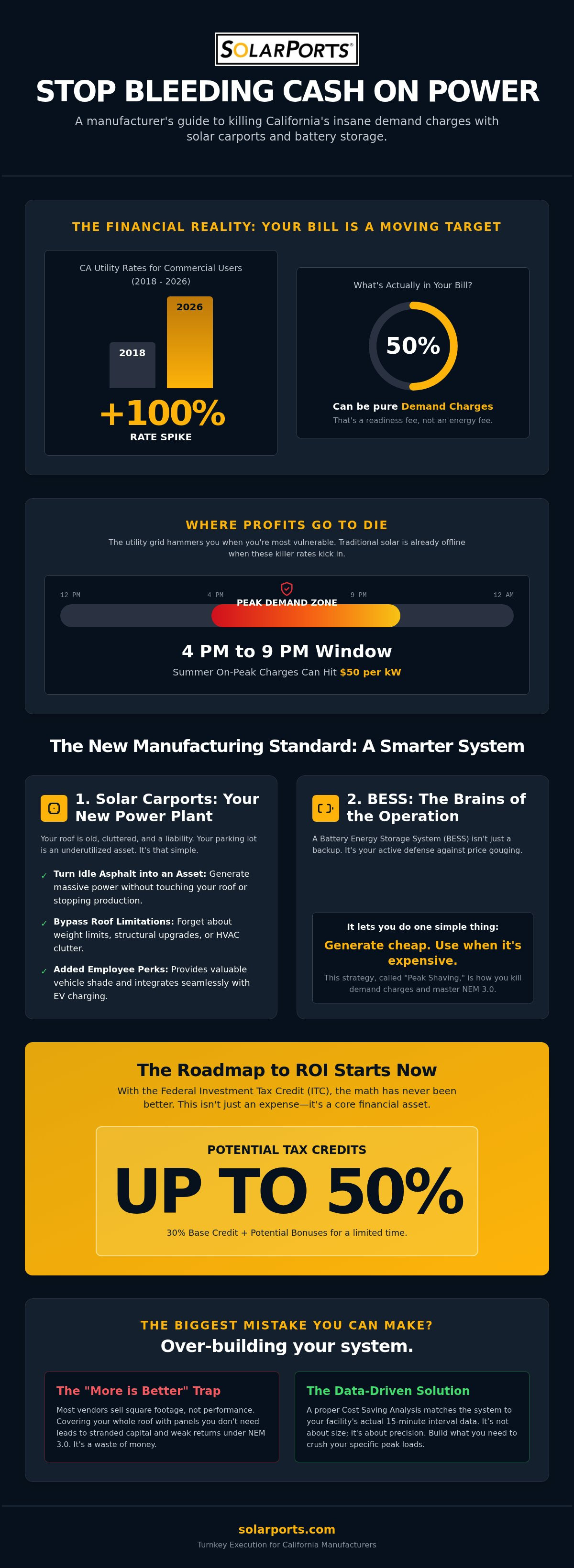
Between 2018 and the start of 2026, California utility rates for medium-sized commercial users have spiked by approximately 100 percent. It is hard to scale a business when your utility bill feels like a moving target, especially with summer on-peak demand charges hitting $50 per kW for many California manufacturers. You already know that relying solely on the grid is a liability for your operational budget. This guide from SolarPorts Development shows you how to stop overpaying for industrial power by integrating solar for manufacturing facilities California with battery storage to neutralize those aggressive spikes. We will walk through the 50 percent potential tax credits available this year, the actual math behind NEM 3.0 for industrial users, and why your parking lot might be a better asset than an aging roof.
Key Takeaways
- Stop the cycle of aggressive demand charges by understanding why the 4 PM to 9 PM utility window is currently draining your operational budget.
- Shift from rooftop limitations to strategic assets like solar carports that turn underutilized parking lots into dedicated power plants.
- Use Battery Energy Storage Systems (BESS) as the "brain" of your facility to manage peak loads and ensure energy independence.
- Avoid the common "over-built" trap by starting with a professional cost saving analysis to right-size solar for manufacturing facilities California.
Table of Contents
- The Financial Reality of Manufacturing Energy in California: Ending the Demand Charge Cycle
- Beyond Rooftops: Why BESS and Solar Carports are the New Manufacturing Standard
- The Roadmap to ROI: Right-Sizing Your Facility’s Energy Independence
The Financial Reality of Manufacturing Energy in California: Ending the Demand Charge Cycle
California utilities don't just bill you for the electrons you consume. They bill you for the infrastructure required to keep your heaviest machinery ready to run. This "readiness" fee manifests as aggressive peak demand charges that can account for up to 50 percent of a commercial bill. The 4 PM to 9 PM window is where manufacturing profits go to die under current time-of-use rates. While the history of Solar power in California shows massive growth, traditional rooftop systems often stop producing just as these expensive rates kick in. You can't treat solar for manufacturing facilities California as a simple "green" project anymore. It's a mandatory financial hedge against a grid that is becoming increasingly volatile. Implementing solar for manufacturing facilities California requires a strategy that looks at your meter data, not just your roof size.
Why Peak Demand Charges are Your Facility's Biggest Hidden Expense
A demand charge is calculated based on your highest 15-minute window of energy usage during a billing cycle. One bad afternoon where every compressor and motor starts simultaneously can set your price for the entire month. Industrial machinery creates massive "spikes" that standard solar panels can't flatten because those draws often happen during shift changes or late afternoon peaks when production is at its highest. Relying on the grid for these surges is an expensive gamble that most margins can't support. Peak Shaving is the process of using stored power to avoid utility spikes. By using a data-driven approach, you can identify these triggers before they hit your bottom line. You can see how we map these costs in our energy cost saving analysis to ensure the system actually performs.
Beyond Rooftops: Why BESS and Solar Carports are the New Manufacturing Standard
Rooftop solar isn't always the right fit for a high-output manufacturing line. If your roof is 15 years old or cluttered with heavy HVAC equipment, a traditional install might cost more in structural upgrades than it saves in energy. Solar carports solve this by turning underutilized asphalt into a dedicated power plant. They provide vehicle shade for your staff and high-density energy production without touching your facility’s roof or production floor. It’s a cleaner, faster way to deploy solar for manufacturing facilities California without the operational downtime of a major roof renovation.
Battery Energy Storage Systems (BESS) act as the "brain" of this entire setup. Under California's solar incentive programs and the current NEM 3.0 rules, the real ROI comes from self-consumption. BESS allows you to "buy" or generate power when it's cheap and "use" it when the utility wants to charge you triple during the evening peak. With the 2026 Federal Investment Tax Credit (ITC) offering a 30 percent base and potential bonuses up to 50 percent, standalone or paired battery storage has become a core financial asset rather than just an emergency backup.
The Strategic Advantage of Solar Carports for Industrial Sites
Industrial sites often have massive parking footprints that sit idle. Installing solar carport systems bypasses rooftop weight limits and provides a secondary benefit for employee retention through vehicle shade. Integrating EV charging into these structures allows you to utilize excess solar generation during low-load hours, effectively turning your parking lot into a profit center. It’s a pragmatist's solution to space constraints when planning solar for manufacturing facilities California. If you want to see how these assets fit your specific property layout, book a strategy session to walk through your options.
The Roadmap to ROI: Right-Sizing Your Facility’s Energy Independence
Most vendors want to cover your entire roof in glass. That's a mistake. Your system should be sized to your actual load, not your available square footage. Sizing solar for manufacturing facilities California for maximum ROI means matching the 15-minute interval data of your plant to the right mix of panels and storage. Over-building leads to stranded capital and diminished returns under NEM 3.0. You need a system that performs, not one that just looks impressive on a satellite map.
Northern California businesses face a complex utility landscape where PG&E’s infrastructure and rate hikes create constant friction. You need a partner who knows the local interconnection quirks and doesn't treat your facility like a generic warehouse. We focus on turnkey execution. This means we handle the heavy lifting of permitting and final utility sign-off so you don't have to pull your plant manager off the floor to chase paperwork or navigate the 2025 California Energy Code requirements alone.
Executing the Energy Cost Saving Analysis
This isn't a ballpark estimate; it's a financial blueprint. We follow a methodical process to ensure the numbers land exactly where we project:
- Step 1: We perform a deep-dive into 12 months of interval data. This identifies the exact "leaks" in your current spend and defines your peak demand triggers.
- Step 2: We right-size the BESS and solar components. This ensures the commercial solar ROI analysis reflects the unfiltered reality of your site rather than a best-case scenario.
- Step 3: Secure the 2026 tax credits. With the potential for a 50 percent ITC based on domestic content and energy community bonuses, timing is as important as the engineering.
Securing Your Industrial Energy Predictability
California’s utility landscape isn't getting simpler or cheaper. Between 4 PM peak rates and the constant threat of demand charge spikes, the status quo is a direct tax on your manufacturing margins. You’ve seen how right-sized solar for manufacturing facilities California, paired with BESS and carports, can neutralize these risks. It’s about moving from a monthly liability to a fixed, predictable asset that you actually control. The 2026 tax window is open, but the real value starts with knowing your specific load data before you commit to hardware.
The next step is simple math. Schedule your free strategic solar consultation and energy analysis here to bridge the gap between your current utility bill and full energy independence. You don't have to guess at the ROI when the data is already there waiting to be analyzed. Let's get to work on protecting your bottom line.
Common Questions About Industrial Energy Upgrades
How much can a manufacturing facility save with solar and BESS in California?
Savings depend on your specific load profile, but the primary target is neutralizing the 50 percent of your bill driven by demand charges. By using BESS to "shave" 15-minute usage spikes, you stop the utility from setting your monthly rate based on one heavy machinery startup. It's about surgical cost reduction during the expensive 4 PM to 9 PM window.
What is the typical payback period for industrial solar in 2026?
Most industrial projects hit their break-even point within five to seven years, but 2026 incentives can shorten that timeline. Between the 30 percent base ITC and potential 10 percent bonuses for domestic content, the federal government is effectively subsidizing half the project. You're trading a volatile monthly expense for a fixed asset that hedges against 9 percent annual rate hikes.
Do solar carports require significant downtime for my facility?
Installation typically happens with zero impact on your production schedule since the work is contained in the parking area. Unlike rooftop installs that might require structural reinforcement or internal access, carports are external. Your team keeps working inside while we turn the asphalt outside into a power plant. It’s the least intrusive way to upgrade your facility’s energy infrastructure.
Can I install BESS without installing solar panels?
You can absolutely install standalone storage to manage costs without adding a single panel. This is a strategic move for solar for manufacturing facilities California that have limited roof space but suffer from massive peak demand charges. You simply "buy" power when it's cheapest at night and deploy it to run your heavy equipment when utility rates triple in the afternoon.
Frequently asked questions
How much can a manufacturing facility save with solar and BESS in California?
Savings depend on your specific load profile, but the primary target is neutralizing the 50 percent of your bill driven by demand charges. By using BESS to "shave" 15-minute usage spikes, you stop the utility from setting your monthly rate based on one heavy machinery startup. It's about surgical cost reduction during the expensive 4 PM to 9 PM window.
What is the typical payback period for industrial solar in 2026?
Most industrial projects hit their break-even point within five to seven years, but 2026 incentives can shorten that timeline. Between the 30 percent base ITC and potential 10 percent bonuses for domestic content, the federal government is effectively subsidizing half the project. You're trading a volatile monthly expense for a fixed asset that hedges against 9 percent annual rate hikes.
Do solar carports require significant downtime for my facility?
Installation typically happens with zero impact on your production schedule since the work is contained in the parking area. Unlike rooftop installs that might require structural reinforcement or internal access, carports are external. Your team keeps working inside while we turn the asphalt outside into a power plant. It’s the least intrusive way to upgrade your facility’s energy infrastructure.
Can I install BESS without installing solar panels?
You can absolutely install standalone storage to manage costs without adding a single panel. This is a strategic move for solar for manufacturing facilities California that have limited roof space but suffer from massive peak demand charges. You simply "buy" power when it's cheapest at night and deploy it to run your heavy equipment when utility rates triple in the afternoon.