
MACRS Depreciation for Commercial Solar in California: The 2026 Strategy

Your 2026 tax filing is either a missed opportunity or a massive liquidity engine for your business. Most CFOs look at solar carports as a simple utility hedge, but the real financial win is how you handle MACRS depreciation for commercial solar California. It's exhausting to watch Northern California utility rates climb while your capital sits locked in a project's upfront CAPEX. You likely know the tax credits are there, yet the friction between federal incentives and California's specific code makes the math feel like a moving target.
This guide shows you how to leverage accelerated depreciation to recover a massive portion of your investment in the first five years. We'll break down the 2026 bonus depreciation shift to 20 percent and the specific year-one cash flow impacts. You'll see exactly how these deductions justify adding a BESS or carport to your site today, providing the data needed to move a project from the wishlist to the balance sheet.
Key Takeaways
- MACRS depreciation for commercial solar California isn't just a tax term; it's a liquidity engine that helps you recover a massive portion of your investment within five years.
- The federal bonus depreciation rate is dropping to 20 percent in 2026, which means your project timing and filing strategy will directly dictate your immediate cash flow.
- California’s tax code is notoriously picky about federal conformity, so you'll need to know exactly how the state treats carports and storage differently than the IRS.
- A detailed energy cost saving analysis moves your solar project from a hopeful expense to a strategic asset with a predictable schedule of tax liability reductions.
Table of Contents
- The 2026 Reality of Federal MACRS for Commercial Solar
- Why California State MACRS Changes the Math for Carports and BESS
- Turning Tax Depreciation into a Strategic Capital Advantage
The 2026 Reality of Federal MACRS for Commercial Solar
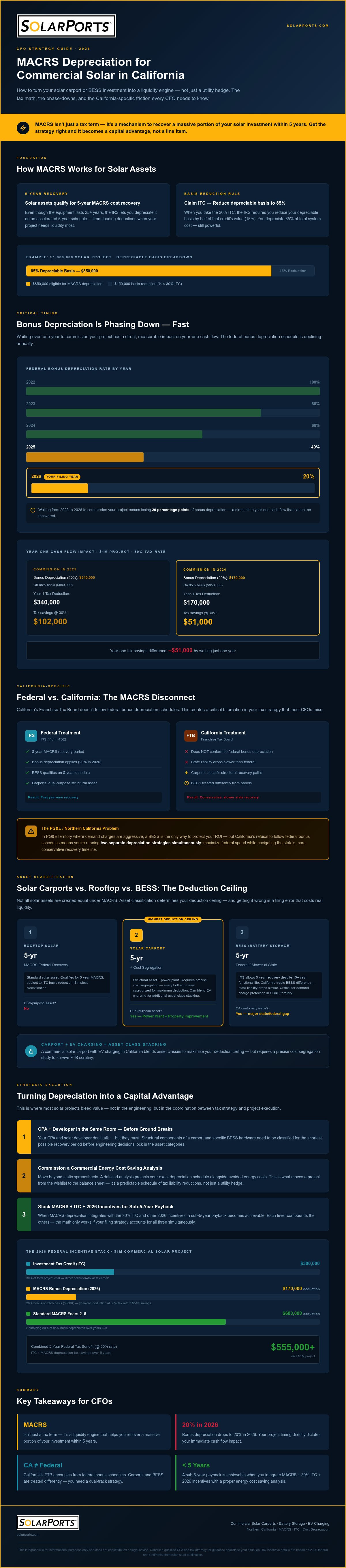
MACRS isn't just a dry tax term for accountants; it's the federal government's way of footing a substantial part of your solar bill. By utilizing MACRS depreciation for commercial solar California, you essentially create a mechanism that accelerates the return of your capital. MACRS is a 5-year cost recovery system specifically for renewable energy assets. By compressing the depreciation schedule, you front-load deductions during the first five years, exactly when your project needs the liquidity most.
You need to account for the basis reduction rule to get your math right. If you claim the 30 percent Investment Tax Credit, the IRS requires you to reduce the depreciable basis by half of that credit's value. This means you'll depreciate 85 percent of the total system cost. Even with this reduction, the impact of MACRS depreciation for commercial solar California remains the most powerful lever for shortening your payback period.
The 2026 Bonus Depreciation Phase-Down
The rules are shifting as we move toward 2026. Under the current phase-down schedule, bonus depreciation drops from 40 percent in 2025 to just 20 percent in 2026. This 20 percent reduction represents a significant hit to your year-one cash flow. Waiting an extra year to commission your project effectively leaves money on the table that could have been reinvested elsewhere in your operations. You can find more detail on these shifts in our 2026 Commercial Solar Tax Credit in California guide. Calculating the immediate impact on your 2026 tax liability requires looking at the combined weight of the standard MACRS schedule plus this diminished bonus percentage. The math is clear. For many CFOs, this drop is the deciding factor for moving forward now rather than later.
Why California State MACRS Changes the Math for Carports and BESS
California doesn't just copy the federal government's homework. The Franchise Tax Board (FTB) is notoriously protective of its revenue, often decoupling from federal bonus depreciation rules that CFOs rely on for year-one impact. This creates a massive disconnect. When you're calculating MACRS depreciation for commercial solar California, you have to recognize that state-level treatment for solar carport systems is fundamentally different from a basic rooftop install. Carports are structural assets, yet they qualify for specific recovery paths that rooftop panels don't always trigger.
Batteries introduce even more friction. In Northern California territories like PG&E, where demand charges are aggressive, a BESS is the only way to protect your ROI. However, the state's refusal to follow federal bonus schedules means your state tax liability won't drop as fast as your federal one. It's a balancing act. You're trying to maximize the federal speed while navigating the state's more conservative recovery timeline.
Depreciating BESS and Solar Carports in 2026
The IRS allows a five-year recovery for BESS hardware despite the equipment having a much longer functional life. This mismatch is where the profit lives. Carports offer a "dual-purpose" strategy, serving as both a power plant and a property improvement. If you're evaluating a commercial solar carport with EV charging in California, you're essentially blending asset classes to maximize your deduction ceiling. This requires a precise cost segregation approach to ensure every bolt and beam is categorized correctly for the FTB. You don't want to lose liquidity over a filing error. To see how these state rules apply to your specific facility, you can schedule a technical review of your project's tax potential.
Turning Tax Depreciation into a Strategic Capital Advantage
Stop treating your solar project like a standard utility bill. It's not an expense. It's an asset that pays you back through aggressive tax liability reduction. If you get the strategy right, MACRS depreciation for commercial solar California becomes a liquidity engine rather than just a line item on a tax return. You need to move beyond static spreadsheets and use a commercial energy cost saving analysis that projects your exact depreciation schedule alongside your avoided energy costs.
Communication is usually where these projects bleed value. Your CPA and your solar developer don't talk, but they should. They need to be in the same room before the first shovel hits the ground. This coordination ensures structural components of a carport or specific BESS hardware are classified for the shortest possible recovery period. Properly navigating MACRS depreciation for commercial solar California requires a unified front between your tax and engineering teams. When you integrate these deductions with the 30 percent ITC and other 2026 incentives, a sub-5-year payback becomes the standard, not the exception.
The ROI of Proper Financial Planning
A legitimate commercial solar ROI analysis must include the net present value of your tax shields. If you ignore the tax shield, you're ignoring a massive portion of your internal rate of return. Real property owners in California look at the balance sheet impact over the first 60 months, not just the monthly utility offset. It's about how much cash stays in the business. If you're ready to stop guessing and start projecting, you can book your free 2026 solar consultation here.
Securing Your 2026 Cash Flow Strategy
The window to capture maximum year-one liquidity is closing as bonus depreciation shifts to 20 percent. MACRS depreciation for commercial solar California transforms a project from a simple utility hedge into a high-yield capital asset. It's not just about the federal five-year schedule. Success means handling the specific quirks of the California Franchise Tax Board while optimizing BESS and carport structures for the best possible recovery path. You need a strategy that accounts for state-level decoupling before you break ground.
We specialize in California commercial real estate, providing turnkey BESS and carport solutions backed by data-driven ROI modeling for CFOs. You don't have to guess at the math. Schedule your free commercial solar cost-saving analysis for 2026 to see exactly how these tax shields impact your bottom line. Let's get your energy project off the wishlist and onto the balance sheet.
Frequently Asked Questions
Can I combine MACRS with the 30% Investment Tax Credit (ITC) in 2026?
Yes, you can stack these incentives. In 2026, you'll claim the 30 percent ITC while simultaneously applying MACRS depreciation for commercial solar California. Just account for the basis reduction. You must lower your depreciable basis by half the credit's value, or 15 percent. This leaves 85 percent of the system cost to be recovered over the standard five-year window.
Does California allow bonus depreciation for commercial solar systems?
Generally, no. California's Franchise Tax Board usually decouples from federal bonus depreciation rules. While you'll benefit from the 20 percent federal bonus in 2026, your state tax return will follow a standard schedule without that first-year spike. It's a critical distinction. You need separate state-level projections to accurately model your total cash flow during the first year of operation.
What happens to my depreciation schedule if I sell the commercial property?
Selling the property usually triggers depreciation recapture. If you exit the asset before the five-year recovery period is complete, the IRS may treat a portion of your previous deductions as taxable income. This depends on the system's remaining book value at the time of sale. It's essential to coordinate with your tax team to ensure the solar asset's value is properly allocated in the closing documents.
Are battery storage systems (BESS) eligible for the same 5-year MACRS schedule as solar?
Yes, BESS hardware qualifies for the same five-year recovery period. Standalone storage now mirrors the accelerated schedule used for solar panels. This makes MACRS depreciation for commercial solar California a powerful tool for projects that include battery storage. You can write off the battery cost quickly, which helps offset the initial CAPEX and shortens the overall payback period for the entire facility upgrade.
Frequently asked questions
Can I combine MACRS with the 30% Investment Tax Credit (ITC) in 2026?
Yes, you can stack these incentives. In 2026, you'll claim the 30 percent ITC while simultaneously applying MACRS depreciation for commercial solar California. Just account for the basis reduction. You must lower your depreciable basis by half the credit's value, or 15 percent. This leaves 85 percent of the system cost to be recovered over the standard five-year window.
Does California allow bonus depreciation for commercial solar systems?
Generally, no. California's Franchise Tax Board usually decouples from federal bonus depreciation rules. While you'll benefit from the 20 percent federal bonus in 2026, your state tax return will follow a standard schedule without that first-year spike. It's a critical distinction. You need separate state-level projections to accurately model your total cash flow during the first year of operation.
What happens to my depreciation schedule if I sell the commercial property?
Selling the property usually triggers depreciation recapture. If you exit the asset before the five-year recovery period is complete, the IRS may treat a portion of your previous deductions as taxable income. This depends on the system's remaining book value at the time of sale. It's essential to coordinate with your tax team to ensure the solar asset's value is properly allocated in the closing documents.
Are battery storage systems (BESS) eligible for the same 5-year MACRS schedule as solar?
Yes, BESS hardware qualifies for the same five-year recovery period. Standalone storage now mirrors the accelerated schedule used for solar panels. This makes MACRS depreciation for commercial solar California a powerful tool for projects that include battery storage. You can write off the battery cost quickly, which helps offset the initial CAPEX and shortens the overall payback period for the entire facility upgrade.