
Solar for Distribution Centers: A Strategic Hedge Against California’s Energy Volatility

In 2026, your distribution center's roof is either a liability or a strategic power plant. If you're still paying retail for electricity, it's definitely the former. Between 2018 and early 2026, SCE rates for medium commercial customers doubled; PG&E rates jumped 70 percent. It's a trend that turns operational forecasting into a high-stakes guessing game. You've likely looked at that massive, empty roof and wondered why you're still writing six-figure checks to the utility every single month. We're going to show you how commercial solar for warehouses California turns that space into a financial asset that kills peak demand charges and stabilizes your overhead. This guide covers the math behind locking in the 30 percent Investment Tax Credit before the July 4 deadline. We'll also explain why pairing rooftop solar with battery storage is the only way to beat NEM 3.0 export rates and how it helps you hit WAIRE compliance without paying mitigation fees.
Key Takeaways
- Stop letting "when" you use power dictate your margins. Learn to neutralize the specific demand charges that punish distribution centers during California's peak hours.
- Discover why a combination of BESS and commercial solar for warehouses California is the only way to offset the 75 percent drop in export credits under NEM 3.0.
- Future-proof your facility against escalating utility rates and grid uncertainty, ensuring stable energy costs for years to come.
- Secure the 30 percent federal Investment Tax Credit before the July 2026 deadline. We'll show you how to navigate the "commence construction" requirements to protect your project's ROI.
- Use 12 months of interval data to right-size your system. A precise energy analysis ensures you aren't paying for more capacity than your facility actually needs.
Table of Contents
- The Financial Reality: Why Distribution Centers are Energy Targets in California
- Strategic Deployment: Rooftops, Carports, and BESS
- The Turnkey Path to Operational Independence
The Financial Reality: Why Distribution Centers are Energy Targets in California
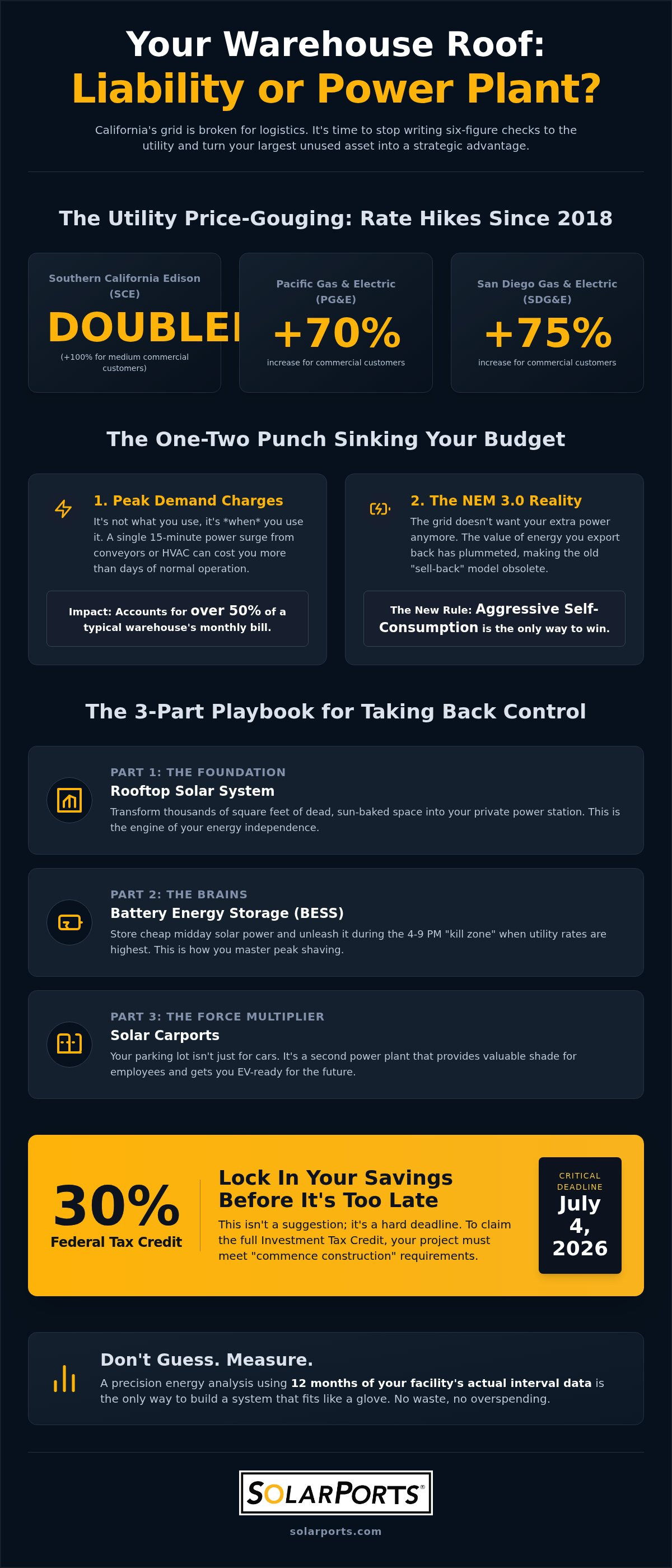
Utility rates in California aren't just rising; they're behaving like a volatile commodity. Since 2018, Southern California Edison rates for medium commercial customers have doubled. PG&E and SDG&E haven't been far behind, with increases of 70 percent and 75 percent respectively. As of August 2026, the average commercial rate in the state sits at 25.75¢/kWh. For a logistics operation, electricity has shifted from a predictable overhead cost to a primary threat to the bottom line. Doing nothing is no longer a safe, neutral stance. It is a decision to let the utility dictate your operating margins for the next decade.
Most warehouse operators view their massive rooftops as a maintenance liability that requires constant inspection and repair. It's time to reframe that. By installing a rooftop solar power system, you transform thousands of square feet of idle space into a private utility. This isn't about environmental optics. It is about seizing the 2026 Commercial Solar Tax Credit in California, which offers a 30 percent base credit for projects that commence construction by July 4, 2026. This incentive significantly compresses the ROI timeline, turning a capital expenditure into a high-yield asset.
Peak Demand vs. Consumption
High-volume distribution centers are uniquely vulnerable to the way California utilities structure their billing. Your facility doesn't draw power at a steady, predictable rate. Instead, industrial HVAC systems, high-speed conveyors, and sorting automation create massive surges in energy draw. The utility monitors these spikes with unforgiving precision.
Demand charges are fees based on the single highest fifteen minute window of energy use during a billing cycle, often accounting for more than half of a warehouse's total monthly bill. Integrating commercial solar for warehouses California allows you to generate power exactly when these spikes occur, effectively shielding your facility from the most expensive minutes of the day.
NEM 3.0 and the Logic of Self-Consumption
The regulatory landscape shifted permanently with the implementation of the Net Billing Tariff, or NEM 3.0. Under these rules, the value of energy you export back to the grid has dropped by approximately 75 percent compared to older systems. The "sell-back" model is dead. Today, the only way to win is through aggressive self-consumption. You need to use every kilowatt you produce on-site to avoid buying power at retail rates.
This shift makes turnkey commercial solar in CA more attractive than ever because it focuses on internalizing your energy economy. When you produce your own power, you aren't just lowering a bill; you're opting out of a broken system that penalizes logistics firms for their operational success.
Strategic Deployment: Rooftops, Carports, and BESS
Logistics hubs are designed for throughput, not energy efficiency. That has to change. Your parking lot and roof are the only assets you have that can actually fight back against utility rate hikes. While rooftop solar is the standard starting point for commercial solar for warehouses California, it's rarely enough on its own. You need a multi-faceted approach to truly exit the utility's pricing cycle.
The Power of Integrated BESS
Solar panels only work when the sun is up. California's most expensive power hits between 4 PM and 9 PM. This is where battery energy storage for commercial buildings becomes the MVP of your facility. It acts as the "brain" of the system, storing mid-day surplus and discharging it during that expensive evening window. We call this peak shaving. It's the difference between a high bill and a manageable one. If you're unsure which combination fits your footprint, you can speak with a specialist to review your specific site data.
Maximizing the Parking Lot with Carports
Rooftops are great until you run into HVAC units, skylights, or structural limits. Solar carports turn your parking lot into a second power plant. They offer more than just energy. They provide shade for employees and protect vehicles from the harsh sun. When you look at the benefits of solar carports for businesses, you see they also act as the backbone for EV readiness. Solar energy in California is shifting toward this kind of multi-use strategy where every square foot of the property has to pull its weight.
Electric delivery vans are coming fast. If your facility isn't ready to charge them, you'll face massive infrastructure costs down the road. Integrating solar today ensures you're building the foundation for heavy-duty truck charging before mandates force your hand. It's about future-proofing your operations while the 30 percent tax credit still makes the math easy.
The Turnkey Path to Operational Independence
Most solar companies jump straight to quoting a system size based on your roof dimensions. That's backward. You don't need a system that fits your roof; you need a system that fits your load profile. Over-building is just as expensive as doing nothing. A smaller, more efficient setup often results in a much better commercial solar ROI analysis because you aren't paying for capacity the utility won't credit you for under NEM 3.0. It's about fiscal precision, not just filling up empty space.
Why Analysis Trumps Installation
SolarPorts Development starts with a "thinking fix." This involves analyzing 12 months of your facility's interval data to see exactly when those demand spikes hit. It's not about the panel brand. It's about finding the precise balance between solar generation and battery capacity. SolarPorts Development uses this data to right-size commercial solar for warehouses California, ensuring you only pay for the infrastructure that actually moves the needle on your monthly bill. If the data shows you don't need a massive array to kill your peak charges, we won't build one.
Navigating the Timeline
The transition from a high utility bill to a predictable asset isn't overnight. You have to deal with the "black box" of California utility approvals and complex CPUC regulations. A realistic commercial solar installation timeline usually stretches several months, mostly due to the wait for Permission to Operate (PTO). This is why commercial solar project management in CA is so vital. You need a partner who knows how to push back on utility delays and keep the interconnection process moving so your capital doesn't sit idle.
Once the engineering is done and the system is live, your energy costs become a fixed, predictable line item. You're no longer at the mercy of the next double-digit rate hike. You've turned a warehouse into a self-sustaining financial engine that makes sense to the board and protects your long-term margins. It's a strategic move from being a utility customer to being an energy owner.
Securing Your Energy Independence Before the Window Closes
The days of viewing electricity as a passive, unavoidable expense are over. In California, utility rates have become a primary threat to logistics margins, but your facility's footprint provides a direct way out. By focusing on demand charge mitigation through integrated BESS and right-sized arrays, you can effectively opt out of the most expensive peak pricing windows. It's about data, not just hardware. Using 12 months of interval data ensures your investment in commercial solar for warehouses California is built for your specific load profile, not a generic estimate.
We focus exclusively on the California commercial market, navigating the specific interconnection hurdles and regulatory shifts that stall most projects. There is a limited window to lock in the property tax exclusion and the full 30 percent ITC before the July 2026 "commence construction" deadline. Don't leave your operational overhead to chance. You can Request a Turnkey Energy Cost Saving Analysis for Your Distribution Center today to see exactly how much you can shave off your monthly spend. It's time to turn your roof into a hedge against volatility.
Frequently Asked Questions
Is rooftop solar or a solar carport better for a California distribution center?
The choice depends entirely on your facility's structural capacity and parking lot layout. Rooftop solar is the standard approach because it utilizes existing space without interfering with truck maneuvers, but carports are often superior for sites with roof obstructions like skylights or heavy HVAC equipment. Carports also provide the added benefit of vehicle protection and a direct foundation for future EV charging infrastructure.
How much roof space do I need for a commercial solar system to be financially viable?
Financial viability is driven by your specific energy load rather than a fixed square footage number. Even a relatively small system can be highly profitable if it's designed to shave off the most expensive peak demand charges. We focus on right-sizing the system based on 12 months of interval data to ensure every panel you install is actually working to lower your utility spend.
Can solar and BESS protect my distribution center from California grid outages?
Solar panels alone won't keep your facility running during a blackout because they're designed to shut down when the grid goes dark for safety. You need an integrated Battery Energy Storage System (BESS) with "islanding" capabilities to maintain power during an outage. This setup allows your critical sorting automation and security systems to stay operational even when the utility grid fails.
What is the typical payback period for warehouse solar under NEM 3.0?
Payback periods for commercial solar for warehouses California under NEM 3.0 usually land between five and eight years when you include battery storage. Since the utility now pays about 75 percent less for power you send back to the grid, the fastest ROI comes from using BESS to store your own energy. This strategy allows you to avoid buying power at retail rates during the expensive 4 PM to 9 PM window.
How does the 2026 Investment Tax Credit (ITC) work for commercial solar projects?
The federal ITC provides a 30 percent base tax credit on the total cost of your solar and battery storage project. To lock in this 30 percent rate, your project must meet the "commence construction" criteria by July 4, 2026. There are also potential 10 percent bonus credits for using domestic content or building in designated energy communities, which can significantly improve the project's bottom line.
Does installing solar panels affect my warehouse roof warranty?
Installing solar shouldn't void your roof warranty if the project is managed correctly from the start. We work directly with your original roofing contractor to ensure the mounting system and any necessary penetrations meet their specific standards. Using ballasted systems that sit on the roof without piercing the membrane is often the preferred way to keep your warranty fully intact while generating power.
Frequently asked questions
Is rooftop solar or a solar carport better for a California distribution center?
The choice depends entirely on your facility's structural capacity and parking lot layout. Rooftop solar is the standard approach because it utilizes existing space without interfering with truck maneuvers, but carports are often superior for sites with roof obstructions like skylights or heavy HVAC equipment. Carports also provide the added benefit of vehicle protection and a direct foundation for future EV charging infrastructure.
How much roof space do I need for a commercial solar system to be financially viable?
Financial viability is driven by your specific energy load rather than a fixed square footage number. Even a relatively small system can be highly profitable if it's designed to shave off the most expensive peak demand charges. We focus on right-sizing the system based on 12 months of interval data to ensure every panel you install is actually working to lower your utility spend.
Can solar and BESS protect my distribution center from California grid outages?
Solar panels alone won't keep your facility running during a blackout because they're designed to shut down when the grid goes dark for safety. You need an integrated Battery Energy Storage System (BESS) with "islanding" capabilities to maintain power during an outage. This setup allows your critical sorting automation and security systems to stay operational even when the utility grid fails.
What is the typical payback period for warehouse solar under NEM 3.0?
Payback periods for commercial solar for warehouses California under NEM 3.0 usually land between five and eight years when you include battery storage. Since the utility now pays about 75 percent less for power you send back to the grid, the fastest ROI comes from using BESS to store your own energy. This strategy allows you to avoid buying power at retail rates during the expensive 4 PM to 9 PM window.
How does the 2026 Investment Tax Credit (ITC) work for commercial solar projects?
The federal ITC provides a 30 percent base tax credit on the total cost of your solar and battery storage project. To lock in this 30 percent rate, your project must meet the "commence construction" criteria by July 4, 2026. There are also potential 10 percent bonus credits for using domestic content or building in designated energy communities, which can significantly improve the project's bottom line.
Does installing solar panels affect my warehouse roof warranty?
Installing solar shouldn't void your roof warranty if the project is managed correctly from the start. We work directly with your original roofing contractor to ensure the mounting system and any necessary penetrations meet their specific standards. Using ballasted systems that sit on the roof without piercing the membrane is often the preferred way to keep your warranty fully intact while generating power.