
Sizing Commercial BESS: Guide for California Owners

In certain California utility territories, demand charges now represent more than half of a commercial electricity bill. It is a staggering figure that makes solar alone an incomplete solution for most property owners. You are likely tired of seeing your ROI vanish into peak-hour surcharges that feel like a moving target. The confusion between kW and kWh often leads to a paralyzing fear of over-investing in hardware you don't actually need.
Understanding how to size a commercial BESS is the only way to stop the bleeding and regain control over your operational costs. We are going to move past the engineering jargon and look at your utility data as a financial roadmap. This guide explains how to match a system to your specific load profile, ensuring you buy exactly enough capacity to slash demand charges without wasting a cent on excess storage. You will learn how to turn those unpredictable utility bills into a predictable, high-performing asset.
Key Takeaways
- Start with 12 months of "Green Button" interval data to see exactly where your money is going. This is the only way to identify the specific demand charges that are killing your ROI.
- Learning how to size a commercial BESS requires balancing power (kW) against energy (kWh). You are building a system to shave off expensive spikes, not to power the entire property indefinitely.
- Capitalize on California's SGIP incentives to lower your upfront investment. These rebates are moving targets, so timing your application is just as important as the hardware itself.
- Don't ignore the physical layout of your property. Real world constraints like site access and proximity to the main electrical room will dictate the final design and cost of your storage system.
Table of Contents
- The Data Foundation: Why Your Utility Bill is the Sizing Map
- The Math of Right-Sizing: Balancing kW vs. kWh
- From Analysis to ROI: The Turnkey Implementation Reality
The Data Foundation: Why Your Utility Bill is the Sizing Map
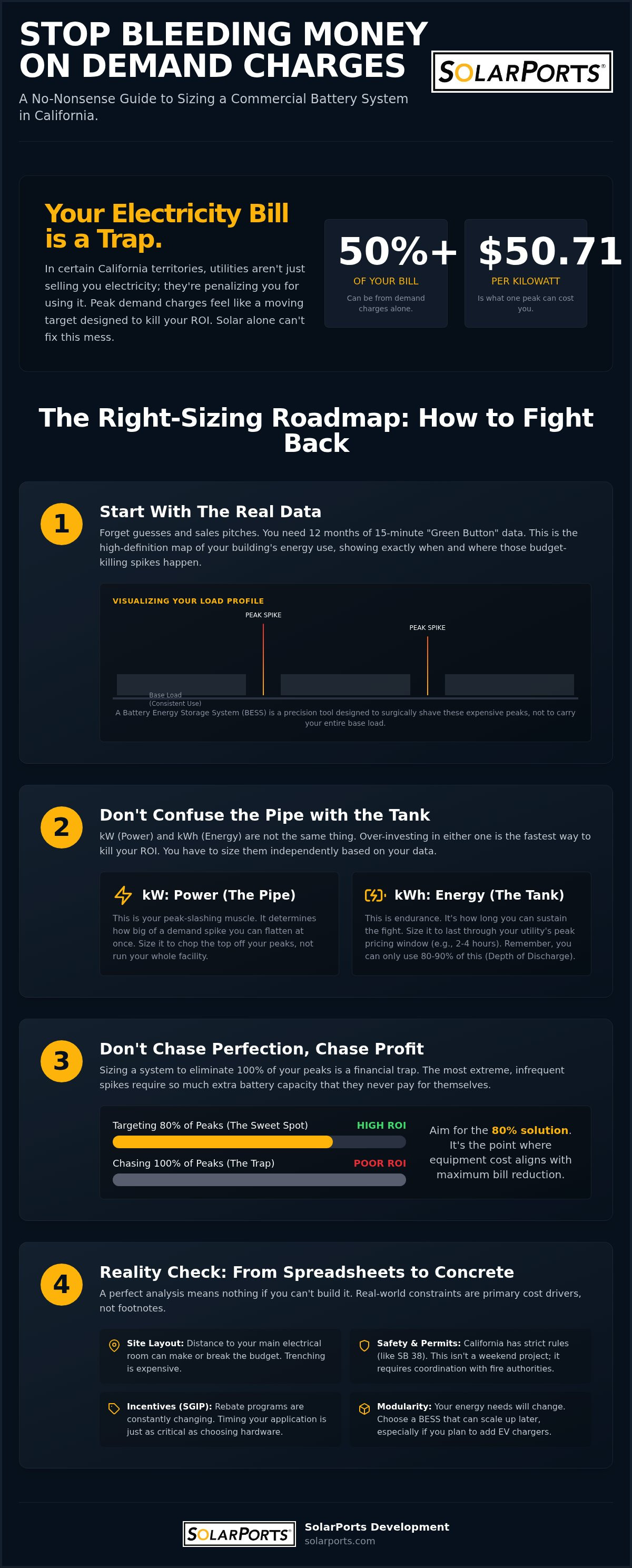
Most owners look at the total amount due and stop there. That's a massive oversight. To truly understand how to size a commercial BESS, you need to pull 12 months of 15-minute interval data, commonly known as Green Button data. This isn't just a summary. It's a high-definition map of your facility's electrical heartbeat. It shows you exactly when your HVAC or heavy machinery kicks on and creates the spikes that trigger your utility's most aggressive pricing. The data tells you how to size a commercial BESS based on reality, not on a salesman's best-case scenario.
In California, the demand charge is often the most expensive part of the bill. You have to distinguish between your base load, which is the steady hum of your building, and the intermittent spikes that drive costs through the roof. A Battery Energy Storage System (BESS) is a precision tool. It should be sized to flatten those peaks, not to carry the entire load. Sizing for the base load is a fast way to over-invest in hardware that will never pay for itself. You want to target the specific kilowatt spikes that blow your budget every month.
Decoding California Utility Load Profiles
PG&E and SCE have specific discharge windows where rates skyrocket. These windows dictate the logic of your system. For many California commercial buildings, a 2-hour battery that aggressively shaves a sharp peak is much smarter than a 4-hour system. You're looking for "non-coincident" peaks. These are the surges unique to your operations that don't always align with the utility's system-wide peak periods. Targeting these specific moments during our commercial property energy cost saving analysis is what turns a generic battery into a strategic financial asset. It's about surgical precision rather than raw storage capacity.
The Math of Right-Sizing: Balancing kW vs. kWh
Think of kW as the pipe and kWh as the tank. One is about speed; the other is about endurance. When you're determining how to size a commercial BESS, you aren't trying to replace the grid. You are trying to outsmart it. Size your kW rating to chop off your highest avoidable demand spikes. Don't size it for the whole building load. That is a fast way to kill your ROI with unnecessary hardware costs. You only need enough power to keep your meter below the utility's high-tier thresholds, which is critical when California demand charges can reach $50.71 per kW in some territories.
The kWh capacity depends on how long your utility wants to overcharge you. If your utility has a five-hour peak window, you need a tank big enough to sustain your discharge rate for that full duration. But you can't use every last drop. Depth of Discharge (DoD) limits mean you might only have 80% or 90% of that energy actually available. If you ignore this technical reality, you'll find your battery empty while expensive peak pricing is still in effect.
Peak Shaving vs. Load Shifting Economics
Sizing for 100% peak shaving is usually a financial trap. Those extreme peaks often happen so rarely that the extra battery capacity never pays for itself. Aim for 80% instead. It's about finding the sweet spot where equipment costs align with actual bill reductions. This logic mirrors the process of Evaluating the Impact of Solar Energy Savings, where precision beats brute force. If the math feels muddy, you can book a data review to see the trade-offs on your specific bill.
From Analysis to ROI: The Turnkey Implementation Reality
Implementation is where spreadsheets meet literal concrete. Once you've figured out how to size a commercial BESS, you have to find a place to put it. Site constraints aren't just an engineering footnote; they're a primary cost driver. If your battery is too far from the main electrical room, the trenching and wiring costs can eat your ROI before the system even turns on. You've also got to navigate California's safety framework, like SB 38, which mandates specific fire authority coordination and emergency planning.
The financial side is just as granular. While many SGIP budget categories are currently reserved, navigating the remaining pathways is essential for offsetting capital costs. We often suggest modular BESS units for our projects. These allow you to scale your capacity incrementally as your load profile shifts or as you add more EV charging stations. This flexibility keeps you from being locked into a static system that won't grow with your property's needs.
Turnkey Strategy for California Commercial Real Estate
Integrating storage with solar carport systems fundamentally changes the sizing math. These structures provide the physical footprint and the generation needed to charge your BESS during low-cost periods. Determining how to size a commercial BESS requires looking at these integrated systems as a single financial unit. We handle the heavy lifting of the commercial energy cost saving analysis to remove the guesswork. For a deeper look at the financial side, read our Commercial Solar ROI Analysis. It's about moving from a "best guess" to a verified, data-backed investment that actually lands.
Take Control of Your Energy Infrastructure
Success in storage comes down to data, not guesswork. Understanding how to size a commercial BESS is the difference between an expensive paperweight and a high-yield financial asset. You now know that your utility bill is the map, and balancing kW versus kWh is the key to neutralizing those aggressive California demand charges. We specialize in the small-scale commercial market because we know that turnkey integration, especially with solar carports, is where the real ROI lives.
The transition to a resilient, cost-effective property doesn't have to be a gamble. Get your custom commercial energy cost saving analysis from SolarPorts to see exactly how these numbers land on your specific site. It's time to stop reacting to utility hikes and start dictating your own operational costs. You have the roadmap; now it's time to build.
Frequently Asked Questions
What is the difference between kW and kWh in a commercial BESS?
Power (kW) represents the rate at which electricity is delivered, while energy (kWh) is the total volume stored. Think of kW as the diameter of a hose and kWh as the size of the water tank. When learning how to size a commercial BESS, you need enough kW to cover your highest peak and enough kWh to sustain that output through the utility's peak pricing window.
How much space does a commercial battery storage system require?
A typical commercial system usually occupies between 50 and 200 square feet, depending on its capacity. This footprint includes the battery enclosures, inverters, and required clearance for safety and cooling. We often place these units in parking lots or near existing electrical rooms to minimize trenching costs. Physical site constraints are a major factor in the final design and total project cost.
Can I size a BESS for backup power and peak shaving at the same time?
Yes, but you have to reserve a portion of the capacity specifically for emergencies. This "backup reserve" means you can't use 100% of the energy for daily peak shaving. It complicates the math on how to size a commercial BESS because you're balancing daily bill savings against the insurance of resiliency. It's a trade-off that usually requires a larger, more expensive system to be effective for both.
How long does a commercial BESS typically last before it needs replacement?
Most modern lithium-ion systems are designed to last between 10 and 15 years. This lifespan is measured in cycles, meaning how many times the battery is charged and discharged. If you're aggressively peak shaving every single day, the cells will degrade faster than a system used primarily for occasional backup. Most manufacturers provide performance warranties that guarantee a certain capacity remains after 10 years of use.
Frequently asked questions
What is the difference between kW and kWh in a commercial BESS?
Power (kW) represents the rate at which electricity is delivered, while energy (kWh) is the total volume stored. Think of kW as the diameter of a hose and kWh as the size of the water tank. When learning how to size a commercial BESS, you need enough kW to cover your highest peak and enough kWh to sustain that output through the utility's peak pricing window.
How much space does a commercial battery storage system require?
A typical commercial system usually occupies between 50 and 200 square feet, depending on its capacity. This footprint includes the battery enclosures, inverters, and required clearance for safety and cooling. We often place these units in parking lots or near existing electrical rooms to minimize trenching costs. Physical site constraints are a major factor in the final design and total project cost.
Can I size a BESS for backup power and peak shaving at the same time?
Yes, but you have to reserve a portion of the capacity specifically for emergencies. This "backup reserve" means you can't use 100% of the energy for daily peak shaving. It complicates the math on how to size a commercial BESS because you're balancing daily bill savings against the insurance of resiliency. It's a trade-off that usually requires a larger, more expensive system to be effective for both.
How long does a commercial BESS typically last before it needs replacement?
Most modern lithium-ion systems are designed to last between 10 and 15 years. This lifespan is measured in cycles, meaning how many times the battery is charged and discharged. If you're aggressively peak shaving every single day, the cells will degrade faster than a system used primarily for occasional backup. Most manufacturers provide performance warranties that guarantee a certain capacity remains after 10 years of use.