
Solar Carport with EV Charging in California: A 2026 Strategic Guide

Your parking lot is likely a depreciating asset that yields nothing but maintenance costs. In the current fiscal climate, ignoring the potential of a solar carport with EV charging California commercial properties require is a missed opportunity for optimization. We recognize that skyrocketing peak-demand charges and mounting tenant pressure for infrastructure are straining your operational budget. It's a significant financial burden that requires a sophisticated, data-driven response.
This strategic guide demonstrates how to transform underutilized space into a high-yield energy asset. You'll learn to hedge against utility volatility while increasing total property valuation. We'll examine the 2026 landscape, focusing on the integration of battery storage and the federal investment tax credit to ensure your capital allocation delivers maximum returns. It's time to stop overpaying for power and start generating measurable value from your existing footprint.
Key Takeaways
- Convert underutilized parking asphalt into a revenue-generating power plant. Transitioning from passive energy consumption to active asset management is essential for mitigating California’s utility volatility.
- Neutralize peak-demand charges through integrated battery storage systems. Strategic energy management allows you to lower operational expenses while simultaneously satisfying increasing tenant requirements for EV infrastructure.
- Deploy a solar carport with EV charging California commercial properties can leverage for long-term fiscal stability. Utilizing a turnkey development model eliminates costly scope gaps and ensures structural integrity across all project phases.
- Maximize your capital efficiency by navigating the 2026 federal and state incentive landscape. Precision in financial planning and project execution is the key to transforming a physical structure into a high-yield energy asset.
Table of Contents
- The Strategic Value of Solar Carports in the 2026 California Market
- Maximizing ROI: Integrating EV Charging and Battery Storage
- Navigating California Incentives and the Turnkey Path
The Strategic Value of Solar Carports in the 2026 California Market
Passive energy consumption is a fiscal liability. California's utility landscape has shifted toward high-demand pricing, making standard power procurement a structural weakness for commercial properties. Under the Net Billing Tariff, the value of exported energy has diminished, making on-site consumption and strategic storage essential. A solar carport with EV charging California developers integrate into their sites transforms underutilized asphalt into a revenue-generating power plant. This transition preserves your building’s footprint while addressing the 2026 reality. High-speed EV charging is no longer an optional amenity; it's a baseline requirement for maintaining Class A and B occupancy rates.
Why California Commercial Real Estate is the Ideal Use Case
High solar irradiance and some of the nation's highest commercial electricity rates create a unique opportunity for fiscal optimization. Proactive property owners utilize these systems to implement strategies to lower commercial electricity bills in California before utility costs escalate further. State mandates for EV infrastructure are tightening. Early adoption of a solar carport with EV charging California businesses can rely on avoids the excessive costs of future retrofitting. Consider these strategic advantages:
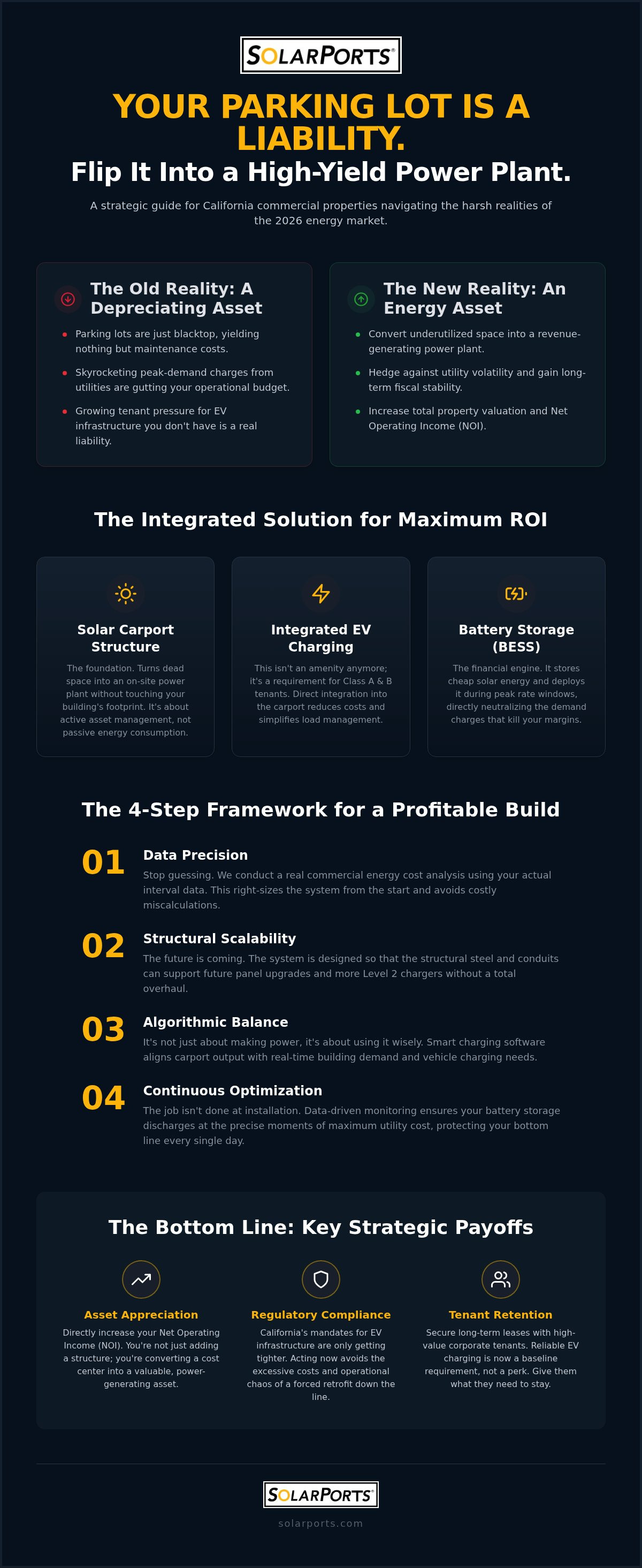
- Asset Appreciation: Converting dead space into a power-generating asset increases Net Operating Income (NOI).
- Regulatory Compliance: Meeting building codes before they become mandatory prevents operational disruptions.
- Tenant Retention: Providing reliable charging infrastructure secures long-term leases with high-value corporate tenants.
The convergence of fiscal necessity and regulatory pressure demands a strategic response. Waiting for utility rates to stabilize is not a viable financial plan. By capitalizing on underutilized parking areas, you secure a predictable energy hedge that protects your bottom line for decades.
Maximizing ROI: Integrating EV Charging and Battery Storage
Energy generation is only half the equation. In the current California regulatory environment, the fiscal value of your power depends entirely on when it's consumed. A solar carport with EV charging California owners install provides a dual-purpose solution that addresses both infrastructure and operational costs. By integrating charging stations directly into the carport structure, you significantly reduce trenching expenses and simplify electrical load management. This architectural synergy prevents the "scope gap" that typically occurs when solar and EV projects are handled by separate vendors.
Battery Energy Storage Systems (BESS) act as the financial engine of the project. These systems allow for "peak shaving," where stored solar energy is deployed during high-rate utility windows. This reduces the impact of expensive demand charges that often erode commercial margins. Without storage, your ROI is tethered to utility export rates that have become increasingly unfavorable for commercial producers.
A 4-Step Framework for a Profitable Carport Integration
- Step 1: Data Precision. Conduct a commercial energy cost saving analysis to right-size the system based on actual interval data rather than estimates.
- Step 2: Structural Scalability. Design for long-term growth by ensuring structural steel and conduits can support future panel upgrades and additional Level 2 chargers.
- Step 3: Algorithmic Balance. Implement smart charging software to align carport output with real-time building demand and vehicle requirements.
- Step 4: Continuous Optimization. Utilize data-driven monitoring to ensure your BESS discharges at the precise moments of maximum utility cost, protecting your bottom line.
Strategic planning ensures your infrastructure remains an asset rather than a liability. To determine the specific financial impact of a solar carport with EV charging California installation, you can schedule a detailed energy assessment with our strategy team.
Navigating California Incentives and the Turnkey Path
Fiscal optimization in 2026 requires a granular understanding of available incentives. While the federal landscape remains favorable, navigating the 2026 Commercial Solar Tax Credit in California requires precise financial modeling to maximize returns. California's "Net Billing" environment has fundamentally changed the ROI calculation. It now rewards self-consumption over grid export. This makes the carport-to-EV-to-Building loop the most efficient financial circuit for your property. By consuming your own generated power, you bypass the diminishing returns of utility buy-back rates.
Fragmented project management is a recipe for budget overruns. Managing separate contractors for structural steel, solar arrays, and EV charging infrastructure often leads to "scope gaps" that stall deployment. A turnkey approach is essential for maintaining structural integrity and operational continuity. Integrating a solar carport with EV charging California developers can trust means centralizing accountability. This ensures that the electrical load management and physical construction are synchronized from day one, preventing costly field modifications.
The Unfiltered Reality of Project Management
Interconnection with utilities like PG&E or SCE remains a primary bottleneck. Delays in grid approval can postpone your savings for months; you can find more detail in our guide on commercial solar project management in CA. We focus on small-scale commercial projects under 1MW. This strategy avoids the regulatory quagmire of utility-scale developments while capturing significant fiscal benefits. Reviewing past solar projects is the only way to verify a developer’s ability to navigate local Northern California permitting and specific utility constraints. Precision in the planning phase is the only protection against the volatility of the California energy market.
Securing Your Energy Independence in the 2026 Market
Commercial property owners in California face a decisive moment. Transitioning from passive energy consumption to active asset management is no longer optional; it's a fiscal necessity for maintaining property value. Implementing a solar carport with EV charging California commercial properties require allows you to hedge against utility volatility while satisfying tenant demand for infrastructure. Success depends on precise, data-driven planning and the seamless integration of battery storage to capture maximum value from every kilowatt generated.
As specialists in Northern California commercial real estate, we provide the turnkey BESS and solar integration required to stop overpaying for power. Schedule your free Commercial Solar Consultation and Energy Analysis to begin your data-driven savings journey. Taking action now ensures your parking lot becomes a high-yield asset for years to come.
Frequently Asked Questions
How much does a commercial solar carport with EV charging cost in California?
Total investment for a solar carport with EV charging California developers commission depends on structural complexity, total kilowatt capacity, and the number of charging ports required. We prioritize a custom energy cost saving analysis to determine the precise capital allocation necessary for your site. This data-driven approach ensures you don't overpay for capacity that doesn't align with your actual interval data and tenant demand.
What is the typical ROI for a solar carport on a California commercial property in 2026?
ROI is primarily driven by the offset of high-tier utility rates and the avoidance of peak-demand charges. In 2026, the inclusion of federal tax credits and accelerated depreciation schedules significantly compresses the payback period for commercial owners. By converting underutilized parking space into a power-generating asset, you increase the property’s Net Operating Income and total valuation while providing essential infrastructure to high-value tenants.
Do I need battery storage (BESS) for my solar carport to be effective?
Battery storage is the critical component for maximizing fiscal efficiency under current California utility structures. While a carport generates power, a BESS allows you to control when that power is used to shave expensive peak-demand loads. Without storage, you remain vulnerable to utility volatility and lower export rates. Integrating storage ensures your facility operates as a self-sustaining energy circuit that protects your bottom line.
How does the California Net Billing Tariff (NEM 3.0) affect solar carport savings?
The Net Billing Tariff has shifted the financial advantage from grid exportation to on-site self-consumption. Savings are now maximized by using your solar carport with EV charging California system to power your building and vehicles directly during high-cost windows. This regulatory shift makes the integration of storage and EV charging essential. It transforms the system from a simple generator into a strategic tool for mitigating rising operational expenses.
Frequently asked questions
How much does a commercial solar carport with EV charging cost in California?
Total project costs depend entirely on your specific site constraints and the number of chargers you're deploying. You have to account for structural steel engineering, foundation work, and the electrical upgrades needed to handle the new load. It's best to look at these as an integrated infrastructure investment rather than just a per-panel price.
What is the typical ROI for a solar carport on a California commercial property in 2026?
ROI is driven by your current utility rate schedule and how much energy you're consuming on-site. By 2026, the combination of federal tax credits and avoided peak-demand charges significantly accelerates the payback period. It's a strategic move to lock in low energy costs for a solar carport with EV charging California properties use to attract high-value tenants.
Do I need battery storage (BESS) for my solar carport to be effective?
You don't technically need it, but you'll be leaving money on the table. In the current California grid environment, the ability to store solar power and discharge it during expensive evening peaks is what makes the math work. Without BESS, you're still vulnerable to the utility's demand charge spikes when the sun goes down but the building's load stays high.
How does the California Net Billing Tariff (NEM 3.0) affect solar carport savings?
The Net Billing Tariff drastically reduced what utilities pay you for excess power sent back to the grid. This makes a solar carport with EV charging California installation more valuable because you're using the power exactly where it's generated. Charging vehicles on-site allows you to capture the full retail value of every kilowatt-hour rather than selling it back for pennies.