
Commercial Solar Carports in California: A Strategic 2026 Guide for Property Owners

What if your largest operational liability was actually your most underutilized financial asset? Between skyrocketing utility rates and the relentless heat-island effect of sun-drenched asphalt, those acres of pavement represent a massive drain on your bottom line that many property owners simply accept as an unavoidable overhead. It's a leak in your budget you can actually plug. By investing in commercial solar carports California property owners are finally flipping the script on peak-demand charges and transforming dead space into a high-yield energy asset that generates value instead of just absorbing heat.
You're probably tired of watching your operational expenses climb every time a utility provider hikes their rates again. This 2026 guide is designed to help you reclaim that lost capital by turning underutilized parking stalls into a shield against market volatility. We're going to break down the financial mechanics of the NEM 3.0 rules, the 30% federal tax credit, and why pairing these structures with battery storage is now the only logical path to getting a real return. We'll show you how to drive down those expenses and finally get some real utility out of that hot pavement.
Key Takeaways
- Stop paying the "asphalt tax." Unshaded parking lots are heat-absorbing liabilities that should be slashing your operational costs instead.
- See why commercial solar carports California properties deploy in 2026 need integrated battery storage. Without it, you aren't actually neutralizing those peak-demand charges.
- Discover why right-sizing your array matters more than total panel count. It's about matching generation to your real-world load so you don't waste capital.
- Learn why a rigorous energy cost saving analysis is the only way to avoid expensive interconnection surprises with utilities like PG&E.
- Get the facts on 2026 tax incentives. We'll show you how to stack the 30% federal credit with bonus adders to maximize your project's fiscal resilience.
Table of Contents
- The Strategic Logic of California Commercial Solar Carports in 2026
- Beyond Shade: Engineering for ROI and BESS Integration
- Navigating the California Installation Reality: Analysis to Interconnection
The Strategic Logic of California Commercial Solar Carports in 2026
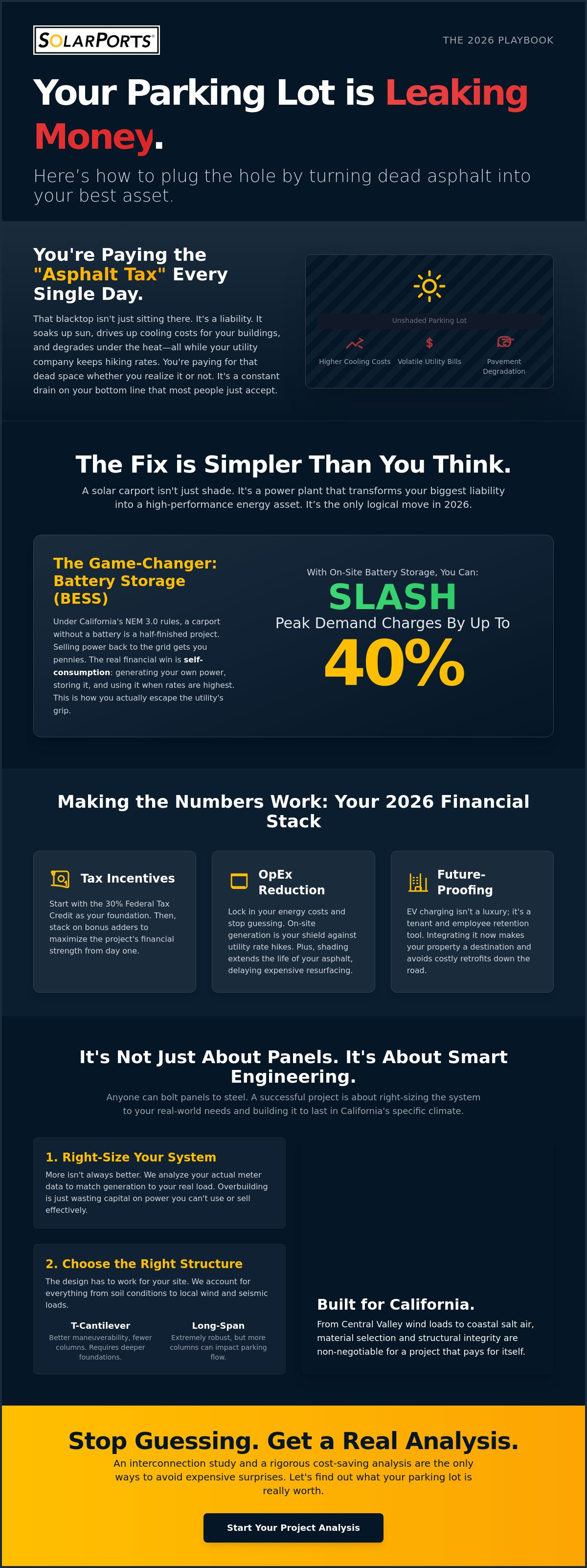
Every square foot of unshaded parking lot in this state is essentially a hidden tax on your operations. We call it the "asphalt tax." In the California climate, raw pavement absorbs massive amounts of thermal energy, which doesn't just bake your tenants' cars; it accelerates the degradation of the parking surface itself and drives up adjacent building cooling loads. A commercial solar carport is a steel-framed canopy that generates site-specific power while protecting physical assets. These Solar canopies effectively turn a passive liability into a high-functioning power plant.
Economic Resilience vs. Utility Volatility
Grid dependence is becoming a dangerous financial gamble. If you're operating under PG&E in Northern California, you've seen the aggressive rate hikes that make budgeting feel like guesswork. Municipal utilities like SMUD or Roseville Electric might offer different structures, but the trend is identical: prices are only moving in one direction. By deploying commercial solar carports California owners can finally lock in their energy costs and stop the bleeding from peak-demand charges. Beyond the meter, shading your lot significantly extends the life of your asphalt, delaying the five-figure costs of resurfacing and slurry seals by years.
Maximizing Real Estate Footprint
Not every building is a candidate for a rooftop solar system. Maybe your roof is cluttered with HVAC units, or the structural integrity won't support the load of a modern array. Carports bypass these limitations entirely. They allow you to convert "dead space", area that's currently doing nothing but sitting there, into a Tier 1 energy-producing asset. It’s a strategic way to scale your energy capacity without interfering with existing building systems or requiring a full roof replacement. You're essentially creating a new layer of value out of thin air, or more accurately, out of the sun hitting your parking lot.
Beyond Shade: Engineering for ROI and BESS Integration
A carport without a battery is a half-finished project in 2026. Under the current NEM 3.0 rules, selling power back to the grid at "avoided cost" rates of $0.05 to $0.08 per kWh is a bad deal for your balance sheet. The real money is in self-consumption. By pairing commercial solar carports California installations with Battery Energy Storage Systems (BESS), you're building a buffer against the utility's most aggressive pricing. BESS integration can reduce peak demand charges by up to 40% for typical California commercial meters, which is often the difference between a project that pays for itself quickly or drags on for a decade. This shift toward storage reflects broader market trends for solar carports where the focus has moved from simple generation to strategic load management.
Designing commercial solar carports California owners can actually rely on means accounting for more than just sunshine. In Northern California, we have to account for specific wind loads in the Central Valley and high seismic requirements along the coastal fault lines. If you under-power the system, you aren't hitting your ROI targets. If you over-build, you're wasting capital on infrastructure you won't use. It’s about right-sizing the canopy to match your actual meter data rather than just covering every available square inch of asphalt.
The Role of EV Charging Infrastructure
As businesses transition to electric fleets, the demand for sophisticated, integrated charging networks is growing. This is a global trend where specialized firms like Plugmycar provide the necessary expertise to implement robust EV charging solutions that work in tandem with solar infrastructure.
Charging isn't a luxury anymore; it's a retention tool for tenants and employees who expect to plug in while they work. Integrating Level 2 or DC Fast Charging directly into the carport substructure is the most efficient way to deploy this tech without tearing up your lot twice. You can see how these different options stack up in our comparison of EV charging solutions.
Structural Integrity and Material Selection
You generally have two paths: long-span or T-cantilever designs. Long-span structures are robust but require more columns, which can frustrate drivers and limit parking flexibility. T-cantilevers offer better maneuverability but demand significantly deeper foundations to handle the leverage. Choosing the right one depends on your specific microclimate. If you're near the coast, salt air will eat cheap steel for breakfast, so material selection isn't just an aesthetic choice. It’s a long-term maintenance decision. If you want to see how these variables play out on your specific property, you might want to book a strategic analysis to find the right engineering fit.
Navigating the California Installation Reality: Analysis to Interconnection
The "turnkey" promise is often a marketing trap. Most vendors want to talk about steel and panels immediately, but in this state, the hardware is the easy part. The real work happens in the data. Before a single bolt is turned for commercial solar carports California projects, you need an exhaustive energy cost saving analysis that looks at how your specific meter behaves throughout the year. Without that, you're just guessing at your ROI. It's better to find the flaws in the math now than after the concrete is poured.
The Energy Cost Saving Analysis
We don't rely on averages or "typical" building profiles. At SolarPorts Development, we dive into your historical interval data to see exactly when your demand peaks and how it aligns with solar production. It’s an unfiltered look at the numbers. Sometimes that means telling a client their lot isn't a good fit for a massive array, or that they need to scale back to avoid paying for capacity they can't utilize under NEM 3.0 rules. It's about precision, not a sales pitch.
Interconnection and Timelines
Dealing with the utility is the biggest hurdle. If you're in PG&E territory, you're looking at a completely different set of technical requirements and delays than if you're working with a municipal utility in Northern California. These local munis often have their own quirks regarding transformer capacity and line-side taps. Understanding the installation timeline is critical for managing your capital expectations. You need a partner with a deep portfolio of completed California projects who knows how to navigate these specific bureaucratic minefields.
The financial side remains a strong motivator in 2026. The 30% Federal Investment Tax Credit is still the baseline, and if your property is in an "energy community" or uses domestic content, you can stack bonus adders on top of that. You can find a deeper breakdown of these current tax credits to see how they impact your first-year depreciation. The goal isn't just to build a structure; it's to execute a data-driven property assessment that turns a parking lot into a predictable financial instrument.
Stop Letting Your Parking Lot Drain Your Bottom Line
The 2026 landscape doesn't leave much room for error. You can't keep letting your parking lot sit there as a heat-absorbing liability while utility rates climb. Turning that asphalt into a power plant isn't just about providing shade. It's a calculated move to kill demand charges and protect your operational budget. By investing in commercial solar carports California owners can finally decouple their fiscal health from grid volatility and start seeing a real return on their underutilized real estate.
Success depends on more than just hardware. You need a partner who understands that right-sizing and BESS integration are the only ways to win under NEM 3.0. We focus on turnkey solutions for California commercial real estate, stripping away the sales fluff to give you data-driven recommendations that actually land. The first step is always the numbers. It's time to stop guessing and start measuring what your property is actually capable of producing.
Request Your Commercial Energy Cost Saving Analysis and see exactly what your asphalt is worth. You've got the space; let's make it work for you.
Frequently Asked Questions
How much does a commercial solar carport cost in California in 2026?
Industry benchmarks for commercial solar carports California projects typically range from $2.50 to $4.50 per watt. For a mid sized operation, that usually lands between $30,000 and $250,000 before you factor in any incentives. It's important to remember that these figures vary based on soil conditions and current steel prices. You should look at the total project cost minus the 30% federal tax credit to get a sense of the actual capital outlay.
Do solar carports require a lot of maintenance compared to rooftop solar?
The maintenance profile is different, but it isn't necessarily more intensive. Carports are easier to reach than roofs, so you won't need specialized lift equipment for a simple inspection or cleaning. However, being at ground level means they're more exposed to vehicle exhaust and dust. Regular panel washing is critical here to keep your generation high, especially during the dry summer months when buildup can significantly tank your production.
Can I install a solar carport if my parking lot is small or oddly shaped?
Yes, and that's where T cantilever designs really prove their worth. These structures use a single central pillar, which means we can tuck them into tight corners or narrow drive aisles without killing your parking count. While long span structures are more cost effective for massive, open lots, custom engineered canopies can be adapted to almost any footprint. It’s about being smart with column placement so you don't turn your lot into an obstacle course.
What is the typical ROI for a commercial solar carport in Northern California?
Most properties see a full return in 5 to 7 years, but that assumes you're using a battery to dodge peak demand charges. Under the NEM 3.0 rules, your ROI will stall if you're just selling power back to PG&E for a few cents. The real math depends on your specific utility rate and how much you're currently losing to peak pricing. When you stack the 30% ITC with bonus depreciation, the first year tax benefits often cover a massive chunk of the investment.
Frequently asked questions
Economic Resilience vs. Utility Volatility
Grid dependence is becoming a dangerous financial gamble. If you're operating under PG&E in Northern California, you've seen the aggressive rate hikes that make budgeting feel like guesswork. Municipal utilities like SMUD or Roseville Electric might offer different structures, but the trend is identical: prices are only moving in one direction. By deploying commercial solar carports California owners can finally lock in their energy costs and stop the bleeding from peak-demand charges. Beyond the meter, shading your lot significantly extends the life of your asphalt, delaying the five-figure costs of resurfacing and slurry seals by years.
Maximizing Real Estate Footprint
Not every building is a candidate for a rooftop solar system. Maybe your roof is cluttered with HVAC units, or the structural integrity won't support the load of a modern array. Carports bypass these limitations entirely. They allow you to convert "dead space", area that's currently doing nothing but sitting there, into a Tier 1 energy-producing asset. It’s a strategic way to scale your energy capacity without interfering with existing building systems or requiring a full roof replacement. You're essentially creating a new layer of value out of thin air, or more accurately, out of the sun hitting your parking lot. A carport without a battery is a half-finished project in 2026. Under the current NEM 3.0 rules, selling power back to the grid at "avoided cost" rates of $0.05 to $0.08 per kWh is a bad deal for your balance sheet. The real money is in self-consumption. By pairing commercial solar carports California installations with Battery Energy Storage Systems (BESS), you're building a buffer against the utility's most aggressive pricing. BESS integration can reduce peak demand charges by up to 40% for typical California commercial meters, which is often the difference between a project that pays for itself quickly or drags on for a decade. This shift toward storage reflects broader market trends for solar carports where the focus has moved from simple generation to strategic load management. Designing commercial solar carports California owners can actually rely on means accounting for more than just sunshine. In Northern California, we have to account for specific wind loads in the Central Valley and high seismic requirements along the coastal fault lines. If you under-power the system, you aren't hitting your ROI targets. If you over-build, you're wasting capital on infrastructure you won't use. It’s about right-sizing the canopy to match your actual meter data rather than just covering every available square inch of asphalt.
The Role of EV Charging Infrastructure
Charging isn't a luxury anymore; it's a retention tool for tenants and employees who expect to plug in while they work. Integrating Level 2 or DC Fast Charging directly into the carport substructure is the most efficient way to deploy this tech without tearing up your lot twice. You can see how these different options stack up in our comparison of EV charging solutions.
Structural Integrity and Material Selection
You generally have two paths: long-span or T-cantilever designs. Long-span structures are robust but require more columns, which can frustrate drivers and limit parking flexibility. T-cantilevers offer better maneuverability but demand significantly deeper foundations to handle the leverage. Choosing the right one depends on your specific microclimate. If you're near the coast, salt air will eat cheap steel for breakfast, so material selection isn't just an aesthetic choice. It’s a long-term maintenance decision. If you want to see how these variables play out on your specific property, you might want to book a strategic analysis to find the right engineering fit. The "turnkey" promise is often a marketing trap. Most vendors want to talk about steel and panels immediately, but in this state, the hardware is the easy part. The real work happens in the data. Before a single bolt is turned for commercial solar carports California projects, you need an exhaustive energy cost saving analysis that looks at how your specific meter behaves throughout the year. Without that, you're just guessing at your ROI. It's better to find the flaws in the math now than after the concrete is poured.
The Energy Cost Saving Analysis
We don't rely on averages or "typical" building profiles. At SolarPorts Development, we dive into your historical interval data to see exactly when your demand peaks and how it aligns with solar production. It’s an unfiltered look at the numbers. Sometimes that means telling a client their lot isn't a good fit for a massive array, or that they need to scale back to avoid paying for capacity they can't utilize under NEM 3.0 rules. It's about precision, not a sales pitch.
Interconnection and Timelines
Dealing with the utility is the biggest hurdle. If you're in PG&E territory, you're looking at a completely different set of technical requirements and delays than if you're working with a municipal utility in Northern California. These local munis often have their own quirks regarding transformer capacity and line-side taps. Understanding the installation timeline is critical for managing your capital expectations. You need a partner with a deep portfolio of completed California projects who knows how to navigate these specific bureaucratic minefields. The financial side remains a strong motivator in 2026. The 30% Federal Investment Tax Credit is still the baseline, and if your property is in an "energy community" or uses domestic content, you can stack bonus adders on top of that. You can find a deeper breakdown of these current tax credits to see how they impact your first-year depreciation. The goal isn't just to build a structure; it's to execute a data-driven property assessment that turns a parking lot into a predictable financial instrument. The 2026 landscape doesn't leave much room for error. You can't keep letting your parking lot sit there as a heat-absorbing liability while utility rates climb. Turning that asphalt into a power plant isn't just about providing shade. It's a calculated move to kill demand charges and protect your operational budget. By investing in commercial solar carports California owners can finally decouple their fiscal health from grid volatility and start seeing a real return on their underutilized real estate. Success depends on more than just hardware. You need a partner who understands that right-sizing and BESS integration are the only ways to win under NEM 3.0. We focus on turnkey solutions for California commercial real estate, stripping away the sales fluff to give you data-driven recommendations that actually land. The first step is always the numbers. It's time to stop guessing and start measuring what your property is actually capable of producing. Request Your Commercial Energy Cost Saving Analysis and see exactly what your asphalt is worth. You've got the space; let's make it work for you.
How much does a commercial solar carport cost in California in 2026?
Industry benchmarks for commercial solar carports California projects typically range from $2.50 to $4.50 per watt. For a mid sized operation, that usually lands between $30,000 and $250,000 before you factor in any incentives. It's important to remember that these figures vary based on soil conditions and current steel prices. You should look at the total project cost minus the 30% federal tax credit to get a sense of the actual capital outlay.
Do solar carports require a lot of maintenance compared to rooftop solar?
The maintenance profile is different, but it isn't necessarily more intensive. Carports are easier to reach than roofs, so you won't need specialized lift equipment for a simple inspection or cleaning. However, being at ground level means they're more exposed to vehicle exhaust and dust. Regular panel washing is critical here to keep your generation high, especially during the dry summer months when buildup can significantly tank your production.
Can I install a solar carport if my parking lot is small or oddly shaped?
Yes, and that's where T cantilever designs really prove their worth. These structures use a single central pillar, which means we can tuck them into tight corners or narrow drive aisles without killing your parking count. While long span structures are more cost effective for massive, open lots, custom engineered canopies can be adapted to almost any footprint. It’s about being smart with column placement so you don't turn your lot into an obstacle course.
What is the typical ROI for a commercial solar carport in Northern California?
Most properties see a full return in 5 to 7 years, but that assumes you're using a battery to dodge peak demand charges. Under the NEM 3.0 rules, your ROI will stall if you're just selling power back to PG&E for a few cents. The real math depends on your specific utility rate and how much you're currently losing to peak pricing. When you stack the 30% ITC with bonus depreciation, the first year tax benefits often cover a massive chunk of the investment.