
BESS Installation for Commercial Properties: A Strategic 2026 California Guide

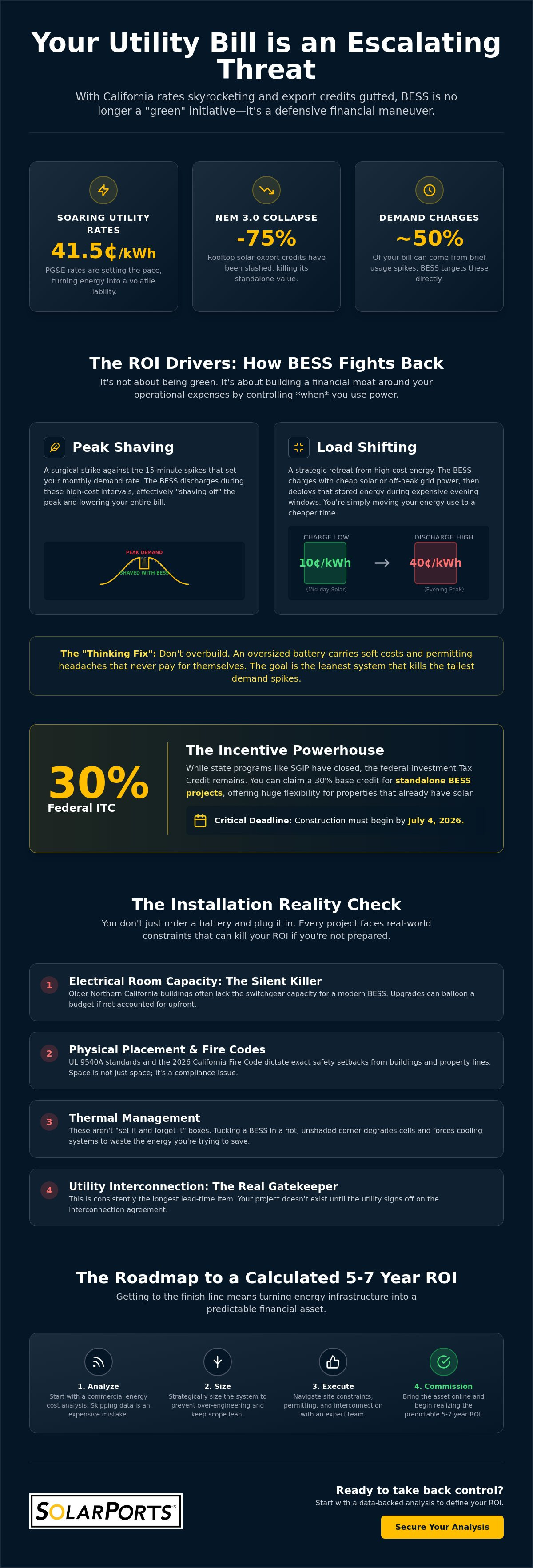
Your utility bill isn't a line item anymore; it's an escalating threat to your net operating income. With PG&E rates hovering around 41.5 cents per kilowatt-hour and SCE trailing just behind, the financial math for California property owners has fundamentally shifted. You've probably noticed that rooftop solar alone doesn't stop the bleeding, especially since NEM 3.0 slashed export credits by roughly 75 percent. This reality makes BESS installation for commercial properties the only logical move for an owner who wants to claw back control over peak demand charges and grid volatility.
It's exhausting to manage tenant expectations while watching grid instability threaten daily operations, and the complexity of programs like SGIP doesn't make it any easier. I understand the hesitation. This guide provides a pragmatic, data-backed roadmap to help you secure energy resilience and finally extract the full value from your solar carports. We'll walk through the 30 percent federal tax credit deadlines, the impact of the 2026 California Fire Code updates, and the specific analytical steps required to turn your energy infrastructure into a predictable financial asset.
Key Takeaways
- Utility rates are moving in one direction, and it isn't down. You'll see how BESS serves as a defensive financial maneuver to neutralize peak demand volatility.
- Electrical room capacity is the silent killer of storage projects. We identify the specific site constraints that often catch Northern California property owners off guard.
- Skipping the data is an expensive mistake. Learn how a commercial energy cost saving analysis prevents over-engineering and keeps your project scope lean.
- Getting to the finish line requires more than just buying hardware. We provide the roadmap for BESS installation for commercial properties that secures a calculated 5-7 year ROI.
Table of Contents
- The Financial Logic of BESS for California Commercial Real Estate
- Navigating the Installation Reality: Site Constraints and Strategic Sizing
- Execution and ROI: Moving from Analysis to Commissioning
The Financial Logic of BESS for California Commercial Real Estate
California utilities aren't just raising rates; they're restructuring how they charge you to prioritize their own grid stability over your bottom line. Demand charges are the primary driver here. They can easily eat up 50 percent of your monthly bill, turning a simple operational cost into a volatile financial liability. BESS installation for commercial properties is no longer a "green" initiative; it's a defensive infrastructure play designed to cap those costs. A BESS is a turnkey energy asset that decouples your property’s power consumption from the volatile timing of the utility grid. When you integrate storage with existing solar carport systems, you create a closed-loop ecosystem. You generate power when it's cheap and deploy it when the utility wants to charge you a premium.
For a deeper look at the hardware mechanics, understanding BESS technology helps clarify how these units buffer your site from the grid. It's about building a moat around your operational expenses.
While our focus is on California’s commercial sector, the global shift toward grid independence is being driven by innovations in utility scale battery energy storage systems Australia, which demonstrate the effectiveness of these technologies at a massive scale.
Navigating the California Incentive Landscape
The incentive map for 2026 has shifted away from state rebates toward federal tax benefits. While many SGIP general market tiers closed to new applications at the end of 2025, the federal Investment Tax Credit (ITC) remains a powerhouse. You can claim a 30 percent base credit for standalone BESS projects, provided construction begins by July 4, 2026. If you pair the battery with solar, the logic holds, but the standalone credit now offers more flexibility for properties that already have panels in place but need to fix their demand charge problem.
Peak Shaving vs. Load Shifting: The ROI Drivers
Peak shaving targets the highest-cost intervals on your meter. It's a surgical strike against the 15 minute spikes that set your monthly demand rate. Load shifting is different; it's the process of moving bulk energy use from expensive evening windows to cheaper morning hours. Here is the "thinking fix" for your ROI: don't overbuild. An oversized battery carries soft costs and permitting headaches that never pay for themselves. You want the leanest possible system that kills the tallest demand spikes without adding unnecessary capital expenditure.
Navigating the Installation Reality: Site Constraints and Strategic Sizing
You don't just order a battery and plug it in. Every viable project starts with a granular commercial energy cost saving analysis. This isn't just paperwork; it’s the only way to prevent expensive over-engineering that kills your ROI before the first slab is poured. In older Northern California buildings, the primary bottleneck isn't the battery cost. It's the electrical room. Most of these structures weren't designed with the switchgear capacity to handle a modern BESS, and upgrading that infrastructure can quickly balloon a budget if you haven't accounted for it upfront.
Physical placement is governed by more than just convenience. Fire safety setbacks and UL 9540A standards dictate the footprint on your property. You have to maintain specific distances from building openings and property lines to stay compliant with 2026 California Fire Code updates. BESS installation for commercial properties also requires a "thinking fix" regarding thermal management. These systems aren't "set it and forget it" boxes. If you tuck them into a stagnant, unshaded corner of a parking lot, the heat will degrade the cells and trigger cooling systems that eat into your energy savings. Strategic placement is as much about airflow as it is about electrical proximity.
The Physical Footprint: Where Does the Battery Go?
Parking lot enclosures are the standard for a reason: they are easier to permit and keep cool. But if you’re tight on space, integrating storage with rooftop solar for office buildings can consolidate your footprint. This move saves your asphalt for parking but requires a rigorous structural analysis to ensure the roof can support the concentrated weight of the battery racks.
Interconnection and Permitting Hurdles
The AHJ (Authority Having Jurisdiction) approval process in California is the unfiltered reality of any build. While California's Self-Generation Incentive Program (SGIP) status might be on your mind for funding, your utility interconnection agreement is the actual gatekeeper. It is consistently the longest lead-time item in the installation timeline, often taking months for PG&E or SCE to finalize. If you're trying to figure out if your current panel can even handle the load, let's look at your site map together.
Execution and ROI: Moving from Analysis to Commissioning
Execution is where the "messy middle" happens. It's the part where the spreadsheets meet the shovel. You're dealing with open trenches, conduit runs, and utility inspectors who couldn't care less about your project timeline. BESS installation for commercial properties requires a partner who can absorb that friction for you. The end goal is commissioning. Commissioning is the final verification that the battery actually talks to the grid and responds to your building's load in real time.
We aim for a calculated ROI within 5 to 7 years. That’s the benchmark for a healthy project. If the math pushes you past eight years, the system is likely over-engineered or your load profile wasn't analyzed correctly. The real work starts after the trucks leave. Post-installation monitoring is where the financial savings are actually harvested through algorithmic dispatch. The software watches the meter and decides when to discharge, ensuring you never hit those expensive demand peaks.
The Turnkey Advantage for Commercial Real Estate
Piecemeal procurement is a recipe for finger-pointing. If the battery vendor and the inverter manufacturer aren't on the same page, you're the one who pays for the downtime. Stick to integrated turnkey commercial solar. SolarPorts Development’s approach is simple: we right-size the hardware to the meter data. We don't build to a sales quota. We build to a performance requirement.
Maintenance and Long-Term Performance
Batteries degrade. It’s a chemical fact. You have to factor a 2 to 3 percent annual capacity loss into your 10 year financial pro forma or your projections will be junk. Software-as-a-service (SaaS) for energy management is non-negotiable now. You need a platform that optimizes state-of-charge while protecting the health of the cells. This ensures your BESS installation for commercial properties doesn't just work today, but remains a viable asset a decade from now.
It is also important to consider the durability of supporting hardware; for example, international resources like zonnepanelen-brabant.nl provide data on the typical lifespan of solar inverters, which helps in planning for future component replacements and maintaining overall system health.
Stabilize Your Net Operating Income Through Strategic Storage
The window for reactive energy management has closed. In California, you're either paying the utility's premium for peak demand or you're building the infrastructure to bypass it. We've covered why demand charges dominate your bill and how site-specific constraints like electrical room capacity can derail a project if they aren't caught early. Successful BESS installation for commercial properties is a data-first endeavor. It requires moving past the hardware specs and focusing on the algorithmic dispatch that actually harvests your savings.
We provide turnkey BESS solutions specifically designed for the complexities of California real estate. Our team is specialized in Northern California utility rate structures; we focus on data-driven cost saving recommendations that prioritize your bottom line over equipment sales. If you're ready to see the actual math for your site, Request a Commercial Energy Cost Saving Analysis. Taking control of your energy costs is the most predictable way to protect your property's value in an unstable market. You've got this.
Frequently Asked Questions
How much space does a commercial BESS installation actually require?
A standard commercial battery enclosure typically occupies the footprint of a single parking stall. However, you have to account for the 2026 California Fire Code setbacks, which often demand 10 feet of clearance from building openings and property lines. This means the actual "dead space" around the unit is as important as the battery's physical dimensions. Finding a location that satisfies these safety codes while remaining close to your main electrical panel is the primary site challenge.
What is the typical ROI for a commercial BESS project in California?
A well-engineered BESS project in California usually reaches a full return on investment within 5 to 7 years. This payback period is primarily driven by your ability to mitigate exorbitant peak demand charges, which often represent 50 percent of a commercial utility bill. If your ROI projections stretch beyond eight years, it is usually a sign that the system is oversized for your specific load profile or that the software isn't configured for aggressive peak shaving.
Can I install a BESS if I already have rooftop solar on my building?
You can definitely integrate a battery system with your current rooftop solar setup. In fact, BESS installation for commercial properties is often the best way to salvage the value of an existing solar array under the current NEM 3.0 rules. Instead of exporting your excess power to the utility for a 75 percent lower credit, you store that energy on-site. This allows you to use your own solar power during expensive evening hours when grid rates are highest.
How long does the permitting process for commercial battery storage take in CA?
The permitting and interconnection window in California currently averages between 6 and 12 months. While the physical construction might only take a few weeks, the administrative queue at the utility and the local building department is significant. PG&E and SCE have specific technical requirements that must be met before they grant "permission to operate." It is the longest lead-time item in the project, so beginning the analysis phase early is critical for meeting tax deadlines.
Frequently asked questions
Navigating the California Incentive Landscape
The incentive map for 2026 has shifted away from state rebates toward federal tax benefits. While many SGIP general market tiers closed to new applications at the end of 2025, the federal Investment Tax Credit (ITC) remains a powerhouse. You can claim a 30 percent base credit for standalone BESS projects, provided construction begins by July 4, 2026. If you pair the battery with solar, the logic holds, but the standalone credit now offers more flexibility for properties that already have panels in place but need to fix their demand charge problem.
Peak Shaving vs. Load Shifting: The ROI Drivers
Peak shaving targets the highest-cost intervals on your meter. It's a surgical strike against the 15 minute spikes that set your monthly demand rate. Load shifting is different; it's the process of moving bulk energy use from expensive evening windows to cheaper morning hours. Here is the "thinking fix" for your ROI: don't overbuild. An oversized battery carries soft costs and permitting headaches that never pay for themselves. You want the leanest possible system that kills the tallest demand spikes without adding unnecessary capital expenditure. You don't just order a battery and plug it in. Every viable project starts with a granular commercial energy cost saving analysis. This isn't just paperwork; it’s the only way to prevent expensive over-engineering that kills your ROI before the first slab is poured. In older Northern California buildings, the primary bottleneck isn't the battery cost. It's the electrical room. Most of these structures weren't designed with the switchgear capacity to handle a modern BESS, and upgrading that infrastructure can quickly balloon a budget if you haven't accounted for it upfront. Physical placement is governed by more than just convenience. Fire safety setbacks and UL 9540A standards dictate the footprint on your property. You have to maintain specific distances from building openings and property lines to stay compliant with 2026 California Fire Code updates. BESS installation for commercial properties also requires a "thinking fix" regarding thermal management. These systems aren't "set it and forget it" boxes. If you tuck them into a stagnant, unshaded corner of a parking lot, the heat will degrade the cells and trigger cooling systems that eat into your energy savings. Strategic placement is as much about airflow as it is about electrical proximity.
The Physical Footprint: Where Does the Battery Go?
Parking lot enclosures are the standard for a reason: they are easier to permit and keep cool. But if you’re tight on space, integrating storage with rooftop solar for office buildings can consolidate your footprint. This move saves your asphalt for parking but requires a rigorous structural analysis to ensure the roof can support the concentrated weight of the battery racks.
Interconnection and Permitting Hurdles
The AHJ (Authority Having Jurisdiction) approval process in California is the unfiltered reality of any build. While California's Self-Generation Incentive Program (SGIP) status might be on your mind for funding, your utility interconnection agreement is the actual gatekeeper. It is consistently the longest lead-time item in the installation timeline, often taking months for PG&E or SCE to finalize. If you're trying to figure out if your current panel can even handle the load, let's look at your site map together. Execution is where the "messy middle" happens. It's the part where the spreadsheets meet the shovel. You're dealing with open trenches, conduit runs, and utility inspectors who couldn't care less about your project timeline. BESS installation for commercial properties requires a partner who can absorb that friction for you. The end goal is commissioning. Commissioning is the final verification that the battery actually talks to the grid and responds to your building's load in real time. We aim for a calculated ROI within 5 to 7 years. That’s the benchmark for a healthy project. If the math pushes you past eight years, the system is likely over-engineered or your load profile wasn't analyzed correctly. The real work starts after the trucks leave. Post-installation monitoring is where the financial savings are actually harvested through algorithmic dispatch. The software watches the meter and decides when to discharge, ensuring you never hit those expensive demand peaks.
The Turnkey Advantage for Commercial Real Estate
Piecemeal procurement is a recipe for finger-pointing. If the battery vendor and the inverter manufacturer aren't on the same page, you're the one who pays for the downtime. Stick to integrated turnkey commercial solar. SolarPorts Development’s approach is simple: we right-size the hardware to the meter data. We don't build to a sales quota. We build to a performance requirement.
Maintenance and Long-Term Performance
Batteries degrade. It’s a chemical fact. You have to factor a 2 to 3 percent annual capacity loss into your 10 year financial pro forma or your projections will be junk. Software-as-a-service (SaaS) for energy management is non-negotiable now. You need a platform that optimizes state-of-charge while protecting the health of the cells. This ensures your BESS installation for commercial properties doesn't just work today, but remains a viable asset a decade from now. The window for reactive energy management has closed. In California, you're either paying the utility's premium for peak demand or you're building the infrastructure to bypass it. We've covered why demand charges dominate your bill and how site-specific constraints like electrical room capacity can derail a project if they aren't caught early. Successful BESS installation for commercial properties is a data-first endeavor. It requires moving past the hardware specs and focusing on the algorithmic dispatch that actually harvests your savings. We provide turnkey BESS solutions specifically designed for the complexities of California real estate. Our team is specialized in Northern California utility rate structures; we focus on data-driven cost saving recommendations that prioritize your bottom line over equipment sales. If you're ready to see the actual math for your site, Request a Commercial Energy Cost Saving Analysis. Taking control of your energy costs is the most predictable way to protect your property's value in an unstable market. You've got this.
How much space does a commercial BESS installation actually require?
A standard commercial battery enclosure typically occupies the footprint of a single parking stall. However, you have to account for the 2026 California Fire Code setbacks, which often demand 10 feet of clearance from building openings and property lines. This means the actual "dead space" around the unit is as important as the battery's physical dimensions. Finding a location that satisfies these safety codes while remaining close to your main electrical panel is the primary site challenge.
What is the typical ROI for a commercial BESS project in California?
A well-engineered BESS project in California usually reaches a full return on investment within 5 to 7 years. This payback period is primarily driven by your ability to mitigate exorbitant peak demand charges, which often represent 50 percent of a commercial utility bill. If your ROI projections stretch beyond eight years, it is usually a sign that the system is oversized for your specific load profile or that the software isn't configured for aggressive peak shaving.
Can I install a BESS if I already have rooftop solar on my building?
You can definitely integrate a battery system with your current rooftop solar setup. In fact, BESS installation for commercial properties is often the best way to salvage the value of an existing solar array under the current NEM 3.0 rules. Instead of exporting your excess power to the utility for a 75 percent lower credit, you store that energy on-site. This allows you to use your own solar power during expensive evening hours when grid rates are highest.
How long does the permitting process for commercial battery storage take in CA?
The permitting and interconnection window in California currently averages between 6 and 12 months. While the physical construction might only take a few weeks, the administrative queue at the utility and the local building department is significant. PG&E and SCE have specific technical requirements that must be met before they grant "permission to operate." It is the longest lead-time item in the project, so beginning the analysis phase early is critical for meeting tax deadlines.