
San Jose Commercial Battery Storage: A Tactical Guide to Killing Demand Charges

Demand charges often account for more than 40% of a commercial electricity bill in California. In Silicon Valley, this isn't just a line item; it's a massive financial leak that punishes your property for operating during the 4 p.m. to 9 p.m. peak window. You've probably stared at your utility statement, frustrated by the opaque fees and the sheer unpredictability of monthly costs under the current rate schedules.
It's a common struggle. Navigating the overlap between PG&E delivery fees and San Jose Clean Energy generation rates feels like a full-time job, especially when you're trying to figure out if the SGIP rebate is even still available. This article provides a tactical roadmap for using San Jose commercial battery storage to take control of your energy spend. You'll learn how a Battery Energy Storage System (BESS) can effectively eliminate peak demand charges and how to capture local incentives to fund the transition. We'll move past the technical jargon to focus on what matters: stabilizing your operational costs and securing a predictable return on your energy investment without any operational downtime.
Key Takeaways
- Stop viewing batteries as just backup power. You'll learn how to treat them as a financial buffer that specifically targets the 4 p.m. to 9 p.m. peak window where costs are highest.
- We'll break down how to stack SGIP incentives with the 2026 Federal Investment Tax Credit. This isn't just about saving money; it's about strategic asset management for your property.
- Discover why San Jose commercial battery storage only works if it's based on your specific 15-minute interval data. Guessing on system size is a fast way to ruin your projected ROI.
- A thorough energy cost saving analysis is the difference between a vanity project and a tactical financial hedge. Learn the exact steps to right-size your storage for maximum impact on your bottom line.
Table of Contents
- The San Jose Energy Squeeze: Why Demand Charges Are Killing Your Bottom Line
- Strategic BESS Implementation: Navigating SGIP and San Jose Incentives
- The Thinking Fix: Why Data-Driven Analysis Beats Generic Storage Estimates
The San Jose Energy Squeeze: Why Demand Charges Are Killing Your Bottom Line
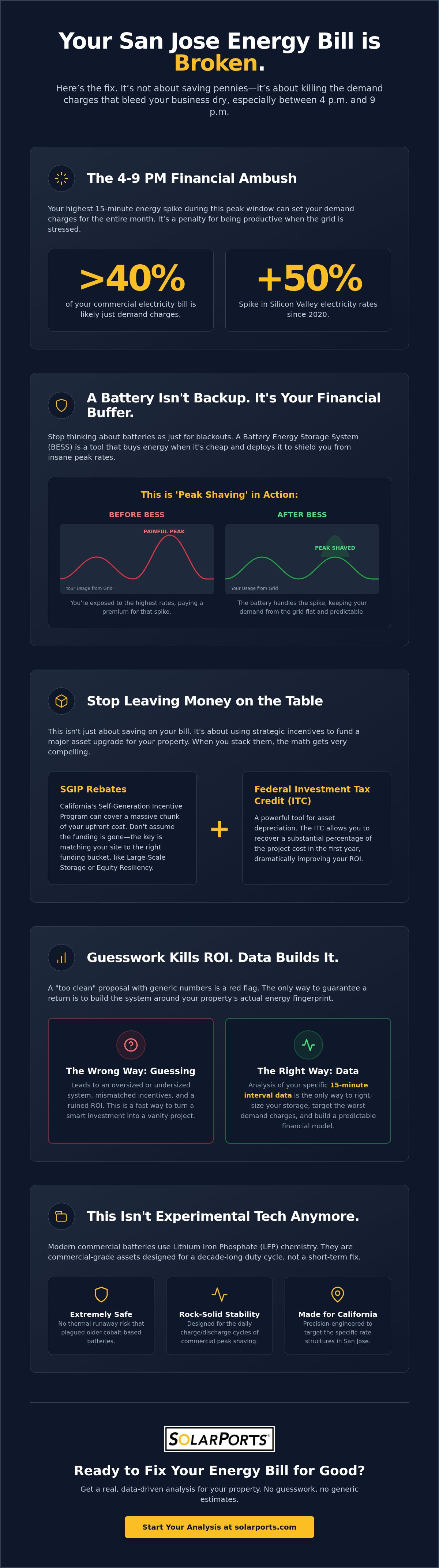
Silicon Valley electricity rates have jumped 50% since 2020. That isn't a typo; it's a structural shift in how California pays for its grid. For a San Jose business owner, the monthly bill usually looks like a confusing mess of delivery fees and generation adjustments. Most of that financial weight comes from demand charges. These fees are calculated based on your highest 15-minute window of usage during a billing cycle. It's essentially a penalty for being productive when the grid is stressed.
A Battery Energy Storage System (BESS) isn't just a backup power source for when the lights go out. You should view it as a financial buffer. It sits between your facility and the utility, absorbing energy when rates are low and deploying it when San Jose Clean Energy (SJCE) and PG&E prices skyrocket. Without this buffer, you're fully exposed to the highest peak demand charges in the country.
The typical solar pitch is often too clean. Salespeople show you a perfect chart of a sunny day and tell you your bill will vanish. The reality is much rougher. California's grid is volatile, and the most expensive hours happen from 4 p.m. to 9 p.m., right when the sun is setting. Small-scale commercial properties are hit hardest because they don't have the sophisticated energy management teams that large tech campuses use to hide from these rates. Investing in San Jose commercial battery storage is how you level that playing field.
The Math of Peak Shaving
Peak shaving is the tactical discharge of stored energy to avoid high-rate intervals. Your monthly utility bill isn't a smooth curve. It's a series of staccato spikes. If your HVAC system kicks on at the same time as your heavy machinery during a 5 p.m. peak, you've just set an expensive new floor for your entire month's billing. When you understand how commercial solar works in tandem with storage, you can use your own generated power to "shave" those spikes off the top. This keeps your demand profile flat and your monthly operational costs predictable.
Strategic BESS Implementation: Navigating SGIP and San Jose Incentives
Implementing San Jose commercial battery storage isn't just about sticking hardware on a concrete pad. It's a strategic move toward behind-the-meter independence. You're shifting from a passive consumer of grid power to an active manager of a local energy asset. This transition is heavily subsidized if you know where to look. Most facility managers assume the incentives are gone, but that's a misunderstanding of how California's funding buckets actually work.
The Self-Generation Incentive Program (SGIP) is the primary vehicle here. It offers tiered rebates that significantly offset the initial capital expenditure. For businesses in high-fire-threat districts or those providing critical infrastructure, the Equity Resiliency tier can cover a massive portion of the system cost. Even if you don't qualify for that specific bucket, the Large-Scale Storage category remains a viable path for San Jose industrial and commercial sites. It's about matching the right incentive to your specific location and operational needs.
Then there is the 2026 Federal Investment Tax Credit (ITC). This is a powerful tool for asset depreciation, allowing you to recover a substantial percentage of the project cost in the first year. When paired with commercial solar tax credits, the financial math for a BESS project becomes incredibly compelling. Is the technology ready for prime time? Yes. We've moved past the experimental phase. Modern systems use Lithium Iron Phosphate (LFP) chemistry. It's more stable than older cobalt-based batteries and lacks the thermal runaway risks that used to keep facility managers up at night. These are commercial-grade assets designed for decade-long duty cycles.
Capturing Local San Jose Rebates
Qualifying for SGIP requires precision. You need to identify whether your site falls into the Equity Resiliency or Large-Scale category based on very specific CPUC maps. Don't trust "too clean" vendor estimates that ignore the reality of local interconnection. PG&E's queue for connecting new storage systems can be long. If your provider doesn't account for these local timelines, your ROI projections are just fiction. If you want to see how these incentives actually apply to your specific meter data, you can book a technical review of your current utility profile.
The Thinking Fix: Why Data-Driven Analysis Beats Generic Storage Estimates
Generic estimates are a liability. If a vendor offers you a quote for San Jose commercial battery storage based on your square footage or a single month's total kilowatt-hours, they aren't solving your problem; they're guessing. Real fiscal optimization requires a granular Commercial Energy Cost Saving Analysis. We look at 15-minute interval data over a full year to identify the exact moments your demand charges spike. This precision ensures you don't overpay for storage capacity you'll never use or, worse, install a system too small to actually shave those peak charges.
Many large-scale developers ignore small-scale commercial projects because the margins aren't high enough for their corporate overhead. SolarPorts Development focuses specifically on these properties. These owners are the ones getting hit hardest by Silicon Valley's rate volatility. Moving to a turnkey solution is about more than just hardware. It's about offloading the technical and regulatory burden so property managers can focus on their core operations instead of decoding utility bills.
The math for storage only works when it's grounded in reality. Navigating California's Self-Generation Incentive Program requires a level of documentation that generic installers often skip. When you treat the battery as a financial asset rather than an appliance, you start to see the ROI in months, not decades.
From Analysis to Asset Management
Integrating rooftop solar with a BESS creates a "micro-hedge" against utility inflation. You're essentially locking in your energy costs for the next two decades. This process isn't always linear. The permitting journey in San Jose can be uneven, with local building departments and PG&E often operating on different timelines. Managing these moving parts is what turns a battery into a long-term financial asset. You can see how this looks in practice by reviewing our local San Jose projects. Seeing the real-world footprint of these systems helps demystify the transition from grid-dependence to strategic energy management.
Securing Your Property’s Financial Future
Peak demand charges don't have to be an unavoidable tax on your operations. We've shown how San Jose commercial battery storage acts as a tactical buffer, shielding your bottom line from the most expensive hours on the grid. By moving away from generic estimates and focusing on your actual 15-minute usage data, you transition from grid-reliance to strategic energy management. The combination of SGIP rebates and federal tax credits makes this the right time to lock in long-term stability.
Success in this market requires more than just hardware; it requires a partner who understands the granular nuances of California's regulatory environment. Our turnkey expertise is built specifically for small-scale commercial properties that need data-backed results without the operational headache. It's time to stop guessing and start optimizing. You can request your data-driven Energy Cost Saving Analysis today to see exactly how much you can shave off your monthly spend. Let's get your facility running on your own terms.
San Jose Energy Storage: Common Questions
What is the typical ROI for San Jose commercial battery storage in 2026?
ROI for San Jose commercial battery storage typically lands between four and seven years, though your specific load profile dictates the exact timeline. If demand charges represent 40% or more of your total utility bill, the payback period usually accelerates. This calculation assumes you're leveraging the 30% Federal Investment Tax Credit and available SGIP tiers to offset the initial capital requirement.
Does San Jose Clean Energy offer specific rebates for BESS?
San Jose Clean Energy (SJCE) doesn't manage its own standalone rebate fund; instead, it directs customers toward the state-level Self-Generation Incentive Program (SGIP). You can also participate in SJCE demand response initiatives like "Peak Rewards." These programs provide financial incentives for discharging your stored energy during high-stress grid events, effectively turning your battery into a revenue-generating asset rather than just a cost center.
How long does a commercial BESS installation take in Santa Clara County?
A typical project requires a six to twelve-month window from the initial data analysis to final commissioning. While the physical construction on-site only takes a few weeks, the administrative hurdles in San Jose are substantial. Navigating the local building department's permitting process and PG&E's interconnection queue is the primary bottleneck. We manage these technical filings to ensure the project doesn't stall in the municipal bureaucracy.
Can I install battery storage without having solar panels on my roof?
You can absolutely install standalone battery storage without solar. Since the 2022 Inflation Reduction Act, these standalone systems still qualify for the 30% Federal Investment Tax Credit. While a solar-plus-storage setup offers the most comprehensive hedge against California's 50% rate increases since 2020, a standalone BESS is a highly effective tool if your primary goal is managing peak demand charges.
Frequently asked questions
The Math of Peak Shaving
Peak shaving is the tactical discharge of stored energy to avoid high-rate intervals. Your monthly utility bill isn't a smooth curve. It's a series of staccato spikes. If your HVAC system kicks on at the same time as your heavy machinery during a 5 p.m. peak, you've just set an expensive new floor for your entire month's billing. When you understand how commercial solar works in tandem with storage, you can use your own generated power to "shave" those spikes off the top. This keeps your demand profile flat and your monthly operational costs predictable. Implementing San Jose commercial battery storage isn't just about sticking hardware on a concrete pad. It's a strategic move toward behind-the-meter independence. You're shifting from a passive consumer of grid power to an active manager of a local energy asset. This transition is heavily subsidized if you know where to look. Most facility managers assume the incentives are gone, but that's a misunderstanding of how California's funding buckets actually work. The Self-Generation Incentive Program (SGIP) is the primary vehicle here. It offers tiered rebates that significantly offset the initial capital expenditure. For businesses in high-fire-threat districts or those providing critical infrastructure, the Equity Resiliency tier can cover a massive portion of the system cost. Even if you don't qualify for that specific bucket, the Large-Scale Storage category remains a viable path for San Jose industrial and commercial sites. It's about matching the right incentive to your specific location and operational needs. Then there is the 2026 Federal Investment Tax Credit (ITC). This is a powerful tool for asset depreciation, allowing you to recover a substantial percentage of the project cost in the first year. When paired with commercial solar tax credits, the financial math for a BESS project becomes incredibly compelling. Is the technology ready for prime time? Yes. We've moved past the experimental phase. Modern systems use Lithium Iron Phosphate (LFP) chemistry. It's more stable than older cobalt-based batteries and lacks the thermal runaway risks that used to keep facility managers up at night. These are commercial-grade assets designed for decade-long duty cycles.
Capturing Local San Jose Rebates
Qualifying for SGIP requires precision. You need to identify whether your site falls into the Equity Resiliency or Large-Scale category based on very specific CPUC maps. Don't trust "too clean" vendor estimates that ignore the reality of local interconnection. PG&E's queue for connecting new storage systems can be long. If your provider doesn't account for these local timelines, your ROI projections are just fiction. If you want to see how these incentives actually apply to your specific meter data, you can book a technical review of your current utility profile. Generic estimates are a liability. If a vendor offers you a quote for San Jose commercial battery storage based on your square footage or a single month's total kilowatt-hours, they aren't solving your problem; they're guessing. Real fiscal optimization requires a granular Commercial Energy Cost Saving Analysis. We look at 15-minute interval data over a full year to identify the exact moments your demand charges spike. This precision ensures you don't overpay for storage capacity you'll never use or, worse, install a system too small to actually shave those peak charges. Many large-scale developers ignore small-scale commercial projects because the margins aren't high enough for their corporate overhead. SolarPorts Development focuses specifically on these properties. These owners are the ones getting hit hardest by Silicon Valley's rate volatility. Moving to a turnkey solution is about more than just hardware. It's about offloading the technical and regulatory burden so property managers can focus on their core operations instead of decoding utility bills. The math for storage only works when it's grounded in reality. Navigating California's Self-Generation Incentive Program requires a level of documentation that generic installers often skip. When you treat the battery as a financial asset rather than an appliance, you start to see the ROI in months, not decades.
From Analysis to Asset Management
Integrating rooftop solar with a BESS creates a "micro-hedge" against utility inflation. You're essentially locking in your energy costs for the next two decades. This process isn't always linear. The permitting journey in San Jose can be uneven, with local building departments and PG&E often operating on different timelines. Managing these moving parts is what turns a battery into a long-term financial asset. You can see how this looks in practice by reviewing our local San Jose projects. Seeing the real-world footprint of these systems helps demystify the transition from grid-dependence to strategic energy management. Peak demand charges don't have to be an unavoidable tax on your operations. We've shown how San Jose commercial battery storage acts as a tactical buffer, shielding your bottom line from the most expensive hours on the grid. By moving away from generic estimates and focusing on your actual 15-minute usage data, you transition from grid-reliance to strategic energy management. The combination of SGIP rebates and federal tax credits makes this the right time to lock in long-term stability. Success in this market requires more than just hardware; it requires a partner who understands the granular nuances of California's regulatory environment. Our turnkey expertise is built specifically for small-scale commercial properties that need data-backed results without the operational headache. It's time to stop guessing and start optimizing. You can request your data-driven Energy Cost Saving Analysis today to see exactly how much you can shave off your monthly spend. Let's get your facility running on your own terms.
What is the typical ROI for San Jose commercial battery storage in 2026?
ROI for San Jose commercial battery storage typically lands between four and seven years, though your specific load profile dictates the exact timeline. If demand charges represent 40% or more of your total utility bill, the payback period usually accelerates. This calculation assumes you're leveraging the 30% Federal Investment Tax Credit and available SGIP tiers to offset the initial capital requirement.
Does San Jose Clean Energy offer specific rebates for BESS?
San Jose Clean Energy (SJCE) doesn't manage its own standalone rebate fund; instead, it directs customers toward the state-level Self-Generation Incentive Program (SGIP). You can also participate in SJCE demand response initiatives like "Peak Rewards." These programs provide financial incentives for discharging your stored energy during high-stress grid events, effectively turning your battery into a revenue-generating asset rather than just a cost center.
How long does a commercial BESS installation take in Santa Clara County?
A typical project requires a six to twelve-month window from the initial data analysis to final commissioning. While the physical construction on-site only takes a few weeks, the administrative hurdles in San Jose are substantial. Navigating the local building department's permitting process and PG&E's interconnection queue is the primary bottleneck. We manage these technical filings to ensure the project doesn't stall in the municipal bureaucracy.
Can I install battery storage without having solar panels on my roof?
You can absolutely install standalone battery storage without solar. Since the 2022 Inflation Reduction Act, these standalone systems still qualify for the 30% Federal Investment Tax Credit. While a solar-plus-storage setup offers the most comprehensive hedge against California's 50% rate increases since 2020, a standalone BESS is a highly effective tool if your primary goal is managing peak demand charges.