
Flat Roof Commercial Solar Installation: A Strategic 2026 Guide for CA Businesses

Your commercial rooftop is either a liability or a strategic financial asset. Right now, most California businesses are letting it sit as the former. It's understandable to hesitate when you're staring at a potential flat roof commercial solar installation and thinking about structural leaks or the shifting sands of utility rate structures. You know the electricity costs are suffocating your margins. Yet, the fear of compromising your building's envelope often wins out. It's a valid concern. We've seen projects where engineering was an afterthought, leading to the exact structural headaches you're trying to avoid.
You're right to be skeptical of the marketing fluff that ignores the reality of NEM 3.0 and the demand charges that can swallow 70% of your utility bill. This guide is a pragmatic look at the structural and fiscal realities of deploying solar on California flat roofs in 2026. We'll map out how to navigate the July 4, 2026, ITC deadline, why battery storage is no longer optional for ROI, and how to ensure your roof remains watertight while it generates revenue. It's time to move past the confusion and look at the actual data behind your facility's energy future.
Key Takeaways
- Realize that flat roof solar is an engineering problem first; the wrong mounting choice can turn your roof into a liability regardless of the energy savings.
- Understand why a flat roof commercial solar installation won't touch your demand charges, which often make up 50% of your bill, unless you're looking at the whole energy picture.
- Use a detailed energy cost saving analysis to stop over-building systems that look good on paper but don't align with your actual operational load profile.
- Navigate the trade-offs between ballasted and penetrated systems so you don't sacrifice structural integrity for a lower upfront price tag.
Table of Contents
- Engineering the Foundation: Mounting Systems and Structural Realities for Flat Roofs
- Beyond the Panels: Navigating California Utility Rates and Demand Charges
- Executing the Project: From Energy Analysis to Turnkey Installation
Engineering the Foundation: Mounting Systems and Structural Realities for Flat Roofs
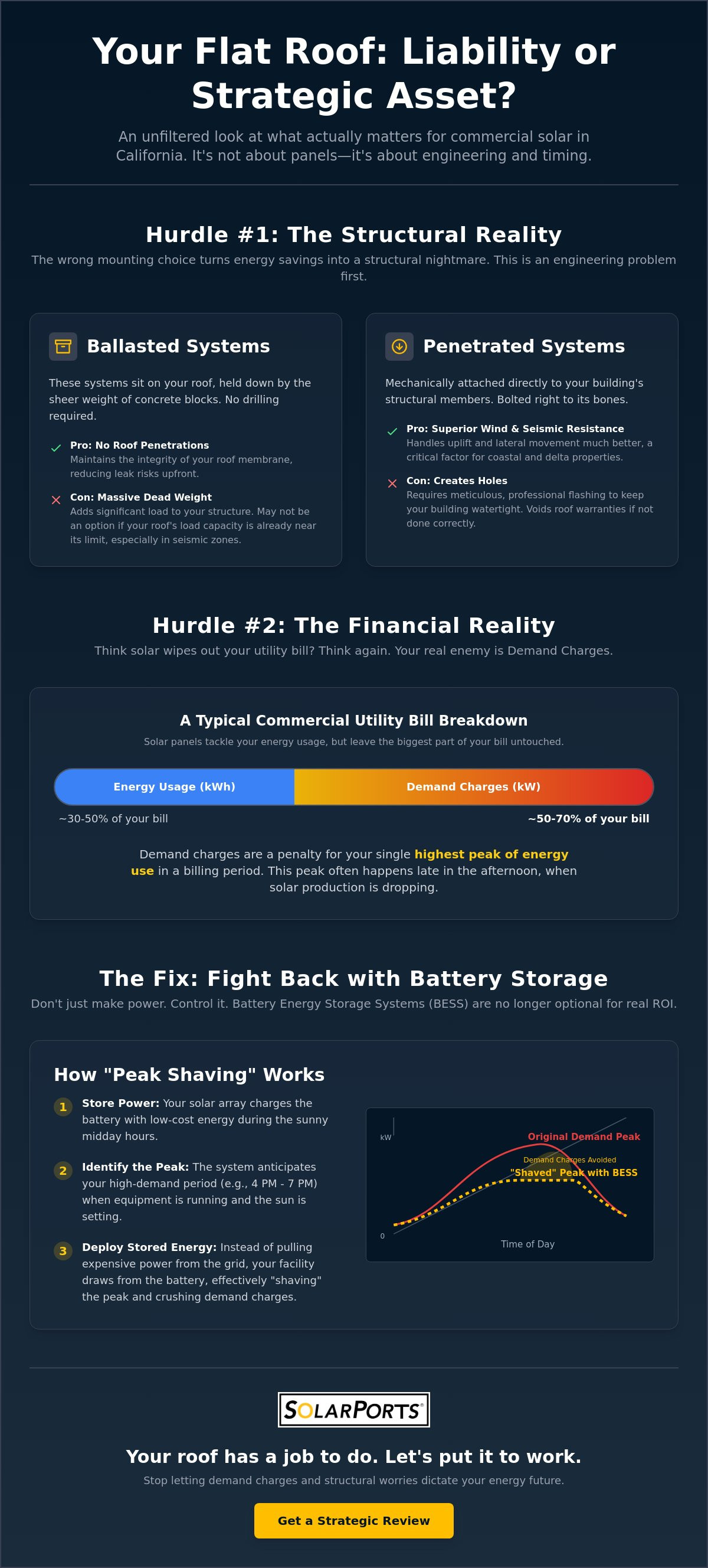
Most people look at the hardware specs and stop at the price per watt. That's a mistake. The real decision for a flat roof commercial solar installation starts with how your building handles gravity, wind, and seismic shifts. You're basically choosing between a system that sits on top of the building and one that becomes part of it. Ballasted systems are the go-to for many because they don't involve drilling hundreds of holes into your membrane. They rely on concrete blocks to stay put. It sounds simple, but you're adding massive dead weight. In Northern California, seismic requirements mean those blocks have to be heavy enough to resist lateral movement during a quake; if your roof load capacity is already near its limit, ballasted simply isn't an option.
Penetrated tilt-up systems are the alternative. These are mechanically attached to the building's structural members. They handle wind uplift much better, which is a major factor for properties near the coast or throughout the Delta. But you're poking holes. You need meticulous flashing to keep things watertight. Understanding the nuances of photovoltaic mounting systems is critical because the wrong choice leads to structural deflection or, worse, a compromised building envelope.
Then there's thermal expansion, the silent killer of large-scale arrays. On a 105-degree day in the Central Valley, your racking system is going to grow. If the panels don't have room to move, the system will eventually stress the mounts or tear at the roof membrane. It's a physical reality that hardware-focused sales pitches often ignore.
Protecting Your Roof Warranty and Integrity
You've likely got a 15 or 20-year warranty on your roof, and you don't want to throw it away. You have to coordinate with the original roofing manufacturer to ensure your solar attachment method doesn't void that protection. We always suggest using "slip sheets" under ballasted blocks. These are sacrificial layers of membrane that prevent the racking system from grinding through your primary roof surface as it shifts over time. A comprehensive pre-installation structural analysis, a standard practiced by reputable firms like Australia's G-Solar & Electrical, is the only way to ensure your building doesn't suffer from catastrophic roof deflection under the combined weight of the system and environmental loads.
Similarly, if your facility is located in the Pacific Northwest, you can discover Advanced Roofing to ensure that your roofing system is properly prepared and protected before any solar hardware is installed.
Beyond the Panels: Navigating California Utility Rates and Demand Charges
If you think a flat roof commercial solar installation will simply wipe out your utility bill, you're only seeing half the balance sheet. In California, your bill isn't just a tally of kilowatt-hours. It's heavily weighted by demand charges, which frequently account for 30% to 70% of a commercial statement. The problem is timing. Your highest energy spikes often hit when the sun is setting or before the array fully wakes up, meaning solar alone leaves those massive demand fees untouched. You're still paying the utility for that 4 PM surge regardless of how many panels are on your roof.
The regulatory landscape has shifted under California's Net Billing Tariff, making the old "sell it back to the grid" model obsolete. Under NEM 3.0, the export rates are based on an avoided cost calculator, which values your excess power at a fraction of what you pay to buy it. This reality demands a more sophisticated approach. You need to look at strategies to lower commercial electricity bills in California that prioritize usage timing over just gross production.
The Role of Battery Energy Storage (BESS)
This is where batteries change the math. Pairing your rooftop system with a Battery Energy Storage System (BESS) allows for "peak shaving." You store the midday sun and deploy it exactly when those expensive demand spikes happen in the late afternoon. It's about fiscal optimization, not just green energy. If you're tired of seeing demand charges eat your margins, it might be worth scheduling a strategic review of your load profile to see if storage is the missing piece.
NEM 3.0 and the Shift Toward Self-Consumption
The current environment favors right-sized systems designed for self-consumption. Paving every square inch of your roof with panels is often a waste of capital if you can't use or store that power. Understanding how commercial solar works in a grid-tied, post-NEM 2.0 world is essential for any executive looking to hedge against California's rising rates, which jumped nearly 50% for major utilities between 2019 and 2023.
Executing the Project: From Energy Analysis to Turnkey Installation
Execution isn't about slapping panels on a roof and hoping for the best. It's a data problem. A flat roof commercial solar installation that isn't preceded by a commercial property energy cost saving analysis is just a guess. You don't want to over-build. If you design a system for your current peak without accounting for future efficiency gains or operational shifts, you're stranded with wasted capital. The "Analysis First" methodology ensures the system is optimized for your specific load profile, not some generic industry average.
Sometimes the roof just won't cut it. If your building is too old or the structural report shows that seismic retrofitting would be cost-prohibitive, don't force the issue. Even for property owners outside of California, specialists like Madison May Consulting Ltd provide the retrofit expertise needed to navigate these types of complex energy efficiency upgrades. We often pivot the strategy toward a parking lot solar carport. It achieves the same energy goals and tax advantages without risking the building's envelope. It's a cleaner way to get to the same ROI when the roof becomes a structural liability. In Northern California, this requires a deep understanding of local AHJ requirements and utility interconnection queues, which vary wildly from one county to the next.
The Turnkey Advantage for Commercial Real Estate
Managing three different contractors for a single project is a fast way to blow your budget. A turnkey approach provides a single point of contact for design, engineering, and the mountain of utility paperwork required in California. It effectively strips out the "soft costs" that often bloat commercial budgets. You can review our past commercial projects to see how we've solved specific engineering hurdles on flat roofs without compromising the timeline or the building's integrity.
Managing the Installation Timeline
Be realistic about the schedule. In 2026, we're still dealing with long-lead items like switchgear and utility transformers that can stall a project for months if they aren't ordered early. You have to plan for these bottlenecks while the utility works through the interconnection process. It generally follows this sequence:
- Application: Submitting technical specs and site plans for utility review.
- Pre-Parallel Inspection: The utility verifies the hardware meets safety and grid standards.
- Permission to Operate (PTO): The final green light to turn the system on and start saving.
Maximizing Your Property's Financial Resilience
California's energy landscape doesn't reward those who guess. We've looked at the structural demands of flat roofs and the fiscal shift toward self-consumption under NEM 3.0. It's clear that a successful flat roof commercial solar installation requires more than just panels; it needs a strategy that integrates battery storage to mitigate those crushing demand charge spikes. You need a turnkey partner who understands the granular engineering required to protect your roof while maximizing your ROI; for those in the UK, you can explore Solar PV System Installation with Jelvis to see how these professional standards are applied internationally.
Similarly, for property owners on the East Coast, working with a specialized roofing contractor Medway MA ensures that your commercial roof maintains its structural integrity and warranty coverage throughout the solar installation process.
Don't let operational waste dictate your margins for another fiscal year. We specialize in data-driven right-sizing and demand charge mitigation for commercial real estate across the state. It's time to turn your roof into a high-performing asset. Get a Professional Energy Cost Saving Analysis for Your Property today and see exactly how the math works for your specific facility. You've got the space; let's make it work for you.
Frequently Asked Questions
Do flat roof solar panels need to be tilted?
Yes, solar panels on a flat roof are almost always installed with a slight tilt, typically between 5 and 10 degrees. This angle isn't just about catching more sun; it's about maintenance and panel longevity. Without a tilt, water and dust pool on the glass, creating "hot spots" that degrade the cells over time. A minimal tilt allows rain to naturally wash away debris, keeping your flat roof commercial solar installation running at peak efficiency without constant manual cleaning.
Will installing solar on my commercial flat roof cause leaks?
It won't cause leaks if the engineering and installation are handled by professionals who respect the building's membrane. Ballasted systems avoid this risk entirely by using weights instead of roof penetrations. If your building requires a mechanically attached system, the risk is managed through professional flashing and heat-welding techniques that mirror the original roof's construction. The real danger comes from cut-rate installers who don't coordinate with your roofing manufacturer's warranty requirements.
How much weight does a ballasted solar system add to a flat roof?
A standard ballasted system typically adds between 3 and 6 pounds per square foot to your roof's dead load. While that sounds manageable, it's cumulative and varies based on your building's height and local wind speeds. California's seismic codes often require more ballast to prevent the array from sliding during an earthquake. You need a structural engineer to verify that your specific building can support this weight alongside potential live loads like rainwater or maintenance crews.
What is the best type of solar mount for a TPO or PVC roof membrane?
Ballasted racking systems are usually the best fit for TPO or PVC membranes because they don't compromise the waterproof seal. You must use slip sheets between the racking and the membrane to prevent friction damage as the system expands and contracts with the heat. For high-wind areas where ballast isn't enough, heat-welded mounts are a superior option. These mounts are welded directly to the membrane, providing a mechanical bond without actually puncturing the roof's structural deck.
Frequently asked questions
Protecting Your Roof Warranty and Integrity
You've likely got a 15 or 20-year warranty on your roof, and you don't want to throw it away. You have to coordinate with the original roofing manufacturer to ensure your solar attachment method doesn't void that protection. We always suggest using "slip sheets" under ballasted blocks. These are sacrificial layers of membrane that prevent the racking system from grinding through your primary roof surface as it shifts over time. A comprehensive pre-installation structural analysis is the only way to ensure your building doesn't suffer from catastrophic roof deflection under the combined weight of the system and environmental loads. If you think a flat roof commercial solar installation will simply wipe out your utility bill, you're only seeing half the balance sheet. In California, your bill isn't just a tally of kilowatt-hours. It's heavily weighted by demand charges, which frequently account for 30% to 70% of a commercial statement. The problem is timing. Your highest energy spikes often hit when the sun is setting or before the array fully wakes up, meaning solar alone leaves those massive demand fees untouched. You're still paying the utility for that 4 PM surge regardless of how many panels are on your roof. The regulatory landscape has shifted under California's Net Billing Tariff, making the old "sell it back to the grid" model obsolete. Under NEM 3.0, the export rates are based on an avoided cost calculator, which values your excess power at a fraction of what you pay to buy it. This reality demands a more sophisticated approach. You need to look at strategies to lower commercial electricity bills in California that prioritize usage timing over just gross production.
The Role of Battery Energy Storage (BESS)
This is where batteries change the math. Pairing your rooftop system with a Battery Energy Storage System (BESS) allows for "peak shaving." You store the midday sun and deploy it exactly when those expensive demand spikes happen in the late afternoon. It's about fiscal optimization, not just green energy. If you're tired of seeing demand charges eat your margins, it might be worth scheduling a strategic review of your load profile to see if storage is the missing piece.
NEM 3.0 and the Shift Toward Self-Consumption
The current environment favors right-sized systems designed for self-consumption. Paving every square inch of your roof with panels is often a waste of capital if you can't use or store that power. Understanding how commercial solar works in a grid-tied, post-NEM 2.0 world is essential for any executive looking to hedge against California's rising rates, which jumped nearly 50% for major utilities between 2019 and 2023. Execution isn't about slapping panels on a roof and hoping for the best. It's a data problem. A flat roof commercial solar installation that isn't preceded by a commercial property energy cost saving analysis is just a guess. You don't want to over-build. If you design a system for your current peak without accounting for future efficiency gains or operational shifts, you're stranded with wasted capital. The "Analysis First" methodology ensures the system is optimized for your specific load profile, not some generic industry average. Sometimes the roof just won't cut it. If your building is too old or the structural report shows that seismic retrofitting would be cost-prohibitive, don't force the issue. We often pivot the strategy toward a parking lot solar carport. It achieves the same energy goals and tax advantages without risking the building's envelope. It's a cleaner way to get to the same ROI when the roof becomes a structural liability. In Northern California, this requires a deep understanding of local AHJ requirements and utility interconnection queues, which vary wildly from one county to the next.
The Turnkey Advantage for Commercial Real Estate
Managing three different contractors for a single project is a fast way to blow your budget. A turnkey approach provides a single point of contact for design, engineering, and the mountain of utility paperwork required in California. It effectively strips out the "soft costs" that often bloat commercial budgets. You can review our past commercial projects to see how we've solved specific engineering hurdles on flat roofs without compromising the timeline or the building's integrity.
Managing the Installation Timeline
Be realistic about the schedule. In 2026, we're still dealing with long-lead items like switchgear and utility transformers that can stall a project for months if they aren't ordered early. You have to plan for these bottlenecks while the utility works through the interconnection process. It generally follows this sequence: California's energy landscape doesn't reward those who guess. We've looked at the structural demands of flat roofs and the fiscal shift toward self-consumption under NEM 3.0. It's clear that a successful flat roof commercial solar installation requires more than just panels; it needs a strategy that integrates battery storage to mitigate those crushing demand charge spikes. You need a turnkey partner who understands the granular engineering required to protect your roof while maximizing your ROI. Don't let operational waste dictate your margins for another fiscal year. We specialize in data-driven right-sizing and demand charge mitigation for commercial real estate across the state. It's time to turn your roof into a high-performing asset. Get a Professional Energy Cost Saving Analysis for Your Property today and see exactly how the math works for your specific facility. You've got the space; let's make it work for you.
Do flat roof solar panels need to be tilted?
Yes, solar panels on a flat roof are almost always installed with a slight tilt, typically between 5 and 10 degrees. This angle isn't just about catching more sun; it's about maintenance and panel longevity. Without a tilt, water and dust pool on the glass, creating "hot spots" that degrade the cells over time. A minimal tilt allows rain to naturally wash away debris, keeping your flat roof commercial solar installation running at peak efficiency without constant manual cleaning.
Will installing solar on my commercial flat roof cause leaks?
It won't cause leaks if the engineering and installation are handled by professionals who respect the building's membrane. Ballasted systems avoid this risk entirely by using weights instead of roof penetrations. If your building requires a mechanically attached system, the risk is managed through professional flashing and heat-welding techniques that mirror the original roof's construction. The real danger comes from cut-rate installers who don't coordinate with your roofing manufacturer's warranty requirements.
How much weight does a ballasted solar system add to a flat roof?
A standard ballasted system typically adds between 3 and 6 pounds per square foot to your roof's dead load. While that sounds manageable, it's cumulative and varies based on your building's height and local wind speeds. California's seismic codes often require more ballast to prevent the array from sliding during an earthquake. You need a structural engineer to verify that your specific building can support this weight alongside potential live loads like rainwater or maintenance crews.
What is the best type of solar mount for a TPO or PVC roof membrane?
Ballasted racking systems are usually the best fit for TPO or PVC membranes because they don't compromise the waterproof seal. You must use slip sheets between the racking and the membrane to prevent friction damage as the system expands and contracts with the heat. For high-wind areas where ballast isn't enough, heat-welded mounts are a superior option. These mounts are welded directly to the membrane, providing a mechanical bond without actually puncturing the roof's structural deck.