
Sacramento Commercial Solar Carports: A Strategic 2026 ROI Guide

Why are you still paying SMUD to bake the asphalt in your parking lot? Most Sacramento business owners treat their open lots as a necessary expense, but right now, that pavement is just a magnet for heat and $9.96 per kW summer peak demand charges. It's a massive waste of real estate that could be working for you. You already know the frustration of opening a utility bill and seeing demand spikes that feel completely out of your control, especially when you're also dealing with the security risks of an unshaded, open lot.
We're here to change how you look at that space. This guide isn't about vague environmental goals; it's about using Sacramento commercial solar carports as a tactical financial shield to kill those peak charges. You'll learn how the 2026 regulatory landscape, including the July ITC construction deadline and new Title 24 mandates, makes this the year to act. We'll walk through the data-driven strategy you need to turn a sun-drenched liability into a high-yield asset that protects your bottom line and your tenants' vehicles at the same time.
Key Takeaways
- Stop letting your parking lot be a liability; learn how to convert that asphalt into a behind-the-meter power plant that targets SMUD's peak demand charges.
- Sacramento commercial solar carports aren't just construction projects-they are financial instruments designed to capture 2026 tax credits and property tax exclusions.
- Avoid the "Sacramento headache" by using a data-driven site assessment to clear permitting hurdles and utility interconnection before ground is even broken.
- Shift your focus from simple energy generation to "avoided costs," where the real ROI lives in shielding your business from peak-hour electricity rates.
Table of Contents
- Sacramento Energy Costs: Turning Parking Lots into Financial Shields
- Navigating Sacramento Permitting and the Grid: A Pragmatic 2026 Reality
- The 2026 Strategic Math: ROI, Tax Credits, and Demand Charge Mitigation
Sacramento Energy Costs: Turning Parking Lots into Financial Shields
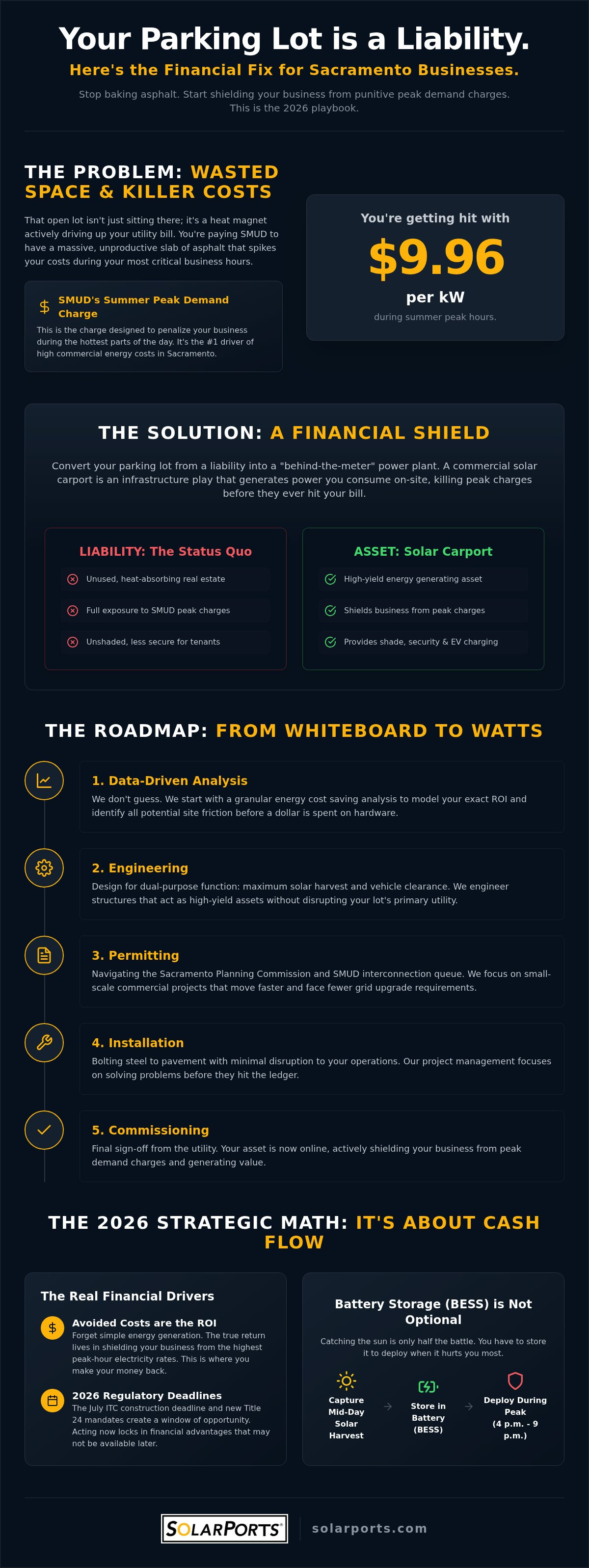
Stop looking at your parking lot as just a place for cars to sit. In a city where summer heat turns asphalt into a furnace, an open lot is a liability. Sacramento commercial solar carports convert that wasted space into a "behind-the-meter" power plant. This isn't just "panels on a roof." It's a strategic infrastructure play. A Solar canopy carport provides shade, security, and energy that you consume on-site before the utility can charge you for it.
Choosing the status quo means choosing to bleed margin. Every month you pay for unfiltered grid power, you're opting into a system designed to extract more during your most productive hours. For many Sacramento businesses, rooftop solar isn't the best fit. Your roof might be at the end of its life, or maybe the HVAC units take up all the usable space. Sacramento commercial solar carports solve this by using the one asset you have plenty of: the parking lot. It's about maximizing yield from every square foot of your property.
The SMUD vs. PG&E Factor: Why 2026 is Different
The geography of your utility bill matters. If you're in SMUD territory, you face a $9.96 per kW summer peak demand charge as of 2026. While SMUD rates are roughly 44% lower than PG&E, the impact of demand spikes remains the primary driver of commercial energy costs. These structures are built to penalize businesses during the hottest parts of the day. Using carports to shield your bottom line isn't just about "going green." It's about risk management. You can find more on the strategies to lower commercial electricity bills California to see how this fits into a broader cost-reduction framework.
Navigating Sacramento Permitting and the Grid: A Pragmatic 2026 Reality
Getting a project off the ground in the Central Valley isn't just about bolting steel to the pavement. It's a logistical grind. Most Sacramento commercial solar carports fail at the whiteboard phase because owners rush into construction without a granular energy cost saving analysis. You need a 5-step roadmap that actually accounts for local friction: data-driven analysis, engineering, permitting, installation, and final commissioning. This isn't just a sequence; it's a "thinking fix." A proper site assessment prevents the kind of expensive mid-construction pivots that happen when you discover underground utility conflicts or soil issues too late. This level of foresight is the backbone of commercial solar project management CA; it's about solving problems before they hit the ledger.
Energy storage is no longer optional. With SMUD's current rate structures, catching the sun is only half the battle. You have to hold onto it. Integrating a Battery Energy Storage System (BESS) allows you to capture mid-day solar harvest and deploy it during the expensive 4 p.m. to 9 p.m. evening peak. It's a simple equation of shifting load to avoid the highest tariffs. If you're ready to see how these timelines apply to your specific lot, you can schedule a technical walkthrough to review your site's potential.
Sacramento Permitting and Grid Realities
The Sacramento Planning and Design Commission has its own rhythm, and it's often slower than you'd like. We focus on small-scale commercial applications because they typically move through the interconnection queue faster. While the California Solar Initiative laid the groundwork for state-wide adoption, local grid saturation means that smaller, behind-the-meter projects face fewer upgrade requirements from the utility. It's the path of least resistance to operational status.
Designing for the Northern California Environment
Sacramento parking lots present unique design challenges. You have to balance maximum solar harvest with vehicle clearance for delivery trucks and integrated security lighting to protect the asset at night. Our services focus on this dual-purpose engineering. We design carports that function as high-yield energy assets without compromising the primary utility of your parking real estate.
The 2026 Strategic Math: ROI, Tax Credits, and Demand Charge Mitigation
ROI is a calculation of cash flow. It's not a collection of optics-focused green initiatives. While most vendors lead with the federal credit, the real fiscal driver for Sacramento commercial solar carports is the avoided cost of peak power. You're buying a hedge against SMUD's summer peak electricity usage charge of $0.2341 per kWh. Every watt produced under that canopy is a watt you don't buy at retail. This fundamental shift in operational expense is the core of a commercial solar ROI analysis that actually lands with a CFO.
Don't ignore the secondary value sitting on your balance sheet. Shade preserves asphalt. In 100-degree Sacramento summers, UV exposure and thermal expansion degrade parking lot surfaces, which forces frequent sealing and repair. By installing a carport, you're putting a roof over a high-maintenance asset. This, combined with tenant retention and EV readiness, turns a "soft" benefit into a hard financial gain. It's about total asset optimization.
Maximizing the 2026 Tax Credits
The clock is loud. To secure the full 30% Investment Tax Credit (ITC), construction must begin by July 4, 2026. Waiting for "better tech" is a losing strategy when you're leaving a 30% subsidy on the table. Our guide on the 2026 commercial solar tax credit California breaks down the specific bonus adders for domestic content. Lock in the math now.
The Power of a Turnkey Solution
Fragmented project management kills margins. Managing five different vendors for one carport project is a recipe for failure in Sacramento's regulatory environment. We act as a strategic partner, handling everything from the initial energy cost saving analysis to the final utility interconnection. You can see the results of this integrated approach in our California projects. We value precision over persuasion.
Stop Bleeding Margin and Start Building Assets
Stop paying for sun you aren't using. Every summer afternoon your parking lot sits open is another day you're choosing to pay SMUD's peak demand charges instead of generating your own power. We've broken down the math. Between the July 2026 ITC deadline and the power to wipe out those $9.96 per kW demand spikes, the window for peak ROI is narrow. Sacramento commercial solar carports aren't just about parking lot shade; they are about taking a liability and turning it into a predictable, high-yield asset.
Don't let the permitting friction or utility interconnection stop your progress. We specialize in turnkey solutions for the California market, focusing on demand charge mitigation through data-driven project sizing. We handle the grid headaches so you can focus on the fiscal impact. It's about finding a streamlined way to solve a complex financial burden without managing five different vendors.
Ready to see the actual numbers for your property? Request a No-Nonsense Energy Cost Saving Analysis to get a clear, analytical breakdown of your site's potential. It's time to put that asphalt to work.
Frequently Asked Questions
Do Sacramento solar carports require a lot of maintenance?
Maintenance requirements are low. These structures are built for industrial longevity, so you'll mostly deal with annual electrical inspections and occasional panel cleanings to clear Central Valley dust. Rain handles much of the work; however, a scheduled rinse during our dry summers keeps the yield high. Since everything is at ground level, you don't have the accessibility costs or roof-penetration risks associated with traditional commercial arrays.
How long does a typical commercial solar carport installation take in Sacramento?
A standard installation typically spans six to nine months. This timeline is rarely about the physical build; it's about the administrative grind. On-site construction for Sacramento commercial solar carports usually wraps in four to eight weeks. The rest of the calendar is occupied by the Sacramento Planning and Design Commission and the utility's interconnection queue. Starting the analysis early is the only way to hit 2026 tax deadlines.
Can I add EV charging stations to my solar carport later?
You can, but retrofitting is a financial mistake. Trenching through fresh asphalt to add conduit later will significantly increase your infrastructure costs. We advise clients to design for "EV-readiness" from day one. This means sizing the electrical service and laying the pipe during the initial carport build. It keeps your options open for tenant charging without forcing you to tear up your parking lot a second time.
What happens to the solar production during Sacramento fogs or cloudy winter days?
Production continues through diffuse light, though at a reduced rate. Sacramento's Tule fog and winter clouds are factored into our initial energy cost saving analysis. We don't model ROI based on perfect summer days alone. The system's value is measured by its annual aggregate performance and its ability to shield you from peak demand charges when the sun is actually at its highest.
Frequently asked questions
Do Sacramento solar carports require a lot of maintenance?
Maintenance requirements are low. These structures are built for industrial longevity, so you'll mostly deal with annual electrical inspections and occasional panel cleanings to clear Central Valley dust. Rain handles much of the work; however, a scheduled rinse during our dry summers keeps the yield high. Since everything is at ground level, you don't have the accessibility costs or roof-penetration risks associated with traditional commercial arrays.
How long does a typical commercial solar carport installation take in Sacramento?
A standard installation typically spans six to nine months. This timeline is rarely about the physical build; it's about the administrative grind. On-site construction for Sacramento commercial solar carports usually wraps in four to eight weeks. The rest of the calendar is occupied by the Sacramento Planning and Design Commission and the utility's interconnection queue. Starting the analysis early is the only way to hit 2026 tax deadlines.
Can I add EV charging stations to my solar carport later?
You can, but retrofitting is a financial mistake. Trenching through fresh asphalt to add conduit later will significantly increase your infrastructure costs. We advise clients to design for "EV-readiness" from day one. This means sizing the electrical service and laying the pipe during the initial carport build. It keeps your options open for tenant charging without forcing you to tear up your parking lot a second time.
What happens to the solar production during Sacramento fogs or cloudy winter days?
Production continues through diffuse light, though at a reduced rate. Sacramento's Tule fog and winter clouds are factored into our initial energy cost saving analysis. We don't model ROI based on perfect summer days alone. The system's value is measured by its annual aggregate performance and its ability to shield you from peak demand charges when the sun is actually at its highest.