
Bay Area Commercial BESS: A No-Nonsense Guide to Defeating Demand Charges in 2026

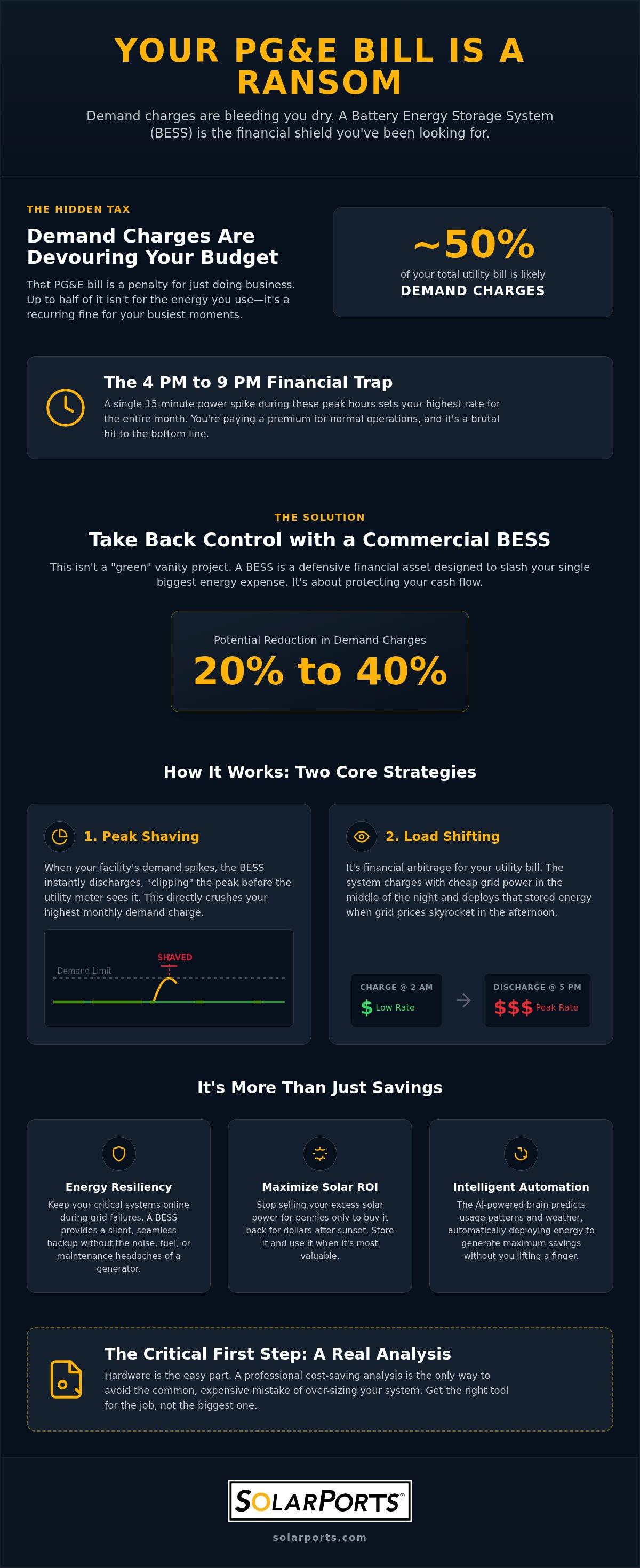
For most Bay Area businesses, the energy crisis isn't just about the occasional grid failure; it's a line item on a PG&E bill that feels like a monthly ransom payment. You've likely noticed that demand charges now eat up nearly 50% of your total utility costs. It's an expensive, recurring penalty for simply operating during normal business hours. Investing in a Bay Area commercial BESS (Battery Energy Storage System) isn't a sustainability vanity project anymore. It's a defensive financial asset designed to protect your bottom line from aggressive utility rate hikes that show no signs of slowing down.
We know the math feels complicated, especially with the shift to NEM 3.0 and the confusing landscape of state incentives. You're looking for a way to stop paying for peak-hour spikes without disrupting your daily operations. This guide explains how to use storage to slash those B-19 demand charges by 20% to 40% and finally secure the energy independence your facility requires. We'll walk through the current reality of SGIP incentives, the impact of the Net Billing Tariff, and how a data-driven cost-saving analysis can turn your property into a high-yield financial tool.
Key Takeaways
- Stop treating PG&E demand charges as an unavoidable tax and learn how local storage allows you to reclaim control over your monthly utility spend.
- Master the mechanics of peak shaving and load shifting to ensure your facility isn't pulling high-cost power during the most expensive partial-peak and on-peak windows.
- Understand why a Bay Area commercial BESS has transitioned from a sustainability "extra" to a mandatory defensive asset for financial stability in 2026.
- Discover why a professional energy cost saving analysis is the critical first step to avoid the common mistake of over-sizing hardware you don't actually need.
- Get the current reality on 2026 SGIP rebate levels and how they factor into the total ROI for a turnkey storage installation.
Table of Contents
- The Bay Area Energy Crisis: Why BESS is No Longer Optional
- Peak Shaving and Load Shifting: The Mechanics of Commercial Savings
- Calculating ROI: From Analysis to Turnkey Implementation
The Bay Area Energy Crisis: Why BESS is No Longer Optional
The Bay Area energy landscape has shifted from predictable to punitive. Between aging infrastructure and frequent Public Safety Power Shutoffs, businesses are operating under a constant threat of instability. For most, the real crisis isn't just the blackouts; it's the cost of staying connected. PG&E’s B-19 and B-20 tariff structures are designed to penalize high-usage events. In fact, demand charges can now account for up to 50% of your total monthly utility bill. A Battery Energy Storage System (BESS) acts as a strategic financial buffer between your business and the volatile grid. Implementing a Bay Area commercial BESS is no longer a "green" elective. It is a necessary defensive move for any operator tired of writing blank checks to the utility.
The Problem with Peak Demand
Utility billing in California isn't just about how much total power you use. It's about when you use it and how fast. A single 15-minute spike in energy consumption, perhaps from a heavy machinery startup or a cooling system surge, sets your demand rate for the entire month. The 4 PM to 9 PM window is a notorious financial trap. This is when partial-peak and on-peak rates converge, turning standard operational needs into exorbitant expenses. Without storage, you're forced to pay whatever the grid demands, regardless of your actual daily average consumption.
Resiliency in Northern California
Grid instability is the new baseline for Northern California. Business downtime during a local outage isn't just an inconvenience; it's a direct hit to your revenue and operational integrity. While traditional generators are noisy, require fuel, and involve heavy maintenance, a BESS provides a silent, instantaneous bridge during brownouts. It ensures your critical systems stay online without the logistical headache of combustion engines. To understand the exact scale of your current exposure, a professional commercial property energy cost saving analysis is the best way to quantify the potential for recovery.
Peak Shaving and Load Shifting: The Mechanics of Commercial Savings
Saving money on energy isn't just about using less power; it's about managing the timing of your draw from the grid. Most businesses pay a heavy premium for their highest consumption moments. Peak shaving uses the battery to "clip" that top off. By discharging stored energy during these surges, you effectively lower your peak demand. This is the primary mechanism for reducing demand charges that otherwise inflate your PG&E bill for the entire month.
Then there's load shifting. Think of this as financial arbitrage for your utility bill. You charge your Bay Area commercial BESS at 2 AM when rates are at their floor and discharge it at 5 PM when prices are at their ceiling. It's a simple buy-low, sell-high strategy applied to electrons. You don't even need solar for this to work. If you're in a leased property or have a roof that won't support panels, a standalone BESS still delivers ROI through this time-of-use shifting. SolarPorts Development BESS solutions are designed to integrate directly with your existing building management systems, making the transition feel like a software upgrade rather than a construction headache.
How BESS Complements Solar Carports
Solar generates power when the sun is out, but that doesn't always align with your operational peaks. A battery captures that excess midday sun and holds it for the evening rush. It's the essential missing piece for a Commercial Solar Carport with EV Charging in California. Without storage, you're often forced to export solar energy for pennies and buy it back for dollars once the sun goes down.
The Role of Smart Software
The battery cells are just hardware; the software is the brain. Modern BESS uses AI to predict when your building will spike based on weather and historical load patterns. It discharges automatically, ensuring you never hit those expensive demand thresholds. This intelligence is what actually generates the ROI. If you're curious about how these patterns look for your specific facility, you can book a strategy session to review your data.
Calculating ROI: From Analysis to Turnkey Implementation
Hardware is the easy part. The real work happens before a single battery is bolted to the floor. A Commercial energy cost saving analysis is the only way to avoid over-sizing or under-sizing your system. If the system is too small, you won't clip the peaks that trigger those $20 to $28 per kW demand charges. If it's too large, you're carrying stranded capital that won't pay for itself. By 2026, the Bay Area commercial BESS market has matured, but the financial modeling has become more precise because the margins for error have thinned under NEM 3.0.
Turnkey implementation is the only logical path for a busy executive. You need one point of contact to handle the engineering, the local permitting, and the often painful PG&E interconnection process. A Bay Area commercial BESS is a 10-to-15-year asset that requires professional commercial solar project management to ensure the software stays optimized as utility rates continue to evolve. While the SGIP landscape has tightened significantly since the general market budgets closed to new applicants in late 2025, a thorough analysis can still identify if your project qualifies for remaining equity pathways or waitlist opportunities that might offset costs.
The 2026 Tax Landscape
The federal Investment Tax Credit (ITC) is the heavy lifter in your capital stack. As of 2026, the 30% credit applies to standalone storage, which is a massive win for properties where rooftop solar isn't viable. This credit directly reduces the tax liability of the entity owning the system, significantly shortening the payback period. For a detailed breakdown of how this hits the balance sheet, see our guide on the 2026 Commercial Solar Tax Credit in California.
Steps to Getting Your Project Done
We start with a deep dive into your "Green Button" interval data. We need twelve months of history to see exactly how your building breathes. Once we understand the load, we conduct a site feasibility study to determine if the battery lives in an existing electrical room or a weather-rated enclosure in the parking lot. We don't move to the contracting phase until the commercial solar ROI analysis proves the project meets your internal rate of return requirements. It's a methodical process designed to eliminate the guesswork before you commit to the investment.
Securing Your Facility’s Financial Resilience
Waiting for PG&E to lower rates is a losing strategy. The grid in Northern California isn't getting any younger, and those B-19 tariff structures don't care about your operational challenges. By integrating a Bay Area commercial BESS, you're building a defensive wall between your bank account and the next 15-minute usage spike. It's about moving from a reactive stance to a proactive one where you dictate when you buy power and when you don't. Hardware is just hardware; it's the strategy behind the discharge that actually saves you money.
We've seen that the real value lies in the data. You can't guess your way into a 10-year ROI, and you shouldn't have to manage the interconnection maze yourself. We specialize in California commercial real estate and provide the turnkey project management needed to get these systems live and optimized. When you're ready to see the actual numbers for your property, Get Your Data-Driven Energy Cost Saving Analysis. Taking control of your energy costs is the smartest move you can make for your bottom line this year.
Frequently Asked Questions
Does my Bay Area business need solar to install a BESS?
No, solar isn't a prerequisite for storage. You can install a standalone Bay Area commercial BESS and still see significant savings through load shifting. The system simply draws power from the grid when rates are at their floor, usually in the middle of the night, and feeds your building when PG&E kicks in those high partial-peak or on-peak rates. It's a pure financial play that works even on properties with shaded roofs or structural limitations that make solar impossible.
How long does a commercial BESS installation typically take in California?
Expect a timeline of 6 to 12 months from the initial data analysis to final commissioning. The physical installation of the battery cabinets usually only takes a few weeks of on-site work. Most of the lead time is eaten up by California's permitting requirements and the PG&E interconnection queue. Getting the technical studies approved is the primary bottleneck, which is why we handle the project management to keep the process moving through the bureaucracy.
What is the lifespan of a commercial-grade lithium-ion battery system?
Most commercial-grade systems are designed to last between 10 and 15 years. This lifespan depends on how hard the system is cycled and the depth of discharge used daily. We typically see Lithium Iron Phosphate (LFP) chemistry dominating the 2026 market because it offers better thermal stability and a longer cycle life than older lithium-ion versions. It's an asset that pays for itself well before the capacity degrades to a point where it needs replacement.
Can BESS help my business avoid PG&E demand charges entirely?
It's unlikely you'll hit zero, but a well-sized Bay Area commercial BESS can realistically slash the demand charge portion of your bill by 20% to 40%. You'll still have fixed meter fees and basic delivery costs. The goal isn't to disconnect from the grid. Instead, you're "shaving" the expensive peaks so you aren't billed for a massive surge just because your HVAC and machinery kicked on at the same time. The savings come from lowering that highest 15-minute usage window that PG&E uses to set your monthly rate.
Frequently asked questions
Does my Bay Area business need solar to install a BESS?
No, solar isn't a prerequisite for storage. You can install a standalone Bay Area commercial BESS and still see significant savings through load shifting. The system simply draws power from the grid when rates are at their floor, usually in the middle of the night, and feeds your building when PG&E kicks in those high partial-peak or on-peak rates. It's a pure financial play that works even on properties with shaded roofs or structural limitations that make solar impossible.
How long does a commercial BESS installation typically take in California?
Expect a timeline of 6 to 12 months from the initial data analysis to final commissioning. The physical installation of the battery cabinets usually only takes a few weeks of on-site work. Most of the lead time is eaten up by California's permitting requirements and the PG&E interconnection queue. Getting the technical studies approved is the primary bottleneck, which is why we handle the project management to keep the process moving through the bureaucracy.
What is the lifespan of a commercial-grade lithium-ion battery system?
Most commercial-grade systems are designed to last between 10 and 15 years. This lifespan depends on how hard the system is cycled and the depth of discharge used daily. We typically see Lithium Iron Phosphate (LFP) chemistry dominating the 2026 market because it offers better thermal stability and a longer cycle life than older lithium-ion versions. It's an asset that pays for itself well before the capacity degrades to a point where it needs replacement.
Can BESS help my business avoid PG&E demand charges entirely?
It's unlikely you'll hit zero, but a well-sized Bay Area commercial BESS can realistically slash the demand charge portion of your bill by 20% to 40%. You'll still have fixed meter fees and basic delivery costs. The goal isn't to disconnect from the grid. Instead, you're "shaving" the expensive peaks so you aren't billed for a massive surge just because your HVAC and machinery kicked on at the same time. The savings come from lowering that highest 15-minute usage window that PG&E uses to set your monthly rate.