
Rooftop Solar for Commercial Real Estate in Oakland: A Strategic 2026 Analysis

In 2026, rooftop solar for commercial real estate in Oakland isn't a sustainability play. It's a defensive financial maneuver against a utility provider that's essentially holding your operational budget hostage. You've seen the March rate shifts and the persistent peak-demand charges that make forecasting your OpEx nearly impossible. It's a grind. Most owners are tired of the "green" talk and just want to know if they can actually cut their dependence on PG&E without getting stuck in a multi-year permit loop with the city.
We know the frustration of watching utility costs climb while the local bureaucracy moves at a crawl. This analysis provides a pragmatic roadmap to leveraging 100% bonus depreciation and localized solar architecture to stabilize your bottom line. That July 4 deadline for the 30% federal tax credit is looming, and the city isn't exactly known for moving fast. We're going to bypass the fluff and look at the actual mechanics of a turnkey energy transition that protects your asset's structural integrity while maximizing these 2026 fiscal incentives.
Key Takeaways
- PG&E’s 2026 rate hikes and demand charges are a direct hit to your margins. We’ll show you how to stop paying for energy you aren't even using.
- Most owners default to rooftop solar for commercial real estate Oakland, but if your roof is crowded with HVAC, a solar carport might be the higher-yield move for your lot.
- Don't fall for the "fast-track" permit myths. Oakland requires a specific online process for commercial projects that most people mess up.
- You’ve got until July 4, 2026, to lock in the 30% federal credit. You need to know exactly how to move from a cost analysis to interconnection before that window shuts.
Table of Contents
- The Oakland Utility Crisis: Why Rooftop Solar is a Financial Necessity in 2026
- Rooftop vs. Carport: Selecting the Right Architecture for Oakland Lots
- Navigating the Oakland Permit Maze and 2026 ROI
The Oakland Utility Crisis: Why Rooftop Solar is a Financial Necessity in 2026
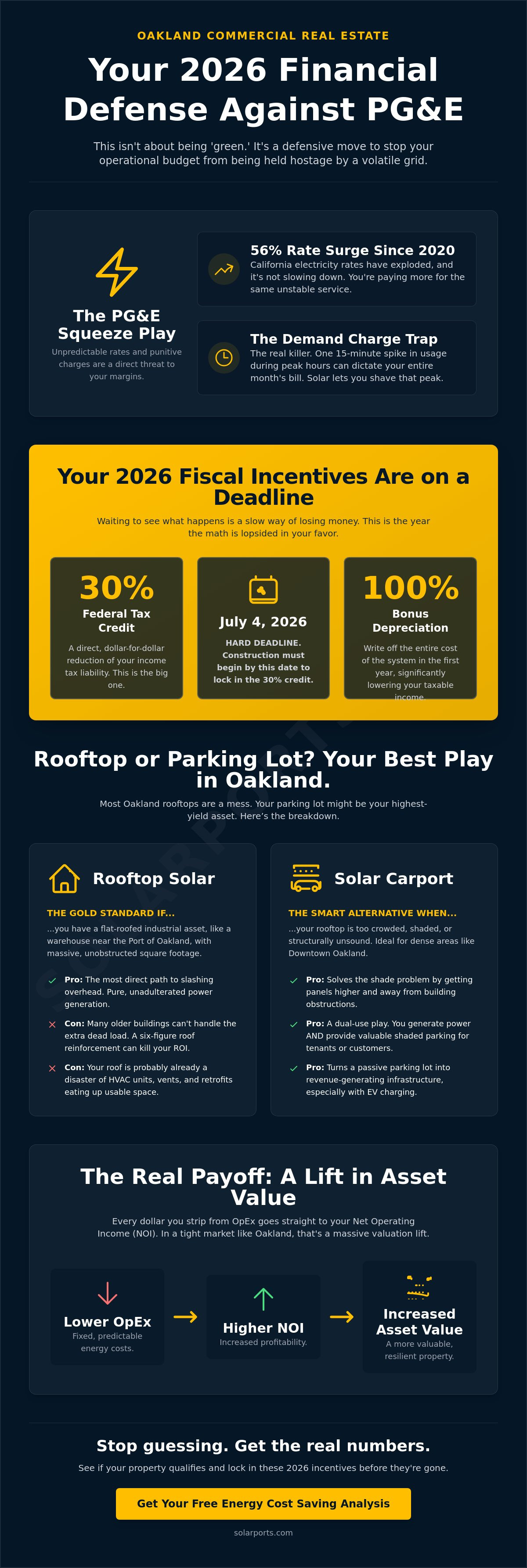
PG&E isn't just expensive. It’s a direct threat to your operating margins. Since 2020, California electricity rates have surged 56%, and Oakland businesses are feeling the brunt of a grid that feels increasingly unstable and punitive. While PG&E introduced a slight usage rate reduction of about $0.05 to $0.07 per kWh in early 2026, they offset it with higher fixed base charges. It’s a shell game. For anyone managing a warehouse or an office park, the real killer isn't the total kilowatt-hours; it's the demand charge trap. One fifteen-minute spike in usage during a heatwave can dictate your bill for the entire month. Implementing rooftop solar for commercial real estate Oakland isn't about being "green" anymore. It’s about installing a fixed-cost hedge that keeps your overhead predictable while the utility company scrambles to cover its own liabilities.
Localized energy generation transforms your property into a self-sustaining financial fortress, insulating your bottom line from the systemic inefficiencies and rising costs of the regional power grid.
Decoding the 2026 Commercial Rate Hikes
The current rate structure is designed to squeeze Oakland’s industrial and office sectors right where it hurts: peak hours. Even with the $24 monthly base charge, the time-of-use tiers make afternoon operations a financial liability. You don't just need energy savings; you need peak-shaving. By using a rooftop solar power system to handle those mid-day surges, you effectively lower the ceiling on your demand charges. It’s a surgical strike against the most expensive parts of your utility bill.
The Asset Value Argument
Every dollar you strip away from OpEx goes straight into your Net Operating Income (NOI). In a market like Oakland, where cap rates are tight, that's a massive valuation lift. 2026 is the hard cutoff. If you don't begin construction by July 4, 2026, you're leaving that 30% federal tax credit on the table. Waiting to see what happens with the grid is just a slow way of losing money. Between the property tax exclusion and the 100% federal bonus depreciation available this year, the math for rooftop solar for commercial real estate Oakland has never been more lopsided in favor of the owner.
Rooftop vs. Carport: Selecting the Right Architecture for Oakland Lots
Oakland is dense. Most rooftops are a total disaster of old vents, outdated HVAC units, and seismic retrofits that eat up every square inch of usable space. If you're looking at rooftop solar for commercial real estate Oakland, you're probably realizing that your roof isn't exactly a blank canvas. It's a logistical puzzle. You have to consider the structural dead load first. Many older warehouses in East Oakland weren't built for an extra few tons of glass and aluminum. A six-figure roof reinforcement can kill your ROI before you even flip the switch. It's often smarter to look at where the sun actually hits without obstruction.
Then there's the California "Z-curve." We produce so much solar during the day that the value drops, then spikes when everyone goes home. This is why we push for a Battery Energy Storage System (BESS). You need to capture that mid-day generation and deploy it when PG&E’s rates are at their most predatory. Following the California Solar Permitting Guidebook standards helps, but the actual physical placement of these units is what determines your long-term yield. You need a system that works with your lot, not against it.
When Rooftop Solar Makes Sense
Flat-roofed industrial assets near the Port of Oakland are the gold standard for this. You have massive square footage and usually fewer shading issues from neighboring high-rises. It's about pure, unadulterated generation. If your structure is sound, rooftop solar for commercial real estate Oakland is the most direct path to slashing your monthly overhead. You can get a commercial property energy cost saving analysis to see if your current roof can actually handle the numbers.
The Solar Carport Alternative
Downtown Oakland is a different beast. Buildings are taller. Shadows are longer. If your rooftop is too crowded or shaded, your parking lot is your best asset. A solar carport solves the shade problem by getting the panels higher and away from building obstructions. It’s a dual-use play. You generate power and provide shaded parking. This is especially true if you're looking at a commercial solar carport with EV charging California, which turns a passive parking lot into a revenue-generating piece of infrastructure.
Navigating the Oakland Permit Maze and 2026 ROI
Oakland’s permit desk is where good intentions go to die if you aren't prepared for the human element. The city website makes a big deal out of SolarAPP+, but that’s a red herring for commercial property owners. If you're planning rooftop solar for commercial real estate Oakland, you're still dealing with the traditional online permit center and a reviewer who might have a very specific opinion on your conduit runs. It’s a grind. If you don't accurately map out the commercial solar installation timeline, you risk missing the construction start dates required for federal incentives. It’s not just about the engineering; it’s about managing the bureaucracy before the clock runs out.
The "Thinking Fix" for Permitting
You need a local partner who knows the Oakland Planning & Building department. It’s non-negotiable. There are traps here that don't exist in other cities, like the hyper-specific recycling plan requirements that can stall a project for weeks if your paperwork isn't perfect. We’ve seen projects sit in "pending" status because of minor building permit discrepancies that a local expert would have caught in ten minutes. It’s about knowing which buttons to push and which reviewers need what information to keep the process moving toward interconnection.
The Bottom Line: 2026 ROI Projections
The financial math for 2026 is brutally clear. Between the 30% hit from the 2026 commercial solar tax credit California and the 100% bonus depreciation, the net cost of these systems is at a historic low. For a typical Oakland office or retail asset, we’re seeing payback periods that make sense even to the most conservative CFO. You have to move from a cost-center mentality to a revenue-generation mindset. Every kilowatt you generate on-site is a kilowatt you aren't buying from PG&E at their inflated 2026 rates. It turns your roof into a predictable, high-yield asset that actually contributes to your bottom line instead of just sitting there leaking heat.
Securing Your 2026 Energy Strategy
The grid isn't going to fix itself. PG&E’s rate structure is a moving target, and for most Oakland owners, the "wait and see" approach has already cost too much. You've got the July 2026 tax credit deadline staring you down and a city permit process that doesn't care about your construction schedule. It's time to stop treating your utility bill as a fixed cost you can't control. Whether you're optimizing a warehouse roof or turning a parking lot into a power plant, the goal is the same: eliminate the demand charge trap and lock in your overhead.
Success with rooftop solar for commercial real estate Oakland requires more than just panels. It takes strategic BESS integration and a partner who knows how to navigate Northern California's specific regulatory mess. We handle the small-scale commercial asset management and turnkey details so you don't have to become an amateur electrician. It's a pragmatic shift from being a utility customer to being an energy producer. Request a Data-Driven Energy Cost Saving Analysis today. Let's get your property’s margins back where they belong.
Oakland Commercial Solar: Your Questions Answered
How long does the commercial solar permitting process actually take in Oakland?
Expect the permitting process in Oakland to take several months from submission to approval. While residential projects might move faster, the city’s Planning & Building Department subjects commercial assets to a manual desk review that is notoriously slow. You aren't just waiting on a rubber stamp; you're waiting for a reviewer to walk through your specific electrical and structural plans. If you want to hit the July 2026 construction deadline for federal credits, you need your application in the system by the start of the year.
Is my Oakland commercial roof strong enough for a solar installation?
You won't have a definitive answer until a structural engineer performs a dead load analysis on your specific building. Many older industrial spaces in East Oakland or near the Port weren't built with the surplus capacity to hold tons of racking and glass. If your roof is already at its limit, the cost of reinforcement can be a dealbreaker. This is exactly why we often look at solar carports as a workaround. They bypass the structural risks of an aging roof while still delivering the same energy hedge.
Can I combine rooftop solar with EV charging stations for my tenants?
Yes, and it’s becoming a requirement for staying competitive in the Oakland market. Integrating rooftop solar for commercial real estate Oakland with EV charging infrastructure allows you to offset the massive spikes in power demand that chargers create. Without on-site generation, those chargers will trigger exorbitant peak-demand charges from PG&E. Using your roof to "fuel" the building's charging stations keeps your utility costs predictable and makes your property far more valuable to high-quality tenants who are transitioning to electric fleets.
What is the difference between SolarAPP+ and standard commercial permits in Oakland?
SolarAPP+ is an automated, expedited system, but it is strictly for residential projects. Commercial real estate owners in Oakland are required to use the standard online permit center, which involves a much more rigorous and manual review process. You'll be paying permit fees that generally range between $150 and $500, but the real cost is the time spent in the queue. Don't let anyone tell you there's a shortcut for commercial solar; it requires a local partner who knows how to navigate the city's specific documentation demands.
Frequently asked questions
How long does the commercial solar permitting process actually take in Oakland?
Expect the permitting process in Oakland to take several months from submission to approval. While residential projects might move faster, the city’s Planning & Building Department subjects commercial assets to a manual desk review that is notoriously slow. You aren't just waiting on a rubber stamp; you're waiting for a reviewer to walk through your specific electrical and structural plans. If you want to hit the July 2026 construction deadline for federal credits, you need your application in the system by the start of the year.
Is my Oakland commercial roof strong enough for a solar installation?
You won't have a definitive answer until a structural engineer performs a dead load analysis on your specific building. Many older industrial spaces in East Oakland or near the Port weren't built with the surplus capacity to hold tons of racking and glass. If your roof is already at its limit, the cost of reinforcement can be a dealbreaker. This is exactly why we often look at solar carports as a workaround. They bypass the structural risks of an aging roof while still delivering the same energy hedge.
Can I combine rooftop solar with EV charging stations for my tenants?
Yes, and it’s becoming a requirement for staying competitive in the Oakland market. Integrating rooftop solar for commercial real estate Oakland with EV charging infrastructure allows you to offset the massive spikes in power demand that chargers create. Without on-site generation, those chargers will trigger exorbitant peak-demand charges from PG&E. Using your roof to "fuel" the building's charging stations keeps your utility costs predictable and makes your property far more valuable to high-quality tenants who are transitioning to electric fleets.
What is the difference between SolarAPP+ and standard commercial permits in Oakland?
SolarAPP+ is an automated, expedited system, but it is strictly for residential projects. Commercial real estate owners in Oakland are required to use the standard online permit center, which involves a much more rigorous and manual review process. You'll be paying permit fees that generally range between $150 and $500, but the real cost is the time spent in the queue. Don't let anyone tell you there's a shortcut for commercial solar; it requires a local partner who knows how to navigate the city's specific documentation demands.