
Questions to Ask a Commercial Solar Installer in CA: A No-Nonsense 2026 Checklist

Most commercial solar proposals in California are just spreadsheets full of optimistic math and shiny hardware specs. You aren't just buying panels; you're looking for a defensive strategy against PG&E, SCE, and SDG&E rates that now regularly exceed $0.26 per kWh. It's a high-stakes decision. One permitting delay or a poorly sized battery system can kill your ROI. This guide provides the exact questions to ask a commercial solar installer CA so you can vet their expertise before signing a contract.
We'll help you move past the marketing fluff and focus on the technical realities of the 2026 tax credit deadlines and BESS integration. You'll learn how to identify a partner who prioritizes your long-term fiscal health over a quick sale. We're breaking down the logistics of solar carports, local permitting hurdles, and the analytical depth required to make a project actually pay for itself.
Key Takeaways
- ROI isn't a guess. You'll learn why a property-specific energy cost saving analysis is the only way to verify financial impact before committing capital.
- Permitting is a bottleneck. We show you how to vet an installer's project management and their specific experience with California's local AHJ requirements.
- Hardware is only half the battle. Use these questions to ask a commercial solar installer CA to ensure your system is optimized for BESS and demand charge mitigation.
- Parking lots are untapped assets. Discover how to integrate solar carports with EV charging to turn a cost center into a high-yield energy generator.
Table of Contents
- Vetting the Strategy: Questions About Commercial Energy Analysis
- Operational Reality: Questions About CA Project Management
- Future-Proofing: Questions About BESS and Carport Integration
Vetting the Strategy: Questions About Commercial Energy Analysis
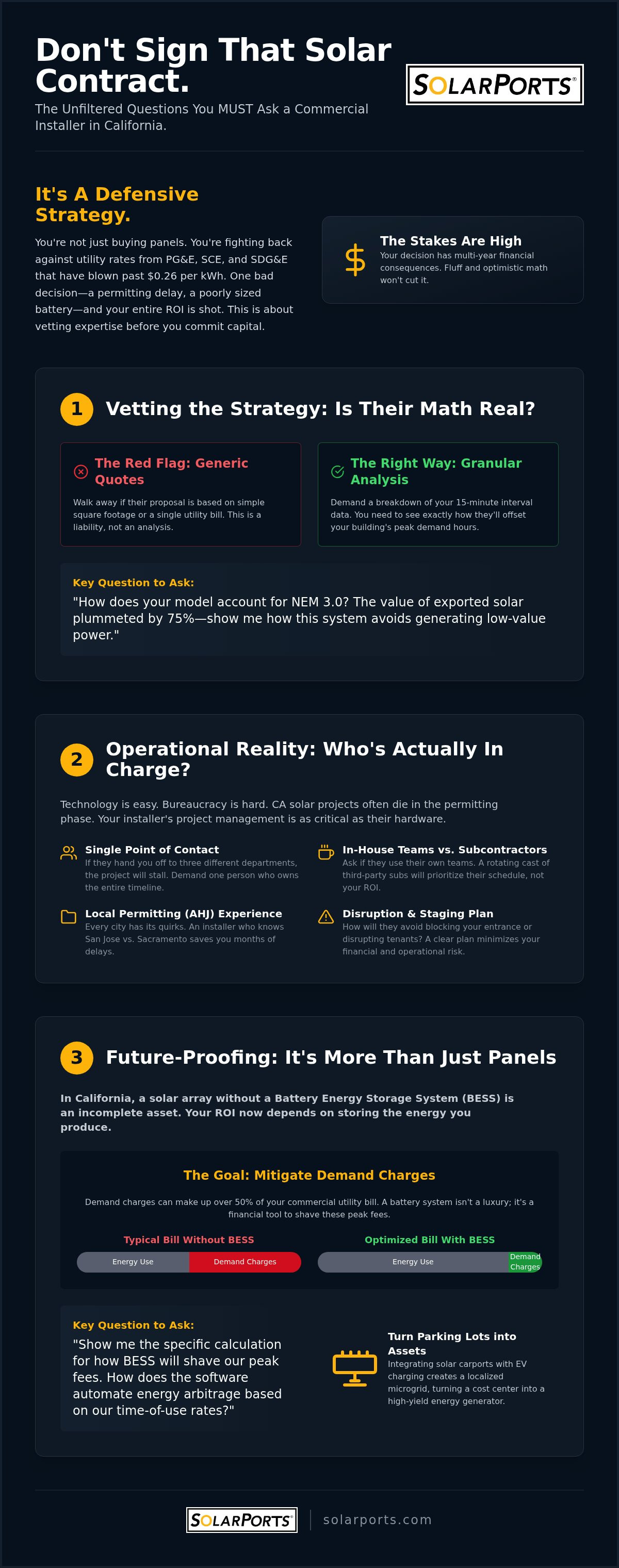
Generic estimates are a liability. If an installer hands you a quote based on square footage or a single utility bill, walk away. You need a granular commercial energy cost saving analysis that looks at 15-minute interval data. One of the most critical questions to ask a commercial solar installer CA is how they account for your specific building's peak demand hours. Solar panels don't just generate power; they need to shave the peaks off your demand charges. If your operations run heavy in the late afternoon when PG&E or SCE rates spike, a standard rooftop layout won't save you. You need to see a breakdown of how the proposed system offsets current utility rate structures, specifically targeting the hours that cost you the most.
How do you account for California's shifting rate structures?
Utility pricing is a moving target. You must ask if the proposal includes a multi-year forecast of rate increases derived from actual CPUC filings and historical trends. Since the "One Big Beautiful Bill Act" of 2025 and the shift to NEM 3.0, the value of exported solar energy has plummeted by approximately 75%, making the "sell back to the grid" model largely obsolete. Your installer needs to demonstrate how they've adjusted their modeling to account for these lower export credits. Precise rate-structure knowledge prevents over-sizing a system that generates low-value excess power you cannot use or sell profitably.
A true partner looks at your load profile first. They should be able to explain how your energy consumption aligns with solar production curves. If they can't show you exactly where the savings come from on a Tuesday in August versus a Tuesday in December, they haven't done the work. Demand charge mitigation is the goal, not just panel count.
Operational Reality: Questions About CA Project Management
CA solar projects often die in the permitting phase. It isn't just about the technology; it's about the bureaucracy. Your list of questions to ask a commercial solar installer CA must start with the chain of command. You need a single point of contact who owns the entire installation timeline from interconnection to final sign-off. If they hand you off to three different departments, your project will stall. Ask specifically how they navigate local AHJ (Authority Having Jurisdiction) permitting in Northern California. Every municipality has its own quirks. A team that knows the specific requirements in San Jose versus Sacramento can save you months of back-and-forth. This is the commercial solar project management CA experience you should demand. Vetting these questions to ask a commercial solar installer CA reveals whether they are a true partner or just another vendor.
Who actually owns the project timeline and permitting?
Ask for examples of recent turnkey projects completed in similar jurisdictions. You want to know if they use in-house teams or rely entirely on a rotating cast of third-party subcontractors. Subcontractors often prioritize their own schedules over your ROI. You also need a specific plan to minimize disruption to tenants or parking during construction. Construction is loud and intrusive. If your parking lot is torn up for weeks without a clear phase-in plan, you'll lose more in tenant goodwill than you save in energy. Ask about their staging strategy. Will they block your main entrance? How do they manage safety for your employees while heavy equipment is on site? These aren't just logistical details; they are financial risks. You can schedule a project strategy review to see how a structured timeline protects your operational continuity.
Future-Proofing: Questions About BESS and Carport Integration
Hardware is easy to buy, but strategy is hard to build. In the current California market, a solar array without storage is essentially an incomplete asset. One of the most important questions to ask a commercial solar installer CA is whether the proposed system is truly 'storage-ready' or if it includes a commercial BESS installation California from day one. Under NEM 3.0, your ROI depends on your ability to hold onto the energy you produce rather than dumping it back into the grid for pennies. Carports add another layer of complexity. You need to know how the installer integrates solar carports with your existing EV charging infrastructure. It isn't just about shade; it's about creating a localized microgrid that can power vehicles without blowing your transformer's capacity.
Is this system built to mitigate demand charges or just generate power?
Demand charges often make up 50% of a commercial utility bill. Ask for a specific calculation showing how battery storage will shave those peak fees. If the installer can't model your specific load spikes and show how the BESS software automates energy arbitrage based on time-of-use rates, they're just selling you glass and aluminum. You also need to address maintenance. Commercial carport systems require different structural inspections and lighting maintenance compared to standard rooftop solar. Carports are high-visibility public assets, so the stakes for uptime and aesthetics are significantly higher. Don't let an installer gloss over the long-term operational costs of these structures just to get the deal signed.
Secure Your Energy Independence Before the 2026 Deadlines
California's energy market is currently too volatile for guesswork. You need an installer who treats your property like a strategic financial asset, not just a construction site. By prioritizing these questions to ask a commercial solar installer CA, you've already filtered out the vendors who don't understand the nuances of NEM 3.0 or the friction of local AHJ permitting. Real ROI in 2026 requires more than just panels; it demands aggressive demand charge mitigation and seamless BESS integration.
We specialize exclusively in the California commercial sector, providing turnkey expertise in solar carports and storage. Our methodology is rooted in a data-driven ROI focus that eliminates waste and maximizes long-term asset value. Stop overpaying for utility spikes and start controlling your operational costs. Request your commercial energy cost saving analysis from SolarPorts Development today to see exactly how your property can perform. It's time to build a system that actually delivers.
Frequently Asked Questions
What is the most important question to ask a commercial solar installer in California?
Ask for a property-specific energy cost saving analysis based on 15-minute interval data. Don't settle for a quote based on a single monthly bill. You need to know how the system interacts with your specific peak demand charges. If they can't show you a load profile match, they aren't modeling your actual savings. This analysis is the primary foundation for your project's ROI.
How do I know if an installer is qualified for small-scale commercial projects?
Look for a portfolio that specifically mirrors your property type. Small-scale commercial projects have unique structural and interconnection requirements that residential installers often miss. Ask if they handle everything turnkey or if they outsource the engineering. A qualified partner understands the specific electrical codes for commercial buildings and doesn't treat your warehouse like a large house.
Should I ask about battery storage even if I only want rooftop solar?
Yes, because rooftop solar alone often fails the ROI test under current export rates. You should include storage in your list of questions to ask a commercial solar installer CA to avoid building a stranded asset. Batteries allow you to capture energy during the day and use it when utility rates peak in the evening. Without BESS, you're just exporting cheap power.
How can I verify an installer's track record with California utility companies?
Ask for proof of Permission to Operate (PTO) letters from projects with PG&E, SCE, or SDG&E within the last twelve months. Interconnection is often the most difficult part of any California project. If an installer has a history of delays with these utilities, your project will sit idle for months. Verifying recent success with utility-specific paperwork is absolutely non-negotiable.
Frequently asked questions
How do you account for California's shifting rate structures?
Utility pricing is a moving target. You must ask if the proposal includes a multi-year forecast of rate increases derived from actual CPUC filings and historical trends. Since the "One Big Beautiful Bill Act" of 2025 and the shift to NEM 3.0, the value of exported solar energy has plummeted by approximately 75%, making the "sell back to the grid" model largely obsolete. Your installer needs to demonstrate how they've adjusted their modeling to account for these lower export credits. Precise rate-structure knowledge prevents over-sizing a system that generates low-value excess power you cannot use or sell profitably. A true partner looks at your load profile first. They should be able to explain how your energy consumption aligns with solar production curves. If they can't show you exactly where the savings come from on a Tuesday in August versus a Tuesday in December, they haven't done the work. Demand charge mitigation is the goal, not just panel count. CA solar projects often die in the permitting phase. It isn't just about the technology; it's about the bureaucracy. Your list of questions to ask a commercial solar installer CA must start with the chain of command. You need a single point of contact who owns the entire installation timeline from interconnection to final sign-off. If they hand you off to three different departments, your project will stall. Ask specifically how they navigate local AHJ (Authority Having Jurisdiction) permitting in Northern California. Every municipality has its own quirks. A team that knows the specific requirements in San Jose versus Sacramento can save you months of back-and-forth. This is the commercial solar project management CA experience you should demand. Vetting these questions to ask a commercial solar installer CA reveals whether they are a true partner or just another vendor.
Who actually owns the project timeline and permitting?
Ask for examples of recent turnkey projects completed in similar jurisdictions. You want to know if they use in-house teams or rely entirely on a rotating cast of third-party subcontractors. Subcontractors often prioritize their own schedules over your ROI. You also need a specific plan to minimize disruption to tenants or parking during construction. Construction is loud and intrusive. If your parking lot is torn up for weeks without a clear phase-in plan, you'll lose more in tenant goodwill than you save in energy. Ask about their staging strategy. Will they block your main entrance? How do they manage safety for your employees while heavy equipment is on site? These aren't just logistical details; they are financial risks. You can schedule a project strategy review to see how a structured timeline protects your operational continuity. Hardware is easy to buy, but strategy is hard to build. In the current California market, a solar array without storage is essentially an incomplete asset. One of the most important questions to ask a commercial solar installer CA is whether the proposed system is truly 'storage-ready' or if it includes a commercial BESS installation California from day one. Under NEM 3.0, your ROI depends on your ability to hold onto the energy you produce rather than dumping it back into the grid for pennies. Carports add another layer of complexity. You need to know how the installer integrates solar carports with your existing EV charging infrastructure. It isn't just about shade; it's about creating a localized microgrid that can power vehicles without blowing your transformer's capacity.
Is this system built to mitigate demand charges or just generate power?
Demand charges often make up 50% of a commercial utility bill. Ask for a specific calculation showing how battery storage will shave those peak fees. If the installer can't model your specific load spikes and show how the BESS software automates energy arbitrage based on time-of-use rates, they're just selling you glass and aluminum. You also need to address maintenance. Commercial carport systems require different structural inspections and lighting maintenance compared to standard rooftop solar. Carports are high-visibility public assets, so the stakes for uptime and aesthetics are significantly higher. Don't let an installer gloss over the long-term operational costs of these structures just to get the deal signed. California's energy market is currently too volatile for guesswork. You need an installer who treats your property like a strategic financial asset, not just a construction site. By prioritizing these questions to ask a commercial solar installer CA, you've already filtered out the vendors who don't understand the nuances of NEM 3.0 or the friction of local AHJ permitting. Real ROI in 2026 requires more than just panels; it demands aggressive demand charge mitigation and seamless BESS integration. We specialize exclusively in the California commercial sector, providing turnkey expertise in solar carports and storage. Our methodology is rooted in a data-driven ROI focus that eliminates waste and maximizes long-term asset value. Stop overpaying for utility spikes and start controlling your operational costs. Request your commercial energy cost saving analysis from SolarPorts Development today to see exactly how your property can perform. It's time to build a system that actually delivers.
What is the most important question to ask a commercial solar installer in California?
Ask for a property-specific energy cost saving analysis based on 15-minute interval data. Don't settle for a quote based on a single monthly bill. You need to know how the system interacts with your specific peak demand charges. If they can't show you a load profile match, they aren't modeling your actual savings. This analysis is the primary foundation for your project's ROI.
How do I know if an installer is qualified for small-scale commercial projects?
Look for a portfolio that specifically mirrors your property type. Small-scale commercial projects have unique structural and interconnection requirements that residential installers often miss. Ask if they handle everything turnkey or if they outsource the engineering. A qualified partner understands the specific electrical codes for commercial buildings and doesn't treat your warehouse like a large house.
Should I ask about battery storage even if I only want rooftop solar?
Yes, because rooftop solar alone often fails the ROI test under current export rates. You should include storage in your list of questions to ask a commercial solar installer CA to avoid building a stranded asset. Batteries allow you to capture energy during the day and use it when utility rates peak in the evening. Without BESS, you're just exporting cheap power.
How can I verify an installer's track record with California utility companies?
Ask for proof of Permission to Operate (PTO) letters from projects with PG&E, SCE, or SDG&E within the last twelve months. Interconnection is often the most difficult part of any California project. If an installer has a history of delays with these utilities, your project will sit idle for months. Verifying recent success with utility-specific paperwork is absolutely non-negotiable.