
Avoiding Commercial Solar Installation Mistakes: A 2026 California Strategic Guide

The most expensive mistake you can make with California solar isn't picking the wrong panels; it's a failure of data. In 2026, building for energy production instead of bill reduction is how you end up with a stranded asset. You're probably already stressed about PG&E's peak-demand charges or the permitting delays that can leave a project sitting idle for months. It's a rational fear. This guide is about avoiding commercial solar installation mistakes by shifting the focus from engineering to fiscal optimization. We're going to break down how to right-size your system under NEM 3.0 and why battery storage is no longer optional for your bottom line. It's about getting a turnkey solution that works without distracting you from your actual job.
Key Takeaways
- Designing for maximum export is a legacy move that kills ROI. Focus on self-consumption and battery storage to actually beat PG&E's peak rates.
- You'll only succeed in avoiding commercial solar installation mistakes if you account for "soft costs" like permitting and engineering, which often exceed 30% of the total investment.
- Stop forcing solar onto an old roof. Carport systems are often the better play because they protect tenant vehicles while generating power without risking your building's structural integrity.
- Low bids usually lead to massive change orders and interconnection delays. Vet your partner for specific Northern California expertise to keep the project from derailing your core operations.
Table of Contents
- The Financial Trap: Why "Bigger" Isn’t Better for California Commercial Solar
- The Operational Gauntlet: Permitting and Infrastructure Pitfalls
- The Strategy Shift: Vetting for Turnkey Execution
The Financial Trap: Why "Bigger" Isn’t Better for California Commercial Solar
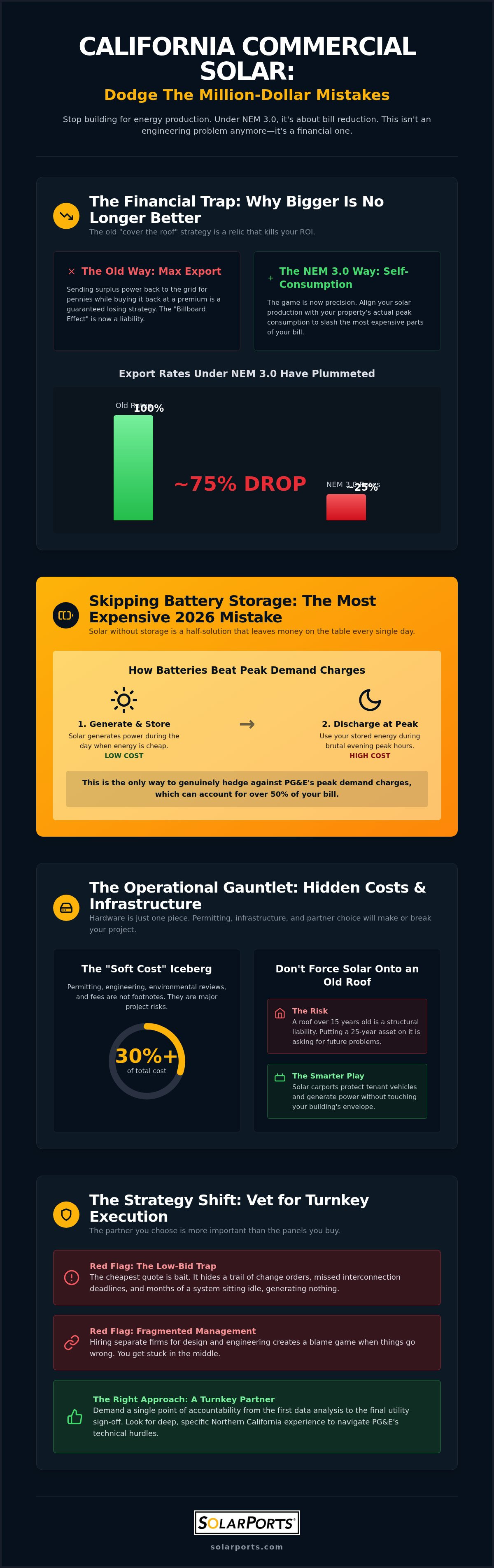
The "bigger is better" mentality is a relic. If you're still chasing the "Billboard Effect" by covering every square inch of your roof just to show off a massive array, you're likely sabotaging your ROI. Under NEM 3.0, California's export rates for surplus energy plummeted by roughly 75%. Sending power back to the grid for pennies while buying it back at a premium is a losing strategy. A core part of avoiding commercial solar installation mistakes is realizing that commercial solar photovoltaic systems are now about precision, not volume.
Solar alone won't solve your highest utility expenses. High peak-demand charges from utilities like PG&E can account for half your bill; standard solar production often misses these spikes. Ignoring these demand charges leads to systems that look productive but do little to lower the actual dollar amount on your statement. Right-sizing is the alignment of solar production with peak property consumption.
The Critical Role of Commercial Energy Cost Saving Analysis
You can't buy hardware based on a guess. We start with a commercial energy cost saving analysis that pulls historical 15-minute interval data. This granular look at how your building actually breathes is the only way to predict how solar will interact with your specific rate schedule. Without this data-driven foundation, you fall into the "over-promise" trap where a commercial solar ROI analysis looks great on paper but fails to materialize on your balance sheet. Precision prevents waste.
The Operational Gauntlet: Permitting and Infrastructure Pitfalls
Permitting and interconnection aren't just administrative boxes to check; they're the variables that frequently sink commercial budgets. In California, these "soft costs"—encompassing engineering, environmental reviews, and local AHJ fees—can easily climb past 30% of your total project investment. You're avoiding commercial solar installation mistakes by accounting for these logistical hurdles during the initial feasibility phase. It's also a mistake to force a rooftop array onto a structural system that's nearing the end of its life. If your roof is over 15 years old, you're better off considering solar carport systems that provide shade while generating power without risking your building's envelope.
Vetting your installer against the SEIA Solar Business Code is a smart way to ensure your partner follows ethical engineering standards. You need a system that's ready for what's coming next, like high-speed EV charging or expanded storage capacity as your operations scale. Building a system that can't grow with your property's load profile is just creating a future bottleneck.
Skipping BESS: The Most Expensive 2026 Mistake
Under current California utility rules, solar without storage is essentially a half-solution. You'll generate power when it's cheap and pay for it when it's expensive because you can't hold onto your own electrons. Integrating battery energy storage for commercial buildings is the only way to genuinely hedge against those brutal evening demand charges. Don't let a vendor gloss over the technical choice between AC-coupled and DC-coupled systems. Choosing the wrong one can lead to unnecessary conversion losses that eat into your daily savings. If you're ready to look at how these infrastructure pieces fit your specific site, request a data-driven site assessment to see the numbers for yourself.
The Strategy Shift: Vetting for Turnkey Execution
Low bids are bait. In the high-stakes world of avoiding commercial solar installation mistakes, the cheapest quote usually hides a trail of change orders and missed interconnection deadlines. If a contractor lacks specific Northern California experience, they will inevitably underestimate PG&E’s technical requirements. This results in a project that sits "behind the meter" for months without generating a cent of savings. Fragmented management is another silent killer. Hiring separate entities for design and engineering creates a blame game when things go wrong; choosing a turnkey commercial solar CA partner ensures a single point of accountability from the first cost analysis to the final utility sign-off.
Building Your Commercial Solar Checklist
Don't treat solar as a one-time transaction. It's a 25-year financial asset that requires long-term O&M (Operations and Maintenance) to maintain peak uptime. When vetting partners, look at their recent commercial projects in California and ask these specific questions:
- Does your commercial solar installation timeline account for the 15 to 90 business days utility interconnection typically adds?
- How do you handle the automated permitting platforms required by California law?
- Is the O&M support handled in-house or outsourced to a third party?
Precision in the vetting stage is the difference between an asset that performs and a liability that drains your focus. A partner who understands the local grid is an investment in your property's structural and fiscal integrity.
Securing Your Property’s Energy Independence
The era of guesswork in California energy is over. Success in 2026 requires shifting from a "more is better" hardware mindset to a strategy rooted in fiscal optimization. You're avoiding commercial solar installation mistakes by prioritizing self-consumption over grid exports and ensuring your infrastructure is ready for the BESS and EV charging demands of the next decade. It's about finding a partner who understands the granular nuances of PG&E's rate schedules and Northern California's specific permitting gauntlet. We focus on small-scale commercial real estate with data-driven ROI modeling that validates your investment before any construction begins.
If you're ready to see the real numbers behind your property’s potential, Request your Commercial Energy Cost Saving Analysis from SolarPorts Development. Let's build a system that actually protects your bottom line.
Frequently Asked Questions
What is the most common mistake in California commercial solar projects?
The most frequent error is oversizing the system without analyzing the property's actual load profile. Many owners still follow legacy logic that more panels always lead to more savings, but under NEM 3.0, that is just a recipe for a low-return asset. You're avoiding commercial solar installation mistakes by focusing on self-consumption and matching production to your highest utility rate periods.
How does NEM 3.0 change how businesses should plan their solar installation?
NEM 3.0 slashed export credits by roughly 75%, which fundamentally breaks the old model of selling excess power back to the grid. Planning now requires a strategic focus on energy storage to capture daytime production for use during expensive evening peak hours. You need a data-driven analysis of your 15-minute interval data to ensure the system is sized to your building's specific breathing patterns.
Can I install a commercial solar system without a battery in 2026?
You can, but it's rarely the most profitable choice for California properties anymore. Without a battery, you can't effectively mitigate the high demand charges that utilities like PG&E levy during peak times. A standalone system leaves you exposed to future rate hikes and low export values. Most modern projects now treat storage as a core component of the fiscal strategy rather than an optional add-on.
What happens if my commercial roof is too old for solar panels?
Don't force an array onto a structural system that's nearing the end of its life cycle. If your roof is over 15 years old, the cost of removing and reinstalling panels for a future roof replacement will destroy your ROI. Solar carports offer a superior alternative, providing vehicle shade for tenants while generating power on an independent structural foundation that won't compromise your building envelope.
Frequently asked questions
What is the most common mistake in California commercial solar projects?
The most frequent error is oversizing the system without analyzing the property's actual load profile. Many owners still follow legacy logic that more panels always lead to more savings, but under NEM 3.0, that is just a recipe for a low-return asset. You're avoiding commercial solar installation mistakes by focusing on self-consumption and matching production to your highest utility rate periods.
How does NEM 3.0 change how businesses should plan their solar installation?
NEM 3.0 slashed export credits by roughly 75%, which fundamentally breaks the old model of selling excess power back to the grid. Planning now requires a strategic focus on energy storage to capture daytime production for use during expensive evening peak hours. You need a data-driven analysis of your 15-minute interval data to ensure the system is sized to your building's specific breathing patterns.
Can I install a commercial solar system without a battery in 2026?
You can, but it's rarely the most profitable choice for California properties anymore. Without a battery, you can't effectively mitigate the high demand charges that utilities like PG&E levy during peak times. A standalone system leaves you exposed to future rate hikes and low export values. Most modern projects now treat storage as a core component of the fiscal strategy rather than an optional add-on.
What happens if my commercial roof is too old for solar panels?
Don't force an array onto a structural system that's nearing the end of its life cycle. If your roof is over 15 years old, the cost of removing and reinstalling panels for a future roof replacement will destroy your ROI. Solar carports offer a superior alternative, providing vehicle shade for tenants while generating power on an independent structural foundation that won't compromise your building envelope.