
Commercial Energy Audit California: Stop Guessing and Start Optimizing Your Bottom Line

Your utility bill isn't just a monthly expense; it's a ransom note that gets more expensive the less you understand it. Most California property owners are tired of staring at peak-demand charges that seem to punish business growth rather than actual consumption. You know the state mandates are coming, but throwing money at random "green" upgrades without a clear ROI feels like a gamble you can't afford. A strategic commercial energy audit California changes that dynamic entirely. It stops the guessing game by performing a financial autopsy on your facility's power usage.
We aren't talking about a simple walkthrough or a basic checklist. This analysis uncovers the specific utility waste and demand spikes bleeding your property dry. You'll get a data-backed justification for high-impact assets like BESS or solar carports that actually move the needle. This article breaks down how to turn those confusing billing structures into a roadmap for energy independence and long-term fiscal control.
Key Takeaways
- Stop looking at total consumption and start looking at peak demand. You'll learn why California's utility structures punish how you use power more than how much you use.
- A legitimate commercial energy audit California needs two years of interval data to actually mean something. If you're looking at a single monthly bill, you're missing the structural waste that's bleeding your bottom line.
- Data is just noise unless it leads to a buildable project. We'll explain how analysis translates into the specific ROI for solar carports and BESS that makes financial sense for your property.
- Compliance is a low bar; strategic cost-saving is the goal. Find out how to turn mandated reporting into a financial blueprint that pays for itself through eliminated utility waste.
Table of Contents
- Beyond Compliance: Why Most California Commercial Energy Audits Miss the Real Savings
- The SolarPorts Methodology: How We Analyze Your Commercial Energy Profile
- Executing on the Audit: Turning Data into Battery and Solar Carport ROI
Beyond Compliance: Why Most California Commercial Energy Audits Miss the Real Savings
Let’s be honest. Most people treat an Energy audit like a mandatory tax filing. You do it because a local ordinance says you have to, or because you want a "Green" sticker for the lobby. That’s a compliance audit, and it’s usually a waste of time. It focuses on consumption (kWh) when the real predator on your balance sheet is demand (kW). With rates from major utilities like PG&E and SCE frequently exceeding $0.18 to $0.26 per kWh, a commercial energy audit California should be a strategic cost-saving analysis, not a clerical exercise.
Stop obsessing over LED lightbulbs. They’re a distraction. While you’re counting bulbs, your HVAC and industrial refrigeration cycles are bleeding your budget dry. These systems don’t just consume power; they surge. If your audit doesn’t account for how these heavy loads interact with your utility’s specific tariff structure, you’re leaving the biggest savings on the table. You need a partner who looks at the services that actually impact your bottom line.
The Peak Demand Trap: Why Efficiency Is Not Enough
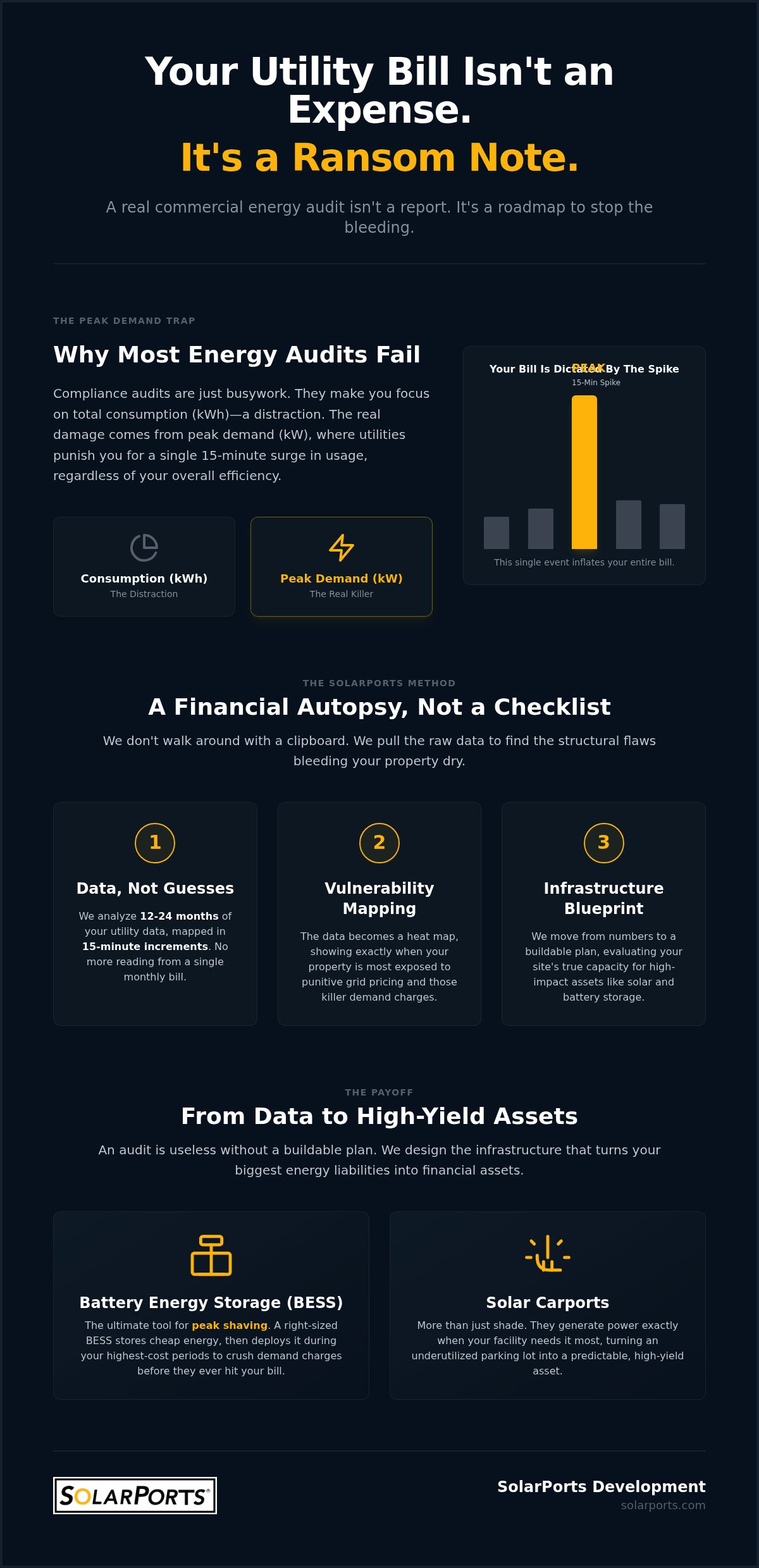
Efficiency measures how much you use, but your bill is determined by when you use it. California utilities typically calculate demand charges based on your highest 15-minute window of usage. You can own a high-efficiency building and still face astronomical bills if your load spikes at the wrong time. A building can be 'efficient' by the book but still have a broken utility profile because of these spikes. Load shifting is the primary objective of a modern audit. We aren’t just looking to reduce consumption; we’re looking to move that load to avoid the punitive rates that ignore your total consumption in favor of a single peak.
The SolarPorts Methodology: How We Analyze Your Commercial Energy Profile
A proper commercial energy audit California doesn't start with a clipboard; it starts with your utility's interval data. We pull 12 to 24 months of usage, mapped in 15-minute increments. This isn't just a summary of what you paid. It’s a heat map showing exactly when your property is most vulnerable to the grid. Looking at a single month's bill is like trying to guess the plot of a movie from a single frame; you're missing the context of seasonal shifts and peak-demand spikes.
While California's Building Energy Benchmarking Program mandates reporting for buildings over 50,000 square feet, our analysis is built for the owner's benefit, not just the state's. We identify "low-hanging fruit" like schedule adjustments, but we focus on structural issues that only infrastructure can solve. This includes evaluating parking lot orientation for solar carports and verifying rooftop structural integrity to ensure your site can actually support a long-term generation asset.
Data-Driven Insights: Moving from Utility Bills to Infrastructure Blueprints
Raw data is only useful if it leads to a right-sized Battery Energy Storage System (BESS) recommendation. We model your ROI by projecting inevitable utility rate hikes against the fixed cost of solar production. It’s about creating a predictable financial future in a state where grid pricing is anything but stable. For a deeper dive into how these numbers play out over a decade, see our Commercial Solar ROI Analysis. If you're ready to see how a commercial energy audit California identifies savings for your specific Northern California rate structure, schedule a brief data review with our team.
Executing on the Audit: Turning Data into Battery and Solar Carport ROI
An audit is just a stack of paper if you don't have a plan to act on it. Most consulting firms hand you a report and walk away, leaving you in a state of "analysis paralysis." That’s a poor use of capital. We use the commercial energy audit California data to design actual infrastructure. We look at your peak usage times to engineer solar carports that do more than just provide shade. These structures integrate specific strategies to lower commercial electricity bills by generating power exactly when your facility needs it most, turning your parking lot into a high-yield asset.
Peak shaving is where the real money is saved. The audit might show a massive spike every Tuesday afternoon when your cooling systems or machinery kick into high gear. A Battery Energy Storage System (BESS) is designed to "shave" that peak. It discharges stored power to keep your grid draw below the punitive threshold. It’s a surgical strike against your utility bill that provides immediate relief without requiring you to change your daily operations.
Turnkey Implementation in Northern California: From Analysis to Activation
Getting a project built in California is notoriously difficult. Between environmental reviews, local building departments, and utility interconnection queues, the process is a minefield. Our approach to commercial solar project management handles the entire lifecycle from the first data point to final activation. We specialize in Northern California, meaning we know the specific permitting quirks of local jurisdictions and PG&E interconnection requirements. A commercial energy audit California isn't a success until the hardware is commissioned and saving you money. You can see how this data-backed approach translates into real-world results by viewing our completed projects. We don't just find the waste; we build the solution that eliminates it for good.
Secure Your Financial Blueprint for Energy Independence
Stop letting opaque utility bills dictate your operational budget. Compliance is a low bar. The real objective is aggressive cost reduction through peak-demand mitigation. By leveraging 24 months of interval data, we strip away the guesswork and replace it with a definitive financial strategy. A commercial energy audit California is your first step toward structural independence. As turnkey BESS and solar carport experts, we specialize in small-scale commercial properties where precision matters. Our data-driven ROI modeling ensures your investment is backed by logic, not just hope. It's about turning a passive expense into a strategic asset that stabilizes your bottom line for decades. You don't have to navigate the complexity of the California grid alone. Request your Commercial Energy Cost Saving Analysis from SolarPorts today and start building your path to energy autonomy.
Frequently Asked Questions
How much does a commercial energy audit cost in California?
Costs are determined by the complexity of your building systems and the specific depth of the analysis required. A high-level screening is naturally less intensive than a full investment-grade report. Instead of looking for the lowest entry price, focus on the depth of the interval data retrieved. A cheap audit that misses peak-demand charges will cost you significantly more in lost savings than the initial analysis fee.
What is the difference between an ASHRAE Level 1, 2, and 3 audit?
ASHRAE levels represent the technical depth of the energy investigation. Level 1 is a basic walkthrough to identify obvious waste. Level 2 provides a detailed energy survey and financial analysis of potential upgrades. Level 3 is a comprehensive investment-grade audit for major capital projects. Most businesses seeking a commercial energy audit California find that Level 2 offers the best balance of actionable data and clear financial ROI.
Can an energy audit help my business comply with California building mandates?
Yes, a professional analysis is often a legal necessity for compliance with evolving state and local laws. California’s AB 802 requires annual benchmarking for buildings over 50,000 square feet. Major cities like Los Angeles and San Francisco have even stricter local ordinances requiring periodic audits. A strategic commercial energy audit California ensures you meet these deadlines while identifying the specific infrastructure needed to lower your long-term utility burdens.
How long does a commercial energy cost saving analysis typically take?
A comprehensive analysis usually takes between three to six weeks from the moment we receive your raw utility data. The timeline depends heavily on the speed of data acquisition from your utility provider. We typically require 24 months of interval data to model seasonal shifts and peak-demand spikes accurately. Once that data is secured, the technical modeling and infrastructure blueprinting happen quickly to avoid analysis paralysis.
Frequently asked questions
How much does a commercial energy audit cost in California?
Costs are determined by the complexity of your building systems and the specific depth of the analysis required. A high-level screening is naturally less intensive than a full investment-grade report. Instead of looking for the lowest entry price, focus on the depth of the interval data retrieved. A cheap audit that misses peak-demand charges will cost you significantly more in lost savings than the initial analysis fee.
What is the difference between an ASHRAE Level 1, 2, and 3 audit?
ASHRAE levels represent the technical depth of the energy investigation. Level 1 is a basic walkthrough to identify obvious waste. Level 2 provides a detailed energy survey and financial analysis of potential upgrades. Level 3 is a comprehensive investment-grade audit for major capital projects. Most businesses seeking a commercial energy audit California find that Level 2 offers the best balance of actionable data and clear financial ROI.
Can an energy audit help my business comply with California building mandates?
Yes, a professional analysis is often a legal necessity for compliance with evolving state and local laws. California’s AB 802 requires annual benchmarking for buildings over 50,000 square feet. Major cities like Los Angeles and San Francisco have even stricter local ordinances requiring periodic audits. A strategic commercial energy audit California ensures you meet these deadlines while identifying the specific infrastructure needed to lower your long-term utility burdens.
How long does a commercial energy cost saving analysis typically take?
A comprehensive analysis usually takes between three to six weeks from the moment we receive your raw utility data. The timeline depends heavily on the speed of data acquisition from your utility provider. We typically require 24 months of interval data to model seasonal shifts and peak-demand spikes accurately. Once that data is secured, the technical modeling and infrastructure blueprinting happen quickly to avoid analysis paralysis.