
Office Park Solar Carports in Walnut Creek: A 2026 Financial & Strategic Guide

Your parking lot is currently a sun-scorched liability that leaks capital every time the Walnut Creek heat index climbs. It's a familiar headache for property managers who watch PG&E demand charges spike during peak office hours while tenants complain about the "heat island" effect. You're likely feeling the squeeze from rising utility rates and the mounting pressure to provide EV infrastructure. Implementing office park solar carports in Walnut Creek isn't just a sustainability play; it's a strategic financial hedge designed to dismantle those overhead costs once and for all.
This guide breaks down how to transform that underutilized asphalt into a high-yield energy asset. We'll explore the path to a 3.9 year payback period, the critical July 4 federal tax credit deadline, and how to navigate the 2026 PG&E rate shifts without micro-managing the process. You'll see exactly how a turnkey system can slash your LCOE and boost your property's valuation while you focus on your core business. It's about moving from a defensive posture with your utility bill to a position of long-term operational control.
Key Takeaways
- Stop letting PG&E dictate your overhead by deploying office park solar carports in Walnut Creek to crush peak-hour demand charges when rates are highest.
- Use a precise energy cost saving analysis to right-size your system, ensuring you aren't stuck paying for hardware that doesn't align with your actual building load.
- Capitalize on the 30% federal tax credit before the July 2026 deadline to lock in a project with a documented 3.9 year payback period.
- Leverage bifacial panel technology to capture reflected light from the asphalt, maximizing energy yield within your existing parking footprint.
- Adopt a turnkey procurement strategy to bypass the headaches of fragmented contracting and keep your project on a strict financial timeline.
Table of Contents
- The Financial Logic of Walnut Creek Office Park Solar
- Engineering the "Right-Sized" Carport System
- The 2026 Procurement Strategy: Tax Credits and ROI
The Financial Logic of Walnut Creek Office Park Solar
Most Walnut Creek office parks are burning cash on their roofs without realizing the real gold is in the parking lot. Older buildings along the 680 corridor often fail the "pencil test" for rooftop solar because structural reinforcement costs or crowded HVAC footprints make the ROI move backwards. This is why office park solar carports in Walnut Creek have become the strategic standard for 2026. You're taking a flat, heat-absorbing liability and turning it into a high-performance power plant that actually makes sense on a balance sheet.
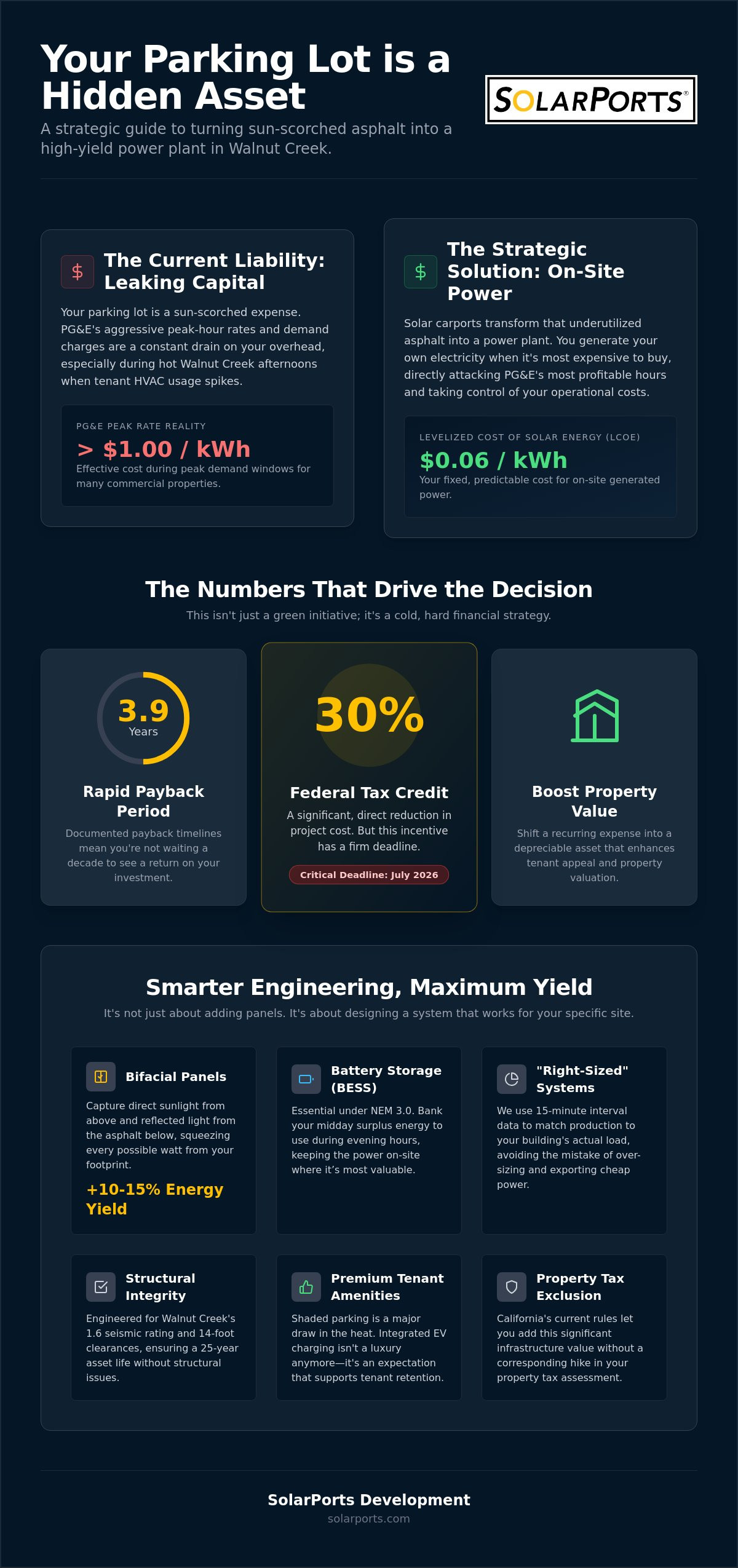
The math is simple but brutal. Between the hours of 9 AM and 5 PM, when your tenants are maxing out the HVAC and lighting, PG&E rates are at their most aggressive. When you factor in demand charges, some local businesses are effectively paying over $1.00 per kWh during those peak windows. By installing solar canopies, you're generating power exactly when it's most expensive to buy. It's a direct hit to the utility's most profitable hours, flipping the script on how you fund your building's operations.
The PG&E Demand Charge Reality
The utility doesn't just charge you for the volume of energy you consume. They penalize you for the "spikes" in your load, and those high-noon energy spikes are typical for office environments. These demand charges can make up a massive chunk of a commercial bill, often catching managers off guard. Generating your own power on-site at a levelized cost of $0.06 per kWh acts as a permanent hedge against these volatile utility fees. You can start with a commercial property energy cost saving analysis to see the exact spread between your current peak spend and what you'd save with on-site generation.
Increasing Asset Value in Contra Costa County
Shifting a recurring operating expense into a depreciable, value-generating asset is a fundamental move for any property owner. Beyond the immediate cash flow, these structures provide shaded parking, which is a massive draw for high-value tenants in the Walnut Creek heat. Shaded spots are a premium amenity that directly supports tenant retention and justifies higher lease rates compared to properties with exposed asphalt. Plus, California's property tax exclusion for solar systems means you're adding significant infrastructure value without a corresponding hike in your tax assessment, provided you act before the current exclusion window shifts at the start of 2027.
Engineering the "Right-Sized" Carport System
Don't build for the sake of building. The most expensive mistake in California solar right now is over-sizing a system that exports too much cheap power back to the grid. To avoid this, we start with a Commercial Energy Cost Saving Analysis. This isn't just a bill review; it’s a deep dive into your 15-minute interval data to find the "sweet spot" where your production meets your actual building demand.
For office park solar carports in Walnut Creek, we prioritize bifacial panels. These modules don't just sit there. They capture direct sunlight on top and reflected irradiance from the asphalt underneath. In a hot, reflective parking lot, that extra 10 to 15% yield can be the difference between a four-year and a five-year payback. It's about squeezing every possible watt out of your existing footprint.
The structure itself needs to be practical, not just efficient. We design for 14-foot minimum clearances to ensure delivery trucks and emergency vehicles don't treat your investment like a clearance obstacle. Since California's Net Energy Metering Program (NEM 3.0) slashed export rates, adding a Battery Energy Storage System (BESS) is no longer optional for high-efficiency sites. It lets you bank that midday surplus for evening security lighting or late-shift operations, keeping your energy on-site where it's worth the most.
Site Assessment and Seismic Rating
Walnut Creek sits in a high-activity zone with a 1.6 seismic rating. You can't just bolt these things down and hope for the best. We evaluate the asphalt integrity and run ground-penetrating radar to map utility lines before a single pier is drilled. It’s about ensuring structural longevity in Contra Costa’s specific soil conditions so the asset lasts 25 years without shifting.
Integrating EV Charging Infrastructure
By 2026, tenants don't ask if you have EV charging; they ask how many stalls are available. Integrating this now prevents expensive retrofits later. You can see how this plays out in our guide on Commercial Solar Carport with EV Charging in California. If you're looking at your own lot and wondering where the piers should go, book a quick site layout consultation to get some real numbers on your specific property.
The 2026 Procurement Strategy: Tax Credits and ROI
The 2026 fiscal calendar is moving faster than most property owners realize. To capture the full 30% federal Investment Tax Credit (ITC), construction on your project must begin by July 4, 2026. Waiting until Q3 or Q4 means risking a significantly lower credit or missing the 100% accelerated depreciation window for the first year of service. For office park solar carports in Walnut Creek, this isn't just a tax break; it's the primary engine that drives your internal rate of return.
You shouldn't be managing a fragmented mess of electrical contractors, steel fabricators, and solar installers. A turnkey approach is the only way to keep a project on schedule and under budget. We handle everything from the initial load study to the final PG&E Permission to Operate (PTO). It typically takes about six to nine months to move from analysis through permitting and construction. You can see how these finished structures look and perform by browsing our Walnut Creek project gallery.
The 3.9-Year Payback Path
The math works because you're replacing expensive retail power with energy you own. While maintenance costs for these systems are minimal, the year-one utility offsets are massive, especially when paired with battery storage to dodge the newest PG&E base service charges. For a deeper look at the numbers, check out our Commercial Solar ROI Analysis to see the unfiltered reality of California property ownership in 2026.
Avoiding the "Solar Cowboy" Trap
Don't get stuck with a vendor who disappears the moment the panels are bolted down. A system designed to last 30 years requires a partner who provides ongoing Operations and Maintenance (O&M) to ensure the hardware actually hits its projected yields. If you want to avoid the common pitfalls of hiring the wrong team, read our turnkey commercial solar CA guide. It’s a no-nonsense look at how to secure energy independence without the typical contractor headaches.
Securing Your Property’s Energy Future
The window to lock in that 30% tax credit is closing fast, and PG&E isn't going to lower their demand charges out of the goodness of their hearts. You've seen the data. Transitioning to office park solar carports in Walnut Creek isn't just about providing shade; it's a calculated move to drop your effective energy costs from over a dollar during peak windows to a fraction of that. With a 3.9 year average payback for local installs and specialized BESS integration to store your midday surplus, the financial logic is hard to ignore.
You don't need to be an energy expert to get this right. We handle the entire turnkey process from the first permit application to the final Permission to Operate. It's about getting a high-yield asset on your lot without the typical contractor friction or operational headaches. Start by seeing exactly how the numbers look for your specific building footprint and current utility spend. It's time to stop paying for a liability and start owning an asset.
Get Your Free Walnut Creek Energy Cost Saving Analysis
Your parking lot is ready to start paying you back. Let's get your project on the 2026 calendar before the tax deadlines shift.
Common Questions Regarding Walnut Creek Solar Carports
Do I need to upgrade my main electrical panel for a solar carport in Walnut Creek?
Most older office parks require at least a dedicated sub-panel or a line-side tap to safely integrate a new solar load. It isn't always a full main service upgrade, but the age of your building and the existing switchgear capacity dictate the scope. If you're planning to add EV charging stations alongside the project, the probability of needing a panel upgrade increases to handle the additional amperage requirements.
How much does a typical office park solar carport cost per parking stall?
Total project costs are determined by structural complexity, soil conditions, and whether you're integrating battery storage rather than a flat per-stall rate. Every site in the East Bay has unique engineering needs, from seismic reinforcement to underground utility clearance. Instead of a generic estimate, we focus on the total return on investment and how the 30% tax credit offsets the initial capital expenditure for your specific layout.
Will construction disrupt my tenants during the installation process?
We manage construction in phases so you never lose more than a small fraction of your parking capacity at once. Heavy work like drilling piers and steel erection for office park solar carports in Walnut Creek is localized to specific rows while the rest of the lot remains fully operational. Electrical tie-ins that require a brief power shutdown are typically scheduled for weekends or after-hours to ensure zero downtime for your tenants.
What happens to the solar production on cloudy days in the East Bay?
Solar panels continue to produce electricity on overcast days by capturing diffused sunlight, though the total yield is naturally lower than on a clear day. This variability is exactly why we prioritize bifacial panels and Battery Energy Storage Systems (BESS) for local office parks. The batteries allow you to bank surplus energy from sunny days to maintain a consistent hedge against PG&E demand charges even when the marine layer rolls in.
Frequently asked questions
Do I need to upgrade my main electrical panel for a solar carport in Walnut Creek?
Most older office parks require at least a dedicated sub-panel or a line-side tap to safely integrate a new solar load. It isn't always a full main service upgrade, but the age of your building and the existing switchgear capacity dictate the scope. If you're planning to add EV charging stations alongside the project, the probability of needing a panel upgrade increases to handle the additional amperage requirements.
How much does a typical office park solar carport cost per parking stall?
Total project costs are determined by structural complexity, soil conditions, and whether you're integrating battery storage rather than a flat per-stall rate. Every site in the East Bay has unique engineering needs, from seismic reinforcement to underground utility clearance. Instead of a generic estimate, we focus on the total return on investment and how the 30% tax credit offsets the initial capital expenditure for your specific layout.
Will construction disrupt my tenants during the installation process?
We manage construction in phases so you never lose more than a small fraction of your parking capacity at once. Heavy work like drilling piers and steel erection for office park solar carports in Walnut Creek is localized to specific rows while the rest of the lot remains fully operational. Electrical tie-ins that require a brief power shutdown are typically scheduled for weekends or after-hours to ensure zero downtime for your tenants.
What happens to the solar production on cloudy days in the East Bay?
Solar panels continue to produce electricity on overcast days by capturing diffused sunlight, though the total yield is naturally lower than on a clear day. This variability is exactly why we prioritize bifacial panels and Battery Energy Storage Systems (BESS) for local office parks. The batteries allow you to bank surplus energy from sunny days to maintain a consistent hedge against PG&E demand charges even when the marine layer rolls in.