
BESS for Cold Storage Facilities in the Central Valley: A 2026 Strategic Buying Guide

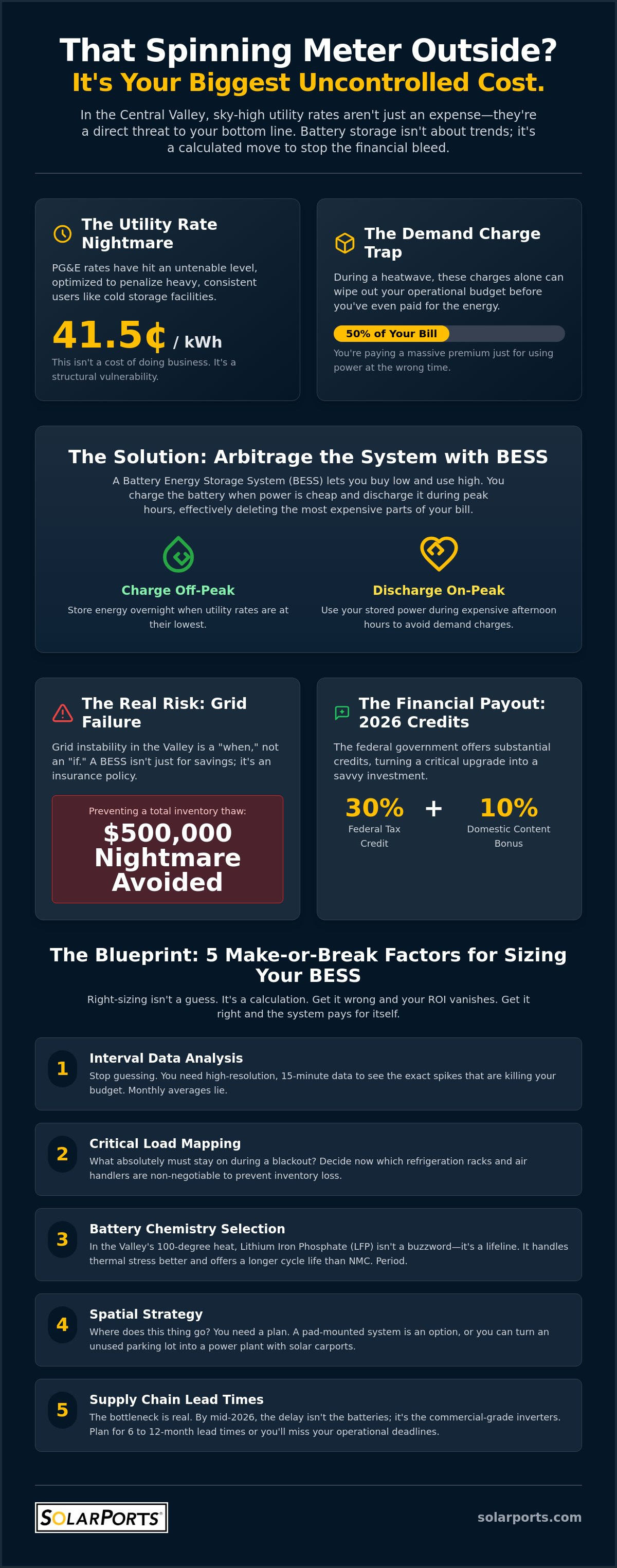
The most expensive piece of equipment in your facility isn't the refrigeration rack; it's the utility meter spinning outside. In the Central Valley, where PG&E rates have hit 41.5 cents per kilowatt-hour, your energy bill has become a direct threat to your bottom line. During a July heatwave, demand charges alone can swallow 50% of your monthly operating budget. Implementing BESS for cold storage facilities Central Valley isn't about chasing a sustainability trend. It is a calculated financial maneuver to stop the bleeding and protect your margins from a utility provider that keeps moving the goalposts.
You've likely watched your costs climb while grid reliability drops, and you're right to be skeptical of overbuilt, generic energy solutions. This guide cuts through the noise to show you how to secure operational resiliency and hedge against those skyrocketing demand charges. We will walk through the 2026 tax credit requirements, the reality of new fire code mandates like SB 283, and why data-driven analysis is the only way to avoid overspending on hardware. You'll get a clear roadmap to claim your 30% federal credit and finally take control of your facility's energy future.
Key Takeaways
- Peak demand charges are the single largest drain on your operational budget. Learn how to use battery storage to arbitrage utility rates and neutralize these spikes before they hit your bottom line.
- Right-sizing is everything. We explain why high-resolution interval data is the only way to deploy BESS for cold storage facilities Central Valley without wasting capital on unneeded battery capacity.
- Grid instability is a reality in the Valley. Secure your facility's resiliency by determining exactly which critical loads must stay online to prevent total product loss during a summer blackout.
- Maximize your 2026 investment. This guide details how to qualify for the 30% federal tax credit and the specific steps needed to capture the additional 10% domestic content bonus.
- The right financing model depends on your real estate strategy. Compare the long-term ROI of Capex, PPA, and leasing options to find the best fit for your facility's cash flow.
Table of Contents
- The Financial Case for BESS in Central Valley Cold Storage
- Selecting and Sizing Your BESS: 5 Critical Factors
- Navigating the 2026 Investment Landscape and ROI
The Financial Case for BESS in Central Valley Cold Storage
Cold storage is a high-stakes game of thermal management. Your load profile is remarkably predictable, yet it's also incredibly expensive. Utilities in the Central Valley have optimized their rate structures to penalize this exact type of heavy, consistent usage. By 2026, demand charges can account for up to 50% of your total utility bill. This isn't just a cost of doing business; it's a structural inefficiency that you can actually solve.
Integrating BESS for cold storage facilities Central Valley allows you to exploit the thermal flywheel effect. You already have a massive thermal mass in your frozen inventory. By using a battery energy storage system (BESS), you can shift your heaviest cooling cycles to off-peak hours without risking a single degree of temperature rise. It's about using stored energy to keep compressors running when the grid is most expensive, effectively deleting those massive demand spikes from your statement.
Arbitraging Central Valley Utility Rates
The TOU windows for PG&E and SCE in 2026 are aggressive. Peak hours usually hit right when your facility is fighting the afternoon heat. BESS executes peak shaving by discharging stored power during these high-rate windows. Demand charge mitigation is the primary ROI driver for Central Valley warehouses because it targets the most expensive kilowatts you buy.
Risk Mitigation and Grid Independence
Grid instability isn't a "what if" scenario in the Valley. It's a "when." During summer peak-load events, the grid is fragile. A seamless transition to island mode ensures your refrigeration stays online 24/7. This prevents the $500,000 nightmare of a total inventory thaw, which is a risk no executive should have to tolerate.
Selecting and Sizing Your BESS: 5 Critical Factors
Sizing a battery isn't a "best guess" exercise. It's a precise calculation based on how your facility actually breathes. If you over-engineer the system, your payback period stretches into a decade. If you under-size it, you'll still get crushed by peak demand charges. For BESS for cold storage facilities Central Valley, success depends on five specific variables.
- Interval Data Analysis: Forget monthly averages. You need high-resolution, 15-minute interval data to identify the exact spikes that trigger your highest charges.
- Critical Load Mapping: Not everything needs to stay on during a grid failure. You have to decide which refrigeration racks and air handlers are non-negotiable to prevent inventory loss.
- Chemistry Selection: While NMC batteries are common, LFP (Lithium Iron Phosphate) is generally superior for the Central Valley's 100-degree summers. It handles thermal stress better and offers a longer cycle life.
- Spatial Strategy: Space is often at a premium. You need to decide if a pad-mounted system makes sense or if you should look at solar carport systems to turn your parking lot into a power plant.
- Supply Chain Lead Times: By mid-2026, the bottleneck isn't usually the batteries. It's the commercial-grade inverters. Planning for 6 to 12-month lead times is the only way to hit your operational deadlines.
The Importance of Right-Sizing
ROI dies in the gap between "too big" and "too small." A system that's too large carries unneeded capital costs, while a small one fails to clip the peaks that drive your 41.5 cent/kWh rates. We use a commercial property energy cost saving analysis to pinpoint that "sweet spot" where the equipment pays for itself fastest. While many general market tiers for California's Self-Generation Incentive Program (SGIP) closed at the end of 2025, the federal ITC remains a primary driver for these projects. If you want to see how the numbers look for your specific footprint, you can book a brief technical review with our team.
Central Valley Environmental Considerations
The Valley is brutal on outdoor electronics. Heat and dust in places like Bakersfield or Fresno will degrade a poorly managed system in years, not decades. You need NEMA 3R or 4X rated enclosures and a strict maintenance schedule for air filtration. Without active thermal management, your BESS for cold storage facilities Central Valley will see its efficiency drop exactly when you need it most: during a triple-digit heatwave. It's about protecting the asset so the asset can protect your bottom line.
Navigating the 2026 Investment Landscape and ROI
The financial math for BESS for cold storage facilities Central Valley has shifted as we head into late 2026. It's no longer just a defensive play against PG&E; it's a sophisticated tax and asset management strategy. The federal Investment Tax Credit (ITC) provides a 30% base credit for standalone BESS projects, provided you've started construction by July 4, 2026. Beyond that, hitting the 10% domestic content bonus can push your total credit to 40%, which changes the payback period from "reasonable" to "immediate."
Your tax advisor will also want to look at MACRS accelerated depreciation. By front-loading the depreciation of these assets, you're looking at a massive reduction in your taxable income during the first few years of the project. Whether you choose a Capex model to own the hardware outright or a PPA to preserve your capital for BESS for cold storage facilities Central Valley, the goal is the same: predictable, locked-in energy costs that aren't subject to the whims of the California grid.
Monetizing Your Energy Asset
Your battery shouldn't just sit there waiting for a blackout. You can monetize the asset by participating in Demand Response programs, essentially getting paid to help the grid during emergencies. It's an additional revenue stream that most facility managers overlook. For a deeper look at how these numbers actually hit the ledger, check out this commercial solar ROI analysis.
The SolarPorts Turnkey Advantage
Managing three different vendors for analysis, hardware, and installation is a recipe for a project that never goes live. We've found that a single-point-of-contact approach is the only way to navigate the 2026 regulatory environment, including new fire code inspections and SB 283 requirements. This is the core of turnkey commercial solar in CA. From the initial data crunch to the final interconnection, we move from a "thinking fix" to an operational reality. You can see how we've executed this for other facilities by looking at our SolarPorts projects.
Transforming Energy Overhead into a Strategic Asset
The days of accepting crushing utility bills as a fixed cost are over. We've seen that implementing BESS for cold storage facilities Central Valley isn't just about backup power; it's a defensive financial tool to arbitrage PG&E's aggressive rate hikes. By right-sizing your system and leveraging the 30% federal ITC before the July 2026 deadline, you move from being a victim of the grid to an active manager of your overhead. It's about protecting your margins while everyone else is still complaining about the meter.
You need more than a generic hardware vendor. You need a partner with specialized Central Valley operational knowledge who understands why a small-scale commercial project differs from a massive utility development. SolarPorts provides the turnkey California-specific expertise required to navigate SB 283 and fire code mandates without stalling your operations. It's time to stop overpaying for power and start building resiliency. Get a data-backed Commercial Energy Cost Saving Analysis for your facility. You've got the thermal mass; let's put it to work.
Common Questions Regarding Central Valley BESS
How long does a BESS typically last in the Central Valley heat?
A BESS typically lasts 10 to 15 years, but Central Valley heat is a major variable. High ambient temperatures accelerate battery degradation, so active thermal management is non-negotiable. You should factor in a 2% to 3% annual capacity loss in your financial models. Using LFP chemistry helps, but without proper enclosure cooling, you'll see the system's lifespan drop significantly before the investment fully pays off.
Can I install a BESS for my cold storage facility without adding solar?
You can absolutely install a BESS for your cold storage facility without adding solar. In fact, standalone BESS projects qualify for the 30% federal Investment Tax Credit in 2026. While solar provides generation, the primary ROI for BESS for cold storage facilities Central Valley comes from demand charge mitigation. You're essentially using the battery to "delete" expensive peak-time usage from your utility bill regardless of where the power originated.
What is the typical payback period for a BESS in a California warehouse?
The typical payback period for a commercial BESS in California is between 5 and 7 years. This ROI is driven by the fact that demand charges often make up 50% of your monthly bill. With PG&E rates currently at 41.5 cents per kilowatt-hour, the savings from peak shaving and energy arbitrage add up fast. When you factor in the 30% ITC, the project usually pays for itself well within the equipment's warrantied life.
What happens to my refrigeration system during the split-second grid-to-battery transition?
Your refrigeration system won't even notice the switch. Modern commercial inverters provide a transition to battery power in less than 20 milliseconds. This is fast enough to keep sensitive PLC controllers online and prevent heavy compressors from stalling. It ensures your facility enters island mode seamlessly, protecting your inventory from the momentary voltage drops that often precede a total grid failure during summer peak events.
Frequently asked questions
How long does a BESS typically last in the Central Valley heat?
A BESS typically lasts 10 to 15 years, but Central Valley heat is a major variable. High ambient temperatures accelerate battery degradation, so active thermal management is non-negotiable. You should factor in a 2% to 3% annual capacity loss in your financial models. Using LFP chemistry helps, but without proper enclosure cooling, you'll see the system's lifespan drop significantly before the investment fully pays off.
Can I install a BESS for my cold storage facility without adding solar?
You can absolutely install a BESS for your cold storage facility without adding solar. In fact, standalone BESS projects qualify for the 30% federal Investment Tax Credit in 2026. While solar provides generation, the primary ROI for BESS for cold storage facilities Central Valley comes from demand charge mitigation. You're essentially using the battery to "delete" expensive peak-time usage from your utility bill regardless of where the power originated.
What is the typical payback period for a BESS in a California warehouse?
The typical payback period for a commercial BESS in California is between 5 and 7 years. This ROI is driven by the fact that demand charges often make up 50% of your monthly bill. With PG&E rates currently at 41.5 cents per kilowatt-hour, the savings from peak shaving and energy arbitrage add up fast. When you factor in the 30% ITC, the project usually pays for itself well within the equipment's warrantied life.
What happens to my refrigeration system during the split-second grid-to-battery transition?
Your refrigeration system won't even notice the switch. Modern commercial inverters provide a transition to battery power in less than 20 milliseconds. This is fast enough to keep sensitive PLC controllers online and prevent heavy compressors from stalling. It ensures your facility enters island mode seamlessly, protecting your inventory from the momentary voltage drops that often precede a total grid failure during summer peak events.