
Multi-Family Commercial Solar in the Bay Area: A Strategic 2026 Buying Guide

If you're looking at a PG&E bill and wondering how electricity jumped to nearly 50 cents per kilowatt-hour this June, you've realized the old rules don't apply anymore. This isn't just another rate hike. It's a fundamental threat to your operating income. For property owners, commercial solar for multi-family housing Bay Area installations are no longer about sustainability goals. They're a strategic defense against a utility structure that's becoming increasingly hostile to high-density housing.
You're likely exhausted by the tension between skyrocketing demand charges and the rigid requirements of Title 24. We understand the pressure. This guide provides a direct, data-backed roadmap for using solar carports and battery storage to hedge against these spikes and maintain compliance. We will cover why the property tax exclusion deadline this December makes your timing critical and how a commercial energy cost saving analysis serves as the only logical starting point for your 2026 capital planning.
Key Takeaways
- Stop bleeding cash to PG&E. With rates hitting nearly 50 cents per kWh this year, doing nothing is the most expensive mistake a property owner can make right now.
- Navigate the 2026 Title 24 mandates without overbuilding. You'll see why a "bigger is better" approach actually kills your ROI in the current regulatory environment.
- Strategically deploy commercial solar for multi-family housing Bay Area projects by using solar carports. They protect tenant vehicles and boost asset value without sacrificing a single parking spot.
- Master the "energy arbitrage" play. Learn how Battery Energy Storage Systems (BESS) turn cheap midday sun into expensive evening power, cutting those brutal peak-demand charges.
- Start with a Commercial Energy Cost Saving Analysis. It's the only way to get a real handle on your specific meter data before you commit to a major capital expenditure.
Table of Contents
- The Bay Area Reality: Why Multi-Family Solar is Non-Negotiable in 2026
- Designing for ROI: BESS, Carports, and Right-Sizing Your Infrastructure
- Executing the Transition: From Energy Analysis to Commissioning
The Bay Area Reality: Why Multi-Family Solar is Non-Negotiable in 2026
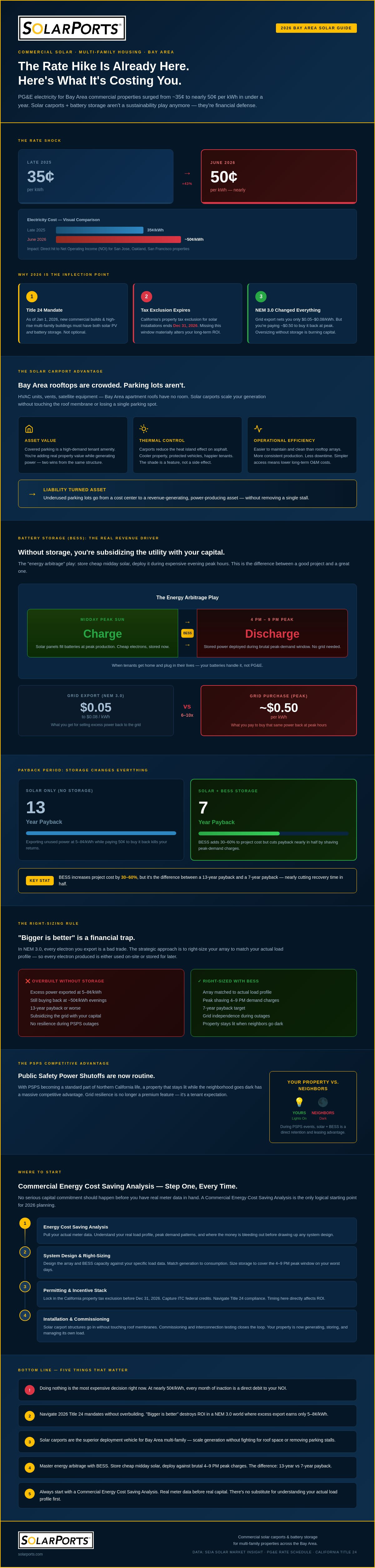
PG&E isn't asking for permission to squeeze your margins. Between late 2025 and June 2026, the cost of electricity from the grid surged from roughly 35 cents per kWh to nearly 50 cents. For property owners in San Jose, Oakland, or San Francisco, this isn't just a budget line item. It's a direct hit to your Net Operating Income. The reality of commercial solar for multi-family housing Bay Area projects has shifted from a "nice-to-have" sustainability goal to a core fiscal defense strategy. If you aren't producing your own power, you're essentially writing a blank check to the utility every month.
The state's aggressive push toward California's renewable portfolio standard has fundamentally changed how properties must function. We are moving away from simple rooftop arrays toward integrated energy ecosystems. This means your property needs to do more than just sit there. It needs to generate, store, and manage its own load to avoid those brutal peak-demand charges that kick in right when your tenants get home and plug in their lives.
Navigating California Title 24 and Local Mandates
As of January 1, 2026, the building code has caught up with the crisis. Most new commercial builds and high-rise multi-family buildings are now required to have both solar PV and battery storage. It's a mandatory standard. You can view this as a compliance headache, or you can see it as a way to lock in operational costs for the next twenty years. Timing is everything here; the California property tax exclusion for solar installations is currently set to expire on December 31, 2026. Missing that window could significantly alter your long-term ROI calculations.
The Strategic Advantage of Solar Carport Systems
Roof space on Bay Area apartment complexes is notoriously crowded with HVAC units, vents, and satellite equipment. This is why solar carports have become the superior play for commercial solar for multi-family housing Bay Area developments. They allow you to scale your system without touching the roof membrane or fighting for space.
- Asset Value: You're adding covered parking, which is a high-demand tenant amenity, while simultaneously generating power.
- Thermal Control: Carports reduce the "heat island" effect on your asphalt, keeping the property cooler and tenant vehicles protected from the sun.
- Operational Efficiency: These systems are easier to maintain and clean than rooftop arrays, leading to more consistent production.
By utilizing underused parking lots, you're turning a liability into a revenue-generating asset. Read more about solar carport systems for commercial properties to see how these structures integrate into existing layouts without losing a single parking stall.
Designing for ROI: BESS, Carports, and Right-Sizing Your Infrastructure
"Bigger is better" is a financial trap. In the current NEM 3.0 environment, exporting excess energy to the grid only nets you about $0.05 to $0.08 per kWh. Meanwhile, you're paying nearly $0.50 per kWh to buy that power back during peak evening hours. If you build a massive system without the ability to store what you produce, you're essentially subsidizing the utility's infrastructure with your capital. Strategic design for commercial solar for multi-family housing Bay Area projects now focuses on "right-sizing" the array to match your actual load profile, ensuring every electron produced is either used on-site or stored for later.
The BESS Factor: Why Storage is the Real Revenue Driver
Batteries are the only way to make the math work in 2026. While adding a Battery Energy Storage System (BESS) can increase project costs by 30% to 60%, it's the difference between a 13-year payback and a 7-year payback. The goal is energy arbitrage: using your stored solar power to "shave" those brutal peak-demand charges between 4 PM and 9 PM. According to the SEIA Solar Market Insight Report, this shift toward storage is the primary driver for commercial viability in high-cost markets like California.
Beyond the daily savings, storage provides the grid resiliency that Bay Area tenants now expect. With Public Safety Power Shutoffs becoming a routine part of Northern California life, a property that stays lit while the neighborhood goes dark has a massive competitive advantage. You can check out our 2026 Commercial Solar ROI Analysis to see the granular breakdown of how storage changes the valuation of your asset.
Avoiding the "Solar Cowboy" Pitfalls
Don't let a "solar cowboy" sell you a system based on generic estimates. Fragmented subcontracting is where ROI goes to die. You need a turnkey provider that handles everything from the initial data pull to the final commissioning. A successful rollout of commercial solar for multi-family housing Bay Area depends on verified historical meter data, not "averages" for your zip code. If you're ready to see what the numbers actually look like for your specific property, you might want to schedule a brief technical review of your current utility load.
Executing the Transition: From Energy Analysis to Commissioning
Execution isn't a hardware problem. It's a timeline problem. Successfully deploying commercial solar for multi-family housing Bay Area requires a disciplined five-step sequence: analysis, design, permitting, installation, and commissioning. You can't skip the first step. A Commercial Energy Cost Saving Analysis is the only way to map your actual interval data against the specific 2026 rate schedules. Without this, your ROI is just a guess.
Expect friction during the permitting and interconnection phase. Northern California's utility backlogs are a notorious bottleneck that can stall a project for months. You need a partner who treats the utility as a hurdle to be cleared, not an excuse for delays. Once the system is live, the work shifts to verification. Monitoring isn't just about seeing if the sun is shining; it's about ensuring your BESS is discharging at the exact moment PG&E's demand charges are highest. If the software isn't tuned to the 2026 rate spikes, you're leaving money on the table.
Financing and Incentives: Making the Numbers Work
The 30% Federal Investment Tax Credit remains the heavy hitter for 2026, provided you begin construction before July 4. Couple that with the 20% bonus depreciation available this year, and the tax benefits can cover a significant portion of the initial outlay. For affordable housing, the SOMAH program offers up to $3.50 per AC Watt, though you have to move fast before funds are exhausted. Ownership usually beats a PPA for multi-family assets because it builds property equity and maximizes long-term cash flow. For a deeper dive, read our guide on Turnkey Commercial Solar in CA.
Selecting a Turnkey Partner in the Bay Area
Don't hire a generalist. Look for a specialized project portfolio that specifically includes multi-family BESS and carport integration. Ask them how they handle tenant billing disputes for shared solar and what their plan is for long-term BESS maintenance. If they can't explain the granular details of local interconnection requirements in San Mateo or Santa Clara counties, they aren't the right fit. You need an advocate for your bottom line, not just a vendor with a ladder.
Securing Your 2026 Energy Independence
The window to act is narrowing fast. Between the December 31 property tax exclusion deadline and the July 4 construction start required for the full tax credit, 2026 is defined by these hard dates. Successfully deploying commercial solar for multi-family housing Bay Area projects requires more than just panels. It takes a partner who knows that every parking stall and every kilowatt-hour stored in a BESS is a financial lever for your property valuation.
We provide turnkey solutions built for California commercial real estate, moving you from raw meter data to a commissioned system without the typical subcontracting friction. Our expertise in BESS and carport integration ensures your infrastructure is right-sized for the current PG&E rate landscape, all backed by data-driven ROI modeling. You don't have to guess at the numbers or navigate these utility hikes alone.
The first step is getting real data. To see exactly how these systems impact your bottom line, Request Your Commercial Energy Cost Saving Analysis today. Let's turn that underutilized parking lot into a reliable hedge against rising costs.
Frequently Asked Questions
Is commercial solar worth it for older multi-family buildings in the Bay Area?
It's absolutely worth it if the structural integrity holds. Older buildings often suffer the most from inefficient common-area systems and outdated meters. By implementing commercial solar for multi-family housing Bay Area projects on older assets, you're essentially modernizing the building's cost structure without a full gut renovation. We always look at the roof age first. If it's over 15 years old, we usually suggest a move toward carports to avoid double labor costs later.
How long does a typical multi-family solar installation take in Northern California?
You should budget between 6 and 12 months from the initial analysis to the final permission to operate. The physical construction only takes a few weeks, but the Northern California permitting and utility interconnection backlog is the real hurdle. PG&E's review process can be unpredictable. We handle the paperwork early to keep the project moving. Starting your analysis in early 2026 is the only way to ensure you're live before the next summer peak.
Can I use solar carports if my property has limited roof space?
Solar carports were designed exactly for this scenario. If your roof is crowded with HVAC units or has shading issues from neighboring buildings, your parking lot is your best energy asset. This approach for commercial solar for multi-family housing Bay Area properties turns asphalt into a power plant while adding a premium tenant amenity. It's often a cleaner installation than rooftop work because we don't have to worry about roof penetrations or existing structural leaks.
What is the expected ROI for a BESS-integrated solar system in 2026?
The estimated payback period for a BESS-integrated system in 2026 is roughly 7 to 9 years. While solar-only systems have a lower upfront price, their payback has stretched to 9-13 years under NEM 3.0 because exported energy is worth 75% less than it used to be. The ROI isn't just about utility savings. It's about demand charge management. Using the 30% tax credit helps offset the initial capital expenditure significantly.
Frequently asked questions
Navigating California Title 24 and Local Mandates
As of January 1, 2026, the building code has caught up with the crisis. Most new commercial builds and high-rise multi-family buildings are now required to have both solar PV and battery storage. It's a mandatory standard. You can view this as a compliance headache, or you can see it as a way to lock in operational costs for the next twenty years. Timing is everything here; the California property tax exclusion for solar installations is currently set to expire on December 31, 2026. Missing that window could significantly alter your long-term ROI calculations.
The Strategic Advantage of Solar Carport Systems
Roof space on Bay Area apartment complexes is notoriously crowded with HVAC units, vents, and satellite equipment. This is why solar carports have become the superior play for commercial solar for multi-family housing Bay Area developments. They allow you to scale your system without touching the roof membrane or fighting for space. By utilizing underused parking lots, you're turning a liability into a revenue-generating asset. Read more about solar carport systems for commercial properties to see how these structures integrate into existing layouts without losing a single parking stall. "Bigger is better" is a financial trap. In the current NEM 3.0 environment, exporting excess energy to the grid only nets you about $0.05 to $0.08 per kWh. Meanwhile, you're paying nearly $0.50 per kWh to buy that power back during peak evening hours. If you build a massive system without the ability to store what you produce, you're essentially subsidizing the utility's infrastructure with your capital. Strategic design for commercial solar for multi-family housing Bay Area projects now focuses on "right-sizing" the array to match your actual load profile, ensuring every electron produced is either used on-site or stored for later.
The BESS Factor: Why Storage is the Real Revenue Driver
Batteries are the only way to make the math work in 2026. While adding a Battery Energy Storage System (BESS) can increase project costs by 30% to 60%, it's the difference between a 13-year payback and a 7-year payback. The goal is energy arbitrage: using your stored solar power to "shave" those brutal peak-demand charges between 4 PM and 9 PM. According to the SEIA Solar Market Insight Report, this shift toward storage is the primary driver for commercial viability in high-cost markets like California. Beyond the daily savings, storage provides the grid resiliency that Bay Area tenants now expect. With Public Safety Power Shutoffs becoming a routine part of Northern California life, a property that stays lit while the neighborhood goes dark has a massive competitive advantage. You can check out our 2026 Commercial Solar ROI Analysis to see the granular breakdown of how storage changes the valuation of your asset.
Avoiding the "Solar Cowboy" Pitfalls
Don't let a "solar cowboy" sell you a system based on generic estimates. Fragmented subcontracting is where ROI goes to die. You need a turnkey provider that handles everything from the initial data pull to the final commissioning. A successful rollout of commercial solar for multi-family housing Bay Area depends on verified historical meter data, not "averages" for your zip code. If you're ready to see what the numbers actually look like for your specific property, you might want to schedule a brief technical review of your current utility load. Execution isn't a hardware problem. It's a timeline problem. Successfully deploying commercial solar for multi-family housing Bay Area requires a disciplined five-step sequence: analysis, design, permitting, installation, and commissioning. You can't skip the first step. A Commercial Energy Cost Saving Analysis is the only way to map your actual interval data against the specific 2026 rate schedules. Without this, your ROI is just a guess. Expect friction during the permitting and interconnection phase. Northern California's utility backlogs are a notorious bottleneck that can stall a project for months. You need a partner who treats the utility as a hurdle to be cleared, not an excuse for delays. Once the system is live, the work shifts to verification. Monitoring isn't just about seeing if the sun is shining; it's about ensuring your BESS is discharging at the exact moment PG&E's demand charges are highest. If the software isn't tuned to the 2026 rate spikes, you're leaving money on the table.
Financing and Incentives: Making the Numbers Work
The 30% Federal Investment Tax Credit remains the heavy hitter for 2026, provided you begin construction before July 4. Couple that with the 20% bonus depreciation available this year, and the tax benefits can cover a significant portion of the initial outlay. For affordable housing, the SOMAH program offers up to $3.50 per AC Watt, though you have to move fast before funds are exhausted. Ownership usually beats a PPA for multi-family assets because it builds property equity and maximizes long-term cash flow. For a deeper dive, read our guide on Turnkey Commercial Solar in CA.
Selecting a Turnkey Partner in the Bay Area
Don't hire a generalist. Look for a specialized project portfolio that specifically includes multi-family BESS and carport integration. Ask them how they handle tenant billing disputes for shared solar and what their plan is for long-term BESS maintenance. If they can't explain the granular details of local interconnection requirements in San Mateo or Santa Clara counties, they aren't the right fit. You need an advocate for your bottom line, not just a vendor with a ladder. The window to act is narrowing fast. Between the December 31 property tax exclusion deadline and the July 4 construction start required for the full tax credit, 2026 is defined by these hard dates. Successfully deploying commercial solar for multi-family housing Bay Area projects requires more than just panels. It takes a partner who knows that every parking stall and every kilowatt-hour stored in a BESS is a financial lever for your property valuation. We provide turnkey solutions built for California commercial real estate, moving you from raw meter data to a commissioned system without the typical subcontracting friction. Our expertise in BESS and carport integration ensures your infrastructure is right-sized for the current PG&E rate landscape, all backed by data-driven ROI modeling. You don't have to guess at the numbers or navigate these utility hikes alone. The first step is getting real data. To see exactly how these systems impact your bottom line, Request Your Commercial Energy Cost Saving Analysis today. Let's turn that underutilized parking lot into a reliable hedge against rising costs.
Is commercial solar worth it for older multi-family buildings in the Bay Area?
It's absolutely worth it if the structural integrity holds. Older buildings often suffer the most from inefficient common-area systems and outdated meters. By implementing commercial solar for multi-family housing Bay Area projects on older assets, you're essentially modernizing the building's cost structure without a full gut renovation. We always look at the roof age first. If it's over 15 years old, we usually suggest a move toward carports to avoid double labor costs later.
How long does a typical multi-family solar installation take in Northern California?
You should budget between 6 and 12 months from the initial analysis to the final permission to operate. The physical construction only takes a few weeks, but the Northern California permitting and utility interconnection backlog is the real hurdle. PG&E's review process can be unpredictable. We handle the paperwork early to keep the project moving. Starting your analysis in early 2026 is the only way to ensure you're live before the next summer peak.
Can I use solar carports if my property has limited roof space?
Solar carports were designed exactly for this scenario. If your roof is crowded with HVAC units or has shading issues from neighboring buildings, your parking lot is your best energy asset. This approach for commercial solar for multi-family housing Bay Area properties turns asphalt into a power plant while adding a premium tenant amenity. It's often a cleaner installation than rooftop work because we don't have to worry about roof penetrations or existing structural leaks.
What is the expected ROI for a BESS-integrated solar system in 2026?
The estimated payback period for a BESS-integrated system in 2026 is roughly 7 to 9 years. While solar-only systems have a lower upfront price, their payback has stretched to 9-13 years under NEM 3.0 because exported energy is worth 75% less than it used to be. The ROI isn't just about utility savings. It's about demand charge management. Using the 30% tax credit helps offset the initial capital expenditure significantly.