
Solar for Manufacturing Facilities in Northern California: A Strategic 2026 Financial Hedge

Paying double the national average for power isn't just an annoyance; it's a structural threat to your margins. With average utility rates hovering near 40 cents per kilowatt-hour in early 2026, Northern California manufacturers are operating in one of the most expensive energy environments in history. You've probably felt the weight of those peak-demand charges that hit your balance sheet regardless of how efficient your floor team becomes. It's an exhausting cycle of rising costs and grid instability that forces you to choose between production speed and fiscal discipline. The grid is failing, and the bills are rising. This article shows you how to use integrated solar for manufacturing facility Northern California projects to dismantle those charges and reclaim control over your overhead. We'll break down the 2026 financial incentives you can't afford to miss and explain why battery storage is now the only logical way to navigate the current regulatory landscape. By the end, you'll see a clear path to predictable energy costs for the next two decades without distracting from your core operations.
Key Takeaways
- Demand charges can consume half of your power budget. We've shown how to neutralize these fees before 2026 rate hikes hit your margins.
- SolarPorts Development converts underutilized roofs and parking lots into revenue-saving assets with solar for manufacturing facility Northern California designs.
- Pairing solar with battery storage is the only logical way to navigate NEM 3.0 and ensure your plant stays online during grid instability.
- A rigorous energy cost saving analysis prevents the common mistake of over-sizing or under-sizing a system that doesn't match your actual load.
- SolarPorts Development manages the entire utility interconnection process so you don't have to waste time navigating the state's bureaucracy.
Table of Contents
- The Financial Reality of Manufacturing in Northern California
- Tactical Infrastructure: Carports, Rooftops, and Integrated Systems
- The SolarPorts Development Approach: From Analysis to Interconnection
The Financial Reality of Manufacturing in Northern California
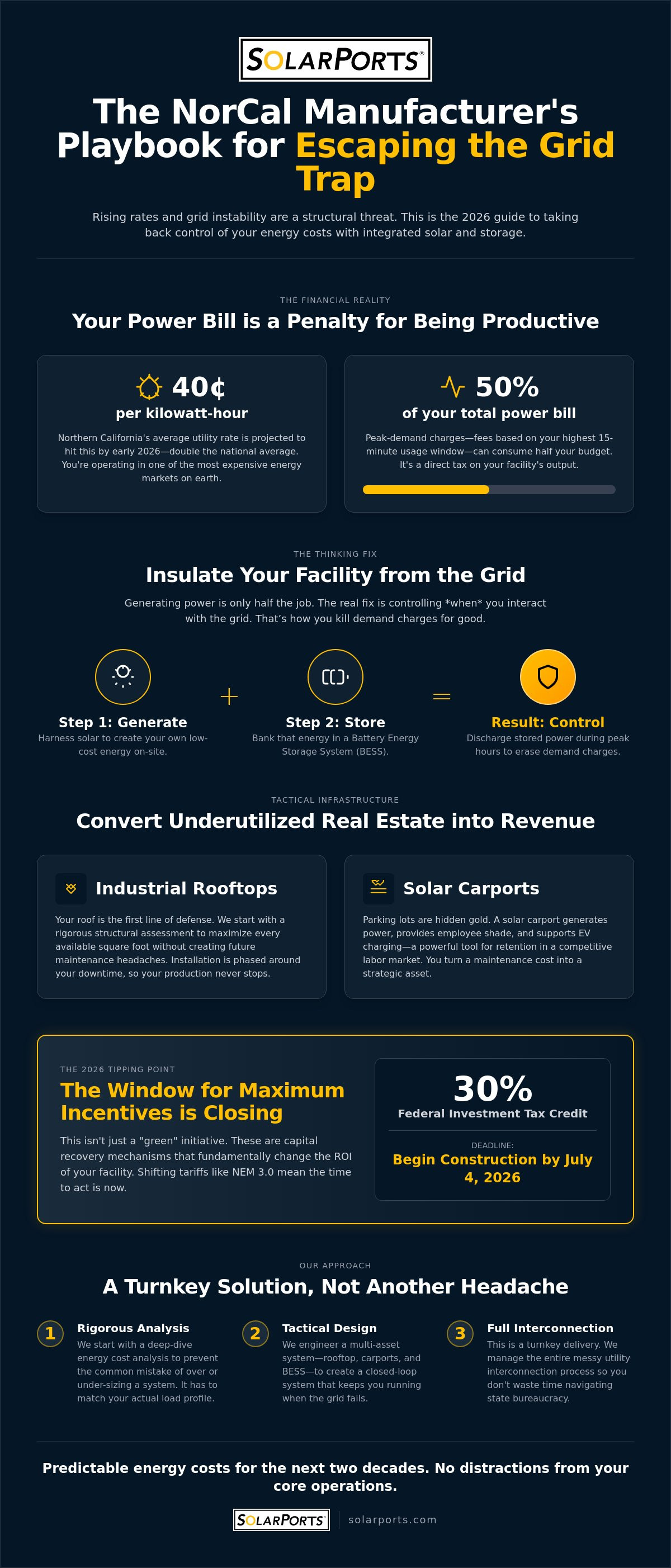
Utility bills for NorCal industrial sites have moved past the point of simple overhead. They're now a structural liability. Most operators are currently grappling with PG&E rate structures where demand charges, those aggressive fees based on your highest 15 minute window of usage, can account for up to 50% of the total monthly statement. It's a penalty for being productive. This is why investing in solar for manufacturing facility Northern California projects has shifted from an ESG goal to a defensive financial necessity. 2026 represents a specific tipping point because the gap between grid costs and self-generation has never been wider, especially as grid volatility threatens to disrupt 24/7 production cycles.
Mitigating Demand Charges with BESS
Generating power is only half the battle. The real "thinking fix" involves controlling when your facility interacts with the grid. Battery Energy Storage Systems (BESS) allow you to "shave the peaks" of your consumption profile by discharging stored energy during high-cost windows. When you integrate BESS with solar, you effectively insulate your facility from the most expensive hours of the day. You're no longer at the mercy of the utility's timing. You're running on your own schedule.
The 2026 Regulatory Landscape in NorCal
The window for maximizing federal incentives is closing fast. To capture the full 30% Investment Tax Credit, construction must begin by July 4, 2026. This sense of urgency is compounded by the evolving history of Solar power in California, where shifting tariffs like NEM 3.0 have made standalone solar less viable than integrated solar-plus-storage models. For a deeper dive into the fiscal implications, see our 2026 Commercial Solar Tax Credit California guide. These aren't just "green" incentives. They're capital recovery mechanisms that fundamentally change the ROI of your facility's infrastructure.
Tactical Infrastructure: Carports, Rooftops, and Integrated Systems
Space is a premium in the Bay Area and Central Valley. You don't need a desert plot to secure your energy future. Implementing solar for manufacturing facility Northern California operations often starts with the real estate you already own: your roof and your parking lot. According to recent California energy data, industrial consumption remains a massive driver of state demand, making on-site generation the most logical hedge against volatility. By utilizing existing footprints, you avoid the complications of land acquisition while placing power generation exactly where it's consumed.
Maximizing Underutilized Real Estate
Parking lots are the hidden gold of industrial sites. Most facilities view them as a maintenance cost, but they're actually prime energy real estate. A solar carport does more than just generate power; it provides employee shade and supports high-speed EV charging stations. This dual-use strategy is a powerful tool for employee retention in a competitive labor market. If you're looking for a breakdown of the fiscal advantages, check out our guide on commercial solar carport with EV charging California ROI.
Industrial-Scale Rooftop Considerations
Your roof is your first line of defense. Before installing a high-efficiency array, we conduct a rigorous assessment of structural integrity and load-bearing capacity. Manufacturers often worry about production interruptions. We solve this through phased installation schedules that sync with your facility's downtime, ensuring the transition to solar doesn't compromise your output. It's about precision, not just placement. We look at the age of the membrane and the current HVAC layout to ensure the array maximizes every available square foot without creating future maintenance headaches.
Maximum resilience requires a multi-asset approach. Combining rooftop panels with carports and battery storage creates a closed-loop system that keeps you running when the grid fails. Managing these moving parts shouldn't be your job. You need a single point of contact to handle the messy work of engineering, permitting, and construction. It's a turnkey delivery designed to let you focus on your core business while we fix the energy problem. If you're ready to see how this fits your specific footprint, you can book a strategic consultation to review your site's potential.
The SolarPorts Development Approach: From Analysis to Interconnection
You wouldn't buy a million-dollar CNC machine based on a hunch. Energy infrastructure requires the same level of analytical rigor. Our work on solar for manufacturing facility Northern California projects starts with a Commercial Energy Cost Saving Analysis. SolarPorts Development doesn't guess. We look at the actual interval data to ensure the system is right-sized for your facility's load profile.
Interconnection is where most projects die. PG&E's grid is congested and the bureaucracy is thick. SolarPorts Development manages the entire lifecycle of engineering, procurement, and construction (EPC) because we know where the utility bottlenecks are. We build to the latest commercial and industrial solar installation standards to ensure the system handles the specific stresses of a heavy industrial environment. It's about getting to the finish line without distracting your team from production.
Data-Driven Decision Making
We pull your raw utility data before we talk about hardware. This allows us to model how a battery will discharge to crush those peak-demand charges. If the numbers don't work, we'll be the first to tell you. You can see how we build these models in our commercial solar ROI analysis to see the logic behind the investment.
Streamlined Project Management
Permitting in Northern California is a maze. SolarPorts Development handles the structural reviews and the utility sign-offs. We've seen the pitfalls that typically stall commercial projects for months. Look at our past industrial projects to see how this turnkey methodology actually plays out. Once the system is live, we stay on for the monitoring to keep that 20-year ROI on track. We're not just installing panels; we're managing a financial asset.
Securing Your Operational Continuity for the Next Decade
The math is pretty clear at this point. You're either paying the utility for the privilege of running your machines, or you're owning the infrastructure yourself. We've seen how solar for manufacturing facility Northern California projects use carports and rooftop arrays to flip the script on utility costs. It isn't just about panels. It's about the data-backed ROI modeling and the specialized expertise needed to push through the interconnection mess. You need a partner who handles the engineering and procurement so you can get back to the floor. We provide the turnkey development that bridges the gap between high overhead and long-term fiscal stability. The window to lock in these 2026 financial benefits is shrinking. Don't wait for the next rate hike to start looking for a solution. It's time to take control of your facility's energy future.
Request Your Custom Commercial Energy Cost Saving Analysis
Frequently Asked Questions
How much space does a manufacturing facility need for a meaningful solar array?
Most industrial-scale systems require approximately 10,000 square feet for every 100kW of capacity. For a high-load manufacturing facility, you're likely looking at a much larger footprint to offset significant portions of your utility bill. If your roof is crowded with HVAC units or skylights, we shift the strategy to solar carports. This turns your parking lot into a productive power plant without eating up valuable floor space or expansion land.
Will solar and BESS protect my facility from Northern California power outages?
Integrated solar and BESS will protect your operations during grid failures if the system is specifically configured for islanding. Standard grid-tied solar shuts down during an outage for safety reasons. By adding a Battery Energy Storage System (BESS), your facility can disconnect from the utility and run on stored power. This is critical for solar for manufacturing facility Northern California projects where even a brief voltage dip can ruin a production batch.
What is the typical payback period for industrial solar in Northern California in 2026?
Most industrial projects see a full return on investment within five to seven years. This timeline is accelerated by the 30% federal tax credit and the 100% bonus depreciation available for projects starting in 2026. Because local utility rates are among the highest in the nation, every kilowatt-hour you generate yourself saves significantly more than it would in other markets. The real value is the 15 years of nearly free energy that follows.
Can I install solar carports if my facility is leased?
You can absolutely install carports on a leased property through a coordinated green lease or a third-party ownership model. In these scenarios, the property owner benefits from the increased asset value while the tenant enjoys lower, predictable energy rates. We frequently act as the bridge in these negotiations to ensure the financial structure works for both parties. It's a strategic way to secure solar for manufacturing facility Northern California benefits without needing to own the real estate.
Frequently asked questions
Mitigating Demand Charges with BESS
Generating power is only half the battle. The real "thinking fix" involves controlling when your facility interacts with the grid. Battery Energy Storage Systems (BESS) allow you to "shave the peaks" of your consumption profile by discharging stored energy during high-cost windows. When you integrate BESS with solar, you effectively insulate your facility from the most expensive hours of the day. You're no longer at the mercy of the utility's timing. You're running on your own schedule.
The 2026 Regulatory Landscape in NorCal
The window for maximizing federal incentives is closing fast. To capture the full 30% Investment Tax Credit, construction must begin by July 4, 2026. This sense of urgency is compounded by the evolving history of Solar power in California, where shifting tariffs like NEM 3.0 have made standalone solar less viable than integrated solar-plus-storage models. For a deeper dive into the fiscal implications, see our 2026 Commercial Solar Tax Credit California guide. These aren't just "green" incentives. They're capital recovery mechanisms that fundamentally change the ROI of your facility's infrastructure. Space is a premium in the Bay Area and Central Valley. You don't need a desert plot to secure your energy future. Implementing solar for manufacturing facility Northern California operations often starts with the real estate you already own: your roof and your parking lot. According to recent California energy data, industrial consumption remains a massive driver of state demand, making on-site generation the most logical hedge against volatility. By utilizing existing footprints, you avoid the complications of land acquisition while placing power generation exactly where it's consumed.
Maximizing Underutilized Real Estate
Parking lots are the hidden gold of industrial sites. Most facilities view them as a maintenance cost, but they're actually prime energy real estate. A solar carport does more than just generate power; it provides employee shade and supports high-speed EV charging stations. This dual-use strategy is a powerful tool for employee retention in a competitive labor market. If you're looking for a breakdown of the fiscal advantages, check out our guide on commercial solar carport with EV charging California ROI.
Industrial-Scale Rooftop Considerations
Your roof is your first line of defense. Before installing a high-efficiency array, we conduct a rigorous assessment of structural integrity and load-bearing capacity. Manufacturers often worry about production interruptions. We solve this through phased installation schedules that sync with your facility's downtime, ensuring the transition to solar doesn't compromise your output. It's about precision, not just placement. We look at the age of the membrane and the current HVAC layout to ensure the array maximizes every available square foot without creating future maintenance headaches. Maximum resilience requires a multi-asset approach. Combining rooftop panels with carports and battery storage creates a closed-loop system that keeps you running when the grid fails. Managing these moving parts shouldn't be your job. You need a single point of contact to handle the messy work of engineering, permitting, and construction. It's a turnkey delivery designed to let you focus on your core business while we fix the energy problem. If you're ready to see how this fits your specific footprint, you can book a strategic consultation to review your site's potential. You wouldn't buy a million-dollar CNC machine based on a hunch. Energy infrastructure requires the same level of analytical rigor. Our work on solar for manufacturing facility Northern California projects starts with a Commercial Energy Cost Saving Analysis. SolarPorts Development doesn't guess. We look at the actual interval data to ensure the system is right-sized for your facility's load profile. Interconnection is where most projects die. PG&E's grid is congested and the bureaucracy is thick. SolarPorts Development manages the entire lifecycle of engineering, procurement, and construction (EPC) because we know where the utility bottlenecks are. We build to the latest commercial and industrial solar installation standards to ensure the system handles the specific stresses of a heavy industrial environment. It's about getting to the finish line without distracting your team from production.
Data-Driven Decision Making
We pull your raw utility data before we talk about hardware. This allows us to model how a battery will discharge to crush those peak-demand charges. If the numbers don't work, we'll be the first to tell you. You can see how we build these models in our commercial solar ROI analysis to see the logic behind the investment.
Streamlined Project Management
Permitting in Northern California is a maze. SolarPorts Development handles the structural reviews and the utility sign-offs. We've seen the pitfalls that typically stall commercial projects for months. Look at our past industrial projects to see how this turnkey methodology actually plays out. Once the system is live, we stay on for the monitoring to keep that 20-year ROI on track. We're not just installing panels; we're managing a financial asset. The math is pretty clear at this point. You're either paying the utility for the privilege of running your machines, or you're owning the infrastructure yourself. We've seen how solar for manufacturing facility Northern California projects use carports and rooftop arrays to flip the script on utility costs. It isn't just about panels. It's about the data-backed ROI modeling and the specialized expertise needed to push through the interconnection mess. You need a partner who handles the engineering and procurement so you can get back to the floor. We provide the turnkey development that bridges the gap between high overhead and long-term fiscal stability. The window to lock in these 2026 financial benefits is shrinking. Don't wait for the next rate hike to start looking for a solution. It's time to take control of your facility's energy future. Request Your Custom Commercial Energy Cost Saving Analysis
How much space does a manufacturing facility need for a meaningful solar array?
Most industrial-scale systems require approximately 10,000 square feet for every 100kW of capacity. For a high-load manufacturing facility, you're likely looking at a much larger footprint to offset significant portions of your utility bill. If your roof is crowded with HVAC units or skylights, we shift the strategy to solar carports. This turns your parking lot into a productive power plant without eating up valuable floor space or expansion land.
Will solar and BESS protect my facility from Northern California power outages?
Integrated solar and BESS will protect your operations during grid failures if the system is specifically configured for islanding. Standard grid-tied solar shuts down during an outage for safety reasons. By adding a Battery Energy Storage System (BESS), your facility can disconnect from the utility and run on stored power. This is critical for solar for manufacturing facility Northern California projects where even a brief voltage dip can ruin a production batch.
What is the typical payback period for industrial solar in Northern California in 2026?
Most industrial projects see a full return on investment within five to seven years. This timeline is accelerated by the 30% federal tax credit and the 100% bonus depreciation available for projects starting in 2026. Because local utility rates are among the highest in the nation, every kilowatt-hour you generate yourself saves significantly more than it would in other markets. The real value is the 15 years of nearly free energy that follows.
Can I install solar carports if my facility is leased?
You can absolutely install carports on a leased property through a coordinated green lease or a third-party ownership model. In these scenarios, the property owner benefits from the increased asset value while the tenant enjoys lower, predictable energy rates. We frequently act as the bridge in these negotiations to ensure the financial structure works for both parties. It's a strategic way to secure solar for manufacturing facility Northern California benefits without needing to own the real estate.